
You're halfway through the year, revenue looks strong, and your bank balance still feels tight. Then your accountant asks for updated books and mentions estimated taxes. Suddenly, money you thought was available for hiring, equipment, or owner pay has another job. That surprise usually isn't caused by one bad tax decision. It comes from treating taxes as a filing task instead of a cash-flow system.
Good small business tax planning starts long before year-end. You need clean books, realistic projections, quarterly reviews, and decisions made while you still have options. The goal isn't to chase every possible deduction. It's to know what you'll owe, preserve cash, document legitimate expenses, and choose actions that support the business you're building.
Why Year-Round Tax Planning Beats the December Scramble
A contractor I've worked with once described his tax process as “receipts in a box and hope.” During a strong year, he bought equipment late, paid vendors through several accounts, and mixed personal and business purchases on the same card. By filing time, nobody had a reliable view of profit. The tax bill arrived after the cash had already gone into trucks, payroll, and unfinished jobs.
That approach creates three problems. First, you may not reserve enough cash for taxes. Second, you may miss expenses because nobody can prove what a payment was for. Third, you lose the chance to make useful decisions before the year closes.

Tax planning belongs in the operating rhythm
Monthly bookkeeping gives you a running estimate of revenue, gross margin, payroll, and taxable profit. A quarterly projection then turns that information into decisions. You can adjust estimated payments, review whether a purchase makes sense, and ask your tax professional about entity or compensation changes while they can still help.
The World Bank's assessment of the Kyrgyz Republic shows why process efficiency matters for smaller firms. In 2023, small businesses under the simplified tax regime spent an average of 3.7% of annual turnover on tax compliance, while average compliance cost was 74.1 thousand Soms for small-turnover firms and 458.7 thousand Soms for businesses with turnover above 50 million Soms. The report also found average compliance cost per business reached 152.6 thousand Soms, about US$1,738, in 2023, almost twice the 2021 level. These figures come from a different tax system, but the operating lesson applies broadly: compliance consumes real resources, and weak processes make it more expensive (World Bank assessment).
CFO rule: If you only discover your profit after the tax return is prepared, you're not planning. You're reviewing history.
The OECD has treated the compliance burden on smaller firms as a long-running policy issue. Its 2009 report on SME taxation examined how tax systems affect small-business creation and growth, and its 2015 OECD/G20 review covered 39 OECD and G20 countries, showing how common SME-specific rules and simplification measures had become (OECD background report). Owners should take the same practical view. Build tax work into the monthly close, not into a frantic handoff in March.
For a practical preparation routine, use this tax-season preparation guide. And if you're reviewing expense categories, this resource on how to maximise deductions for small business can help you spot areas that deserve a closer conversation with your tax adviser.
Quarterly Checkpoints That Keep You Ahead of the IRS
A quarterly tax meeting shouldn't be a vague conversation about “how things look.” It should end with updated numbers, assigned actions, and a cash decision. Use the same rhythm each quarter so the process becomes routine.
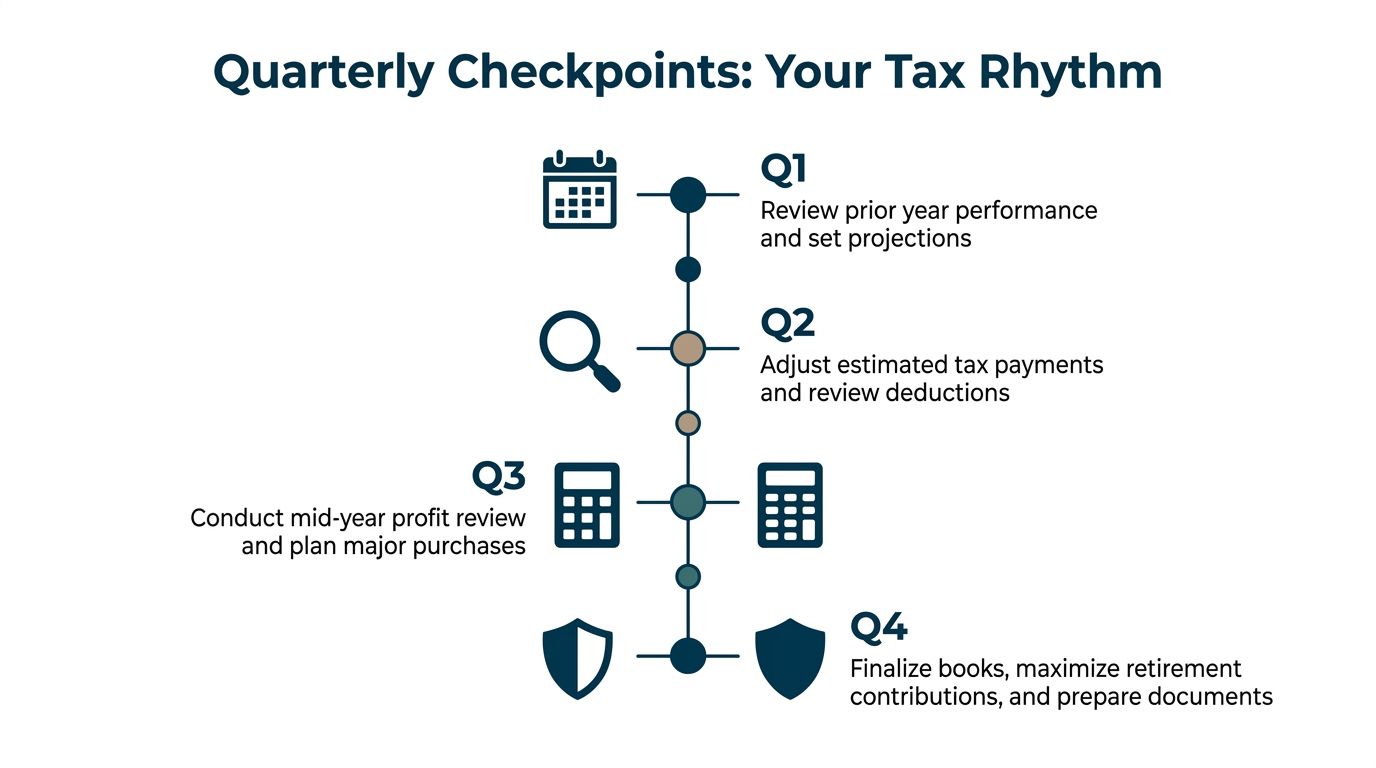
Q1 sets the baseline
Start by closing the prior year properly. Reconcile bank and credit-card accounts, review unpaid invoices, confirm payroll records, and separate owner draws from business expenses. Then create a working projection for the new year based on current contracts, pricing, hiring plans, and known capital needs.
Estimated-tax controls should begin here. The IRS safe-harbor framework generally lets taxpayers avoid an underpayment penalty by paying at least the lesser of 100% of the prior year's tax, or 110% when prior-year AGI exceeded $150,000, or 90% of the current year's tax (IRS estimated taxes). If the balance due after withholding and credits is under $1,000, most taxpayers avoid the penalty under the same IRS guidance.
Q2 tests the forecast
Compare actual revenue and profit with the Q1 projection. Don't focus only on sales. A service firm may be busy but less profitable because subcontractor costs rose. A clinic may have higher collections but weaker cash because payroll and equipment payments increased.
Review expense coding and documentation while transactions are still easy to identify. Check whether new workers are employees or contractors, whether recurring software is recorded consistently, and whether business travel has a clear purpose. If income changed, recalculate estimated payments rather than waiting for year-end.
You can use this guide to plan estimated tax payments around your books and safe-harbor position. Benefits, reimbursements, and other income items can also create questions. For a focused explanation of one commonly misunderstood benefit issue, review this Benely SDI tax guide and confirm the treatment with your tax professional.
Q3 is the decision quarter
By mid-year, you should know whether the business is on track or drifting. Run a profit review, update your cash forecast, and list major purchases under consideration. Ask whether each purchase supports operations, whether the business can afford it, and whether the expected tax treatment matches the timing.
This is also the right time to revisit owner compensation, retirement-plan funding, and hiring plans. A deduction that creates a cash shortage isn't a good business decision.
Q4 closes the gaps
Finalize reconciliations, collect missing receipts, review contractor records, and prepare a document list for your tax preparer. Then make only those year-end purchases and contributions that fit the operating plan.
The IRS warns that estimated-tax penalties accrue as interest, reset quarterly, and are calculated separately for each installment period. A late catch-up payment may not erase an earlier underpayment. That's why quarterly control beats a December scramble.
Categorizing Deductible Expenses Without the Guesswork
A deduction must connect to the business and be supported by records. The biggest bookkeeping mistake I see isn't always an improper expense. It's an expense that's legitimate but coded so poorly that nobody can explain it months later.
Build your chart of accounts around the way you manage the company and the way your tax preparer reviews the return. Keep categories clear enough that a monthly report answers basic questions without detective work.
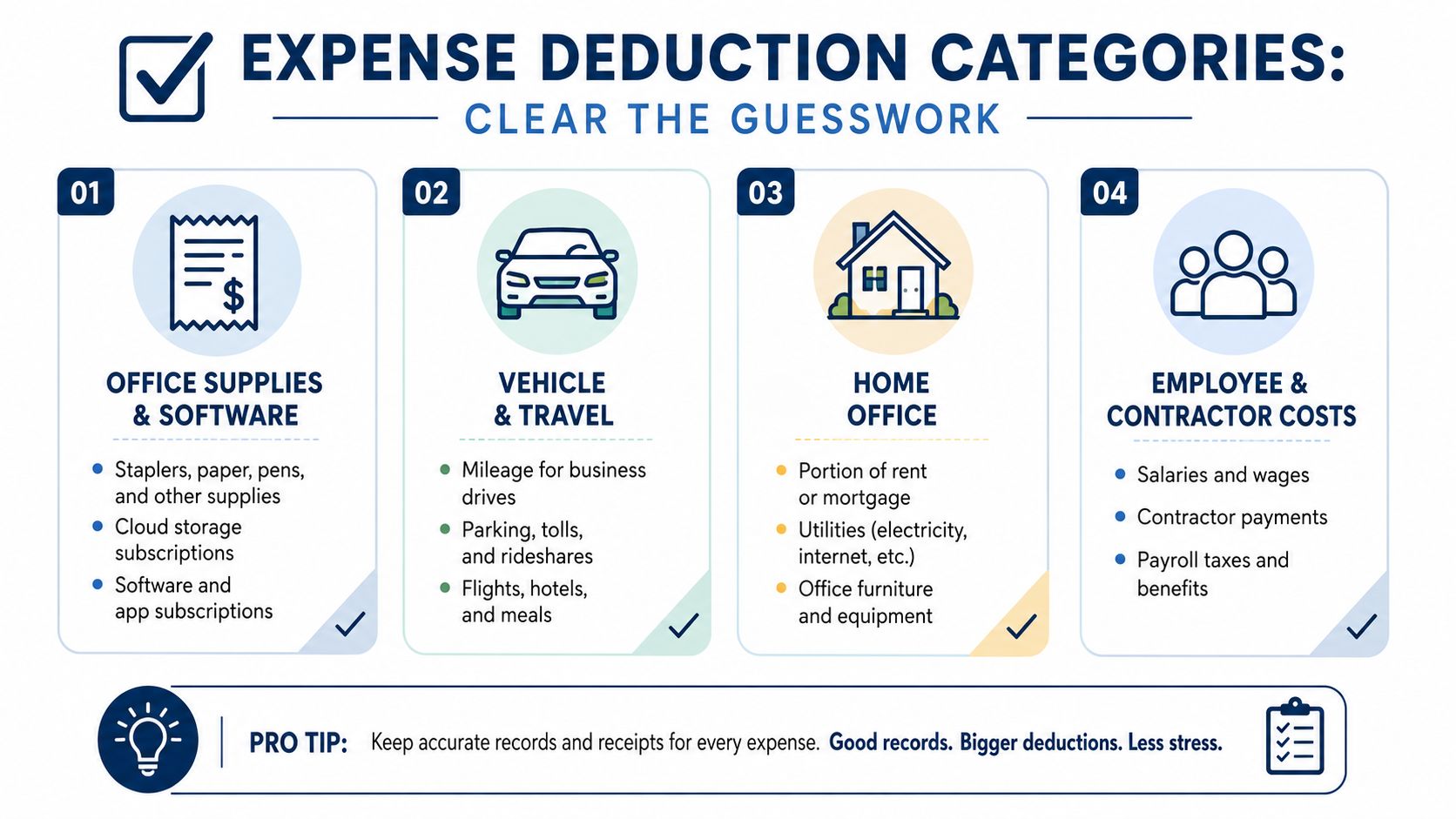
Four categories that need discipline
- Office supplies and software: Paper, shipping materials, cloud storage, accounting software, and other operating tools should be separated from large equipment purchases. A laptop used for years may need different treatment from ordinary office supplies.
- Vehicle and travel: Record the date, destination, business purpose, and related cost. A construction owner driving to a job site has a different record from a personal trip that happens to include a client call.
- Home office: Use a clearly defined business area and keep the supporting records your tax adviser needs. Don't label the whole home as business space because you work there.
- Employee and contractor costs: Payroll, benefits, and payments to freelancers belong in organized categories. Keep contracts, invoices, payment records, and worker classification details together.
Mixed-use expenses require a line between work and life
A phone, vehicle, computer, or home internet service may serve both purposes. Record the business portion using a consistent method and retain the explanation. Don't guess at year-end. A monthly note is far more useful than trying to reconstruct business use from memory.
The IRS identifies recordkeeping as a major burden for small businesses, particularly where owners mix personal and business spending or fail to substantiate deductions. Its small-business income and loss tables also provide data that can help advisers benchmark deductions, credits, and entity-level patterns (IRS small-business tax statistics).
Code expenses when they happen
Monthly classification has two benefits. It keeps financial reports useful, and it gives your adviser time to correct errors before they spread across payroll reports, estimated payments, and tax projections.
For a practical process, follow this guide on categorizing business expenses. The right system is simple: separate accounts, consistent categories, digital receipts, and a monthly review of anything unusual.
Choosing the Right Entity Structure and Payroll Strategy
Your entity should change when the economics change. Reassess it as profits rise, ownership shifts, payroll begins, outside investment becomes possible, or exit plans take shape. The right structure affects tax treatment, administrative work, liability, and the cash available to operate.
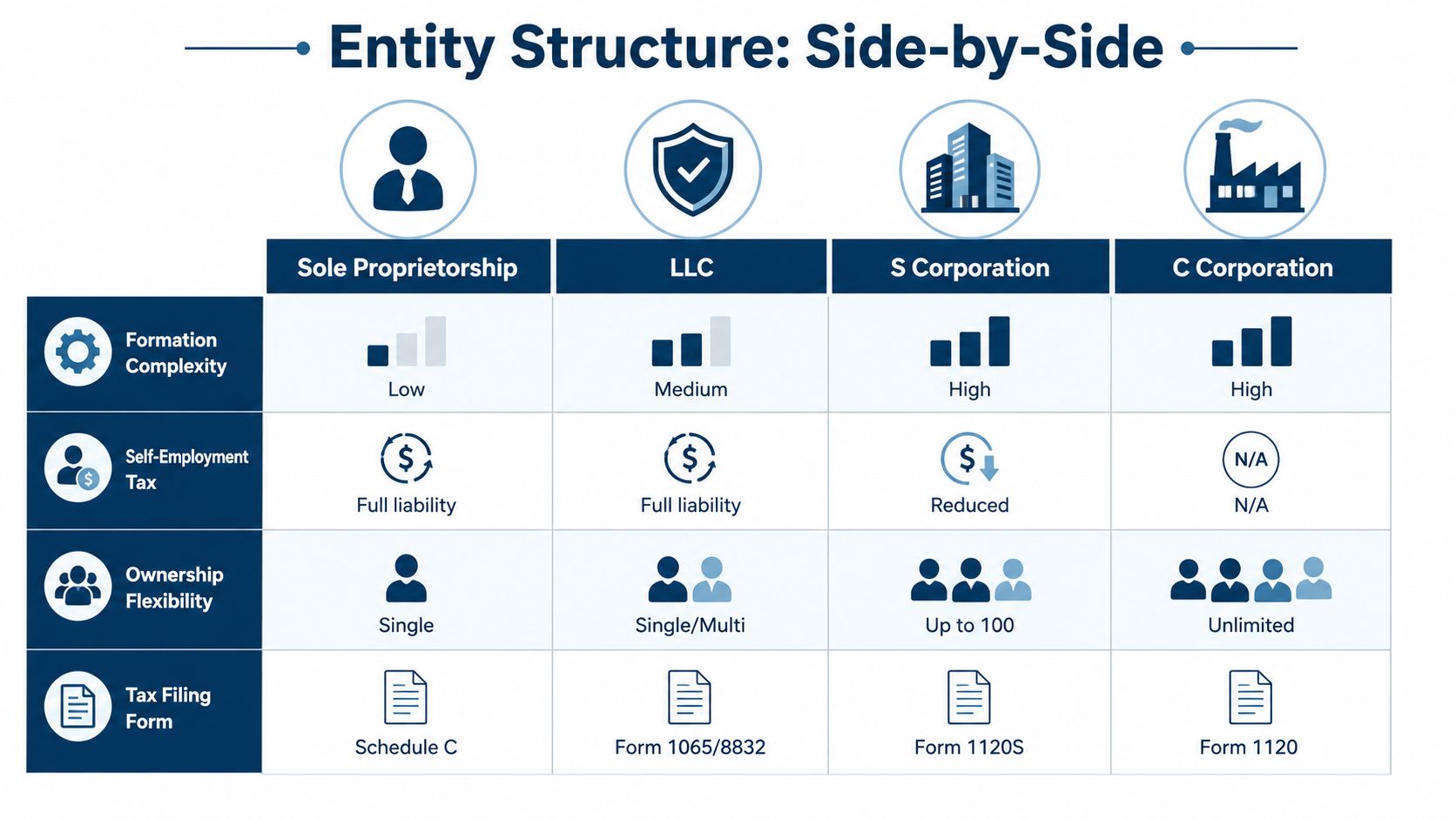
A sole proprietorship keeps formation and reporting simple, but the owner carries the structure's full self-employment-tax exposure. An LLC can provide liability protection and tax flexibility. The label alone does not determine taxation. An LLC may be treated as a disregarded entity, partnership, or corporation based on its election and ownership.
Pass-through choices need modeling
An S corporation can divide business income between wages and distributions, but that approach requires payroll and reasonable compensation. It works only when payroll records, corporate documentation, and shareholder basis stay accurate. A lower payroll number without support creates tax and compliance exposure.
The 20% QBI deduction is now permanent, and the wage and property thresholds were expanded under recent U.S. tax changes. Businesses with average annual gross receipts of $31 million or less may retroactively apply certain changes back to 2022, according to the CBIZ tax-law update. Those rules make entity selection a forecasting exercise, not a checkbox.
Model three paths before changing elections:
- Keep the current pass-through: Project taxable income, QBI treatment, payroll, and cash requirements.
- Elect S corporation treatment: Compare payroll administration and reasonable compensation with possible self-employment-tax effects.
- Consider a C corporation: Examine retained earnings, reinvestment plans, ownership needs, and corporate-level taxation.
S corporation deductions have a specific path
Section 179 does not become a separate shareholder expense deducted directly by the S corporation. The deduction passes through on Schedule K-1, while the corporation reduces the asset's basis by the elected amount. Limitations can cause part of the deduction to carry forward at the S-corporation level, as explained in the IRS Form 1120-S instructions.
Payroll planning also covers benefits and retirement plans. Review workforce requirements and check small business retirement plan obligations before promising a plan or assuming one is required. Match the decision to hiring goals, cash flow, and retention needs. A tax-efficient structure that strains payroll or benefits administration is a poor operating choice.
Timing Purchases and Retirement Contributions for Maximum Impact
A business owner approves new equipment in December, expecting the deduction to rescue the tax bill. The purchase then strains payroll and reserves for months. That is poor planning. Start with the operating need, confirm the cash impact, and only then evaluate the tax timing.
A deduction lowers taxable income. It does not reimburse the purchase price. Schedule the purchase when the business can carry the payment, the asset will be placed in service, and the deduction fits the year's projected profit.
Current rules create meaningful choices. 100% bonus depreciation was restored for qualified property acquired and placed in service after January 19, 2025, while the Section 179 limit is $2.5 million with a $4.0 million phaseout. Check the applicable rules in IRS Publication 946 before committing funds.
Depreciation and expensing options at a glance
| Method | 2025 Limit | Best For | Key Restriction |
|---|---|---|---|
| Section 179 | $2.5 million, with a $4.0 million phaseout | Businesses choosing immediate expensing for qualifying property | Limited by business income and other IRS rules |
| Bonus depreciation | 100% for qualifying property acquired and placed in service after January 19, 2025 | Capital-intensive businesses seeking immediate cost recovery | Applies only to qualifying property and timing |
| Regular depreciation | No single stated annual limit | Owners who want deductions spread across future years | Recovery follows the applicable depreciation rules |
The timing history still matters. Bonus depreciation was 60% for assets placed in service during 2024 and was scheduled to fall to 40% for assets placed in service in 2025, before later law restored 100% for qualifying property placed in service after January 19, 2025, as described by The Tax Adviser.
Apply the IRS ordering rule
Publication 946 sets the sequence. Calculate taxable income without Section 179 or the other deduction. Test a hypothetical Section 179 deduction, subtract it, test the other deduction, then calculate the actual Section 179 amount using the resulting adjusted taxable income.
Retirement contributions belong in the same quarterly forecast. Fund the plan to support long-term wealth and employee retention, then test its effect on profit, payroll, estimated taxes, and cash reserves. Compare the current-year tax result with the value of preserving deductions for later years. Make the contribution decision before the deadline, not after the books reveal a cash shortfall.
Building Clean Books That Make Tax Planning Actually Work
No tax strategy survives unreliable books. If revenue is incomplete, expenses are misclassified, and payroll accounts don't reconcile, your tax projection is fiction with formatting.
A clean monthly close should answer practical questions. What did the business earn? What does it owe? Which invoices are late? Which costs belong to jobs, departments, or owners? Which payments need documentation before the next quarterly review?
The minimum operating system
- Reconcile monthly: Match bank, credit-card, loan, and payment-platform activity to the accounting records.
- Review classifications: Investigate uncategorized transactions and owner-related spending before reports go to the tax adviser.
- Track contractors: Maintain vendor details, agreements, invoices, payment records, and classification notes.
- Project quarterly: Update revenue, margin, payroll, purchases, and estimated-tax requirements from current books.
- Keep source documents: Store receipts, invoices, payroll filings, asset records, and tax correspondence where the team can retrieve them.
Contractor reporting deserves special attention in 2025. Recent coverage states that the 1099-NEC and 1099-MISC threshold rose to $2,000, while 1099-K rules reverted to $20,000 and 200 transactions. The same guidance emphasizes that filing deadlines, payroll-tax deposits, and recordkeeping still matter, and that businesses with freelancers, reimbursements, mixed workforces, or multiple states need year-round controls (contractor compliance update).
That means bookkeeping isn't just data entry. It supports vendor onboarding, payroll decisions, expense substantiation, state compliance, and cash forecasting. An outsourced partner such as MyOfficeOps can provide bookkeeping, payroll integration, financial reporting, forecasting, and CFO-level advisory so owners can work from current numbers instead of reconstructing the past.
If your books are behind, don't wait for the next filing deadline. Schedule a cleanup, establish a monthly close, and set quarterly tax reviews with your accountant.
MyOfficeOps provides bookkeeping, payroll integration, financial analytics, tax planning support, and CFO-level advisory for small and midsize businesses. Visit MyOfficeOps to set up a practical financial system that keeps your books clean, your tax decisions timely, and your cash flow visible.