
You've got three months of invoices, receipts, payroll records, bank activity, and unanswered questions sitting in different places. The profit and loss report says one thing, your bank balance says another, and you're not sure whether you can afford to hire, buy equipment, or take on the next project.
That's the point of quarterly financial reporting. Done properly, it turns raw transactions into a clear check-in on cash, margins, payroll, obligations, and operating decisions. It isn't just paperwork for tax season. It's a way to find problems while you still have time to act.
Why Quarterly Financial Reporting Matters for Your Business
A Philadelphia contractor once reviewed quarterly results and noticed that sales were steady, but one type of renovation job was producing less profit than expected. The issue wasn't obvious from the bank balance. It appeared when the owner compared job revenue with materials, subcontractor costs, and labor by project. That variance gave the owner time to adjust pricing and review estimates before the problem spread across more work.
That's the practical value of a quarterly review. You're not staring at a year-end surprise. You're asking what changed recently, why it changed, and whether the change is temporary or part of a pattern. A restaurant in Fishtown might see food costs rising while sales look healthy. A West Chester consulting firm might have strong billed revenue but weak collections. A medical practice might show profit while cash is tied up in unpaid claims.

What the report should answer
A useful quarterly package should help you answer questions such as:
- Cash: Can the business cover upcoming payroll, taxes, vendors, and debt payments?
- Margin: Which services, products, or jobs are making money?
- Collections: Are customers paying within the terms you offered?
- Spending: Did costs rise because of growth, waste, timing, or a one-time event?
- Capacity: Is the business ready for another employee, vehicle, location, or equipment purchase?
Waiting until year-end makes those questions harder to answer. You may forget why a cost moved, lose track of an estimate, or keep pricing a service that no longer covers its real labor and overhead.
Quarterly reporting also creates a shared language for conversations with your lender, partners, and accountant. If the bookkeeping is difficult to interpret, start with a plain-language resource that explains how to review financial reporting on BookkeepDIY. The report should make decisions easier, not make you feel as if you need an accounting degree to read it.
Practical rule: A quarterly report earns its place when it changes what you do next.
Your Quarterly Closing Checklist and Timeline
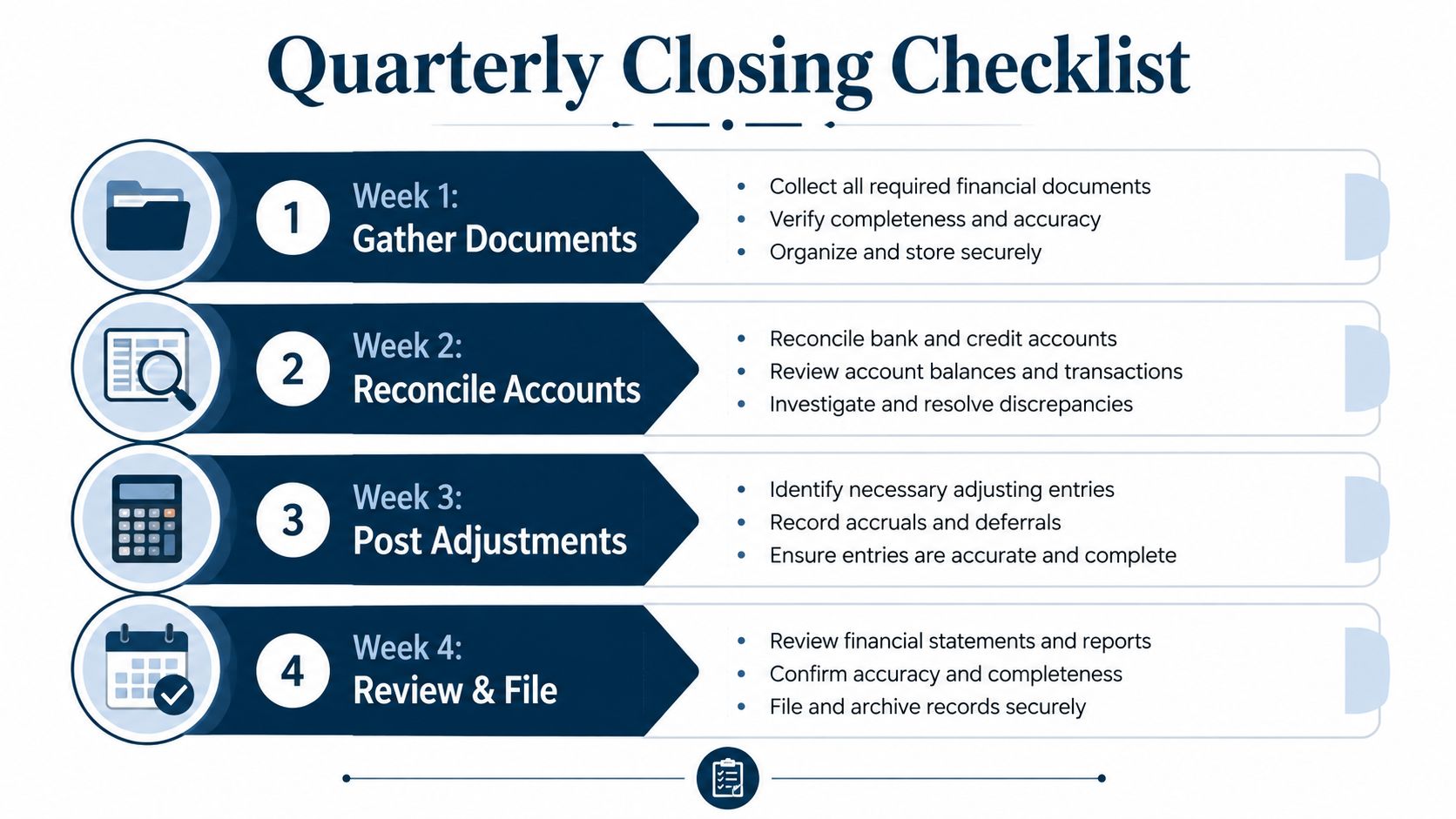
A reliable close follows an order. Entering transactions, reconciling accounts, posting adjustments, and reviewing results can't happen randomly without creating rework.
Week one focuses on gathering
Start by collecting the records needed for the period. Confirm that bank feeds are complete, credit card statements are available, payroll reports are saved, invoices have been entered, and vendor bills are recorded. Pull inventory counts, loan statements, sales reports, and any schedules used for recurring expenses.
Then assign an owner to each task. “The office will handle it” isn't ownership. Name the person responsible, the reviewer, and the date the task should be finished. A simple financial reporting template library can help you standardize the working papers and keep support in one place.
Week two is for reconciliation and adjustment
Reconcile every bank and credit card account through the quarter-end date. Review open customer invoices and follow up on overdue balances. Check unpaid vendor bills, confirm that major purchases were coded correctly, and compare payroll records with the general ledger.
If you carry inventory, complete a physical count or another dependable count process. Review loans, fixed assets, prepaid expenses, and recurring subscriptions. At this point, identify accruals, deferrals, depreciation entries, and corrections. Adjustments should come after the underlying transactions are complete, or you'll keep changing the same numbers.
Week three and four are for review
Review the income statement, balance sheet, and cash flow information together. Compare results with the prior quarter, the budget, and what you expected operationally. Investigate unusual movements instead of accepting them as “just accounting.”
Use the final week for management review, tax obligation checks, support documentation, and filing preparation where a filing applies. Public U.S. companies generally have 40 days after the first three fiscal quarters for large accelerated and accelerated filers, while other registrants generally have 45 days, and no quarterly report is required for the fourth quarter under the SEC's Form 10-Q rules. The exact schedule depends on the company's filing status and isn't a general deadline for private businesses. SEC Form 10-Q filing guidance explains that distinction.
Put these tasks on the calendar before the quarter ends. A close that depends on memory will become a close that depends on panic.
Understanding Reconciliations and Accrual Adjustments
Quarterly reports become useful when recorded transactions match what happened in the business. A reconciliation compares your accounting records with an outside record, such as a bank statement, credit card statement, or customer balance. The goal is to find missing, duplicated, mistimed, or misclassified activity before it distorts a decision.
Start with the bank account. Compare the accounting balance with the statement, then investigate uncleared checks, deposits in transit, duplicate entries, bank fees, transfers posted to the wrong account, and transactions that were never entered. Credit card reviews follow the same approach, with two added checks: confirm the statement closing date and assign purchases to the quarter in which the business received the goods or services, even if payment came later.
Accounts receivable needs judgment as well as matching. Review the aging report, identify old or disputed invoices, and assess whether the recorded balance is likely to be collected. A Philadelphia contractor can show a profitable quarter on paper while waiting months for a customer to pay, leaving too little cash for payroll or materials.

Accruals place revenue and expenses in the period they belong to instead of waiting for cash to move. An electric bill received after quarter-end may cover energy used during the quarter. A consultant may finish work before sending an invoice. Both belong in the quarter's financial picture.
Use these questions during the adjustment review:
- Unpaid expenses: Which goods or services has the business already received?
- Earned revenue: What work is complete but not yet invoiced?
- Prepaid items: What share of insurance, software, or another advance payment belongs in this period?
- Estimate changes: How does the final bill compare with the earlier estimate?
Document meaningful differences between estimates and final amounts. Keep the original entry and record the reason for the adjustment. That explanation improves later estimates and gives another reviewer a clear trail. A consistent general ledger reconciliation process helps owners turn raw transaction data into quarterly insight without needing an accounting degree.
Payroll Taxes and Key Performance Indicators
A profitable quarter can still leave an owner short on cash if payroll taxes, benefits, or overtime were recorded late. Review payroll and performance together because labor costs affect cash, tax obligations, margins, and staffing decisions.
Begin with payroll reports and the general ledger. Match wages, bonuses, commissions, benefits, reimbursements, and employer taxes. Check that new hires, departures, and pay changes appear in the correct period. Confirm payroll tax deposits and filings are recorded, then review estimated tax obligations with your tax professional. Keep support for deductible expenses throughout the quarter instead of reconstructing it at year-end. A practical basics of payroll accounting guide can help organize those records.
The business model determines which KPIs deserve attention. A Philadelphia agency might see revenue holding steady while overtime rises because project work is being assigned inefficiently. A healthcare practice may need separate figures for provider compensation, support payroll, and contract labor before it can see visit-level margin clearly.
Choose a short dashboard that leads to decisions:
- Professional services: Billable hours, utilization, realization, revenue per employee, and client concentration show how capacity and client mix affect results.
- Retail: Sales by category, gross margin, inventory levels, and markdown activity reveal whether revenue is converting into cash and profit.
- Construction: Estimated versus actual job costs, labor, materials, subcontractors, and work in progress expose margin pressure before completion.
- Healthcare: Visits, payer mix, collection timing, provider productivity, and supplies connect operating volume with cash flow and margin.
Review the trend, then assign an action. Falling utilization calls for a scheduling and pipeline review. Rising job costs may require updated estimates or contract terms. Slow inventory movement supports reducing purchases before cash remains tied up on shelves.
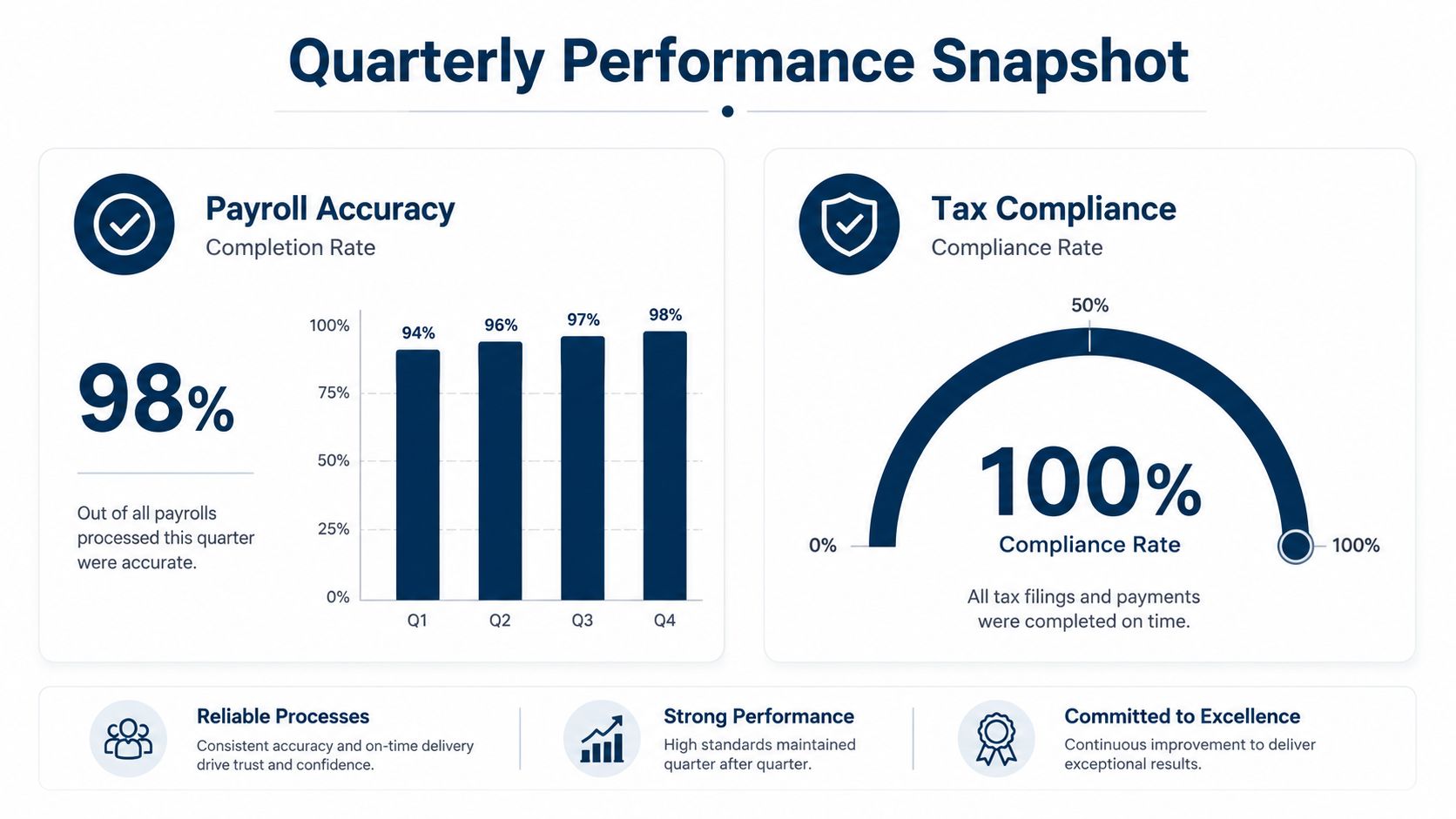
The image shows 98% payroll accuracy and 100% tax compliance as a sample performance snapshot. Treat those figures as dashboard examples, not as a target or result for your business. Guidance on practice management from Advisor Momentum places financial review within a broader management routine. A clear dashboard should help an owner make a decision without needing a CPA degree.
DIY vs Outsourced Support
A Philadelphia café with clean daily sales can often handle quarterly reporting in-house. The owner still needs to decide whether catering revenue belongs in the quarter, whether unpaid bills are recorded, and whether the cash balance covers upcoming obligations. QuickBooks Online, Xero, and Wave can capture transactions and produce reports. They cannot make those judgments or explain why profit changed.
DIY works when transactions are straightforward, the owner understands the reports, and someone can close the books consistently. It becomes harder with multiple entities, inventory, project accounting, complicated payroll, several revenue streams, or a growing management team. At that point, outside support can add review, forecasting, cash planning, KPI design, and decision support. Those services go beyond transaction entry.
Use the closing process itself to choose the model. If it regularly consumes owner time or delays decisions, the current setup costs more than its software subscription. If you cannot explain a margin change, receivable balance, or cash movement, the report is not finished. If the results never affect pricing, hiring, spending, or collections, the business needs a review habit, not additional pages.
A hybrid arrangement often suits a growing Philadelphia business. Internal staff can gather documents, approve bills, and answer operational questions. An outside bookkeeper can review reconciliations, post adjustments, and prepare the quarterly report. A fractional CFO can lead the review meeting and convert the findings into assigned actions.
MyOfficeOps combines bookkeeping, payroll integration, financial analytics, KPI dashboards, and CFO-level advisory for small and midsize businesses in the Philadelphia area. Compare that scope with a local CPA, a fractional finance leader, or a software-only process. Choose based on the complexity you manage today and the decisions the reports must support.
Common Pitfalls and How to Avoid Them
The most damaging mistake is treating quarterly reporting as a compliance checkbox. A report can be technically complete and still fail if it doesn't explain cash pressure, margin movement, customer balances, or operating capacity.
Rushing creates a second problem. Owners skip reconciliations, copy prior estimates, and accept unexplained variances because the deadline feels more urgent than accuracy. That approach may save a day now and create weeks of confusion later.
Five patterns deserve attention
- No documented assumptions: Write down how you estimated unpaid expenses, work in progress, collectibility, and other judgment areas.
- No variance review: Compare actual results with the budget and prior period, then investigate meaningful changes by account and business driver.
- Inconsistent revenue recognition: Use the same rule each quarter and record why an exception was necessary.
- Too much detail: A report with every available metric can hide the few numbers that require action.
- Unclear ownership: Assign each close task to a person, with a reviewer and a completion date.
A healthcare practice can underestimate tax needs when its tax planning doesn't account for items such as bonus depreciation. A professional services firm can lose investor confidence when it changes revenue recognition from one period to the next without a clear explanation. Those examples point to a wider lesson: tax review and revenue policy need documented coordination.
A clean report isn't one with no estimates. It's one where the estimates are reasonable, supported, and reviewed.
Keep the management package simple. Show the income statement, balance sheet, cash flow view, KPI page, variance notes, and a short action list. If a lender or investor needs more detail, provide the supporting schedule separately.
Turning Quarterly Reports Into Growth Strategies
Quarterly reporting becomes useful when it changes a decision. A construction company can review job profitability before accepting more work at the same price. A consulting firm can examine cash collection patterns before adding a full-time employee. A retailer can protect cash by cutting slow-moving purchases instead of assuming every sales increase creates healthy growth.
The report should tell a story in a fixed order. Start with what happened, explain why it happened, show what may happen next, and finish with decisions and owners.
A practical quarterly review meeting
Use a short agenda:
- Results: Review revenue, gross margin, operating costs, net income, and cash movement.
- Drivers: Explain changes by customer, service line, job, location, or product category.
- Risks: Discuss collections, debt, payroll, tax obligations, vendor exposure, and cost shocks.
- Choices: Decide what to change in pricing, staffing, purchasing, spending, or sales focus.
- Ownership: Assign each action to a person and set a follow-up date.
Cash deserves special attention. Profit can rise while cash falls because customers pay slowly, inventory grows, equipment is purchased, or debt principal is repaid. Segmenting results by recurring revenue, working capital, and cost exposure gives you a better read than headline profit alone.
The same discipline helps with growth investments. Before hiring, review whether demand is recurring, whether current staff is fully used, and whether collections can support the added payroll. Before buying equipment, separate the expected operating benefit from the financing burden. Before opening another location, compare the existing location's margins and cash needs with the assumptions behind the expansion.
A quarterly package can also support a sale or ownership transition. Buyers want organized records, consistent classifications, understandable margins, and evidence that the business can operate beyond the owner's daily involvement. Templates can make the presentation easier, including these customisable business report templates from LeaveWizard. Adapt the format to your audience, but keep the underlying numbers consistent.
Start with one repeatable close checklist, one KPI page, and one quarterly meeting. Improve the process after each cycle. You don't need a complex finance department to make better decisions, but you do need records you trust and a clear habit of using them.
MyOfficeOps helps small and midsize businesses organize bookkeeping, payroll integration, financial reporting, KPI dashboards, cash-flow analysis, and CFO-level planning. Visit MyOfficeOps to discuss a quarterly reporting process that fits your business and turn the next close into a useful management tool.