
You're standing at the counter after a long shift, the tip jar's been counted, the cards have been batched, and someone still needs to make sure Friday's pay run is right. That's usually the moment payroll stops feeling simple. It's not just handing out checks, it's making sure the books, the taxes, and the people line up the way they should.
A small cafe makes this easy to see. Say you've got five employees, a mix of hourly staff and one manager, and every pay cycle has the same questions hiding inside it. Who earned what, what got taken out, what taxes do you owe, and what needs to be recorded before the month closes? Payroll accounting is the process that answers all of that, and it belongs in the ledger, not just in a payroll app.
What Payroll Accounting Actually Means
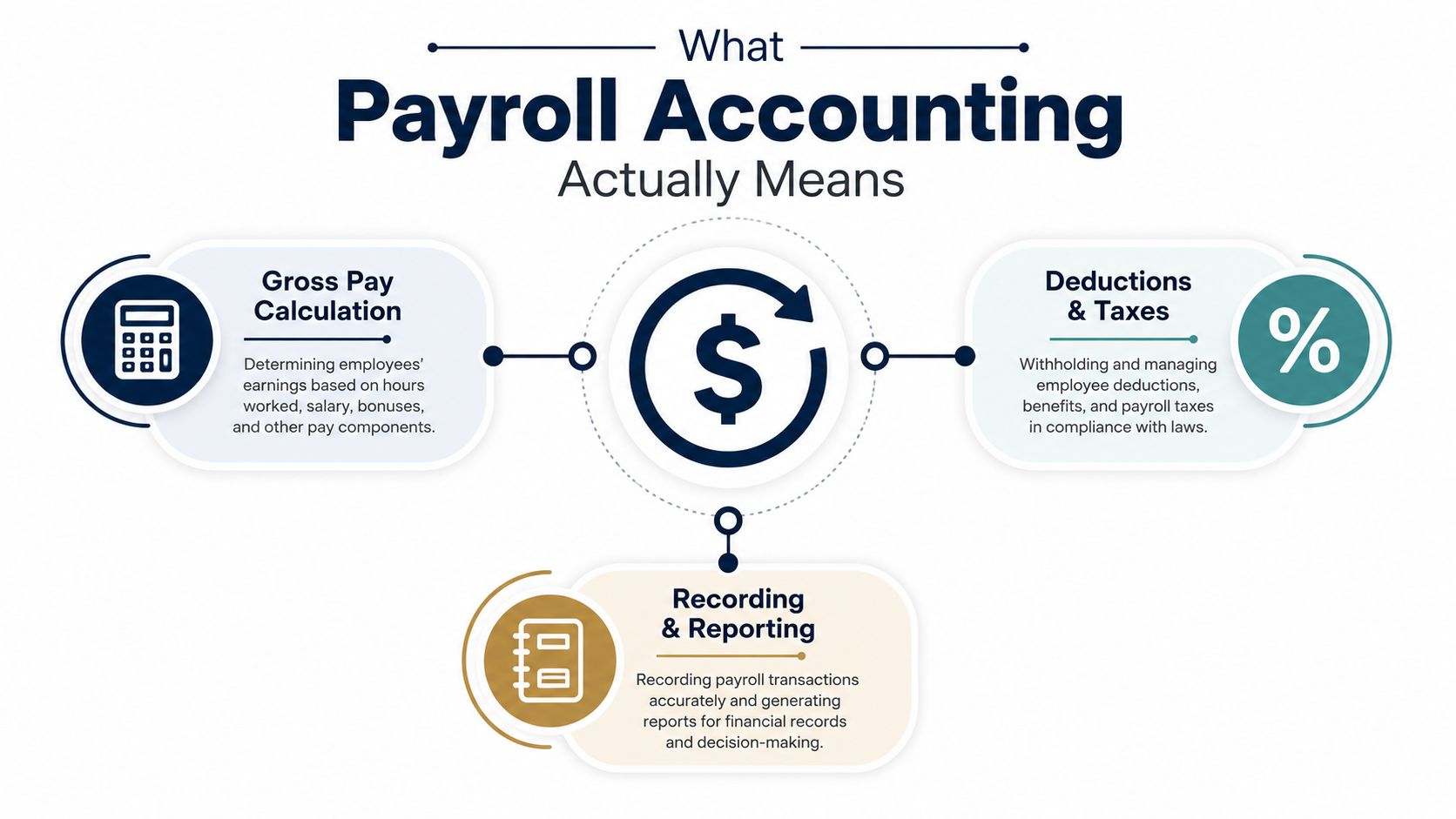
The first mistake many owners make is thinking payroll ends when money leaves the bank. It doesn't. Payroll accounting is the part where you turn a workweek into records that show gross pay, deductions, employer taxes, and the liabilities still sitting on your books.
The cafe version of the idea
In the cafe, Maya the owner runs payroll for five people every other Friday. One barista worked enough hours to earn gross pay, then taxes and benefits came out, and the rest became net pay, the amount that lands in the worker's account. At the same time, Maya still owes the government the withheld tax amounts, so those aren't “gone.” They're liabilities until she remits them.
That's why payroll accounting is a double-entry job, not just a payment step. The records need to show what the business spent on labor, what it holds temporarily for taxes and deductions, and what cash left the account. A basic payroll setup is really a bridge between people getting paid and the financial statements telling the truth.
What belongs in the books
The clean way to think about it is simple. Payroll records capture compensation, withholding taxes, deductions, and employer expenses, then move those amounts into the ledger in the right buckets. That's how payroll becomes part of financial reporting instead of living off to the side in a software screen.
Practical rule: if a payroll amount will matter at tax time, audit time, or month-end close, it belongs in the accounting records, not just in the pay stub.
For a first-time owner, that's the core shift in mindset. You're not only paying people. You're keeping a running record of what was earned, what was withheld, what you still owe, and what was paid out.
Gross Pay, Net Pay, and the Deductions in Between
Think of gross pay like the full bill before you tip, split, or use a coupon. It's the amount earned before anything comes out. Net pay is what's left after the cuts, the number your employee receives.
For the cafe, that means one barista's paycheck might start with hourly wages, then shrink after federal income tax withholding, Social Security, Medicare, state income tax, and voluntary items like health insurance or a retirement contribution. The owner sees one number on the payroll report, but the employee sees a smaller take-home amount. That gap is normal. It's the heart of payroll.
Why the employer's cost is bigger than the check
Here's the part that catches new owners off guard. The business doesn't just pay the worker's net pay. It also carries its own payroll taxes and, in some cases, employer contributions. So the cost of labor is bigger than the check that lands in the employee's account.
That's why a foundational view of payroll accounting treats every cycle as three numbers, gross pay, net pay, and liabilities owed, because net pay is what the employee gets while liabilities are what the employer still has to send to government agencies (Accountutor on payroll accounting basics).
A simple way to hold it in your head
- Gross pay is the full amount earned before deductions.
- Deductions are the amounts taken out for taxes, benefits, or other withholdings.
- Net pay is the take-home amount.
- Employer taxes are the business's separate payroll tax cost.
That split matters because the cafe owner can't treat the withheld money like free cash. If the employee had taxes taken out, that money is already spoken for. It may still be in the bank for a few days, but it belongs in a liability bucket until it gets remitted.
Plain truth: if you only watch the bank balance and ignore liabilities, payroll will look cheaper than it really is.
The Payroll Cycle From Time Card to Paycheck
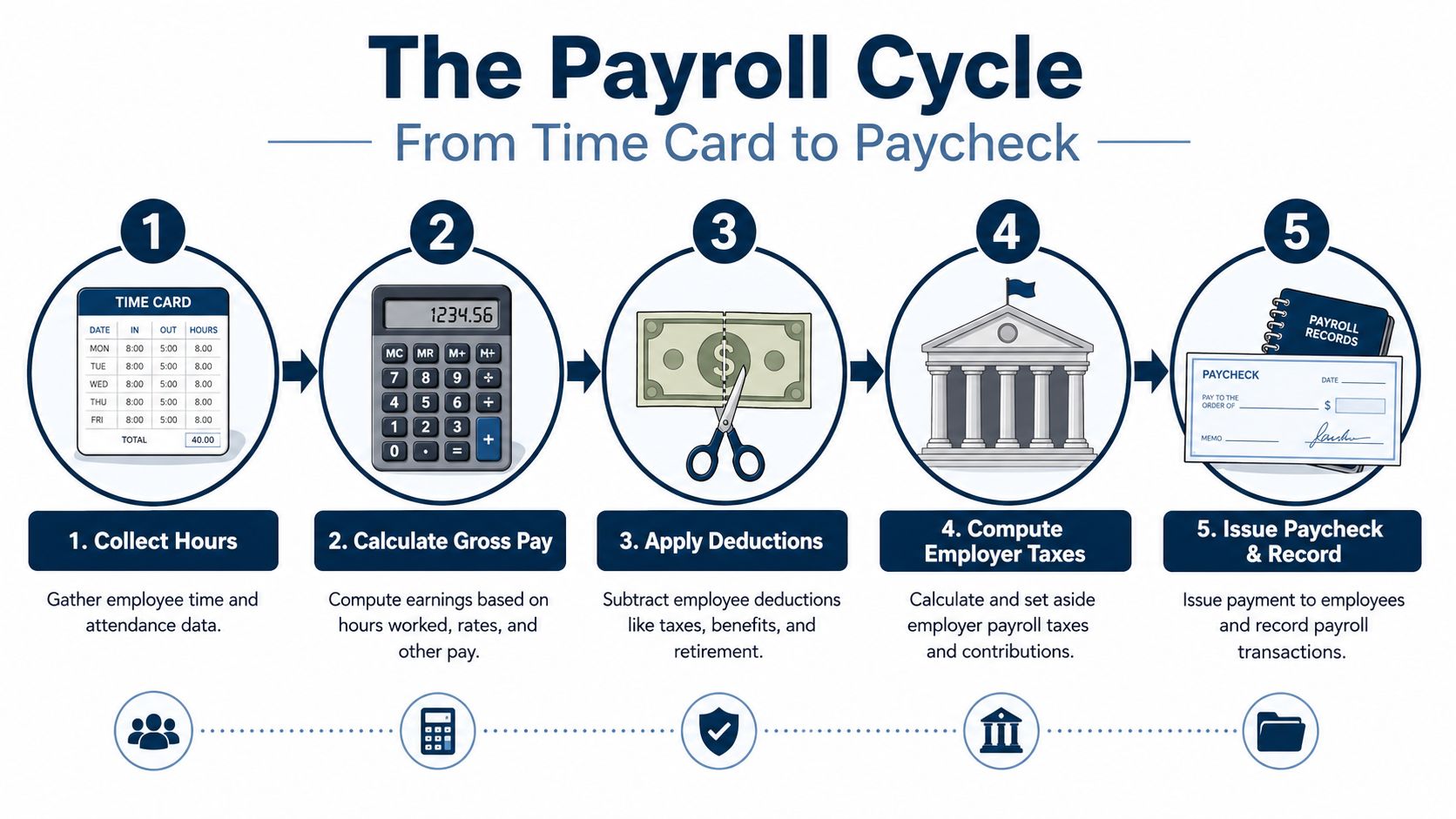
The payroll cycle works best when it follows the same order every time. First, you collect hours. Then you calculate gross pay. After that come deductions, employer taxes, and finally net pay. The accounting entry should follow that same trail, because the numbers are easier to reconcile when they're built in the same sequence (Cursa on payroll accounting workflow).
How it looks in a real week
In the cafe, hours might be collected on Sunday night for a Friday pay date. Monday is when the owner or bookkeeper checks the time cards, confirms overtime, and makes sure tips, sick time, and paid breaks are handled the same way they were last cycle. That review matters more than it sounds like it should, because a small mistake in hours multiplies through the rest of payroll.
Then the payroll register gets built. That register is the source document, the one place where gross pay, deductions, employer taxes, and net pay are all gathered for the period. It should be finalized before any ledger entry is posted. That habit saves a lot of pain later, because you're posting from a finished summary, not from half-checked notes.
Why timing trips people up
Payroll timing can be messy. A paycheck might go out on Friday, while tax deposits and remittances land on a different date. That's where people get confused and book the wrong thing too early or too late.
A good way to stay sane is to think in checkpoints:
- Collect hours and pay data.
- Finish the payroll register.
- Post the accounting entry.
- Pay employees.
- Schedule the tax remittance.
If your business uses outside payroll services, this how payroll services work overview helps show where processing ends and bookkeeping begins. The point is simple. The register comes first, the ledger follows, and the bank payment is only one part of the whole cycle.
Journal Entries That Make Payroll Accounting Work
Payroll stops feeling like a payment task and starts looking like accounting. The ledger needs to show what happened in a way that balances. Gross wages land in wage expense, employer payroll taxes go into a separate employer tax expense, employee withholdings become liabilities, and net pay leaves through cash or a payroll clearing account (ADP on accounting for payroll).
What the cafe entry is doing
If Maya runs payroll for the cafe on Friday, the journal entry doesn't just say “paid wages.” It splits the event into pieces. The gross wage expense shows the labor cost on the income statement. The withholdings sit as liabilities because the business still owes them to the right agencies. The net pay hits cash, or a clearing account if the business uses one to keep payroll moves cleaner.
That split matters because it keeps the books honest. If employee withholdings are recorded wrong, cash flow and tax reporting can drift apart. You might think you've paid everything cleanly, but the ledger will tell a different story.
A simple accounting picture
- Wage expense records the labor cost.
- Employer tax expense records the business's own payroll tax burden.
- Liabilities track what's still owed for employee withholdings and similar amounts.
- Cash or clearing shows what left the business.
The balancing logic is the whole point. Payroll isn't one line item in the books, it's several. That's why a payroll app alone can't do the full job unless the amounts are mapped correctly into the chart of accounts.
Useful habit: match the payroll register to the journal entry before you post it. That one pause catches a lot of small errors.
If you're trying to tighten the accounting side, a journal entry guide can help you see how payroll fits into the larger double-entry system. Once this clicks, the rest of the books get a lot less mysterious.
Payroll Taxes, Deposits, and Reporting Forms
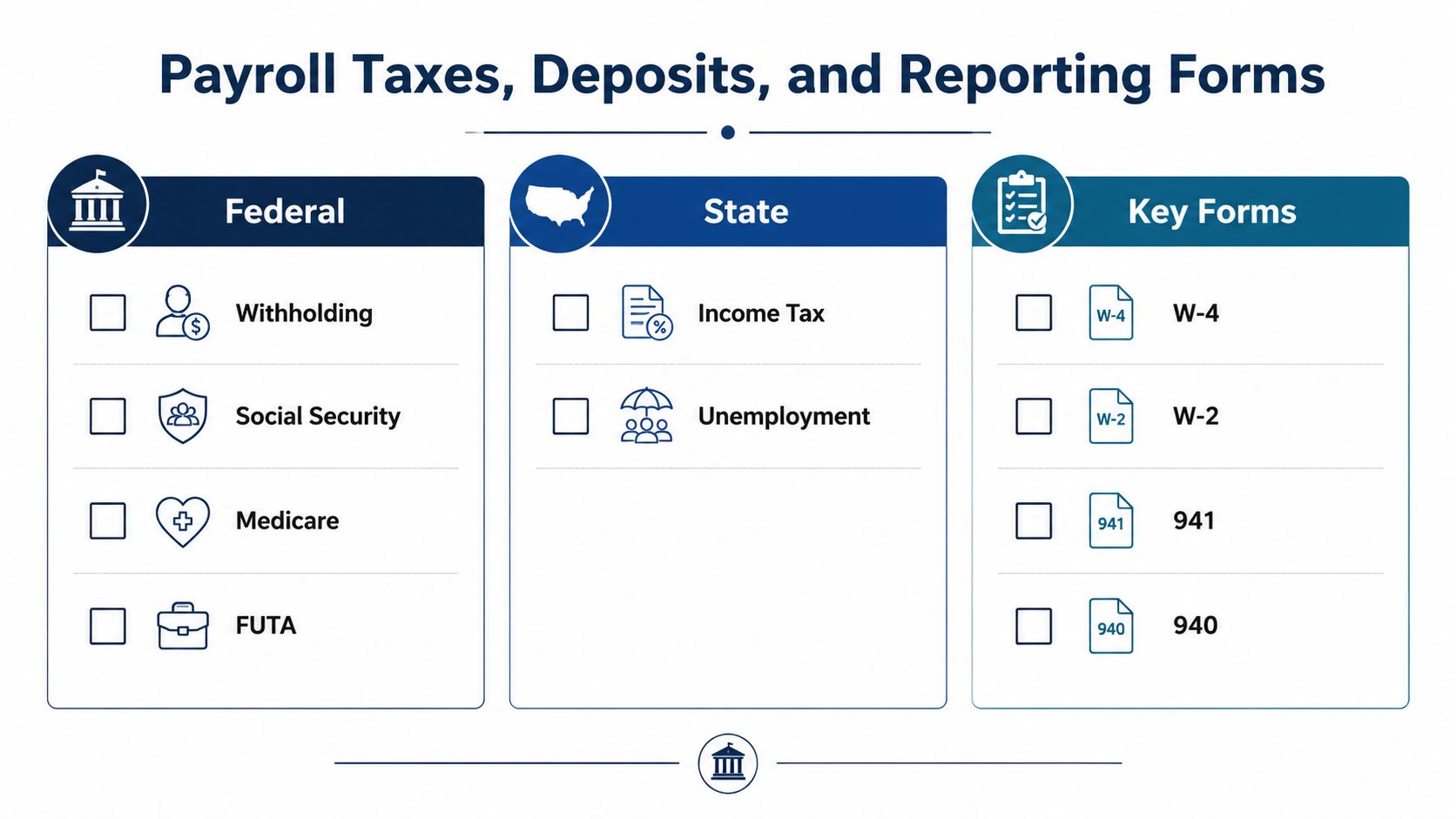
Payroll taxes are where owners start feeling like they need a cheat sheet, and they usually do. The categories are straightforward once you slow them down: federal income tax withholding, Social Security, Medicare, federal unemployment tax, state income tax, state unemployment tax, and any local taxes that apply. The hard part is not the names. It's the timing and the paperwork.
The setup has to come first
Before the first payroll run, the business needs an EIN, state tax registrations, and payroll tax payment channels, because the ledger has to be built around jurisdiction-specific withholding and remittance rules (NetSuite on payroll accounting setup). If that setup is wrong, every payroll after it gets harder to untangle.
That's why the cafe owner can't just “start paying people” and figure it out later. The registrations define where the tax liabilities go in the books. Federal, state, and local buckets need to be set up correctly from the start, or the monthly close becomes guesswork.
A calendar view helps
I like to think of payroll compliance as a calendar, not a pile of forms.
- Each payday, taxes and deductions get calculated.
- During the month, deposits get scheduled based on the business's filing rhythm.
- Quarterly, payroll reporting gets checked against what was withheld and remitted.
- Annually, employee wage forms and employer filings are prepared.
The exact filing rhythm depends on the business's tax profile and location, which is why the setup phase matters so much. If the buckets are right, the filings are easier to trace later. If they're wrong, even a simple close can turn into a messy correction cycle.
How Payroll Connects to Your Books and Financial Reports
Payroll touches all three main reports in a pretty direct way. The income statement shows wage and payroll tax expense. The balance sheet carries unpaid payroll liabilities until they're remitted. And the monthly close uses those liabilities to confirm what's still owed, which keeps the books from drifting.
Under accrual accounting, wages are recognized as expenses in the period they're earned by employees, even when the cash is paid earlier or later (Accounting Coach on payroll accounting). That rule matters a lot in a cafe, because pay dates rarely line up perfectly with the work period. If someone worked the last two days of the month but gets paid next week, the expense still belongs to the month they earned it.
The cafe close, in plain language
Maya closes the books at month-end. She looks at payroll liabilities and checks whether the withheld amounts are still sitting there waiting to be sent. She also makes sure wage expense lines up with the work her staff performed during the month, not just what cleared the bank.
That's the accounting side of payroll in action. One pay run can affect expense, liability, and cash all at once, so the monthly close is really a checkpoint for whether the system is holding together.
For owners who use software to connect timekeeping, payroll, and the ledger, this payroll integration overview is a helpful reference. And if a workers' comp audit is on the horizon, a practical 2026 workers comp audit overview can help you see why payroll records and classification details need to stay tidy.
Payroll numbers don't live in one place. They show up in the books, the tax filings, and the wage reports, so the records have to agree.
That's why payroll is not just an HR task or a bank task. It's part of the reporting system.
Common Payroll Mistakes and How to Prevent Them
A 2026 payroll statistics review reported that about 1 out of every 5 payroll cycles still contains some kind of error, and more than half of U.S. workers have experienced late or incorrect pay at some point (Yomly payroll statistics). That's the kind of mess that makes owners lose sleep, because one bad run can hit the books and the team at the same time.
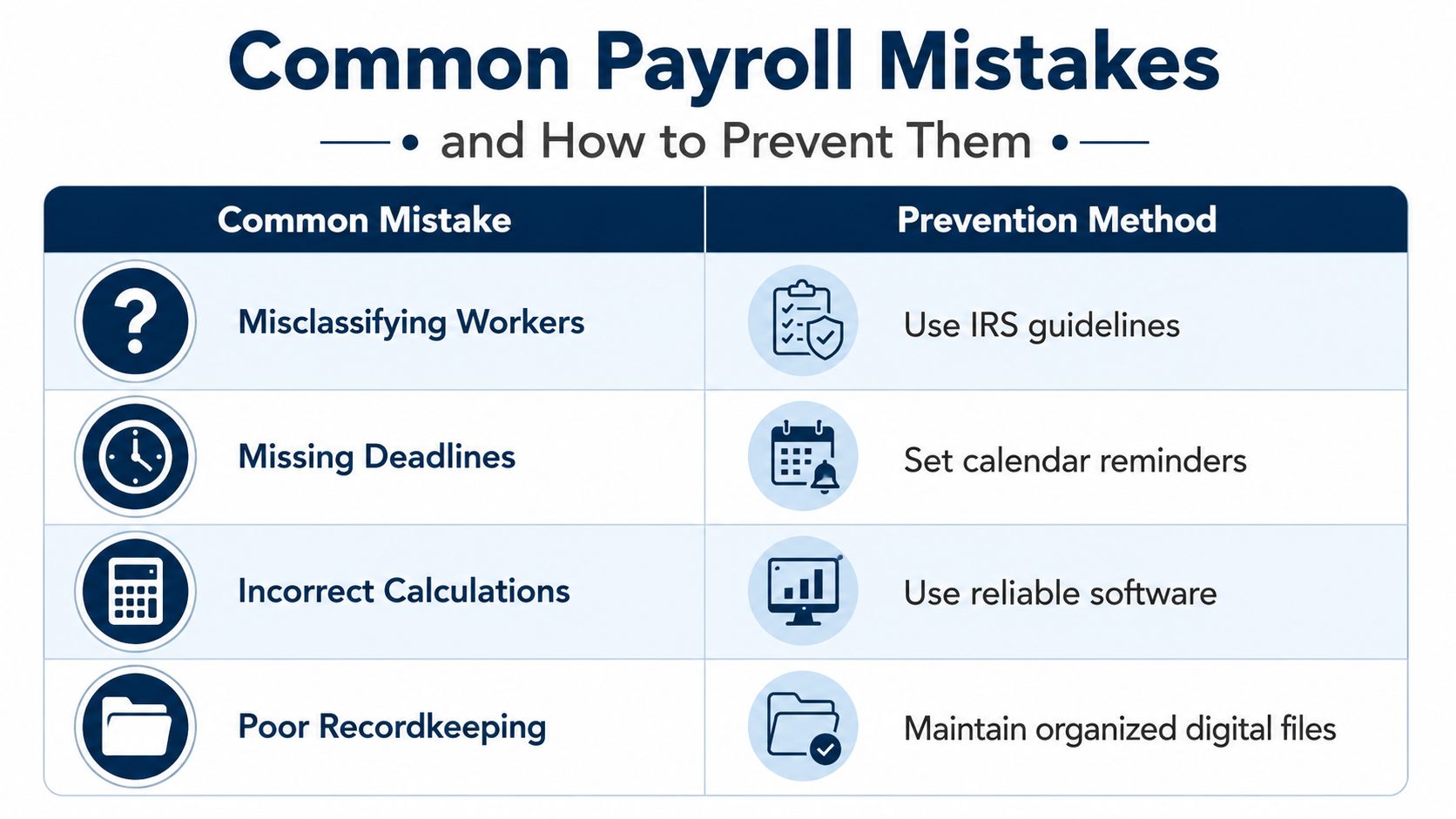
The mistakes that keep showing up
- Misclassifying workers. If someone should be an employee, don't treat them like a contractor just because it feels simpler. Use the right worker rules before the first payment goes out.
- Missing deadlines. Payroll dates, tax deposits, and filing dates need calendar reminders. If the date lives only in someone's head, it will be missed eventually.
- Incorrect calculations. A bad rate, wrong deduction, or stale tax setup turns a clean pay run into a cleanup job. Reliable payroll software helps, but only if the inputs are right.
- Poor recordkeeping. Keep payroll files organized by period so the register, journal entry, and filing support are easy to match later.
How to reduce the damage
The best control is boring, and boring is good here. Review the payroll register before posting, compare it to the ledger entry after posting, and keep payroll liabilities visible until they're paid. That one habit saves a lot of “where did this number come from?” conversations.
If you're interviewing someone to help with payroll or compliance, these top compliance hiring questions are a useful place to start. They can help you check whether the person understands details, not just software buttons.
The goal isn't perfection for its own sake. It's making sure one payroll run doesn't create three more problems in bookkeeping, taxes, and employee trust.
Your Payroll Compliance and Outsourcing Checklist
For a cafe owner, payroll feels much calmer once the basics are locked in. The checklist is short, but it has to be complete: EIN, state registrations, payroll payment channels, accurate time capture, a finalized payroll register, posted journal entries, scheduled tax deposits, and clean year-end forms. If those pieces are working, the process starts feeling predictable instead of scary.
When Maya keeps the cafe's payroll in order, month-end close gets easier because the liabilities are already mapped, the books agree with the pay run, and nobody is chasing missing support at the last minute. That's the whole point of payroll accounting. It should make the business quieter, not noisier.
If you're still doing payroll by hand, or your books and pay runs keep arguing with each other, outsourcing can make sense. A bookkeeping or payroll partner can handle setup, posting, and reconciliation so you're not stuck chasing tax deadlines after closing time. MyOfficeOps offers payroll integration and bookkeeping support for businesses that want the payroll numbers to land in the right place the first time.
If you want help getting payroll to tie out cleanly in your books, MyOfficeOps can help you set up the process, keep the entries aligned, and reduce the end-of-month scramble. Reach out and talk through your current payroll setup, especially if you're tired of reconciling the same numbers twice.