

Friday morning, the payroll file is ready, but the bank balance isn't. You have $80,000 in payroll due Monday, while three approved pay applications totaling $312,000 are still sitting in a lender's lockbox. The controller refreshes the bank portal again at 9 p.m., hoping the draw cleared. It hasn't.
That gap between work earned and money available is where construction companies get hurt. A job can show a healthy margin on paper and still leave the contractor borrowing to cover payroll, suppliers, equipment, and subcontractors. Slow payments cost the U.S. construction industry about $280 billion in 2024 and added roughly 14% to total construction spending, according to industry research on delayed construction payments.
Cash flow forecasting in construction project work exists to close that gap. Done properly, it isn't a report prepared after trouble appears. It's a weekly operating rhythm that gives the owner, controller, and project manager time to act before a cash trough reaches the bank account.
Why Cash Flow Controls Every Construction Project
A profitable job can still leave the company scrambling for payroll. The contractor has installed work, submitted the pay application, and earned the revenue, while the owner or lender continues reviewing the draw. Cash leaves on a schedule. Collections often arrive on another.
Construction firms commonly wait 30 to 60 days to collect payment, and 82% of contractors now face payment waits longer than 30 days, up from 49% two years earlier, according to the 2024 construction payment-delay reporting. Those figures describe a finance problem inside an otherwise active project, not a bookkeeping detail.
Labor runs weekly. Materials may require deposits or early orders before installation. Subcontractors submit billing packages and expect payment under their contract terms. The owner may still require inspections, certifications, lien waivers, lender review, or several approval steps before releasing funds.
A profitable job can still drain the company
Suppose a general contractor expects a strong final margin. If project spending continues steadily while collections arrive late, the company needs enough liquidity to cross that gap. Delayed payment can force additional borrowing, postpone subcontractor payments, and contribute to schedule overruns, all of which research on construction payment impacts connects to the broader payment problem (construction payment-delay research).
The project manager sees installed progress. The estimator sees remaining margin. The controller sees whether the bank balance can cover the next payroll run and the obligations across the rest of the portfolio. Each view can be accurate. Only the cash view answers the immediate operating question: Can the company meet its obligations when they come due?
A single job also competes with every other job for treasury capacity. One delayed draw may be manageable. Several delayed draws at once can turn a profitable backlog into a company-wide borrowing decision.
Practical rule: Treat cash timing as a project deliverable. If the team cannot say when an approved draw should reach the bank, the forecast is unfinished.
Forecasting turns panic into choices
A weekly forecast gives the team time to act. The contractor can complete a pay application, confirm a release date with the owner, defer a discretionary purchase, negotiate supplier terms, reschedule a materials drop, or arrange working capital before the need becomes urgent.
Owners who want broader small-business cash discipline can use this 2026 cash flow guide for business owners, particularly when project timing affects overhead, taxes, debt, and payroll across the company.
The value comes from cadence. A forecast updated monthly usually records what already happened. A forecast refreshed weekly shows which payment risks, commitments, and company-wide cash decisions need attention next.
The Moving Parts That Shape Cash on a Job
A Philadelphia-area GC can have a profitable backlog and still face a payroll problem next week. The reason is timing. Crews and suppliers need payment before the owner's draw completes review, approval, and bank release.
The pay application starts that process. It documents the work completed during the billing period for the owner or lender. The schedule of values supports the request by dividing the contract into measurable categories, including site work, concrete, framing, finishes, and closeout. If those quantities or percentages are disputed, the expected receipt moves even when the field team believes the work is complete.
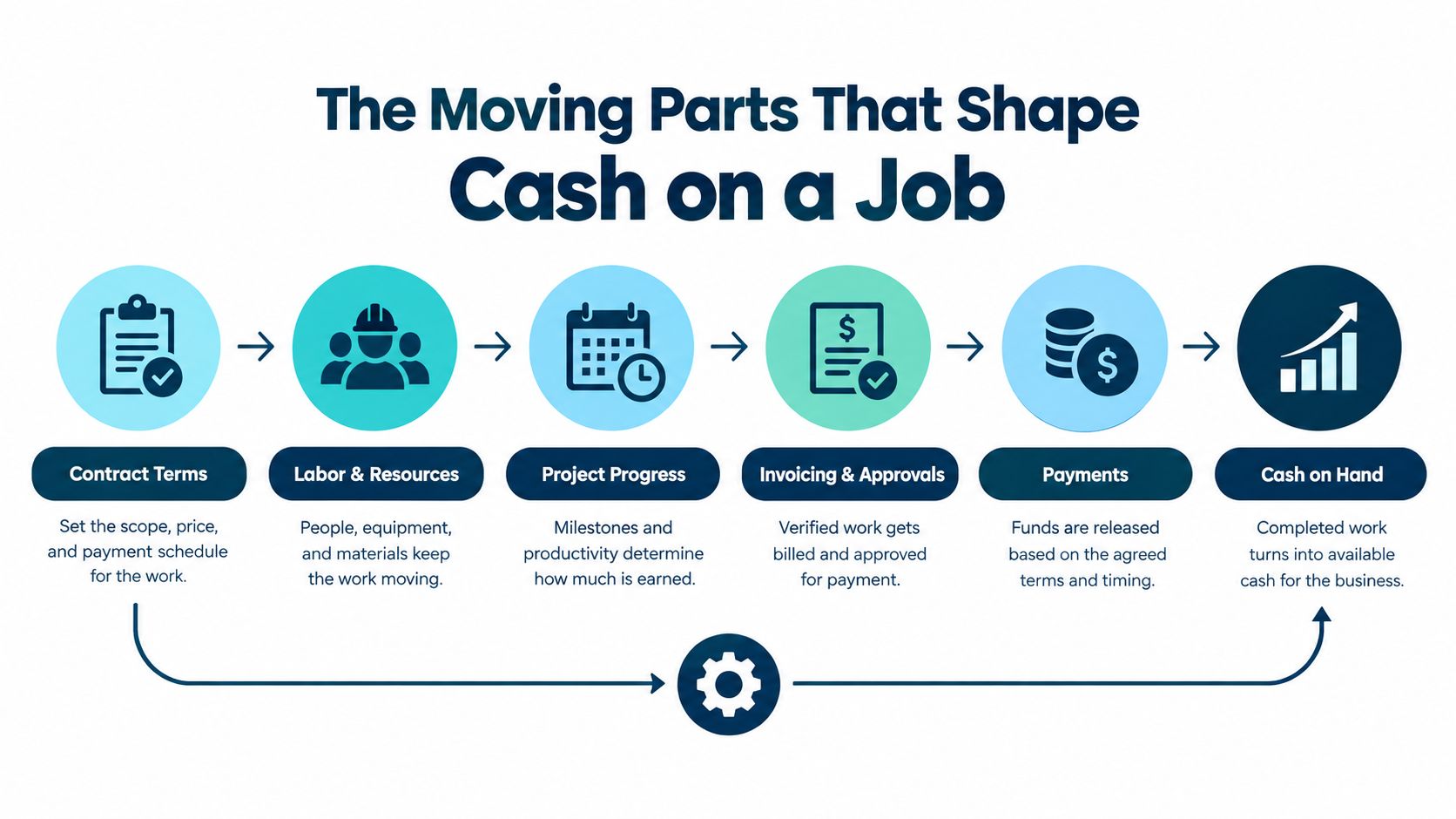
Why the invoice date isn't the cash date
Progress billing is the standard way construction revenue arrives. Contractors typically invoice monthly or at milestones instead of waiting for final completion (construction progress billing guidance). Record four separate points in the forecast: submission, expected approval, contractual payment timing, and the date the customer is likely to pay in practice. Those dates often differ.
Retainage reduces each progress receipt and delays part of the job's cash. Owners or general contractors commonly hold 5% to 10% until a completion milestone, according to construction retainage guidance. On a $500,000 project with 10% retainage, $50,000 remains withheld across the job. Release may depend on substantial completion, punch-list sign-off, or another contract trigger, and the funds can still take 30 to 90 days or longer to arrive after release. That delay belongs in the forecast, not in a footnote.
The paperwork that slows the drain
A pay application can remain in review because a lien waiver is missing, insurance documentation is outdated, or a lender requests another inspection. A pay-when-paid clause may tie a subcontractor's payment to the general contractor's receipt, but its legal effect depends on the contract and applicable law. The controller still needs a realistic estimate of when cash will leave.
Change orders can put costs ahead of billable value. Field crews may complete extra work before approval, while back charges can reduce a receipt for damage, rework, or missed obligations. Track pending changes, disputed amounts, waivers, inspections, and expected release dates by job. A portfolio-level treasury view then shows whether one delayed draw is manageable or several jobs will compete for the same cash.
The 13-Week Rolling Forecast That Actually Works
The 13-week rolling forecast became a construction finance standard because it balances visibility with reality. A 13-week horizon can reveal cash troughs 6 to 11 weeks in advance, while staying close enough to billing and payment cycles to support action (rolling forecast research).
Monthly snapshots blur the week when cash runs short. Payroll and supplier payments don't wait for month-end. Weekly rows show whether an inflow lands before or after a major disbursement.
Build the forecast around decisions
A useful model should show cash in by source, cash out by category, net cash, opening balance, closing balance, and covenant headroom. The detail should be simple enough that a controller can update it without rebuilding the workbook.
| Week | Cash In (AIA Draws) | Cash Out (Payroll + Subs) | Net Cash | Opening Balance | Closing Balance | Notes |
|---|---|---|---|---|---|---|
| Week 1 | Approved draws expected | Payroll and subcontractor runs | Inflows less outflows | Actual cash on hand | Opening balance plus net cash | Confirm bank release |
| Week 2 | Submitted pay applications | Materials and vendor payments | Inflows less outflows | Prior closing balance | Opening balance plus net cash | Check waiver status |
| Week 3 | Owner and lender receipts | Payroll, subs, debt service | Inflows less outflows | Prior closing balance | Opening balance plus net cash | Update collection risk |
| Weeks 4 to 13 | Scheduled receipts | Committed and expected costs | Weekly net | Prior closing balance | Rolling balance | Test scenarios |
Week 1 should reflect operating reality. Weeks 2 through 5 should contain high-confidence commitments. Weeks 6 through 13 are directional and should be tested against slower collections, delayed approvals, and changed procurement timing.
Keep the horizon moving
Every Friday, or at least every Monday, add a new Week 13 and remove the oldest week. That rolling action matters more than a polished template. The forecast keeps looking roughly three months ahead instead of becoming a historical file.
A draw schedule also deserves separate attention when lender approvals control cash timing. A practical rehab funding draw schedule can help teams map inspections, documentation, and releases against the job schedule. For a straightforward operating process, use a rolling forecast workflow that assigns each update to a named owner.
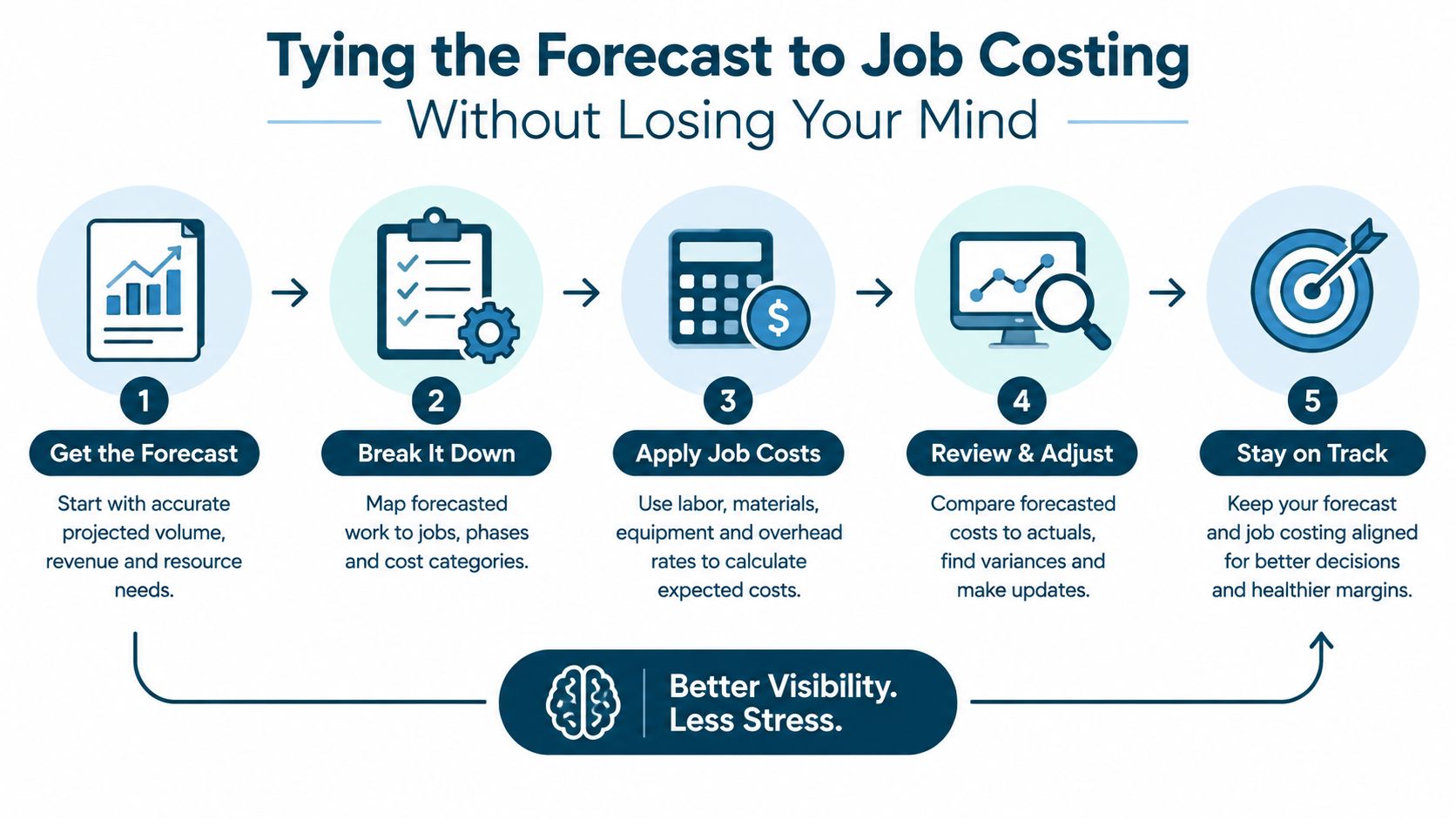
Tying the Forecast to Job Costing Without Losing Your Mind
The forecast should use the same project facts as job costing, but it shouldn't become a second accounting system. Start with the chart of accounts and cost codes already used by the company. If labor, concrete, electrical subcontractors, equipment, and general conditions are separate in job costing, keep those categories visible in the cash forecast.
Connect actuals, commitments, and timing
Each Monday, pull actual costs through the prior week and compare them with the budgeted cost-to-complete. Then add commitments that haven't reached the books yet. A signed subcontract, approved purchase order, or scheduled material delivery is a future cash need even if the invoice hasn't arrived.
The strongest early warning is often committed but unbilled cost. It tells you what cash is likely to leave before accounts payable can show it. That matters on subcontract-heavy jobs, where payment milestones may be spread across mobilization, installation, inspection, and completion.
Use a simple bridge before buying complexity
A controller can export job cost reports from QuickBooks or Sage 300 and load them into a controlled spreadsheet. The bridge works when one person owns the mapping, the file has locked formulas, and every update includes a date and explanation.
It starts breaking down when project managers keep separate commitment lists, accounting rekeys pay applications, and nobody can explain why the forecast changed. At that point, the issue isn't the spreadsheet. It's the lack of one source for cost, billing, and collection status.
For bookkeeping structure that supports this handoff, review construction bookkeeping processes.
Monday controller checklist
- Cost code match: Confirm actual costs and forecast categories use the same project coding.
- Commitment capture: Verify new subcontracts, purchase orders, and unbilled materials are included.
- Billing status: Match each expected pay application with its submission, approval, retainage, and collection date.
A Subcontract-Heavy Job Walkthrough
Consider a mixed-use general contractor managing a $4.2 million project, with 60% of the work handled by subcontractors. The schedule of values shows steady monthly billing, but the owner's payment behavior changes the cash picture. The contract calls for payment on net 30 terms, yet the owner begins paying at net 54.
That delay doesn't change the work schedule. Subs still expect progress payments, payroll still runs, and material suppliers still want payment. The project team initially used the contractual date in the forecast, so the model showed a comfortable balance.
Planned versus actual movement
| Week | Planned Inflow | Planned Outflow | Actual Inflow | Actual Outflow | Net Position |
|---|---|---|---|---|---|
| Week 1 | Scheduled owner draw | Payroll and subcontractor payments | Scheduled draw pending | Payroll and subcontractor payments | Below plan |
| Week 2 | Next progress draw | Materials and subcontractor milestone | Prior draw still pending | Materials and subcontractor milestone | Wider gap |
| Week 3 | Change order draw | Payroll and supplier payments | No owner receipt | Payroll and supplier payments | Liquidity crunch appears |
| Week 4 | Retainage-related receipt | Subcontractor and operating costs | Delayed receipt expected | Committed project costs | Funding pressure remains |
The forecast used three scenarios. The base case used the original payment terms. The downside case shifted the owner receipt to the observed net 54 behavior. The action case included a front-loaded change-order draw after approval, a negotiated subcontractor retainage release, and a materials drop timed to the next pay application.
The model showed the cash problem three weeks before payroll. That gave the GC time to pull the change-order billing forward, ask a subcontractor to release retainage tied to completed work, and avoid paying for materials long before they could be billed. The contractor bridged the timing gap without using the line of credit.
A single forecast line hides risk. A base case, downside case, and action case show which decision protects the bank balance.
The team documented each assumption, including the owner's actual payment behavior. A construction draw schedule template can help organize the planned and actual release dates, but the controller still has to replace contract dates with observed collection dates when reality keeps proving the contract optimistic.
Where Most Forecasts Quietly Fall Apart
A forecast can show a healthy margin and still leave a GC short for payroll. The failure usually starts with a convenient receipt date, an omitted obligation, or an update postponed until month-end. Payment risk has to be modeled from observed behavior, not just contract language.
Four errors that deserve an immediate challenge
- Optimistic payment dates: A planned draw can slip by two weeks because of inspection, waiver, certification, or lender review. The billing may be correct, but the bank balance still takes the hit.
- Missing retainage: Showing the full progress billing as available cash ignores the amount withheld until a completion trigger. Track the receivable and the downstream retainage obligation separately.
- Stale change-order logs: Field work may begin before the change order is approved or billed. The forecast then misses the near-term cost and the later collection opportunity.
- Lump-sum subcontract commitments: One future subcontract line hides cash leaving at mobilization, fabrication, installation, and closeout. Schedule each commitment by milestone.
A delayed draw combined with an unrecorded change order creates a cash shortfall even when the job remains profitable. The issue often surfaces at the portfolio level: one project's late receipt can collide with another job's payroll, supplier run, or subcontractor payment. Treasury needs both the job forecast and the combined company view.
Questions that expose weak inputs
Ask the controller and project team:
- Which expected receipts rely on contract terms instead of actual customer behavior?
- Which approved pay applications still lack a confirmed release date?
- Where is retainage recorded as a receivable and as an amount owed downstream?
- Which change orders were performed before approval or billing?
- Which subcontract commitments are scheduled by milestone rather than lumped into one line?
- What changed from last week's forecast, and who approved the explanation?
RICS guidance recommends comparing actual payments with forecasts and explaining the differences in a useful cash flow forecast (RICS cash flow forecasting standard). That variance review turns the file into a management control. It shows whether a cash gap came from collection timing, cost timing, missing scope, or a weak assumption that should not return next week.
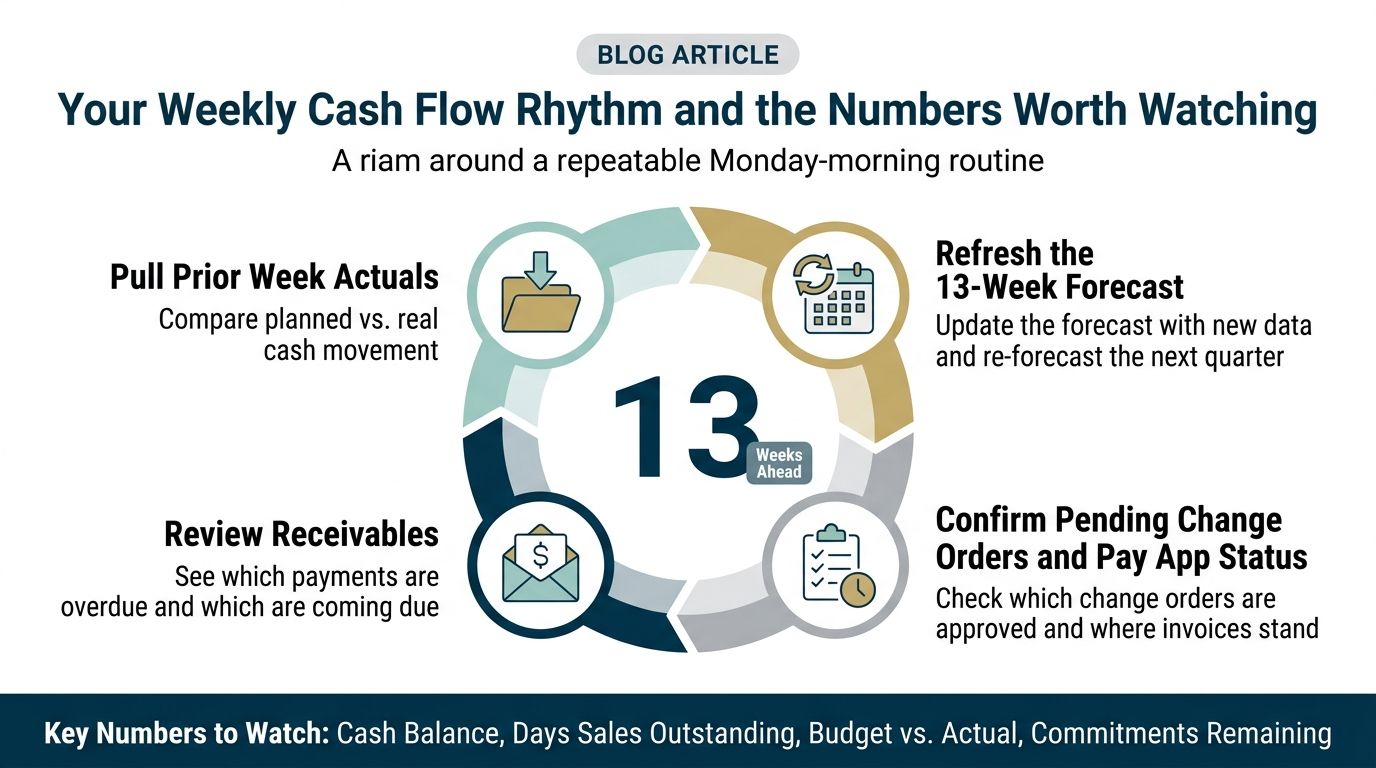
Your Weekly Cash Flow Rhythm and the Numbers Worth Watching
A reliable weekly routine matters more than a complicated model. Monday morning is a good control point because the prior week's bank activity, payroll, supplier payments, and collections are available before new disbursements go out.
The Monday routine
- Pull prior-week actuals. Compare every planned receipt and payment with what cleared.
- Refresh the 13-week view. Move the horizon forward and replace assumptions with updated dates.
- Confirm change orders and pay applications. Ask which change orders are approved, which are pending, and where each invoice sits in the review process.
- Review receivables aging. Separate current amounts from overdue balances and contact the person who controls the next release.
Watch the receivables over 60 days ratio, the balance of retainage receivable versus retainage payable, the projected bank balance at the next two pay runs, and the difference between forecast and actual collections over the last four weeks. These measures help the controller see whether the business is losing cash because of cost pressure, collection delay, or both.
One-page forecast checklist
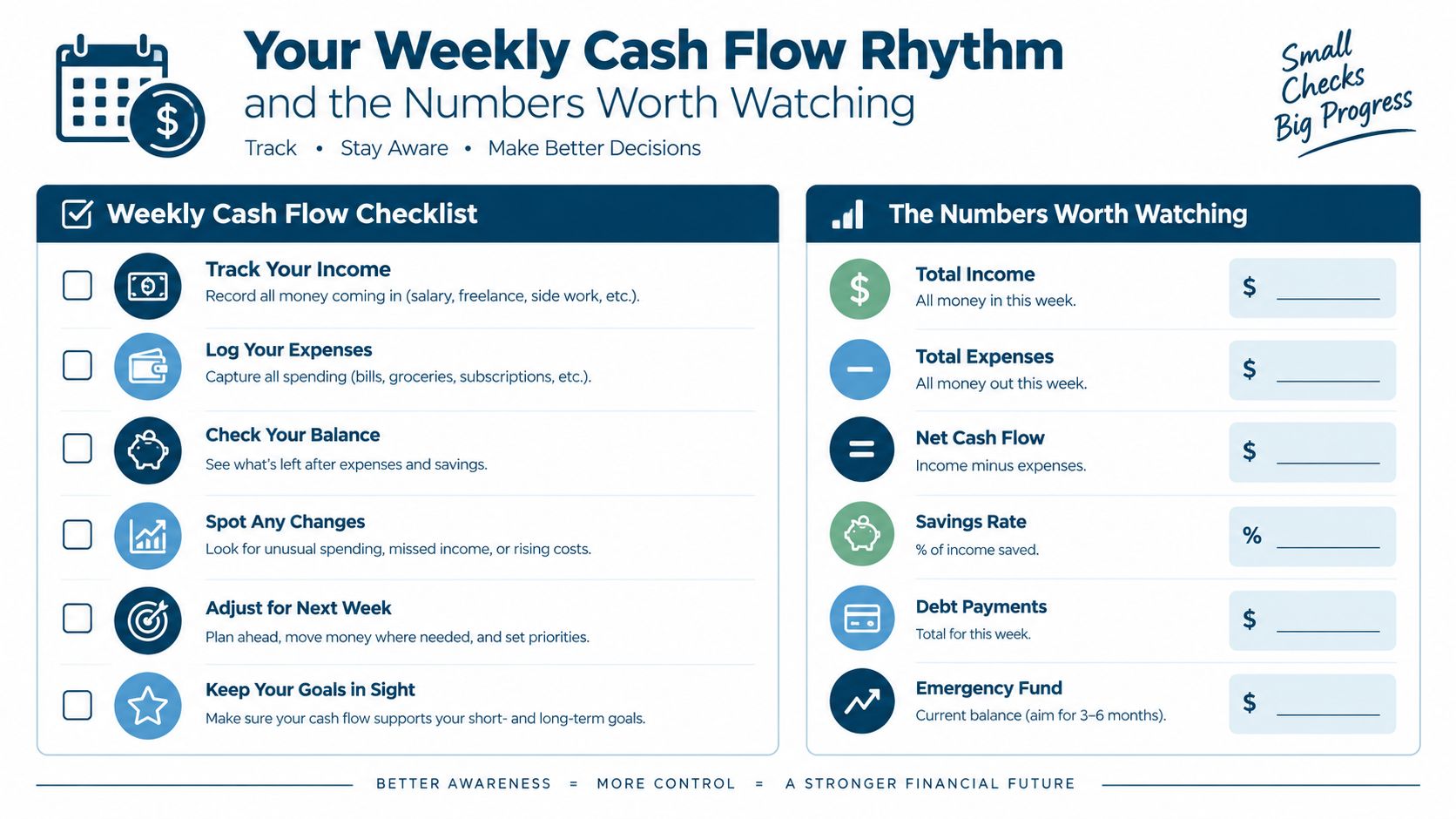
Keep the operating page short enough for a project executive to use in a meeting.
- Header data: Week ending date, prepared by, bank balance, and forecast version.
- Beginning cash: Actual available cash, excluding restricted amounts.
- Expected inflows by week: Pay applications, approved changes, retainage releases, loans, and other receipts.
- Expected outflows by week: Payroll, subcontractors, materials, equipment, debt service, taxes, insurance, and overhead.
- Ending cash: Opening cash plus expected inflows less expected outflows.
- Covenant headroom: Remaining borrowing or liquidity capacity under applicable agreements.
- Notes: Owner payment risk, missing waivers, pending approvals, major commitments, and changes from the prior forecast.
Cash flow forecasting in construction project management succeeds through repetition. The team doesn't need a beautiful model that nobody updates. It needs a clear model that reflects actual collection behavior, actual project progress, and actual obligations every week.
MyOfficeOps provides bookkeeping, accounting, payroll integration, financial analytics, and rolling 13-week cash flow forecasting that can incorporate project billings, approved payment applications, retainage, material commitments, and subcontractor payments. Visit MyOfficeOps to discuss a practical forecast and reporting process for your construction company.