

You've entered your revenue and profit into an online calculator. A business value appears on the screen, and suddenly you're thinking about retirement, a partner buyout, or the offer someone mentioned last month. Then comes the uncomfortable question: could you sell for that amount?
The Number on the Screen and What It Really Means
The number may be useful. It isn't a promise.
Suppose you own a consulting firm. You enter last year's earnings, choose an industry, and download a report. But the calculator never asks whether you personally bring in the clients, manage every project, or hold the relationships that keep customers from leaving. You've valued the business without answering what happens when you stop working there.
That's the gap between an online estimate and a sale-ready valuation. An estimate gives you a starting point. A sale-ready valuation needs evidence that another person can review, question, and connect to the business they'd buy.
Match the output to the decision
| Output | Useful for | Not enough for |
|---|---|---|
| Calculator estimate | Learning what might drive value | Setting a firm asking price |
| Documented software model | Internal planning and comparing options | Assuming a buyer will accept the result |
| Professionally reviewed valuation | Supporting a defined transaction or formal purpose | Guaranteeing a sale price or deal terms |
My advice is to decide what you'll do with the result before choosing business valuation software. Curiosity needs a different level of work than signing a buyout agreement.
Software earns its place by helping you do practical work:
- Structure the information. Put financial records, adjustments, and business risks into a consistent model.
- Test alternatives. See how different operating assumptions affect the result.
- Explain the calculation. Produce a report someone else can follow.
These are analytical tools, not substitutes for judgment. The history of company valuation methods helps explain why modern platforms combine approaches rather than rely on a single formula.
Keep valuation separate from take-home proceeds
Don't use the screen value as your retirement budget. Ask your advisers to distinguish the business valuation from the proposed deal terms and your expected proceeds.
Goodwill deserves a separate tax discussion, too. Allied Tax Advisors' guide to 2026 goodwill amortization rules is a useful resource for framing those questions, not a reason to assume the calculator has handled your tax situation.
Practical rule: Treat the first result as a question to investigate, not an amount to spend.
The Three Valuation Methods Every Owner Should Recognize
You don't need to become an appraiser. You do need to recognize what a tool is measuring, because different methods answer different questions.
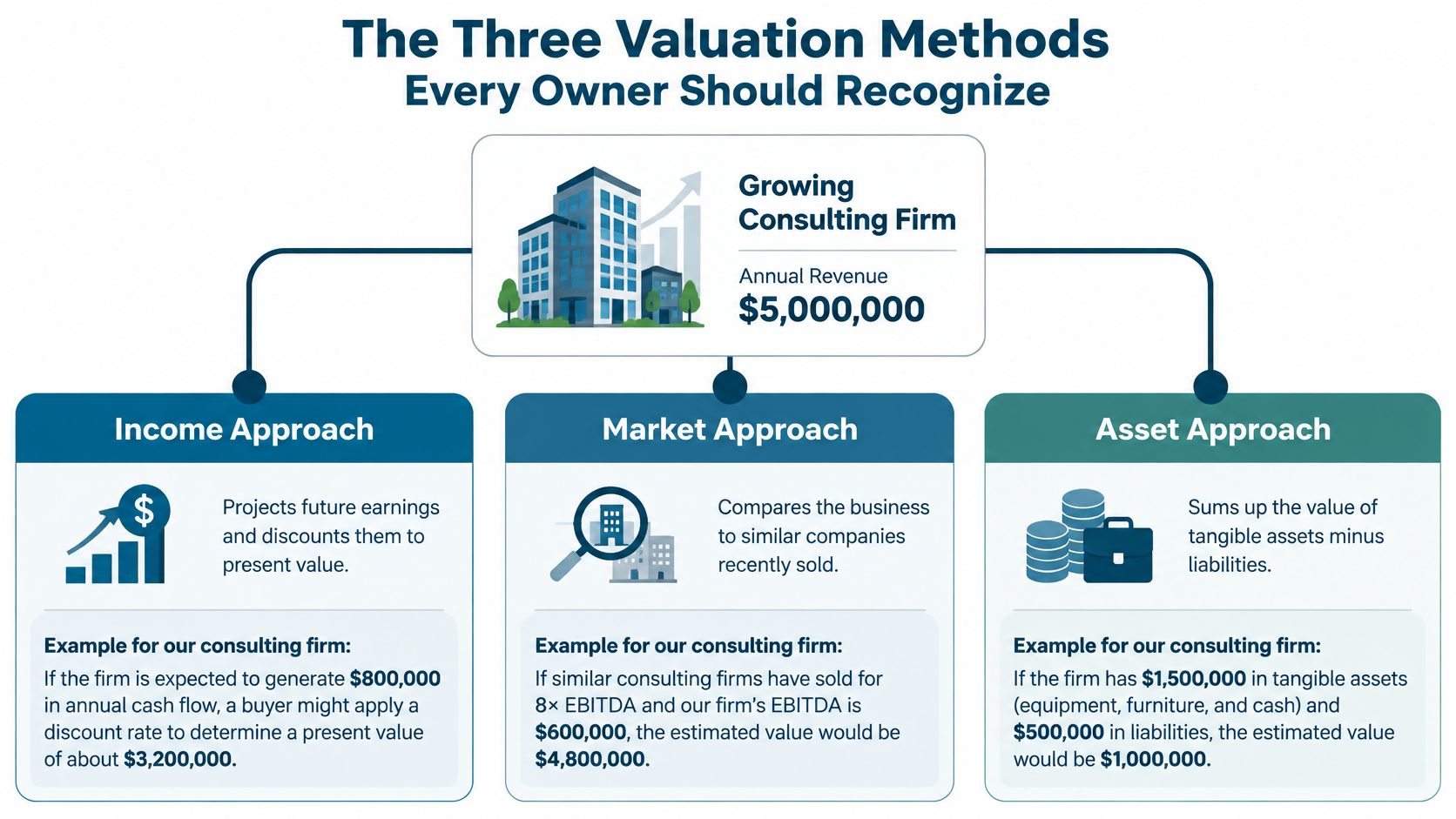
The basic approaches are income, market, and asset. The SBA's guidance on selling a business also calls attention to intangible assets, including brand, intellectual property, customer information, and expected future revenue. Don't let a tool reduce your company to equipment and cash.
Income means future earning power
Consider a growing consulting firm with ongoing client work. An income-based model asks what its expected future earnings or cash flows are worth today, after allowing for risk.
Discounted cash flow, usually called DCF, is a forecast-based version of this approach. The owner must explain why the projected work, margins, and growth are believable. A spreadsheet can calculate the answer perfectly while the forecast remains wishful thinking.
Market means relevant comparisons
A market approach looks at similar businesses and transaction evidence. For the consulting firm, the question becomes whether businesses with comparable services, customer relationships, and operating risks provide a useful guide.
SMB tools also use seller's discretionary earnings, or SDE, and EBITDA, earnings before interest, taxes, depreciation, and amortization. These are different earnings measures, so don't compare their multiples as if they're interchangeable.
For tool selection, look for SDE and EBITDA multiples for owner-operated businesses, revenue multiples where earnings are volatile, DCF for forecast-driven companies, asset-based valuation for asset-heavy firms, and comparable transactions for market validation. The MoneySoft valuation feature overview describes this multi-method toolkit.
Asset means what the business owns and owes
Think of a contractor with valuable equipment but uneven profits. An asset approach examines asset values less liabilities, giving the owner another way to check the result.
For the consulting firm, this approach may tell a less complete story if much of its earning power comes from relationships and expertise rather than physical assets. That doesn't make the method useless. It means you must understand what it captures and what it misses.
The guide to business valuation methods for small businesses offers a useful reference when comparing these approaches.
Don't insist that every method produce the same answer. Ask why they differ and which evidence deserves the most weight.
What the Software Actually Does Under the Hood
I'd group tools by the work you need them to support, not by the vendor's promise of an instant answer. The categories below are a buying framework, not a claim that every product in a category has identical features.
How Valuation Software Categories Compare
| Category | Typical user | Methods covered | Auditability | Integrations |
|---|---|---|---|---|
| Entry-level calculators | Owner exploring value | Check the formula and supported approach | Look for visible assumptions, not just a result | Confirm manual-entry and spreadsheet options |
| SMB valuation platforms | Owner and finance adviser | Look for multiple suitable methods | Require editable adjustments and supporting schedules | Check accounting imports and report exports |
| Advisory-grade systems | Valuation or transaction professional | Require methods suited to the engagement | Demand detailed workpapers and reviewable calculations | Evaluate financial imports, market datasets, and workflow connections |
An entry-level calculator can help you understand the questions. Don't buy a more complex system merely because its report looks impressive. Buy deeper capabilities when your decision requires deeper analysis.
For an SMB platform, the important work happens between importing the accounts and calculating value. The user should be able to record adjustments, explain assumptions, and preserve the connection between the original records and the finished report.
Ask the vendor to demonstrate the work
Bring a sample financial statement to the demonstration. Ask the representative to change an assumption, explain the resulting movement, and export the supporting calculations.
- Financial statements. Can you see how imported accounts map into the model?
- Market evidence. Can you inspect the source, date, and relevance of selected comparisons?
- Assumptions. Can another reviewer identify who changed an input and why?
- Reporting. Can you export the reasoning as well as the final value?
A tool that can't answer those questions is a poor fit for a consequential decision, however attractive its dashboard.
The scope must also extend beyond the latest profit figure. IRS Revenue Ruling 59-60 identifies eight areas for closely held company valuation: business history and nature; economic and industry outlook; book value and financial condition; earning capacity; dividend-paying ability; goodwill and other intangibles; prior stock sales and ownership-block size; and prices of similar publicly traded companies.
You don't need a separate screen for every consideration. You do need somewhere to document the relevant evidence.
A useful report lets a skeptical reader retrace the reasoning. A polished cover page doesn't do that.
Building Your Own Selection Scorecard
Start with the decision you're preparing to make. Then mark each criterion essential, useful, or unnecessary for this engagement. Don't award points for features you won't use.
A vendor should demonstrate essential capabilities with your workflow. A check mark on a sales page isn't enough.
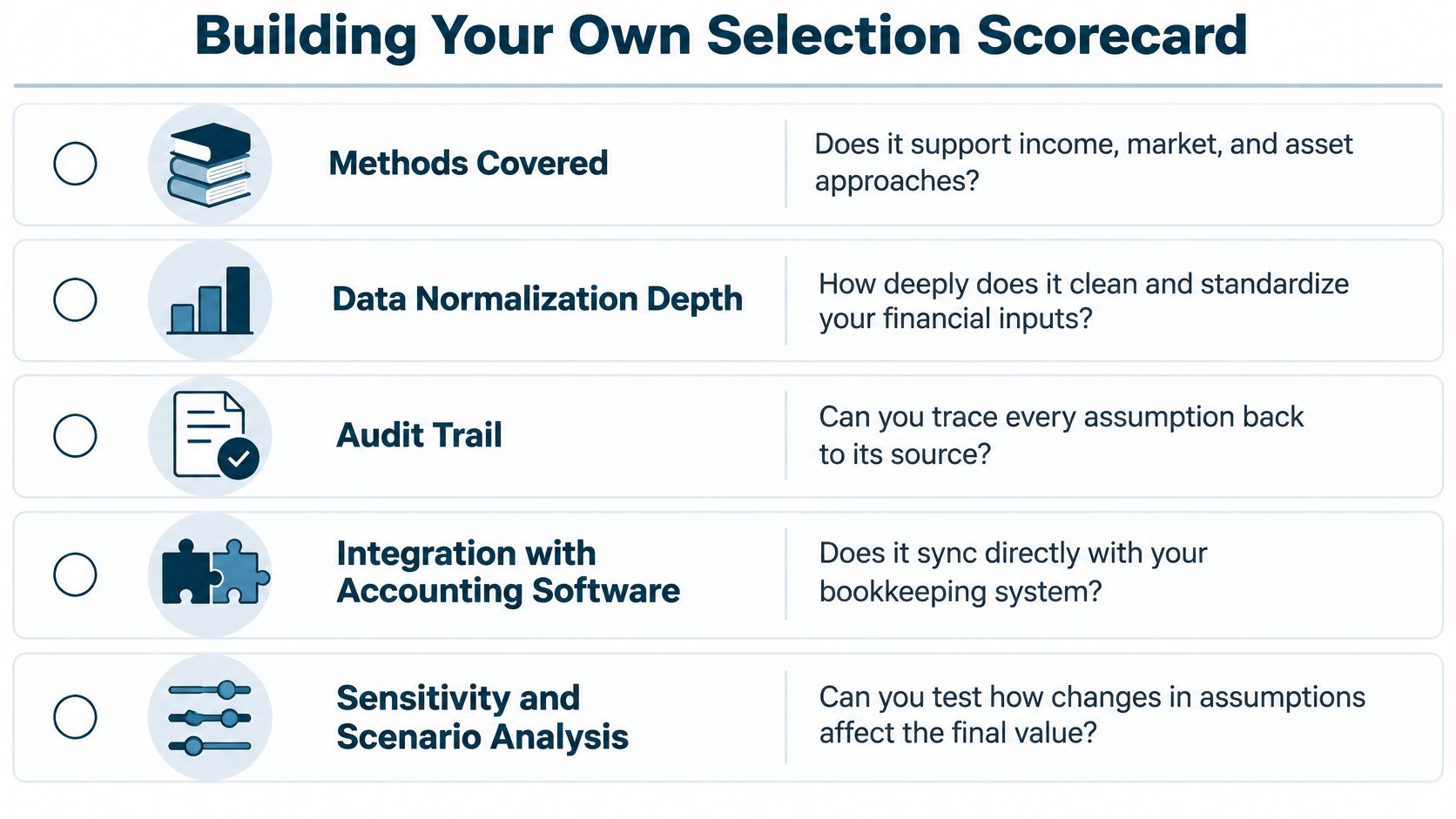
| Criterion | Evidence to request |
|---|---|
| Methods covered | A demonstration of the approaches your business needs |
| Normalization depth | Editable adjustments with explanations and supporting records |
| Audit trail | A clear path from source documents to the result |
| Accounting integration | An import demonstration using your account structure |
| Scenarios and sensitivity | Saved cases and visible effects of changing assumptions |
| Reporting quality | A sample report a buyer or adviser could review |
| Support | Clear responsibility for software questions versus valuation advice |
| Price | Total cost, including data access, exports, and additional users |
Accounting integration deserves real weight. Direct imports from accounting systems or spreadsheets can populate revenue, expenses, EBITDA, assets, liabilities, and owner compensation while reducing transcription risk, as described in this valuation software integration overview.
Still, don't let convenience outrank the purpose of the model. An easy import into an unsuitable valuation method is not a good purchase.
A professional services firm preparing for sale
Suppose an agency owner wants to prepare for a future exit. I'd mark normalization, owner-dependence analysis, saved scenarios, and report quality as essential. The owner needs to understand which earnings a buyer could retain after the founder leaves.
I'd mark acquisition financing features as unnecessary unless an acquisition is also under consideration. Between a simple platform with strong supporting schedules and a complex system built around deal financing, I'd choose the former for this job.
The deciding demonstration would be practical: can the adviser model replacement management, document the adjustment, and explain the effect without rebuilding everything outside the software?
A healthcare practice considering an acquisition
For a practice weighing an add-on acquisition, I'd place more weight on comparing the businesses, modeling financing, and separating existing performance from hoped-for improvements. The owner should be able to inspect the target's results without mixing them with an optimistic combined forecast.
Here, a deeper advisory system may justify its complexity. But I'd reject it if the team can't explain where each assumption came from.
Legal review is a separate selection issue. If a transaction involves Connecticut ownership or business interests, Kons Law's Connecticut business valuation counsel offers a relevant starting point for discussing the legal questions alongside the financial work.
The winning tool is the one that supports your decision, not the one with the longest feature list.
Why a Pretty Number Can Be a Dangerous Number
My view is straightforward: a polished estimate built on messy books can be more dangerous than an openly rough estimate. The presentation encourages confidence that the underlying records haven't earned.
An article on business-sale readiness reports that 15% of owners have obtained a professional valuation, 53% rely on a rough estimate, and 33% have no idea what their business is worth, according to the reported owner valuation findings. Getting a number is not the same as resolving uncertainty.

Validate what a buyer would question
Before relying on the output, ask your accountant or adviser to work through the inputs that require judgment.
- Owner compensation. Identify the work you perform and support the cost of replacing it. Do not add back your pay.
- Related-party expenses. Review rent and other arrangements involving owners or family members. Document the basis for any change.
- Unusual items. Explain why an expense or receipt should be treated as nonrecurring. Calling it unusual doesn't make it disappear.
- Customer concentration. Identify dependence on major customers and explain what evidence supports continued revenue.
- Working capital. Review receivables, inventory where relevant, and payment timing rather than treating reported profit as available cash.
- Comparable data. Confirm that transaction dates, business characteristics, and earnings definitions fit the comparison.
Consider an owner who calls a large expense a one-time cost. Before accepting the adjustment, I'd ask whether a buyer will face another version of that expense after taking over. The answer matters more than the label in the accounting system.
Define decision-grade before sharing the report
For me, decision-grade means the evidence is strong enough for the specific choice at hand. It doesn't mean the estimate is certain, and it doesn't mean every recipient must accept it.
Before sending the report to a lender, buyer, or partner, reconcile the inputs to financial records, resolve unexplained differences, and attach support for adjustments. Use a business valuation report template to organize the purpose, evidence, assumptions, and limitations.
Before you share: Be ready to explain the adjustment you most want the other person to accept.
Negotiation preparation matters, but don't confuse it with valuation evidence. Lein Law Offices' fair settlement negotiation tips concern discrimination mediation, not business sales. They're an adjacent resource for thinking about settlement discussions, not support for a business asking price.
A Practical Cadence for Refreshing the Number
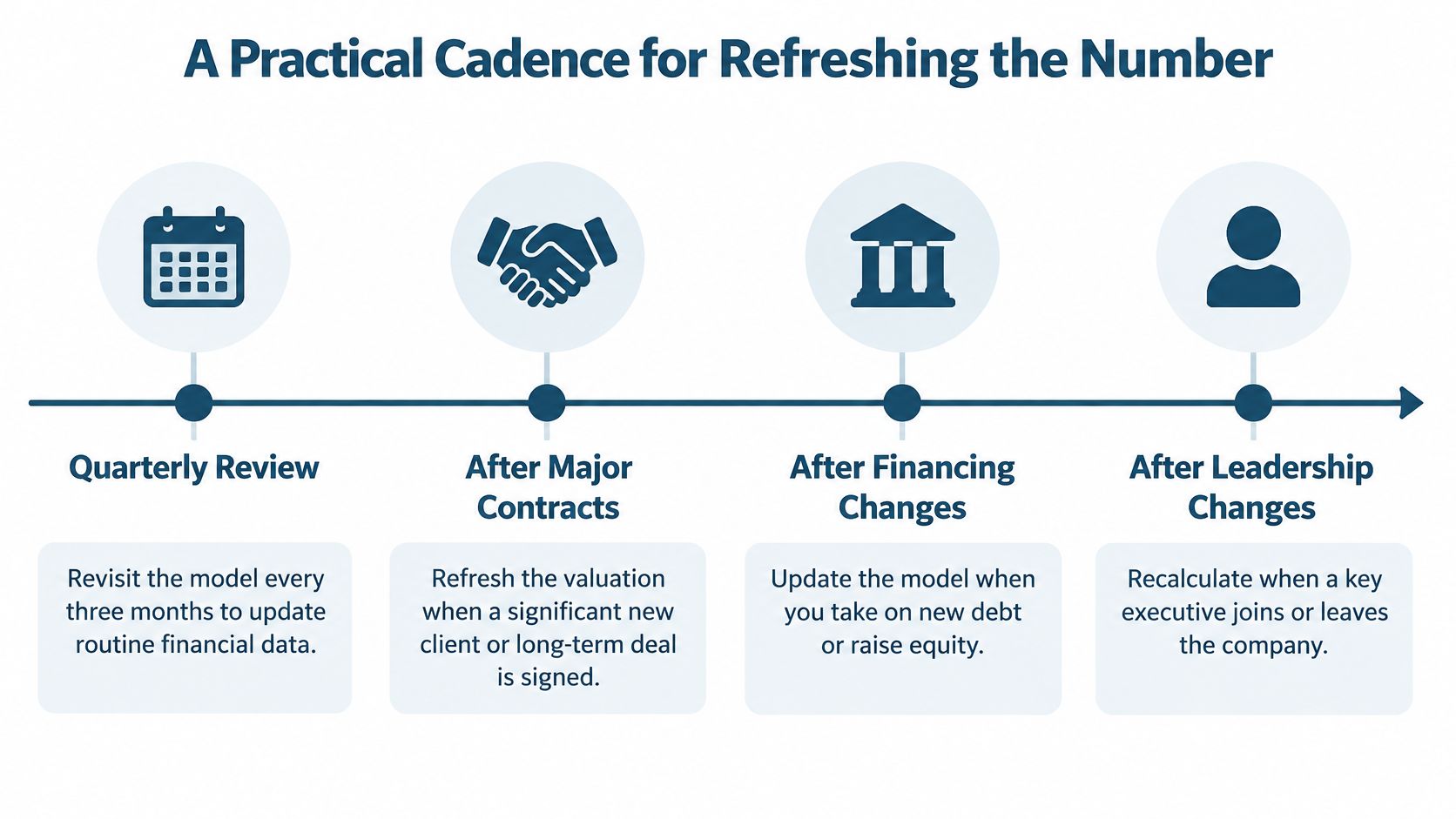
I recommend a quarterly planning review, plus updates after major changes. That's a management habit, not a requirement to commission a formal appraisal whenever you close the books.
Operating conditions deserve attention. The Federal Reserve's 2025 survey of business resource organizations references U.S. Chamber findings that 35% of small businesses cited revenue as a challenge in early 2025, the highest level since the measure began in 2021. Strong historical earnings alone won't answer questions about weaker expected cash flow.
Make the review part of financial management
Begin with closed, reconciled accounts. Compare actual performance with the previous forecast, then investigate the differences before changing the valuation model.
Review recurring revenue, gross margin, customer concentration, backlog quality, owner dependence, and debt service. Assign someone to explain meaningful changes. Don't accept a revised forecast just because the spreadsheet still balances.
Keep the previous model and its assumptions. You want to distinguish a change in business performance from a change in how you're measuring it.
Update after events that change the outlook
- Major contracts. Revisit expected revenue, staffing needs, margins, and customer dependence after winning or losing important work.
- Financing changes. Update debt obligations and cash requirements when borrowing arrangements or ownership funding change.
- Leadership changes. Reassess continuity and replacement costs when an owner steps back or a key manager joins or leaves.
Then save distinct cases rather than overwriting the model with whichever forecast feels most comfortable.
| Case | What to include | Decision it supports |
|---|---|---|
| Base | Results you can support with current evidence | Operating plans |
| Downside | Plausible pressure on revenue, collections, or margins | Cash protection and contingency planning |
| Sale preparation | Specific improvements with named responsibilities | Exit-readiness priorities |
The sale-preparation case shouldn't contain unsupported optimism. If you expect less owner dependence, name who will take over the work and what must happen first.
Finish each review with an action list. A valuation range is more useful when it tells you to improve collections, document delivery processes, or reduce reliance on a customer. Otherwise, you're just refreshing a number.
When to Trust the Tool, When to Call an Advisor, and When You Need Both
Use software alone for learning and internal planning. It can help you explore pricing strategy, compare operating choices, and understand likely value drivers. Label the output as a planning estimate and keep it away from binding commitments.
Bring in an adviser before someone else must rely on it. Lender preparation, partner buyouts, and pre-sale positioning deserve review of the records, adjustments, and intended use. The deliverable should include a supported range and unresolved questions, not just approval of the screen value.
When a formal engagement belongs in the plan
For tax, litigation, and formal M&A decisions, my recommendation is to engage a credentialed valuation professional and have counsel confirm the requirements. Don't assume every transaction has the same legal mandate.
The AICPA's Statement on Standards for Valuation Services distinguishes engagements producing a conclusion of value from those producing a calculated value. Software doesn't turn a limited calculation into a full valuation engagement.
Questions owners ask next
- Can free software replace an appraisal? No. It can help you prepare better questions, but it doesn't replace an engagement suited to a formal purpose.
- Should I buy software before hiring help? Not necessarily. Ask whether your adviser already has an appropriate system and what you'll receive.
- How much should I budget? Define the purpose and scope first. This guide to business valuation cost can help you frame that discussion.
My recommendation is to use software to organize the analysis and professionals to challenge the judgments when the stakes warrant it. The right next step depends less on how impressive the number looks than on what you're about to do with it.
MyOfficeOps offers bookkeeping, financial analytics, business valuation, and CFO-level advisory to help owners connect clean financial records with sale preparation. Visit MyOfficeOps to discuss your decision, identify gaps in the numbers, and build a practical plan for a valuation you can explain.