
CFO services give you part-time or outsourced access to a chief financial officer's work, going beyond bookkeeping into forecasting, cash-flow planning, and decisions about pricing, hiring, and growth. Most small businesses use this help part-time instead of hiring a full-time executive.
You're busy. Work is coming in. Then payroll hits and the bank account looks thin. If that sounds familiar, you're not alone, and you don't need more jargon. You need someone who can look at your numbers and tell you, in plain words, what to do next.
What CFO Services Actually Mean
You open your monthly report. It says you made a profit. Then you check your bank account and think, where is it? That gap confuses a lot of owners.
Profit is not the same as cash in the bank. A client may owe you money but hasn't paid yet. Payroll, rent, and materials may be due before that check arrives. Your books can look fine while your cash feels tight.
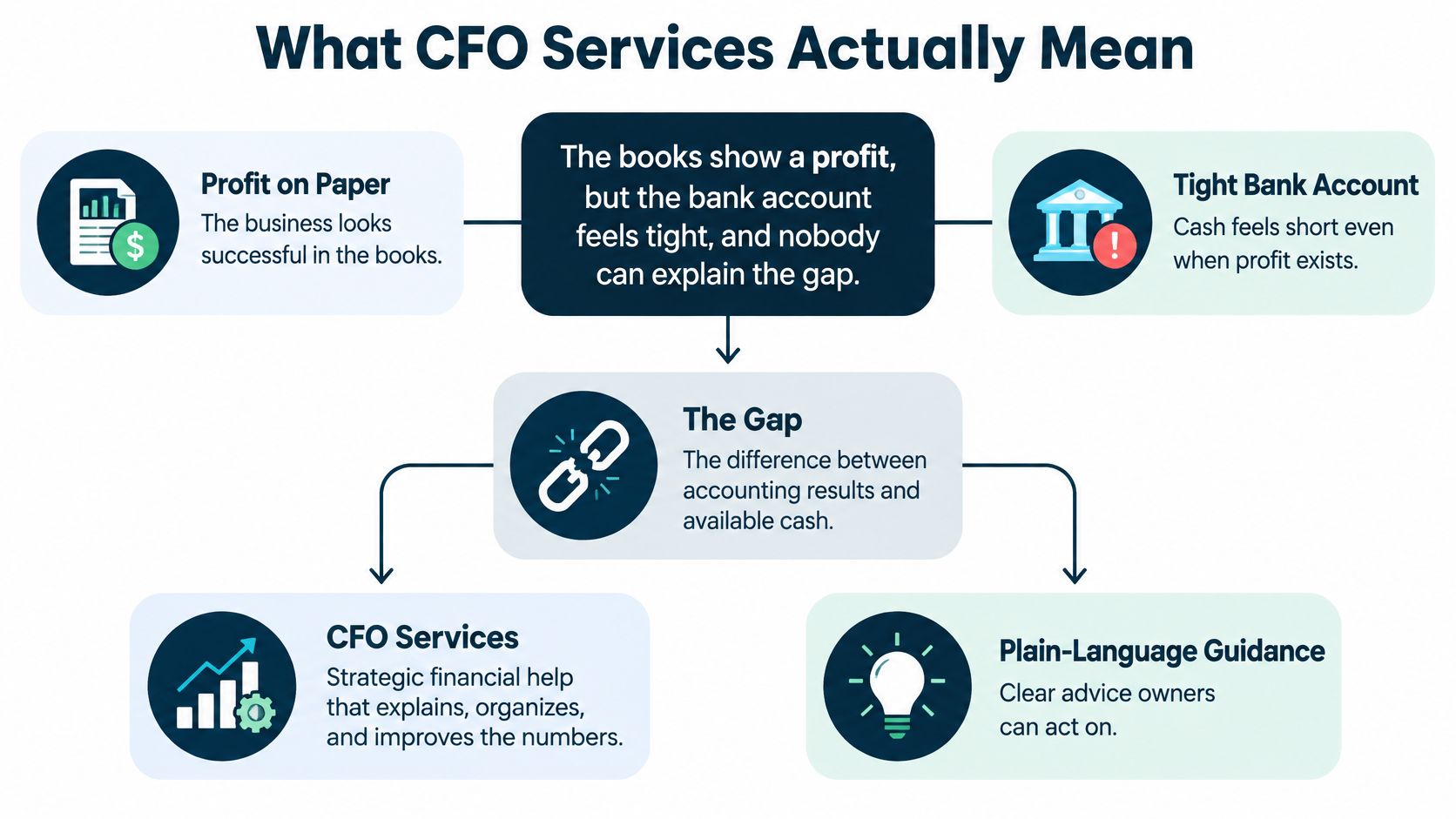
That's where What Is CFO Services becomes a practical question, not a title question. Bookkeeping keeps your records straight. It logs what came in and what went out. CFO services take those records and help you decide what's next.
Records tell you the past. A CFO helps with the next move
Say you're a contractor. You've won three jobs. That's good news. But you'll pay your crew and buy materials weeks before the customer pays you in full. A CFO helps you see that timing problem early, so you can plan billing, deposits, and spending before cash gets tight.
Or say you run a clinic. You're full of patients, but payments come in slowly and payroll never waits. A CFO connects those dots. You'll see which services make money, where cash gets stuck, and whether you can afford that next hire.
Think of bookkeeping as taking a clear photo of where you've been. CFO work uses that photo, plus what's ahead, to help you steer.
The CFO job has also grown bigger in large companies, which helps explain why smaller firms now want the same kind of help. McKinsey reported that functional areas reporting to CFOs rose from 4.5 in 2016 to 6.2 by 2018, a rise of roughly 38%, while the share responsible for board-engagement work rose from 24% to 42%. In plain terms, finance leaders now do more than count. They help run the business.
You probably don't need that person full-time. You may need them a few hours a week, or for a monthly review and big decisions. If you want a clear explainer on the part-time model, Capstacker's guide to fractional CFOs lays out how that setup works.
So when you buy CFO services, you're not buying a thicker report. You're buying clearer decisions. Can we hire? Should we raise prices? Will cash hold up if a big client pays late? Those are CFO questions.
The Core Jobs a CFO Handles
A rearview mirror helps you drive, but you wouldn't drive looking only at it. Your past reports work the same way. A CFO uses them, then looks through the windshield.
Looking ahead with a forecast and a budget
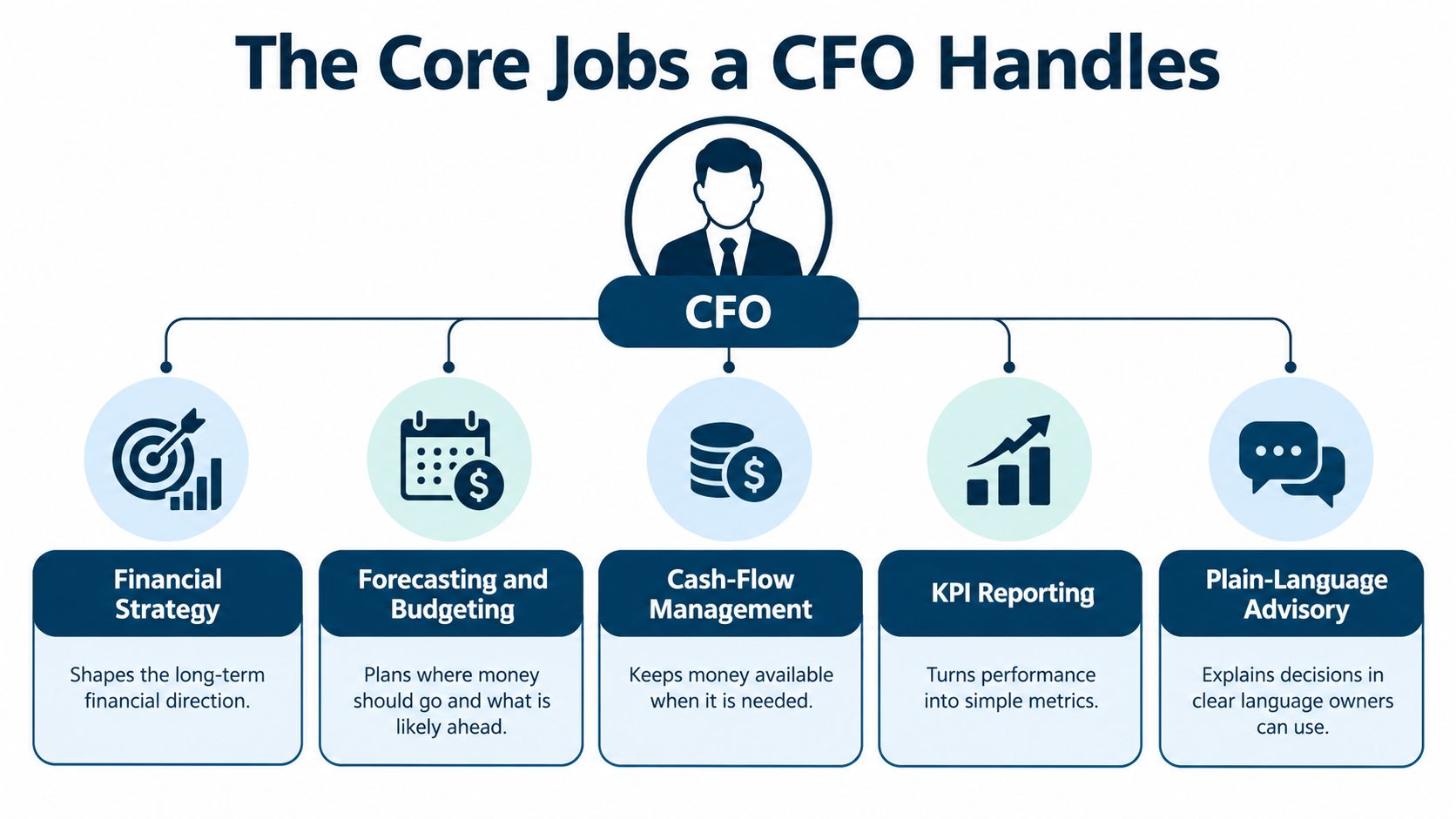
A budget is your plan for where money should go. A forecast is your best guess at what will really happen, based on what you know today. Good CFO work keeps both, and updates the forecast when things change.
Here's a simple way to picture it. Your current path, if nothing changes, is one view. Your formal plan, with a new hire or a price change, is another. A CFO compares the two and asks, what breaks, what improves, and when does cash feel it?
Say an agency wants to hire two people. The CFO doesn't just add two salaries. They check when new client work will start, when invoices will be paid, and how full the team is now. That turns a gut call into a timed plan.
Watching cash and a few key numbers
Cash work links your sales, your bills, and your bank balance. If sales rise but clients pay slowly, cash can still fall. If you buy equipment, profit may look okay while cash drops fast. A CFO shows you that link before you commit.
Then they pick a few key numbers you'll use. Not twenty charts. Just the ones that fit how you make money.
- Contractor example: Gross margin by job, backlog, and how many days clients take to pay
- Clinic example: Revenue by service, payroll timing, and slow-paying claims
- Agency example: How busy billable staff are, average revenue per client, and client concentration
Each month, you compare what happened with what you expected. If there's a gap, the CFO helps find the underlying cause. Was it pricing, slow collections, extra labor, or a job that ran long? The number alone doesn't fix anything. The cause points to the fix.
Keeping the numbers trustworthy
There's also a guardrail job. The SEC says the CFO has ultimate responsibility for financial reporting and for making sure internal controls work. For a small business, that means simple rules. The person who approves a vendor bill shouldn't be the only person who pays it. Bank accounts get reconciled. Odd expenses get a second look.
That may sound dull. It matters when a bank asks for clean reports, when taxes are due, or when a buyer wants proof your numbers are real. Good controls make your business easier to trust.
Put together, the monthly rhythm is simple. Close the books. Update the forecast. Review cash and key numbers. Pick actions, assign owners, and check them next month. That's advisory you can feel, not just a report you file away.
Why Cash Flow Is the Real Test
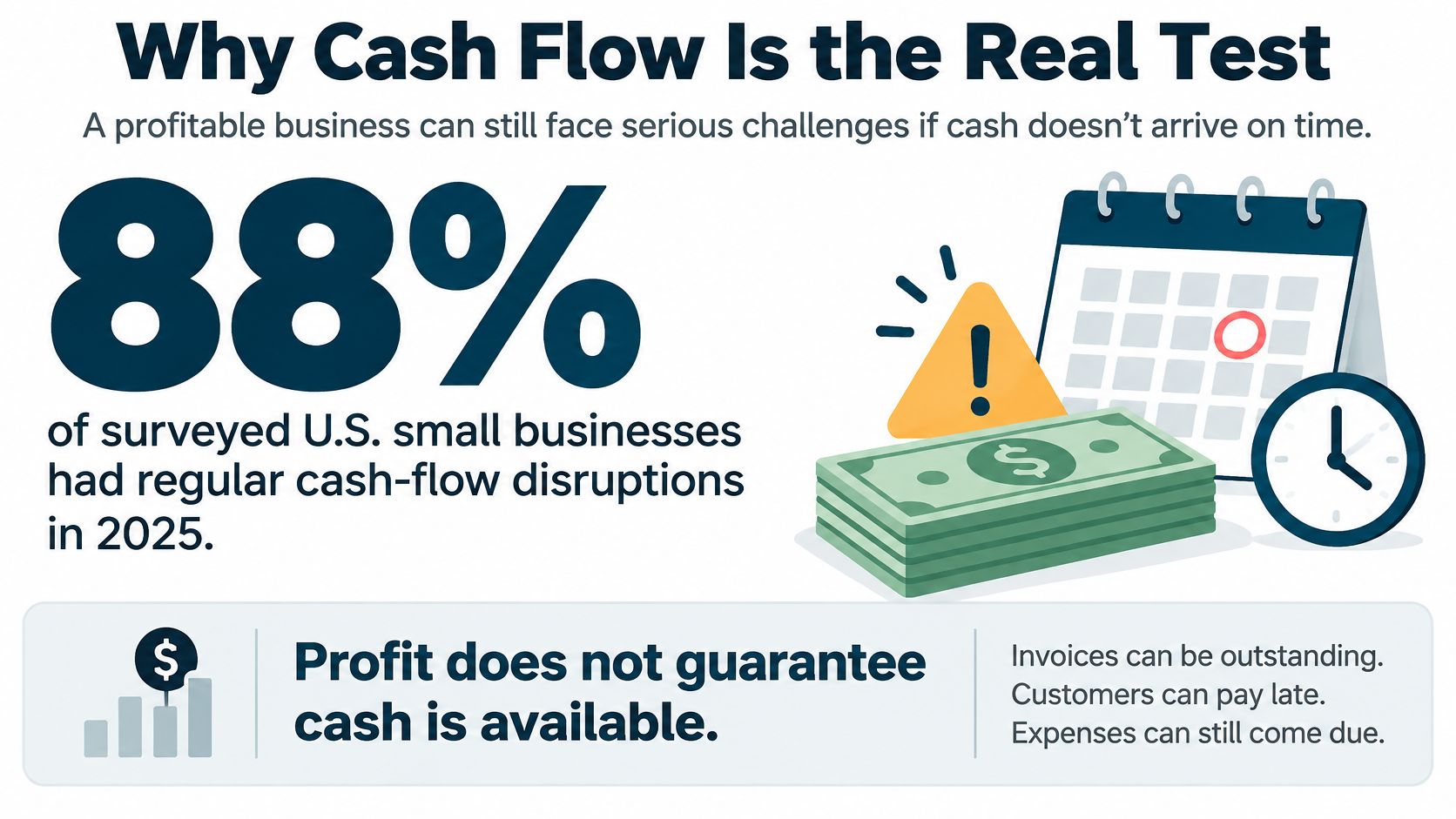
You can be profitable and still miss payroll. That sentence scares owners because they've lived it. Work is done, invoices are out, but the money hasn't landed yet.
The data backs up how common this is. 88% of surveyed U.S. small businesses had regular cash-flow disruptions in 2025, yet only 31% actively worked to improve cash flow, and only 38% of leaders had real-time visibility into their cash position. Many owners don't see the pinch until it's already here.
The fix is often timing, not more borrowing
When cash is tight, the first thought is often a loan or a credit line. Sometimes that's right. Often, the earlier problem is visibility. You didn't see the slow payer, the big tax payment, and the new hire all landing in the same two weeks.
Practical rule: If you can't see the next few weeks of cash in and cash out, you're guessing, even if last month looked profitable.
A CFO builds a 13-week cash forecast. That's just a week-by-week view of money expected in and money due out for the next quarter. It starts with cash that matches the bank. Then it adds likely receipts, payroll, rent, taxes, loan payments, and planned buys.
It also gets honest about who pays late. If one client always pays in 60 days, the plan shouldn't pretend they'll pay in 30. That honesty is what makes the forecast useful.
What happens in a tight week
Say the forecast shows week six will be thin. You now have lead time. You can bill a finished phase sooner. You can call on an old invoice this week, not next month. You can ask a vendor for a few more days, delay a non-urgent buy, or pause a hire until a deposit clears.
A CFO also runs a downside view. What if a project slips? What if your biggest client pays late or leaves? You're not being negative. You're deciding in advance what you'll do first, so you don't panic later.
This is why a clear guide to why cash-flow forecasting matters is worth reading alongside this topic. The habit matters more than fancy software. Update the view, compare it with what really happened, and learn why it was off.
- Each week: Check receipts due, bills due, and any surprise that changes the next two weeks
- Each month: Refresh the full forecast, review slow payers, and reset actions with owners and dates
For contractors, clinics, and service firms, this work hits home fast. Payroll is fixed. Payment timing isn't. CFO services earn their keep when they give you weeks of warning instead of a Friday surprise.
How CFO Services Are Priced and Delivered
There's no single price for CFO help, and anyone who quotes without asking about your books is skipping a step. Cost depends on how big and complex your business is, how many entities you have, how clean your records are, and how hands-on you want the person to be.
What you can compare is the shape of the work. Most offers fall into three buckets.
Common CFO Services Engagement Models
| Model | Typical Scope | Delivery Rhythm | Best For |
|---|---|---|---|
| Project work | Build a forecast, review pricing, prep for a loan or sale | Set start and end, with working sessions | One clear problem or deadline |
| Fractional retainer | Ongoing forecast, cash review, key numbers, decision support | Monthly close review and standing call | Owners who want steady guidance |
| Full-time CFO | Daily finance leadership and team management | Full-time, in-house | Larger firms with daily complexity |
Project work fits a sharp need. You need a cash forecast built. You're buying equipment and want the numbers tested. You're getting ready to sell and need your reports cleaned up. Once the job is done, the work ends.
A fractional retainer fits most small and midsize firms. You get a set rhythm. Books close, numbers get reviewed, the forecast updates, and you leave a call with decisions and next steps. You're not paying for a full-time salary. You're paying for senior thinking on a steady cadence.
A full-time hire makes sense when finance decisions happen daily and you need someone in the room all the time. Many firms aren't there yet. Hiring too early can leave you paying executive cost for work that's still mostly monthly.
How to compare two proposals
Don't compare hourly rate alone. Ask what you'll get, how often, and what decisions it will support.
- Deliverables: Will you get a cash forecast, a budget, and a short list of key numbers you understand?
- Rhythm: Is there a monthly meeting where you review results and pick actions?
- Cleanup: If your books are messy, is fixing them included or priced apart?
- Access: Can you call before a big hire or purchase, or only at month end?
If cost is your main blocker, this breakdown of fractional CFO cost can help you frame the choice. The right question isn't just what it costs. It's what a bad hire, a cash crunch, or a mispriced job would cost you.
Real advisory leaves you with actions, owners, and dates. A fancier report leaves you with a PDF. Pay for the first one.
When Your Business Is Ready for CFO Help
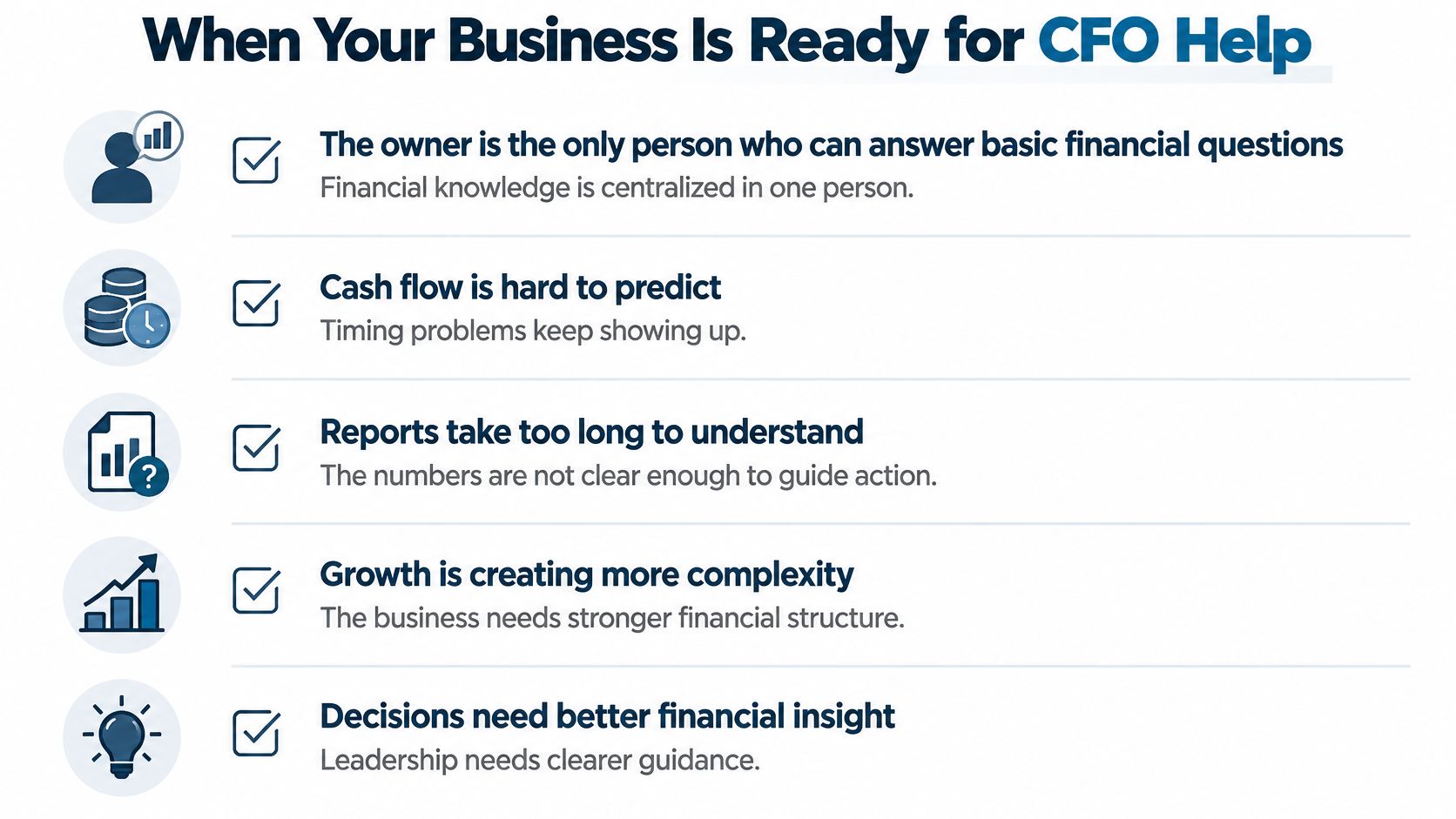
You don't need CFO help because you hit a magic size. You need it when your old way of deciding starts to strain. The signs are usually plain once you name them.
You're the only one who can answer basic money questions. Hiring and equipment calls rest on gut feel. The bank balance surprises you. A lender, partner, or buyer asks for numbers and it takes weeks to pull them together.
A simple readiness check
Start with the base. Are your books current and reconciled? Is payroll tied in cleanly? Can you trust your profit report by the middle of the next month? If not, that's step one. A CFO can't steer with a blurry map.
Next, can you see how you really make money? Useful owner numbers include gross margin by service line, backlog, client concentration, labor burden, and how long cash stays tied up before you collect it. If you can't see those, growth can hide weak spots.
Owners know they need better insight. Nearly 70% of small businesses said they prioritize financial advice and data to support growth over the next five years, while 48% planned to adopt new financial-management tools in 2025. Tools help, but tools alone aren't advice.
Software can give you faster reports. It won't tell you whether to hire, raise prices, or walk away from a low-margin client.
What this looks like in real firms
A contractor hits this point when jobs overlap and no one can say which jobs made money after labor and change orders. A clinic hits it when patient volume rises but cash still swings because payments arrive unevenly. An agency hits it when the team feels maxed out, yet profit stays flat and one client carries too much of the revenue.
Different trades, same root issue. Decisions got bigger, but the financial view stayed small.
If you checked two or three signs above, you're likely ready for at least a project or a light monthly rhythm. Start where the pain is. Clean books first, then a cash view, then the few numbers that drive profit in your kind of work. You don't have to fix everything at once.
Choosing Between a Bookkeeper, an Accountant, and a CFO
These labels get mixed up, and providers don't always use them the same way. The easiest way to choose is to ask what problem you're trying to solve, then match the person to that job.
A bookkeeper keeps daily records accurate. Invoices, bills, payroll entries, and bank reconciliations stay current. If your records are behind or messy, start here. It helps to know what a bookkeeper does for a small business day to day before you shop for higher-level help.
An accountant focuses more on reporting rules, compliance, and tax. They help you file correctly and keep statements in proper form. If your main worry is tax deadlines or clean year-end reporting, that's their lane.
Who do you call for which problem
- Cash will be tight next month: CFO help, to forecast timing and act early
- Books are three months behind: Bookkeeper first, to get records current
- Tax filing or compliance worry: Accountant, to keep filings correct
- Pricing, hiring, loan, or sale decision: CFO help, to test the numbers before you decide
A fractional CFO sits on top of clean records. They don't replace bookkeeping. They use it. If someone tries to sell you CFO advice while your books are a mess, ask how they'll fix the base first.
Some owners prefer one firm that handles all three layers, so nothing gets lost in handoffs. MyOfficeOps is one example of that bundled model. Based in West Chester, PA and serving Greater Philadelphia, it works in three tiers, Core Accounting, Profit Optimization, and Exit Strategy, with an engagement path of Discovery Call, Custom Plan, Smooth Onboarding, and ongoing Growth Partnership.
That kind of setup can fit if you want bookkeeping, payroll integration, reporting, and CFO-level guidance under one roof. It won't fit everyone. You may already love your tax accountant and only need fractional CFO time. That's fine too.
Choose based on the gap you feel each week. If you can't trust the records, fix records. If you trust the records but still can't decide, you need CFO thinking. The title matters less than whether the work matches your problem.
Your First Steps Toward CFO-Level Clarity
You don't need a full-time executive to think clearly about money. You need clean numbers, a forward view of cash, and a monthly habit of acting on what you see.
- Get current: Reconcile your books and close last month
- Pick your drivers: Choose three or four numbers that show how you make money
- Build the cash view: Map the next 13 weeks, week by week
- Set the rhythm: Review monthly, assign actions, and document improvements
Write improvements down as you make them. A lender or buyer later will want proof, not just your word. Start small this month, and let each review make the next decision easier.
If your profit report and your bank balance keep telling different stories, MyOfficeOps can help you build clean books, a clear cash view, and CFO-level guidance for pricing, hiring, and growth. Book a discovery call to see what your numbers are already saying, and start by visiting MyOfficeOps.