
You can have a full pipeline, healthy margins, and plenty of money “on the way,” then still discover that Friday payroll won't clear. That's the part many owners miss. Profit tells you whether the business earned money. Liquidity tells you whether the money arrived before the bills were due.
A rolling cash forecast puts those dates on one page. It helps you decide whether to chase an invoice today, delay a hire, move a purchase, or arrange financing while you still have choices. For a small business with limited cash reserves, that visibility isn't a finance exercise. It's operating control.
The Moment a Profitable Business Almost Did Not Make Payroll
A 14-person professional services firm had a strong quarter. Sales were moving, margins looked healthy, and the backlog kept growing. The owner still opened the bank account on a Wednesday and saw a problem: Friday payroll couldn't clear without using a personal credit card.
The business wasn't unprofitable. Its cash was trapped in accounts receivable. Several invoices wouldn't be collected for another 45 days, a tax payment was due Friday, and nobody had mapped those dates against payroll, rent, and vendor payments. The owner knew the company was doing well. The bank balance told a different story.
That gap between profitability and liquidity is where otherwise healthy companies get hurt. A JPMorgan Chase Institute analysis of 600,000 small and midsize businesses found a median cash runway of 27 days. Restaurants had a median runway of 16 days, while real estate firms had 47 days. If collections slow or expenses jump, many owners have only a few weeks to respond.

The fix isn't checking the bank balance more often. A bank balance shows what happened up to today. It doesn't show the collision coming next Friday.
A cash flow forecast lays out expected collections and payments week by week. It would have shown the professional services owner that receivables were late, taxes were landing, and payroll was exposed. The owner could have chased the largest invoice, delayed a discretionary purchase, or lined up a credit facility before the emergency. Keeping payroll records accurate also matters, so make payroll reconciliation part of the same cash-control routine.
What Cash Flow Forecasting Actually Means in Plain English
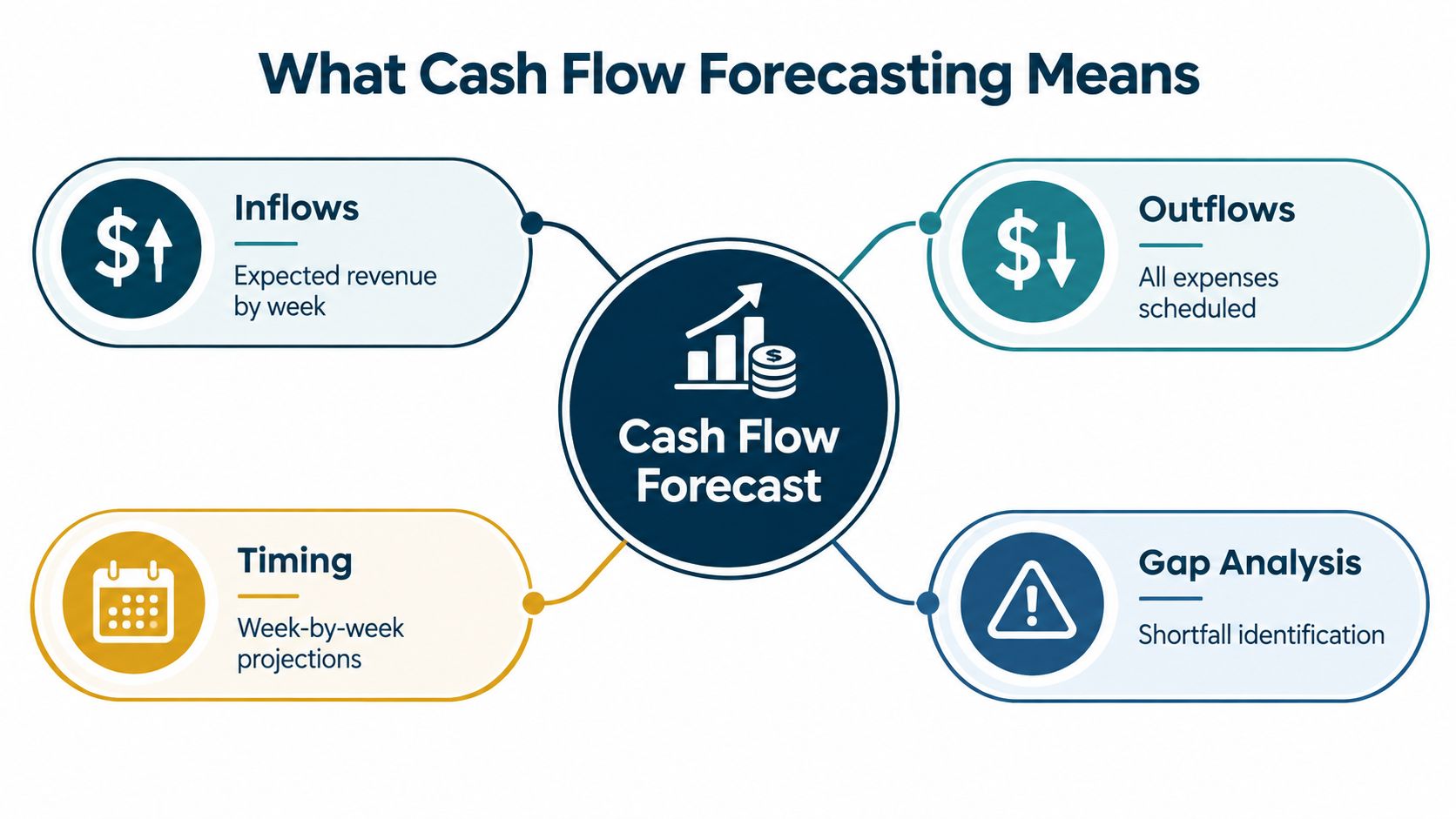
Cash flow forecasting is a forward-looking calendar of money. You list what you expect to collect, what you expect to pay, and the week each transaction should hit the bank. Then you calculate the cash balance you're likely to have after those movements.
It works the same way as checking the weather before a weekend trip. You're not claiming to know every raindrop. You're checking whether you need a rain jacket. A forecast gives you enough warning to make a sensible move before the conditions change.
Owners often confuse four different finance tools:
- Revenue forecast: This estimates sales. It doesn't tell you when customers will pay.
- Profit and loss statement: This reports accounting income and expenses. It doesn't always match the cash in your bank.
- Bookkeeping: This records transactions that already happened. It gives you history, not a clear view of next week.
- Cash flow forecast: This estimates future cash receipts and payments by date, then shows whether the balance stays workable.
The practical backbone is a rolling 13-week forecast. It gives you a 90-day view of weekly cash changes, long enough to spot payroll, tax, supplier, and equipment cliffs while staying close enough to actual transactions to remain useful. Each week, you replace estimates with actual results and add a new future week.
Your working definition should be simple: cash flow forecasting is a weekly decision calendar that shows when cash enters, when cash leaves, and where the gap appears before it becomes a crisis. For help building the broader plan around that forecast, these small business budgeting tips provide a useful starting point.
Five Real Benefits Owners Get From Forecasting
A forecast earns its place when it changes what you do. It should tell you which lever to pull this week, not merely produce another report.
Solvency
A contractor may have signed work and strong margins but still face a six-week gap between completing labor and collecting from the general contractor. A 13-week view shows the exact week payroll and supplier bills exceed available cash. That gives the owner time to request a draw, use an existing line of credit, or negotiate payment terms instead of taking whatever expensive financing is available during a crisis.
Planning
A healthcare clinic might want to buy equipment, but the purchase date matters more than the purchase itself. If insurance reimbursements are expected later than payroll and rent, the owner can move the purchase to a safer week. Forecasting turns “Can we afford this?” into “Can we afford this on that date?”
Hiring
A consulting firm may have enough booked work to justify another employee. The forecast can still show that the next few weeks are tight because clients haven't paid yet. Delaying the start date by three weeks may protect cash without killing the hiring plan. That's a better decision than hiring now and scrambling for payroll later.
Pricing
A service business that repeatedly waits on late-paying clients has a pricing problem as well as a collections problem. The forecast makes the pattern visible. The owner can require a deposit, shorten payment terms, or change the retainer structure so the business isn't financing every customer's project.
Funding readiness
Lenders and investors want more than a tax return. They want to understand how the business manages future obligations. A manufacturer that brings a maintained 13-week forecast can explain expected receipts, payroll, materials, debt payments, and its response to a downside case. That preparation makes the financing conversation more concrete. If you need to start a lender or advisory conversation, you can submit an inquiry with the relevant financial information ready.
| Benefit | Decision It Changes | Example Scenario |
|---|---|---|
| Solvency | Whether to arrange financing early | A contractor sees a receivables gap before payroll |
| Planning | When to approve a purchase | A clinic times equipment spending around expected collections |
| Hiring | Whether to start a new employee now | A consulting firm moves a start date past a tight cash week |
| Pricing | Whether to change payment terms | A service firm adds deposits after repeated late payments |
| Funding readiness | How to present the business to a lender | A manufacturer brings a current 13-week forecast |
The common thread is straightforward. Forecasting converts guesswork into a decision calendar. It gives you time to make reversible moves while the business still has room to maneuver.
What Happens When You Skip Forecasting
Running without a forecast doesn't remove risk. It hides the risk until the deadline arrives.
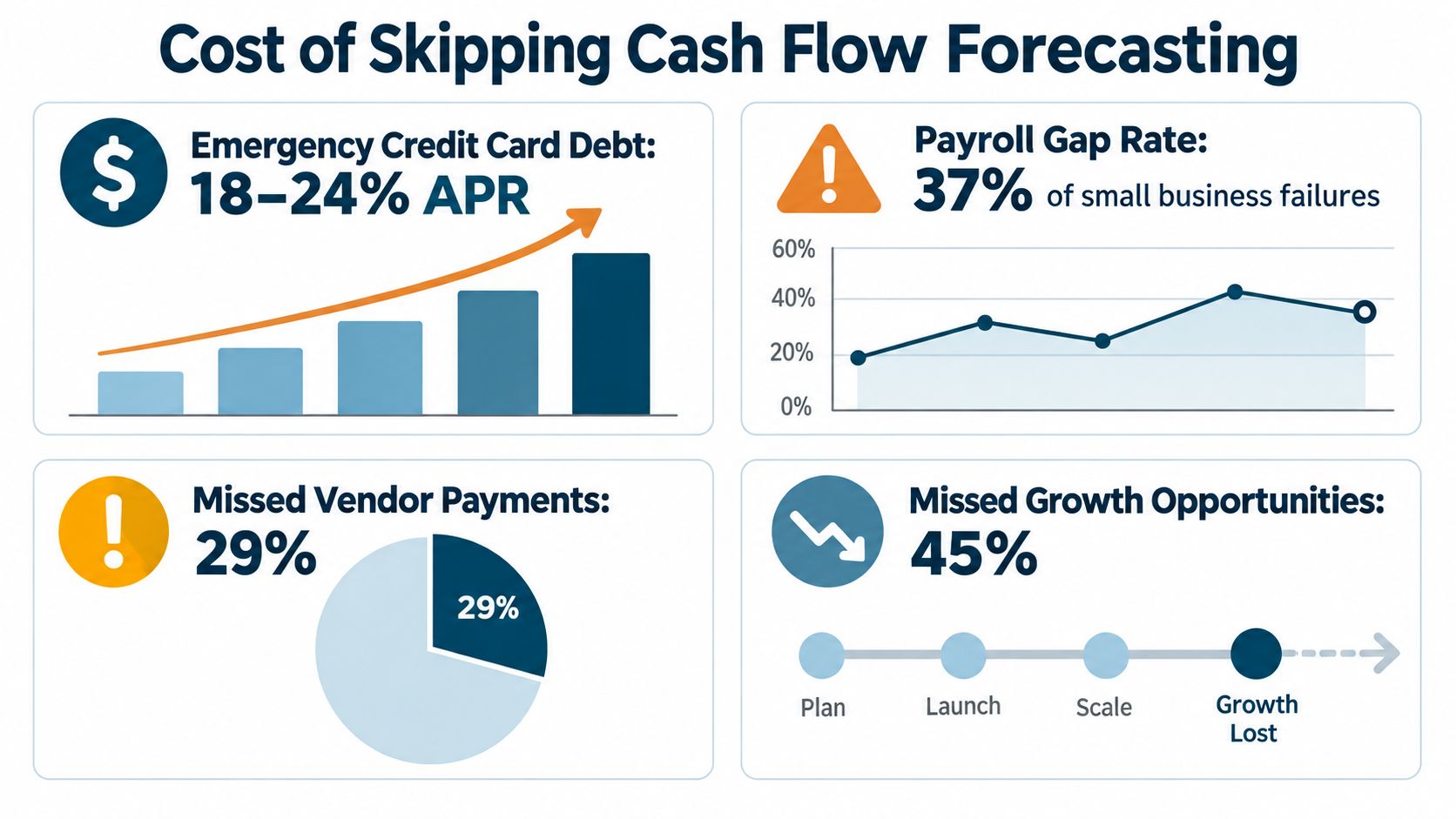
The usual pattern starts with an invoice nobody chased. Then rent, taxes, payroll, or supplier bills hit before the customer pays. The owner uses a credit card, delays a vendor, or accepts a costly loan. Employees and suppliers notice the strain, and the owner loses time that should have gone into sales and operations.
Poor cash flow is widely linked to business failure. An ANZ business guide calls poor cash flow one of the major causes of business failure. A separate finance article cited in that guide's discussion states that cash flow mismanagement plays a role in 82% of business failures in the United States. The point isn't that every cash problem leads to closure. The point is that profitable sales won't save a business if cash arrives after the obligations are due.
Here's how the failure mode usually unfolds:
- Payroll gap: You discover the problem days before payroll, when there's little time to collect receivables or arrange fair financing.
- Vendor strain: You pay one supplier late to protect payroll, then lose favorable terms or damage a relationship you need for the next job.
- Emergency borrowing: You accept whatever credit is available because you're negotiating from panic rather than strength.
- Missed growth: You pass on equipment, a hire, or a profitable project because you don't know whether the cash can support it.
A forecast doesn't guarantee that every week stays positive. It tells you when a negative week is coming and which choice can reduce the damage. Skipping it means choosing to react at the worst possible time, with fewer options and higher costs.
The Key Numbers That Drive a Useful Forecast
A usable forecast has four building blocks. Keep the model simple enough that you'll update it every week.
- Beginning cash balance: Start with the cash available in operating accounts. Don't count an unpaid invoice as cash.
- Expected inflows: Add customer collections, recurring revenue, deposits, loan proceeds, and other money with a realistic expected date.
- Expected outflows: List payroll, rent, taxes, loan payments, supplier bills, insurance, materials, and planned purchases by payment week.
- Ending cash balance: Add inflows to beginning cash, subtract outflows, and carry the result into the next week.
| Line Item | Type | Example | Timing Impact |
|---|---|---|---|
| Beginning cash | Starting position | Bank balance available today | Sets the amount you can use before collections |
| Expected inflows | Cash received | Receivables, deposits, retainers | A late payment can create a shortfall |
| Expected outflows | Cash paid | Payroll, rent, taxes, vendors | A fixed due date can create a cash cliff |
| Ending cash | Projected position | Beginning cash plus inflows minus outflows | Becomes the next week's opening balance |
Timing matters more than totals. A $10,000 invoice collected Tuesday can cover a payroll run. The same invoice collected Friday may arrive after the payment has already failed. That's why a monthly average can look comfortable while a weekly forecast shows a real operating problem.
A 13-week rolling view gives you enough runway to see a full quarter of obligations without pretending that distant estimates are precise. Update it every Friday, compare the prior week's forecast with actual bank activity, and extend the window by one week. For broader operating measurement, track the financial indicators in this guide to key performance indicators for small business.
The number to watch is the projected minimum cash balance across the next 13 weeks. If that number falls below the cash you need for payroll, taxes, and essential vendors, act now. Chase collections, delay discretionary spending, adjust purchase timing, negotiate terms, or arrange financing. Don't wait for the balance to hit zero.
A Simple First-Week Setup for Busy Owners
You don't need special software to build the first version. Excel or Google Sheets is enough if the inputs are honest and the update schedule is firm.
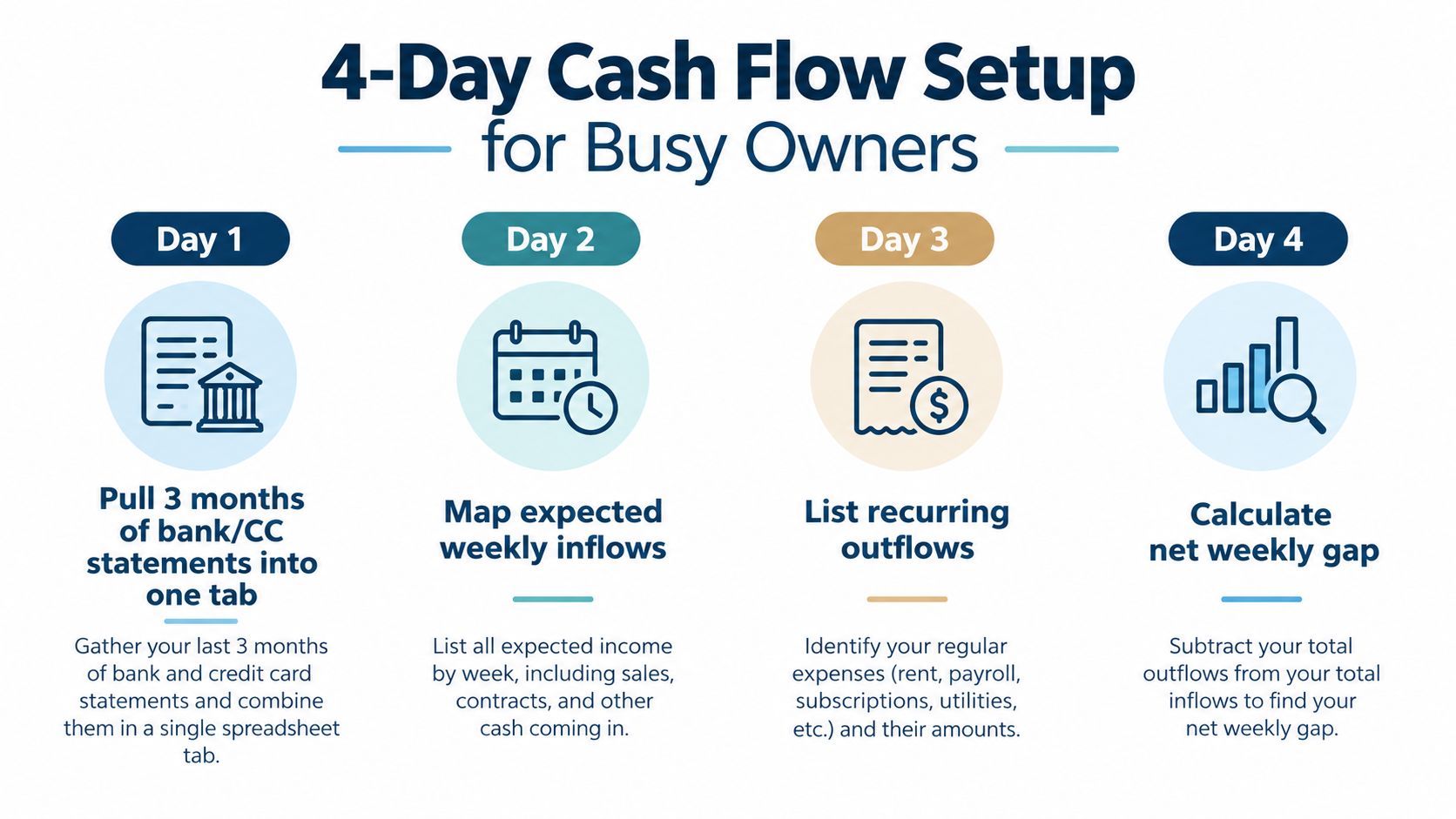
Day 1
Pull three months of bank statements and credit card statements into one working tab. Match the transactions to your bookkeeping records and mark the recurring payments. You're looking for the actual timing of payroll, rent, insurance, debt, subscriptions, supplier payments, and tax transfers.
Day 2
Map expected inflows by week. Start with signed contracts, scheduled receivables, recurring deposits, retainers, and customer payments you have a reasonable basis to expect. Don't put an invoice in a week just because its due date says it should arrive. Use the customer's actual payment behavior.
Day 3
List recurring outflows and their payment dates. Include payroll, rent, insurance, loan payments, tax estimates, materials, and regular software charges. Add one-time purchases and seasonal costs separately so they don't disappear inside a monthly average.
Day 4
Build the 13-week sheet. Use one column for each week and rows for opening cash, inflows, outflows, net cash movement, and projected ending cash. Calculate the lowest projected week, then put a calendar reminder on Friday before close to update the model.
Your first forecast will be imperfect. Build it anyway. Imperfect information gives you more control than no forward view.
Watch for three errors that can make a new forecast look safer than reality:
- Forgotten tax outflows: Add tax payments when the cash leaves, not when the expense feels relevant.
- Duplicate receivables: Enter each invoice once, even if it appears in more than one report.
- Monthly smoothing: Don't spread a large bill across a month. Put it in the week you'll pay it.
The forecast improves when you compare it with actual results. If a customer repeatedly pays later than expected, move future collections later. If materials cost more during busy periods, change the outflow assumption. The model should reflect the business you're running, not the business you hoped to run.
Two Real-World Examples of the Forecast in Action
A five-truck HVAC subcontractor wins a $180,000 hospital fit-out. The general contractor pays on net-60 terms, but materials and two new hires must be funded in week three. The 13-week forecast flags a $42,000 gap before the job becomes a problem.
The owner responds with three moves. He renegotiates a 30% deposit, staggers payroll for the new hires, and delays a truck purchase by two weeks. The project stays viable because the forecast changed the order and timing of decisions.
A four-provider dental clinic faces a different problem. A clearinghouse switch delays insurance reimbursements by 30 days, while a quarterly tax payment is approaching. The forecast surfaces the timing clash before the practice's operating account becomes strained.
The practice uses a working-capital buffer for the tax payment and accelerates patient-portion collections through text-pay links. It doesn't slash payroll or accept emergency financing. It uses a targeted collection action to manage a known timing issue.
The practical lesson: visibility gives you specific, reversible moves. Blindness gives you panic.
Construction owners should map expected draws, retainage, materials, subcontractor payments, and equipment purchases. Healthcare owners should track insurance collections, patient payments, payroll, supplies, and tax dates. Professional services firms need close control over invoice dates, retainer receipts, contractor payments, and payroll.
The industries differ, but the operating question is the same: what will hit the bank before the next major bill clears?
When Outsourced Forecasting and CFO Support Make Sense
Outsourcing forecasting makes sense when finance work starts taking the owner away from sales, delivery, or leadership. It's especially useful once revenue has crossed roughly $1 million, the books have outgrown basic QuickBooks routines, or a lender or investor conversation is scheduled.
Bring in support if you're spending more than five hours a week pulling reports, fixing spreadsheets, or trying to explain why profit doesn't match cash. You need a maintained rolling 13-week forecast, regular variance reviews, KPI tracking, lender packages, and scenario modeling for hires, equipment, pricing, and growth.
A fractional CFO or outsourced advisory team should give you a clear answer to practical questions. Can payroll clear? Which invoice needs attention? Can you accept the next project? Should you delay the purchase? What happens if a major customer pays late?
MyOfficeOps CFO services for small business can support forecasting, budgeting, KPI reporting, bookkeeping, payroll integration, and CFO-level decision support for small and midsize businesses. The goal is simple: fewer surprises, less owner time spent in the weeds, and enough clarity to grow without fearing next Friday's payroll.
MyOfficeOps can build and maintain a rolling 13-week cash flow forecast, connect it to clean bookkeeping and payroll data, and review the decisions behind the numbers with you. Visit MyOfficeOps to start with a practical financial review and get a clear plan for better cash control.