
You can have clean books, filed taxes, and still not know what to do next. That's the spot a lot of owners land in, usually on a Tuesday morning when payroll is coming due, a client wants to expand, and nobody can say, with a straight face, whether hiring now is smart or reckless. That's where accounting advisory services earn their keep, because the point is not more reports. The point is clearer decisions.
A decent bookkeeper tells you what happened. A good advisor tells you what it means and what to do next. If you want a plain-English example of that shift in a real business setting, Clarity's financial playbook lays out the kind of thinking owners need when the numbers stop being enough on their own.
What You Really Need When the Numbers Stop Helping
The cleanest books in the world won't tell you whether you can afford a new hire, raise prices, or push money into marketing. They'll tell you what already happened. They won't tell you what to do this month. That's the gap owners feel when the dashboard looks fine but the bank account still makes them nervous.
A Philadelphia owner usually notices this in a small, annoying moment. The tax return is filed, payroll is current, and the P&L looks “okay.” Then someone asks, “Can we bring on another person in Q3?” and the room goes quiet. That silence is the problem accounting advisory services are built to solve.
Practical rule: if your reports describe the past but don't change the next decision, you need advisory, not more paperwork.
Good advisory doesn't replace bookkeeping. It uses the books you already have and turns them into a next-step answer. That might mean spotting a cash squeeze before it hits, showing which client type makes money, or warning you that the current pricing model is too soft. The best version feels less like a monthly report and more like a steady hand on the wheel.
That's also why owners shouldn't shop for “more analytics” just because the word sounds modern. Ask a harder question. What decision will this change this month? If the answer is vague, the service is probably vague too.
This is the whole point of the topic. Accounting advisory services sit between compliance and strategy. They are for owners who already have data and need judgment. If that sounds like your business, you're in the right place.
What Accounting Advisory Services Actually Are
Think of bookkeeping like a paper map. It shows the roads. Helpful, sure. But it doesn't tell you where to turn when traffic backs up or you need to get across town fast. Accounting advisory services are more like GPS. They use the data you already have, then point you toward the next move.
Accounting advisory services are ongoing decision support that helps an owner use financial data to choose what to do next, not just record what already happened.
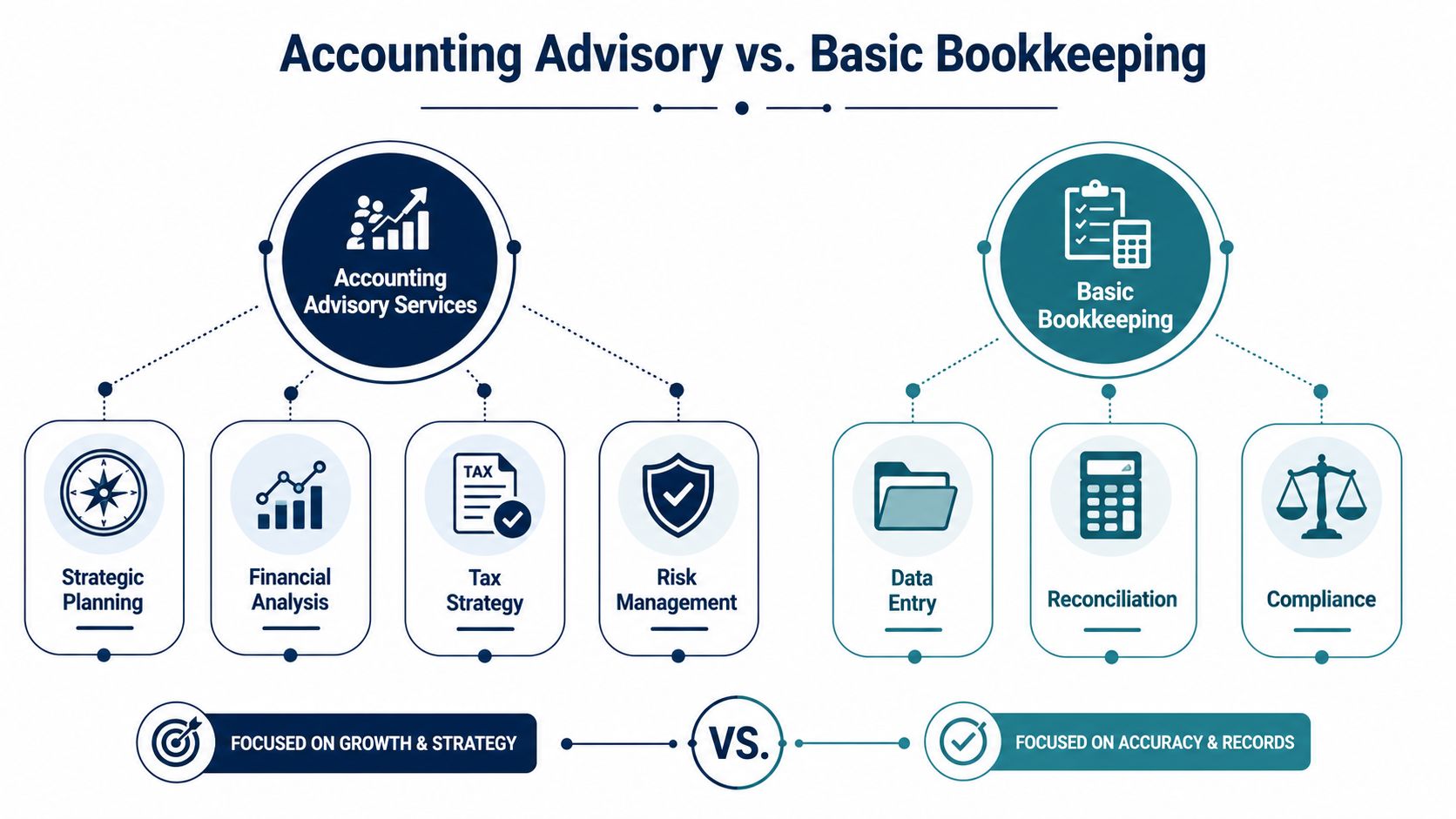
The main pieces in plain English
CFO advisory means a seasoned finance person helps you think like a chief financial officer without hiring one full-time. If you're a West Chester contractor deciding whether to add a project manager, that's CFO advisory work.
Forecasting is a guess with discipline behind it. It helps you answer whether next quarter's cash will be tight or fine, so you're not finding out late.
Profitability consulting examines which service line, job type, or client segment generates profit. A law firm, agency, or clinic can be busy and still leak profit.
M&A readiness is about whether the business is sellable, lender-ready, or just limping along. If you want to sell in a few years, you need the numbers cleaned up before the buyer starts looking.
KPI dashboards are the short list of numbers you check every week. Not fifty metrics, just the few that tell the truth fast.
That's the big difference. Advisory is not a one-time spreadsheet drop. It's a relationship that keeps checking the numbers against real business choices. A good advisor comes back next month, asks what changed, and adjusts the plan with you.
Bookkeeping vs Advisory vs Consulting
Owners mix these up all the time, and the confusion costs money. Bookkeeping records last month. Advisory helps you decide next month. Consulting solves one project and leaves. If you're paying for the wrong one, you're getting a service that doesn't match the problem.
The easiest way to separate them is to think about the bill you're paying. A monthly bookkeeping fee covers categorizing transactions, reconciling accounts, and keeping the records clean. A monthly advisory fee should help you decide if the next hire, price change, or cash move makes sense. A consulting fee is more like paying for a software selection, a policy review, or a one-time cleanup.
| Service | What it does | Cadence | Best for |
|---|---|---|---|
| Bookkeeping | Records and organizes transactions | Weekly or monthly | Staying compliant and accurate |
| Advisory | Turns the numbers into decisions | Ongoing, usually monthly or quarterly | Pricing, hiring, cash flow, and planning |
| Consulting | Solves a defined problem | Project-based | Software selection, process fixes, special projects |
If you want a more detailed breakdown of the overlap and the line between the two, the comparison at financial advisory vs consulting is a useful reference point. For business risk questions tied to operations, business risk advisory for COOs shows how leaders think about risk in a more practical way.
Here's the rule I give owners in Greater Philadelphia. If the issue is “what happened,” call bookkeeping. If the issue is “what should we do next,” call advisory. If the issue is “we need one discrete fix and then we're done,” call consulting.
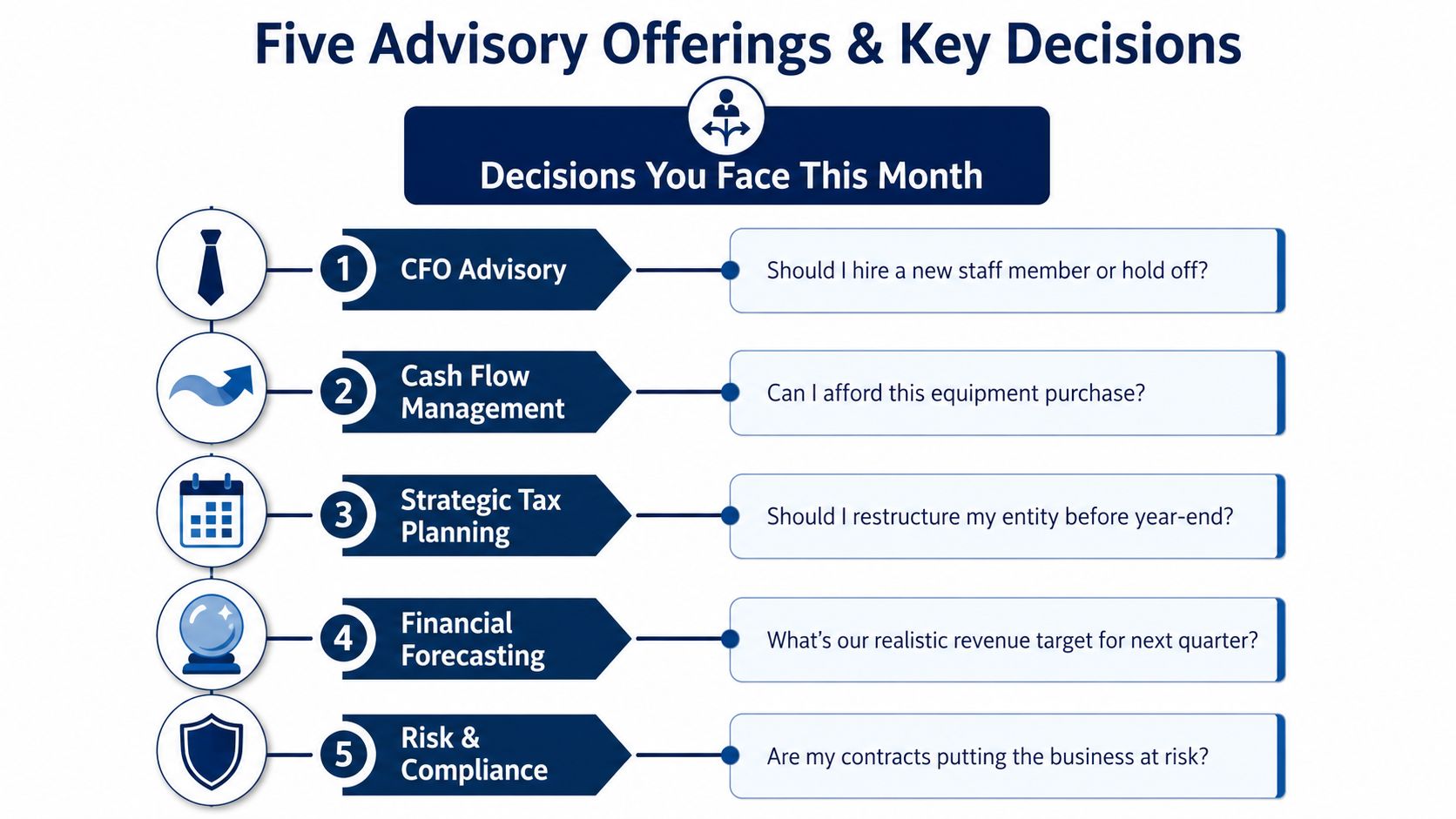
The Five Core Offerings and the Decisions They Drive
Most owners don't need a pile of advisory labels. They need one answer tied to one decision. That's how the work should be sold and how it should be judged.
1. CFO advisory
This is the “do I hire or hold off” question. A real CFO advisor looks at the month ahead, not just last month's close, and helps you decide whether payroll can absorb another person without squeezing the business. If it works, you should see decision speed improve, not just prettier reports.
2. Cash flow management
This is about whether you can cover the next 90 days without panic. If a contractor is waiting on receivables or a healthcare practice has lumpy collections, cash flow work should make the timing visible before it becomes a fire drill. The KPI that should move is the cash balance forecast, because that's what tells you whether the next equipment buy or vendor payment is safe.
3. Strategic tax planning
This is the “should I change the structure before year-end” conversation. Tax planning should not be a March surprise. Good advisory ties tax choices to business choices, so the owner isn't guessing about payroll, draws, or entity setup when the calendar is already closing. The KPI that should improve is tax exposure control, meaning fewer avoidable surprises.
4. Financial forecasting
You ask, “What's our target next quarter?” Not the wish list, the target. A forecast should force honesty about revenue, staffing, and margin, so you can plan around the business you have. If the work is useful, the KPI that changes is forecast accuracy.
5. Risk and compliance
This is the “are our contracts, controls, or filings putting us in danger” check. It matters because mistakes here are expensive, and owners often don't see them until something breaks. The KPI to watch is issues caught before they hit the bank account.
A lot of firms now package these services into monthly support. That makes sense because the value comes from the conversation, the follow-up, and the next decision, not from a one-off file dump. The market reflects that shift too, with the broader financial accounting advisory services market valued at $101.62 billion in 2024 and projected to reach $129.58 billion by 2029 and $165.15 billion by 2034 (Research and Markets).
What Real Advisory Looks Like in Philadelphia
A six-person professional services firm in West Chester looked profitable on paper but couldn't tell which clients were worth the time. The owner had good books, a full calendar, and still no clear answer on where the money was really coming from. After advisory kicked in, the firm stopped treating every client the same and started reviewing client mix and billing patterns by month. On the first of each month now, the owner checks which accounts deserve attention and which ones need a price reset.
A small healthcare practice had a different problem. The owner lived with 90-day cash anxiety because collections, payroll, and vendor bills never seemed to line up cleanly. Advisory changed the conversation from “Are we okay?” to “What will cash do if this payer runs late and that expense lands early?” The first-of-month routine became a cash review, not a gut check.
Good advisory makes the owner's next decision obvious. Bad advisory leaves the owner with more slides and the same headache.
Those two examples look different, but the pattern is the same. The advisor didn't just hand over a prettier report. The advisor changed the cadence of the business. That's the core point of fractional CFO for small business, because the value shows up when the owner starts making better calls without waiting for a crisis.
The best sign advisory is working is simple. The owner opens the dashboard, knows what the numbers mean, and takes action without calling a meeting just to decode the page.
How to Pick the Right Provider in Greater Philadelphia
Start with the decision you need to make this month. If the advisor cannot help you choose between hiring, cutting a service line, or resetting pricing, you are paying for talk, not advice. A good provider should look at your dashboard and tell you which number deserves attention first, because a clean report means nothing if it does not change the next move.
Industry fit comes next. A firm that already works with agencies, clinics, contractors, or professional services will ask sharper questions than a generalist who still has to learn how your money moves. If they cannot speak plainly about your revenue model, your billing cycle, and where margins usually slip, keep looking.
You also want one named person who owns the work. A rotating cast is a bad sign, because nobody feels accountable when cash gets tight or payroll shifts. Remote is fine, but the provider still has to understand Philadelphia tax and payroll issues without making you do the hand-holding.
Use this question flow on the sales call:
- Industry fit: “Have you worked with a business like mine before?”
- Response time: “Who answers when I have a same-week issue?”
- Software stack: “Will this work with what we already use?”
- Pricing: “What's included, and what costs extra?”
- References: “Can I speak with a local client who sounds like us?”
That checklist beats a polished pitch deck. I've seen owners buy the presentation, then wait months for a real answer. A stronger test is whether the provider can explain the work in plain English and map out the first 90 days without hiding behind jargon.
The best advisor also shows you what good and bad output look like on the same dashboard. Good output says which client group to raise prices on, which bill to delay, or which margin gap to fix before month end. Bad output gives you a stack of charts with no owner decision attached. If you are still sorting through local options, our guide on small business financial advisors near me is a useful place to start.
The pricing model matters, too. A monthly retainer fits ongoing support. Hourly advisory can work for a narrow question or a one-time fix. Tiered bundles make sense when you want clear service levels without guessing what each meeting will cost.
For a practical comparison of how advisors are chosen in other service categories, choosing the right marketing agency is a useful reminder that fit, process, and clarity matter more than a shiny presentation. The same standard applies here.
If you want a local provider, ask how onboarding works. The answer should cover discovery, cleanup, and routine reporting in plain steps. One option in the market is MyOfficeOps, a West Chester firm that works through Core Accounting, Profit Optimization, and Exit Strategy. That structure helps owners see what they are buying before the work starts.
Why Most Advisory Engagements Quietly Underperform
The label is not the win. The operating system is the win. If the data is messy, the meetings are irregular, and nobody owns follow-up, the advisory package turns into expensive small talk.
If the dashboard is never opened and the numbers aren't trusted, the firm is selling comfort, not strategy.
That's the contrarian truth owners need to hear. A firm can say “CFO advisory” all day long, but if it doesn't have clean data, a named point of contact, and a steady cadence, the output won't drive better decisions.
The weak spots are easy to spot in a week.
- Check the cadence: If you only hear from them when the month is closed, that's a red flag.
- Check the output: If every meeting ends with “we'll circle back,” the engagement is drifting.
- Check the dashboard use: If you can't name the two or three numbers you're supposed to watch, nobody has built a useful system.
The hidden cost is time. Owners sit through meetings, get reports, and still don't know what changed. That's not advisory. That's report dumping with a nicer title. Good advisory is more disciplined than that, because it turns raw numbers into one clear next move.
Your Next Step If You're in Greater Philadelphia
If your current reports don't help you decide on hiring, pricing, cash, or exit timing, don't keep pretending they do. Good accounting advisory services give you a recurring cadence, a short list of KPIs you can name from memory, and a straight answer to the next decision in front of you.
That's the standard to use when you talk with any provider in the Philadelphia area. Ask what they do for Core Accounting, Profit Optimization, and Exit Strategy, and make them show you how the first 30, 60, and 90 days will work. If the answer is fuzzy, keep looking.
MyOfficeOps is built around that kind of structure in West Chester, PA. Their Discovery Call, Custom Plan, Smooth Onboarding, and Growth Partnership path is meant to turn financial data into a working decision process, not just a prettier month-end package. For small and midsize businesses that want more than compliance, that's the right test.
If your numbers look fine but still don't help you decide what to do next, talk to MyOfficeOps. They work with small and midsize businesses on bookkeeping, forecasting, profitability, and CFO-level advisory so the dashboard means something. Visit MyOfficeOps to set up a discovery conversation and see whether your current reporting is helping you run the business or just keeping score.