
The first sign is usually simple. A managing partner looks at the bank balance, the open invoices, and the trust account report, then realizes none of them answer the same question. The firm may be busy, the calendar may be full, and still nobody can say how much is safe to draw, how much is tied up in client money, or why the month-end numbers keep changing after the books are “done.”
That's where accounting for law firms stops being normal small-business bookkeeping. Legal books have to track client money, matter-level revenue, billing delays, and partner payouts without mixing any of it together. If the setup is sloppy, the firm can look profitable on paper and still run short on cash in real life.
Why Law Firm Accounting Feels Different
A lot of firms start with the same mistake. They use a setup that works for a retail store or a design agency, then expect it to handle retainers, trust money, write-downs, and partner draws without breaking. It usually breaks in the same place first, the numbers don't line up with the questions the partners ask.
The ledger has to tell the truth at the matter level
In a law firm, revenue is not just “money in.” Billing, work in progress, trust balances, and collections all sit in different buckets, and the books have to show how they connect. That matters because a partner does not just want to know whether the firm made money, they want to know which matters made money, which ones dragged, and whether collections kept pace with billing.
The structure is different enough that generic advice can be misleading. A firm can be profitable and still have weak cash because the billing cycle is slow, or because a large share of cash sits in trust until work is earned. That is why the accounting setup has to support matter-based reporting, not just a basic profit and loss statement.
Partner pay is part of the system, not an afterthought
Law-firm financial guides often place revenue per person on payroll in the $150,000 to $175,000 range, using annual gross revenue divided by total payroll headcount, with part-time staff counted proportionally, so a half-time employee counts as 0.5. The same guidance points to an owner's compensation target of 40% of gross revenue Numbers Don't Lie, Interpreting Your Law Firm Financials. Those benchmarks matter because staffing, productivity, and profit distribution all hit the chart of accounts.
Practical rule: if the books can't show payroll, realization, and partner draws in one view, the firm is guessing about its own economics.
A lot of managing partners feel this before they can name it. The numbers are there, but they're not organized around decision-making. Once the ledger is built for legal work instead of generic bookkeeping, the monthly reports start answering real questions, like whether the firm can support another associate, or whether partner draws need to slow down for a few months.
Trust Accounts and IOLTA Without the Headache
A trust account is a labeled account for client money, and that money does not belong to the firm. A client may deposit funds for a matter, but those funds remain the client's until the work is earned, so they should never be treated like operating cash. That is why law firms keep a separate trust account, often an IOLTA account, instead of dropping retainers into the main checking account The Cash Room.
What should happen every month
The trust account should be checked against three records, not one. Three-way reconciliation means the trust bank statement, the trust ledger, and the individual client sub-ledgers all have to match RunSensible. Some jurisdictions require that work to be finished by the 10th or 15th day of the following month, and trust records are typically kept for five years after the representation ends Clio.
That sounds technical, but the practical issue is simple. If a client asks where their money went, the firm has to show the path from deposit to invoice to withdrawal. Every deposit, every fee transfer, and every refund needs a clear trail. If that trail gets messy, the bookkeeper has to fix it before it turns into a compliance problem.
What good trust bookkeeping looks like
Clean trust bookkeeping usually starts with one client ledger for each matter, detailed notes on every movement, and a reconciliation schedule the firm follows. Legal accounting software is often used because it helps reduce mistakes in trust handling, tax filing, and cash-flow management, but the software only works when the process behind it is disciplined American Bar Association.
Keep trust money separate, keep the ledger detailed, and never let operating cash and client money blur together.
For a plain-English control reference, trust account reconciliation rules walks through the same monthly discipline firms need in practice. I also keep this bookkeeping guide for law firms close when training new staff, because the first mistakes are usually process mistakes, not math mistakes.
A trust account only stays clean if the firm treats every transfer as a tracked event, not a casual move between balances. That matters at the ledger level, where one missed client sub-ledger can leave the whole trust balance looking right while an individual matter is wrong. In a law firm, that kind of mismatch is where headaches start.
A Simple Monthly Bookkeeping Workflow
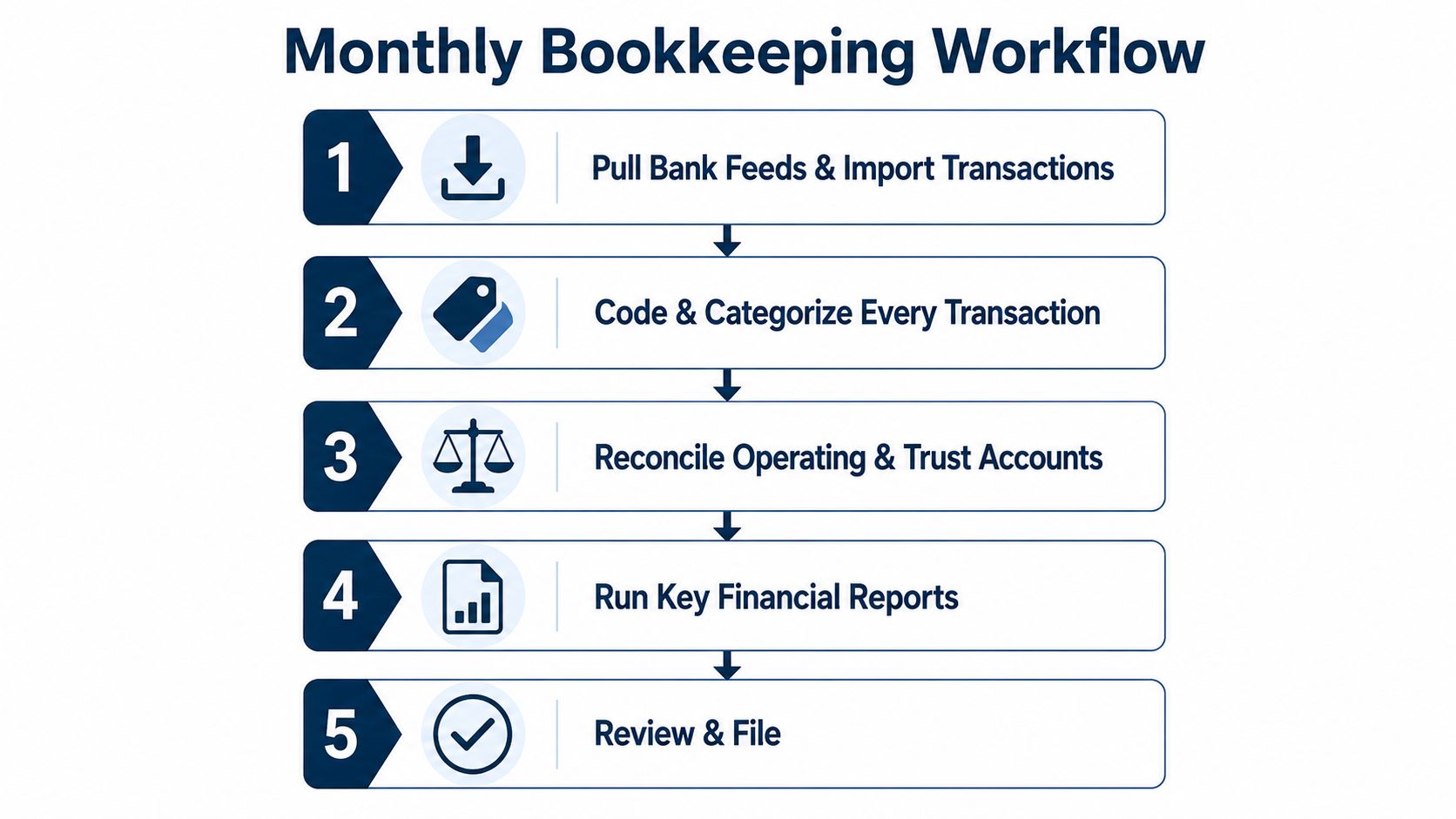
Monthly close for a law firm should feel like a controlled routine, not a rescue mission. The bookkeeper pulls in the bank feeds, codes transactions, reconciles both operating and trust accounts, then turns that cleaned-up data into reports the partners can easily read. If one of those steps gets skipped, the next step starts wobbling.
The pieces have to match
Law firms often run dual systems where billing and general-ledger platforms need the same matter, client, and time-entry data, and drift between the systems can distort revenue, AR aging, and matter profitability reporting Matax HQ. That's why the month-end close is not just about matching bank balances. It's about making sure the billing side and the accounting side are speaking the same language.
A practical monthly workflow usually looks like this:
- Pull bank feeds and import transactions. Get every operating and trust transaction into the books.
- Code and categorize every transaction. Put each item into the right income, expense, or balance sheet bucket.
- Reconcile operating and trust accounts. Catch missing items, duplicate entries, and stray transfers.
- Run key financial reports. Produce the profit and loss, balance sheet, AR detail, and trust reports.
- Review and file. Fix anything odd before the books are closed.
Revenue recognition needs care
Law-firm income can't be treated like a cash drawer. Earned fees should hit the income statement when they're earned, while unearned retainers stay tied to trust until the work is done. When write-offs or billing adjustments happen, they should flow through the right matter, so the firm can see whether the issue was pricing, inefficiency, or collection trouble.
Practical rule: if a bill was sent to the client but the general ledger doesn't reflect the matter properly, the month-end reports can't be trusted.
The point of the close is not perfection, it's consistency. A firm that closes the same way every month can spot a bad billing habit, a collections slowdown, or a trust error before it becomes an expensive mess. A firm that closes whenever someone has time usually learns about problems too late.
The KPIs Every Managing Partner Should Watch
A managing partner sitting down with a month-end packet does not need every account code on the page. The useful numbers are the ones that show whether the firm is using time well, turning bills into cash, keeping overhead in line, and leaving enough liquidity for payroll and partner draws. If those measures are soft, the ledger usually shows it before anyone feels it in the bank.
The core operating numbers
Industry reporting commonly cites 37% utilization, which works out to about 2.9 billable hours per 8-hour day, a 91% collection rate, and 75 to 100 days of total lockup Accounting Atelier. The same benchmark range puts overhead at 45% to 50% of revenue, with healthy firms staying under 45% and keeping collections above 90% Ares dashboard analytics guide.
Those numbers matter because each one points to a different pressure point. Utilization shows whether time is getting captured at all. Collection rate shows whether invoices turn into cash. Lockup shows how long money stays stuck in work-in-progress and receivables. Overhead shows how much revenue gets consumed before profit reaches the partners.
The partner pay conversation lives here
The revenue-per-person benchmark from the earlier section belongs on the same dashboard as payroll and draw planning. If staffing rises faster than revenue per person on payroll, the firm can stay busy while profit gets squeezed. That is why partner compensation has to be discussed alongside production and billing, not after them.
| KPI | Healthy Range | What It Tells You |
|---|---|---|
| Utilization | 37% | How much of available time becomes billable work |
| Collection rate | 91% or above | How much billed work turns into cash |
| Lockup | 75 to 100 days | How long money stays tied up before it reaches the bank |
| Overhead | Under 45% | How much revenue is consumed by running the firm |
| Revenue per person on payroll | $150,000 to $175,000 | Whether staffing is supporting the firm's economics |
A partner dashboard works best when it stays readable at a glance. Use these measures to flag problems early, then drill into the matter-level details only when a number moves the wrong way. That gives the managing partner enough context to question write-downs, collections delays, or staffing drift before those issues show up in the draw account.
Forecasting Cash Flow When Billing Always Lags
Law firm cash flow is slow for reasons that have nothing to do with bad intentions. Work gets done first, bills go out later, and money arrives after that. If the firm bills monthly on 30-day terms, the cash cycle can stretch into 60+ days Anders CPA, and contingency work can stretch it much farther.
Profit is not the same as cash
That distinction trips up a lot of firms. A matter can be profitable and still leave the bank account thin because the firm paid salaries, rent, and vendors before the client's payment arrived. Cash gets even bumpier when bills go out late, which is a problem a practitioner source has flagged directly in the legal accounting space YouTube interview on law firm cash flow.
The right response is not just “bill faster.” The firm needs a cash plan that assumes payment timing will vary. That plan should cover payroll, partner draws, tax distributions, and a little cushion for slow-paying months.
A simple 13-week view helps
A 13-week cash forecast is useful because it forces the firm to look at near-term obligations instead of assuming next month will work itself out. The forecast should start with opening cash, add expected collections by week, subtract payroll and recurring operating costs, then mark partner draws separately so those distributions are visible before they happen.
A few habits make the forecast more honest:
- Use billed work, not wishful work. Only include collections that have a real chance of landing.
- Separate routine cash from partner distributions. Draws should be treated as a decision, not a leftover.
- Stress test slow collections. If a large invoice slips by a few weeks, the forecast should show the pain early.
- Track taxes and reserves as planned outflows. Money that belongs to the firm's owners is still cash that has to be managed.
Practical rule: if the forecast only works when every client pays on time, it isn't a forecast, it's a hope.
Law-firm accounting becomes more than bookkeeping. The firm needs to know when work turns into cash, because that timing decides whether the partners can draw confidently or need to hold back.
Choosing Software That Actually Fits a Law Firm
Software should make the legal books cleaner, not just look nicer. The key question is whether the system handles trust accounting correctly and whether matter-level data moves cleanly between billing and the general ledger. If it doesn't do both, the team usually ends up doing extra work by hand.
Three common setups, three different trade-offs
A law-firm-specific suite can be convenient because billing, trust, and reporting live closer together. General accounting platforms like QuickBooks can work too, but they usually need a separate billing tool and more manual control. Hybrid setups sit in the middle, where a billing system connects to the ledger through integrations so the firm can keep better specialized tools without losing financial control.
MyOfficeOps publishes a law firm accounting software guide that looks at CosmoLex, including built-in general ledger and trust/IOLTA accounting plus three-way reconciliation and matter management for small to midsize firms. That kind of setup is worth comparing against any general ledger stack, because the trust workflow is where many firms feel the most friction.
What to ask before you switch
The most useful questions are boring ones. Can the software keep client money separate from operating money? Does it preserve matter-level detail all the way into the books? Can someone reconcile the trust account without exporting half the system into spreadsheets?
If the answer to any of those is fuzzy, the software is probably making the bookkeeper do the hard parts manually.
The other thing to watch is data drift. If billing and accounting are disconnected, someone has to fix the mismatch, and that usually means duplicate entry, more reconciliation, and weaker reporting. Software should reduce that work, not hide it.
When It Is Time to Outsource the Books
A firm usually outgrows DIY bookkeeping long before it admits it. The clues are easy to spot. Monthly closes keep slipping, partner draws feel like a guess, trust reconciliation gets delayed, and the managing partner spends more time worrying about the books than using them.
What a clean handoff looks like
A good outsourced engagement does not start with fancy dashboards. It starts with getting the records clean, making sure trust activity is handled properly, and building a monthly process the firm can trust. If the firm needs more than bookkeeping, a fractional CFO can layer in forecasting, draw planning, and long-range decisions around growth or transition.
The best handoffs also protect the daily work. The lawyers still bill, staff still enter time, and the outside team takes over the financial cleanup, reporting, and control work that was slowing everyone down. That matters because most firms don't need more software, they need steadier handling of the data they already have.
If you're comparing support options, law firm accounting services is the kind of internal reference that helps a managing partner see where bookkeeping ends and advisory work begins. That line matters when the firm is deciding whether it needs only cleanup or a deeper finance partner.
Signs the firm needs more than a bookkeeper
- Late monthly close: Reports arrive after decisions already got made.
- Weak draw visibility: Partners don't know what's safe to take.
- Trust anxiety: No one feels fully comfortable with the client-money process.
- No forecast discipline: Cash is checked in the bank, not planned on paper.
- Growing complexity: More matters, more staff, and more billing patterns than one person can track well.
Once those signs show up, outsourcing stops being a luxury. It becomes the cleanest way to keep the books accurate without dragging the lawyers into admin work they shouldn't be doing.
Your First 30 Days of Better Law Firm Accounting
Start with the trust account. Get the ledger reconciled, make sure every client balance is documented, and confirm that client money and operating cash are not mixing anywhere. Then set a monthly close calendar that nobody can ignore, because a close that happens whenever someone has time is not a close.
Build a simple 13-week cash forecast next. Use it to plan payroll, partner draws, and tax distributions before the money leaves the bank. The biggest mistake is trusting the bank balance alone, because bank balance and safe-to-draw cash are not the same thing.
MyOfficeOps helps firms clean up bookkeeping, build monthly reporting that partners can use, and set up forecasting that fits how a law practice collects cash. If your firm needs steadier books, better visibility into draws, or help turning trust and billing data into usable reports, visit MyOfficeOps and start a conversation.