
It's the end of the quarter. You've sent invoices, payroll is coming up, rent is due Friday, and a large client says the deposit is on the way. You open QuickBooks and stare at the income line. Should that money show up now, or only after it reaches the bank?
That's the accrual vs cash accounting for small business decision in real life. It isn't a contest between a “simple” method and a “professional” method. It's a question of whether your books should follow your bank balance or the work your company has already completed.
The right answer depends on how your business bills, collects, buys materials, carries inventory, and reports results to other people. Your former CPA's preference isn't a business strategy.
The Moment Every Owner Faces This Choice
A marketing firm finishes a website project in March. The team has paid its designers, bought software, and delivered the work. The client's invoice is due in April. On the bank statement, March looks weak. In the owner's head, March was busy and profitable.
A contractor runs into the same problem from the other direction. A customer pays a deposit for a kitchen renovation, but the job is only partly complete. The bank account looks healthy, while the company still owes labor, materials, and subcontractor bills. Treating the whole deposit as current income can make an unfinished job look like a winning one.
Healthcare owners see this every week. A practice provides care today, submits a claim, and waits for payment. The cash may arrive much later, after insurance processing and adjustments. A cash report can make a full treatment schedule look like a slow month because the payer hasn't sent the money yet.
Practical rule: Your books should help you answer, “What did we earn, and what did it cost us during this period?” They shouldn't only answer, “What cleared the bank?”
That's where the textbook stops being useful. A cash method may be perfectly practical for a solo consultant who gets paid at the time of service. It can be a poor fit for an agency with unpaid invoices, a dental practice waiting on reimbursements, or a builder managing several open jobs.
The choice affects taxes, reporting, cash planning, and the amount of bookkeeping work you'll carry each month. Pick the method that reflects how money moves through your company.
What Cash and Accrual Accounting Actually Mean
Start with a plumber. She repairs a leaking sink on Tuesday, sends the customer an invoice on Wednesday, and receives payment several weeks later.
Under cash accounting, the plumber records the revenue when the payment is received or constructively received. Until then, the completed repair may not appear as revenue on the income statement. The cash method records expenses when the business pays them, so a supplier bill stays out of the expense records until payment is made.
Under accrual accounting, the plumber records revenue when she earns it, usually when the repair is complete and the invoice is issued. The related cost belongs in the period connected to that work, even if the plumber pays a supplier later. The dollars don't change. The timing does.
The two methods in plain English
Cash accounting acts like a checkbook. It answers, “What money came in, and what money went out?”
Accrual accounting acts more like a job scoreboard. It answers, “What work did we complete, what revenue did we earn, and what costs belong to that work?”
The IRS describes the distinction the same way. Under the federal cash method, income is generally recorded when received and expenses when paid. Under the accrual method, income is recorded when earned and expenses when incurred, regardless of payment timing. The IRS explanation of accounting periods and methods also explains that businesses generally need consistency between the method used for income and the method used for expenses.
Accrual books usually contain accounts receivable, which tracks customer invoices not yet collected, and accounts payable, which tracks bills the business owes but hasn't paid. Those accounts are the telltale signs that the books are tracking obligations and earned activity, not just bank movement.
For a more detailed look at the mechanics, see this guide to what accrual accounting means.
The short version is simple: cash follows payment, accrual follows earning and incurring.
Side-by-Side Comparison That Matters for Small Businesses
The basic definitions aren't the hard part. The hard part is understanding what each method does to decisions you make every month.
| Factor | Cash Basis | Accrual Basis |
|---|---|---|
| Tax treatment | Income is generally recognized when received, and expenses when paid | Income is generally recognized when earned, and expenses when incurred |
| Financial reporting | Easy to read against the bank account, but timing can distort profit | Shows earned revenue and related costs in the same period |
| Cash flow picture | Closely reflects available bank cash | Can show profit before cash is collected |
| Day-to-day complexity | Fewer entries and less month-end work | Requires receivables, payables, reconciliations, and adjustments |
Tax treatment
Cash gives many eligible businesses more control over timing. If customers pay late, income may not appear until collection. If the business pays a deductible expense, the payment may affect the period when it leaves the account.
Accrual can produce a lower tax result in a period where accrued expenses exceed accrued income, but it can also create a cash problem if the business owes tax on revenue it hasn't collected. The IRS distinguishes these methods in its guidance on federal accounting methods, and the rules depend on the business and its circumstances.
Reporting and cash visibility
Cash basis usually lines up better with the bank statement. That helps an owner answer whether payroll can clear. It doesn't always show whether the company's work is profitable. A month with strong sales can look terrible if invoices are outstanding, while a month with large deposits can look excellent even if the work hasn't been completed.
Accrual gives a cleaner view of earnings and period-level margins. That's more useful for a lender, investor, buyer, or owner comparing one month with another. It also means the bank balance and the income statement won't match, so you need a separate cash flow review. A practical cash flow statement analysis guide can help keep those two questions separate.
Complexity creep
Cash is easier until it isn't. As unpaid invoices, prepaid expenses, customer deposits, inventory, and open jobs pile up, cash reports become harder to trust. Accrual requires more discipline, but the work produces information you can use.
One point surprises owners: accrual accounting can sometimes defer taxes by recognizing expenses before cash leaves the business. That isn't automatic, and tax treatment needs professional review, but the common assumption that cash always creates the lower tax bill is wrong.
How Each Method Plays Out in Real Industries
The same year can tell three different stories depending on when customers pay. A service firm may finish work before collecting. A healthcare practice may wait on third-party reimbursement. A contractor may collect deposits before completing the job.
Marketing agency
An agency signs a client for a campaign, sends invoices on net terms, and pays freelancers as the work progresses. Under cash accounting, revenue can look thin early in the year if invoices remain unpaid, even though the agency has delivered substantial work. The agency may appear to have a weak quarter while its team has already produced the billable result.
Accrual accounting records the earned revenue and the costs tied to that campaign in the periods where the work occurs. The owner can see which clients produced margin, which invoices are aging, and whether the agency is growing profitably or merely waiting longer to collect.
That distinction matters in a service business because payroll and contractor costs often arrive before customer cash. Cash accounting may help the owner watch the bank. Accrual helps the owner price work and manage delivery.
Dental practice
A dental practice provides treatment, submits claims, and waits for insurance reimbursement. Cash accounting can make the practice's monthly results swing based on payment timing instead of treatment volume and collections work.
Accrual accounting gives the practice a better operating view. It can show earned production, expected receivables, contractual adjustments, and the costs associated with delivering care. The owner can then ask a useful question: which procedures and payer relationships produce acceptable margins after the work is performed?
That doesn't mean every reimbursement should be treated as certain. The practice still needs careful posting, collection review, and adjustment procedures. The point is to avoid confusing delayed payment with poor production.
Residential contractor
A residential contractor collects a deposit, orders materials, pays subcontractors, and bills at milestones. Cash accounting can record a large deposit as current cash activity while the project still carries major future costs. That creates the risk of phantom profit, a profitable-looking job that hasn't earned its final margin.
Accrual accounting ties revenue and costs to job progress and the business's chosen reporting method. It gives the owner a clearer view of work in progress, committed costs, retainage, and outstanding billings. Contractors dealing with specialized field operations can also review an oilfield accounting software overview for a sense of the job, billing, and industry tracking issues that dedicated systems address.
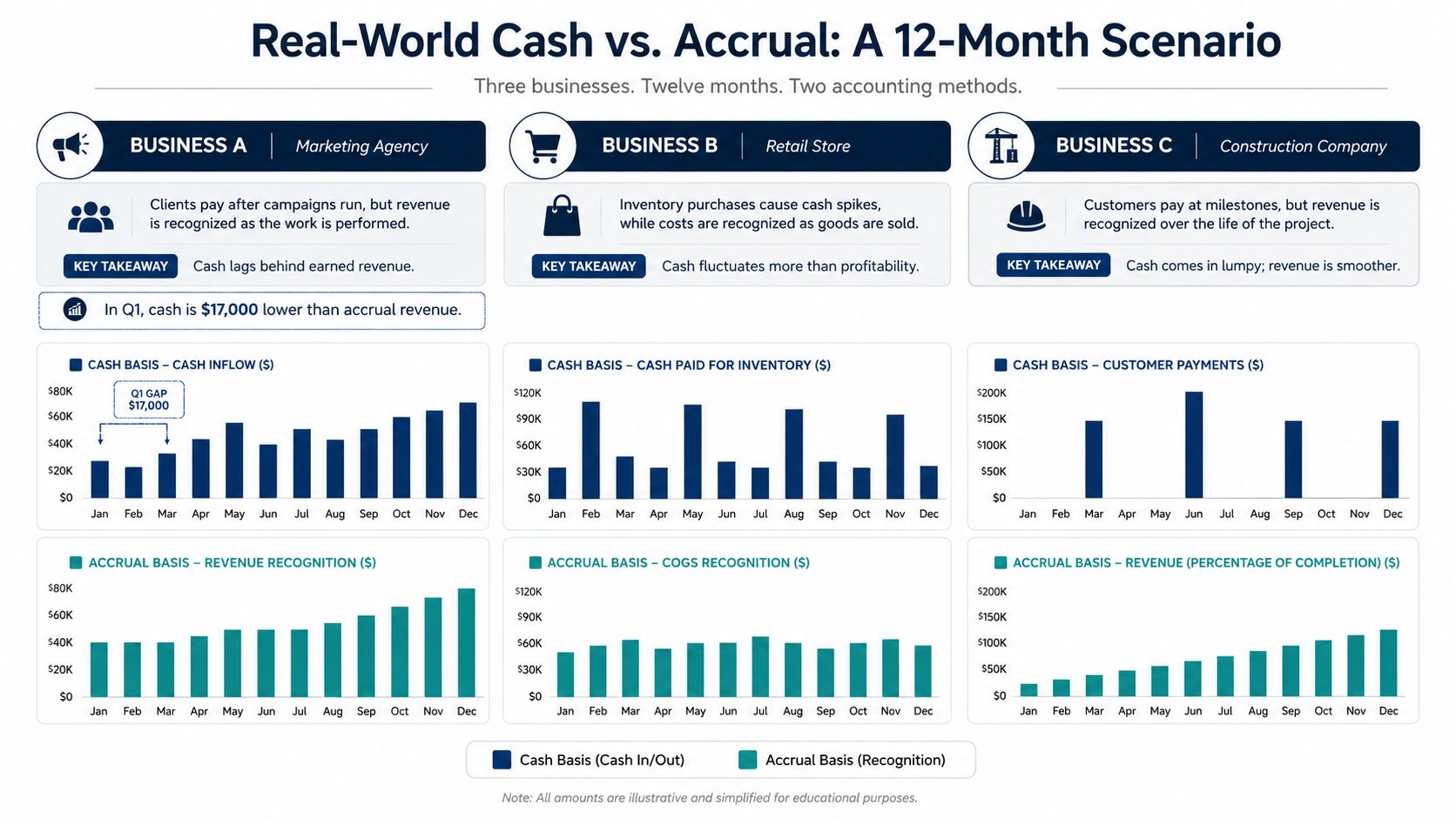
A deposit is cash. It isn't automatically profit.
The Honest Pros and Cons Nobody Prints on the Brochure
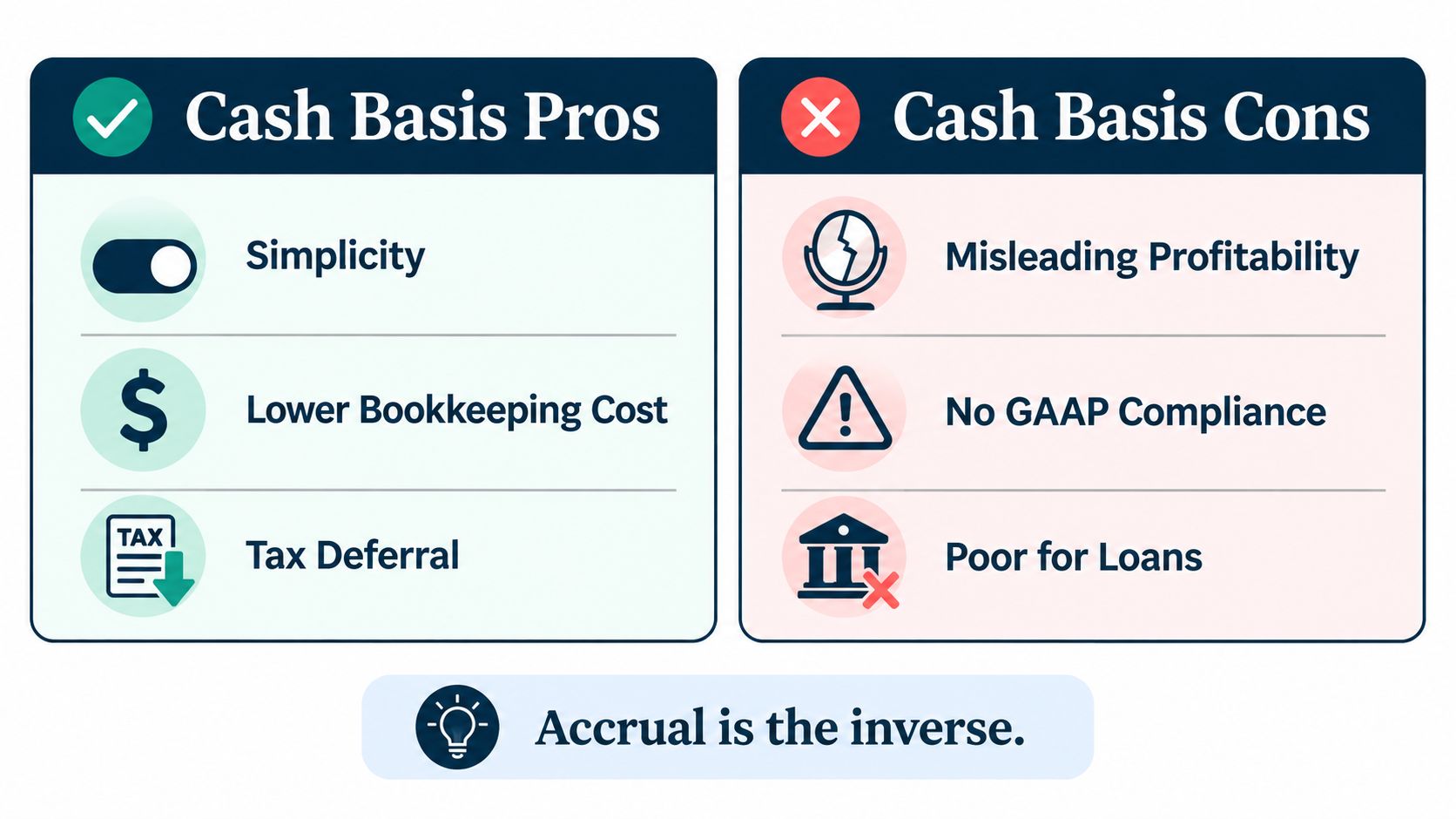
Cash basis wins when the business is uncomplicated. A freelancer who bills promptly, collects quickly, carries no inventory, and has few unpaid obligations may not need a complicated monthly close. The owner can look at the bank, review unpaid invoices, and understand the business without maintaining a large set of adjustments.
Cash can also reduce bookkeeping work and may offer tax-timing flexibility for an eligible business when collections lag. But that convenience has a price.
Where cash gets owners in trouble
Cash basis can hide slow-paying customers because unpaid invoices may sit outside reported revenue. It can also make a profitable month look empty when collections arrive later, or make a deposit-heavy month look strong before the company has delivered the work.
Banks may also ask for accrual-style statements when they evaluate repayment capacity. A cash-basis profit and loss statement doesn't always answer questions about receivables, bills owed, inventory, or unfinished jobs.
Where accrual earns its keep
Accrual matches revenue with the costs connected to earning it. That gives owners a more truthful view of margins, supports better pricing decisions, and makes period comparisons more useful. Lenders, investors, buyers, and business partners generally get more usable information from books that show obligations and earned activity.
The downside is real. Accrual needs month-end reconciliations, accurate accounts receivable and accounts payable, prepaid expense schedules, and journal entries. If nobody owns that process, the reports become messy and the extra complexity buys you nothing.
The popular claim that cash is “for small businesses” is too lazy to be useful. A sizable company may legally use cash if it qualifies and its operations fit. A smaller company may need accrual because it carries inventory, handles long contracts, or must satisfy outside reporting requirements. Revenue size alone doesn't pick the method. Business behavior does.
IRS Rules and the Gross Receipts Test You Need to Know
Your preferred bookkeeping method does not override federal tax rules. Businesses that carry inventory generally need accrual accounting for sales and purchases unless a small-business exception applies. Cash accounting is available to many individuals and small businesses, but eligibility depends on the business structure, operations, and records.
The key test is average annual gross receipts for the prior three tax years. IRS guidance uses an inflation-adjusted small-business threshold, so the applicable amount can change by tax year. Do not rely on an old article or a number remembered from a prior filing. Review the IRS Publication 334 guidance on small-business accounting methods with your tax professional before choosing a method.
The rule is not one-size-fits-all
The gross receipts test is only one part of the decision. Entity type, inventory, tax-shelter status, related businesses, and other tax rules can limit your options. A business below the threshold may still face special inventory requirements. A business above it may have fewer choices for federal tax reporting.
| Business Type | Cash Method Allowed? | Threshold / Rule |
|---|---|---|
| Sole proprietor or eligible small service business | Often, if eligible | Apply the prior three-year average gross receipts test |
| Corporation or partnership | Depends on entity and ownership | Review the small-business exception and related-party rules |
| Business with inventory | Often restricted unless an exception applies | Inventory and purchases may require accrual treatment |
| Tax shelter or otherwise restricted entity | Generally restricted | Entity status can block the cash method |
| Business above the applicable threshold | Often not | Accrual may be required for federal tax purposes |
The test does not look at one strong sales year. It averages the prior three years, and related entities may affect the calculation. Owners planning a major expansion should review their accounting method before the higher revenue appears on a tax return.
Tax reporting also requires consistency. Cash income generally goes with cash expenses, while accrual income generally goes with accrual expenses. Do not change methods casually or keep cash tax records beside accrual financial statements without a plan for reconciling them. Use this small-business tax planning resource to organize the questions and records your CPA will need.
The practical choice is straightforward: match the method to the way money, inventory, and obligations move through your business, then confirm the tax treatment before filing.
Switching From Cash to Accrual Without Losing Your Mind
Switching methods is a cleanup project, not a software setting. Pick a clear cutoff, usually the beginning of a tax year, and make sure the tax return, management reports, and bank reporting all use a consistent plan.
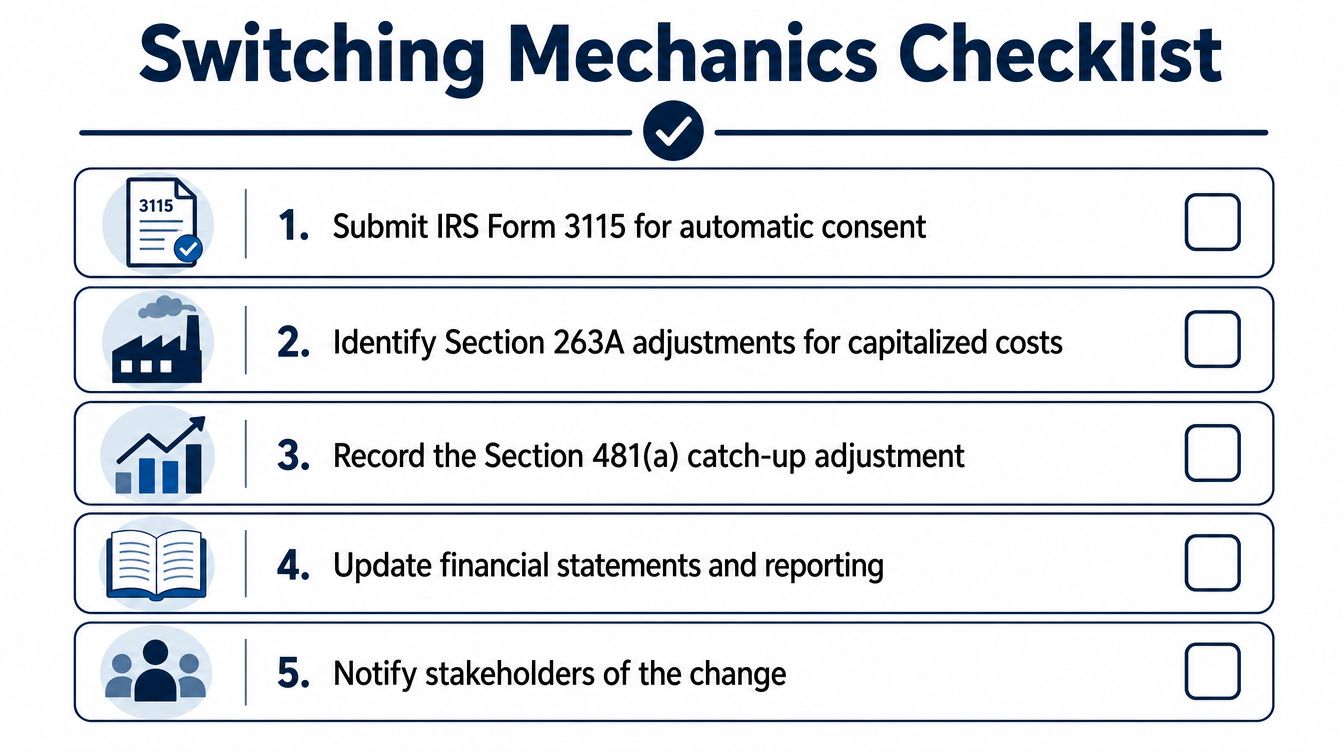
The IRS may require Form 3115, Application for Change in Accounting Method. First-time automatic changes may be available for qualifying businesses under the applicable small-business rules, but the current threshold and eligibility details need CPA review. Contractors and manufacturers also need to examine the Section 263A uniform capitalization rules, which can require certain production and acquisition costs to be included in inventory or job costs.
The conversion work
At the cutoff date, your books may need entries for:
- Accrued receivables: Record earned work that hasn't been collected.
- Accrued payables: Record costs incurred but not yet paid.
- Prepaid expenses: Move future-period costs out of the current period.
- Inventory on hand: Capture items that belong in inventory and cost of goods sold.
- Customer deposits: Separate cash received from revenue earned.
The change can also require a Section 481(a) adjustment, which addresses income or deductions that would otherwise be skipped or counted twice because of the method change. Your CPA should calculate and document it.
A workable transition plan
Start by cleaning customer and vendor records. Then reconcile bank and credit card accounts, review open invoices and bills, identify prepaid items, and confirm inventory or work-in-progress balances. Coordinate the tax filing with your CPA before posting the final conversion entries.
Next, update QuickBooks Online or Xero so the chart of accounts, invoice workflow, bill workflow, and reporting dates support accrual reporting. Give lenders, bonding companies, owners, and managers a short explanation of why gross profit timing changed. If a loan covenant or surety report relies on your statements, send revised reports before someone else discovers the change.
Choosing the Right Method for Your Business
Use cash accounting when your business is simple, customer payments arrive quickly, you don't carry inventory, and outside users don't need formal financial statements. That often fits freelancers, consultants, landlords, and service-only operations. It's not a badge of smallness. It's a practical choice when the bank account gives a reasonable picture of operations.
Choose accrual when you bill and wait, carry inventory, manage long-term contracts, track jobs, or need financial statements for lenders, investors, bonding, franchising, or a future sale. A growing agency may need it before the tax rules force the move. A contractor with open jobs may need it to stop confusing deposits with earned profit.
Some industries use specialized or hybrid approaches, including methods designed for farming or long-term contracts. Those choices require tax and industry guidance. Don't copy another contractor's method because the business card looks similar. Job structure, billing terms, inventory, and reporting needs can be completely different.
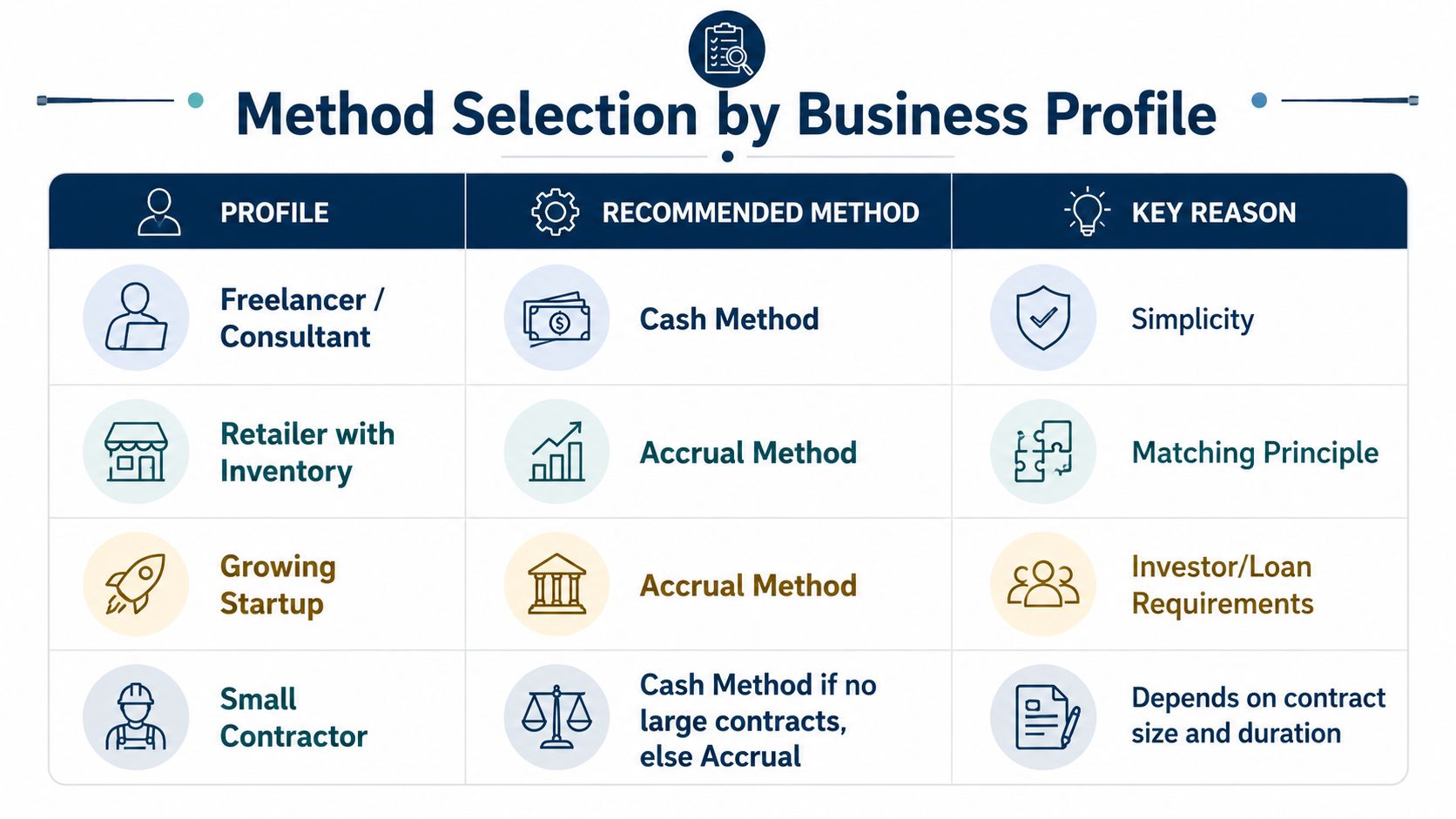
The five-minute self-test
Ask yourself three questions:
- Do you carry inventory? If yes, cash may not be available for every part of your tax accounting.
- Do you bill and wait? If customers take time to pay, accrual will usually give you a clearer operating picture.
- Do outside stakeholders review your books? If a lender, investor, bonding company, buyer, or franchisor will rely on your statements, accrual is usually the safer reporting choice.
Accrual isn't automatically better. It's better when your business earns money in one period, collects it in another, and carries costs across both. Cash is better when simplicity matters more than period-level precision and the business moves money quickly.
If you're unsure, don't change the method because a report looked strange. Have someone review your invoices, bills, deposits, inventory, contracts, and reporting needs together. MyOfficeOps provides bookkeeping, accounting, financial reporting, cash flow analysis, and CFO-level advisory for small and midsize businesses. Visit MyOfficeOps to discuss which method fits your actual operations and build a clean transition plan if your books have outgrown cash accounting.