

You open your bank statement at the end of the month, glance at your accounting software, and the balances don't match. Sometimes the gap is small enough to shrug off. Sometimes it's big enough to make your stomach drop a little.
That moment is where the bank reconciliation process starts. For a lot of small business owners, it feels like a simple matching task. In real life, it rarely stays simple for long. Maybe a customer paid through a card processor instead of ACH. Maybe one transfer between related entities got recorded on one side but not the other. Maybe your bank feed broke for two days and nobody noticed until close.
If you're new to bookkeeping, this can feel harder than it should. If you've been doing it for years, you already know the hidden part: the numbers usually fail to match for normal reasons at first, then for messy operational reasons after that. The trick is knowing which is which.
What Bank Reconciliation Actually Is and Why It Matters
A simple example makes this easier.
Say you run a small design firm. On Friday, your team records a client payment in the books. On Monday, the bank finally posts it. Over the weekend, your accounting software and your bank statement show different cash balances. That difference doesn't automatically mean someone made a mistake. It means you need to reconcile.
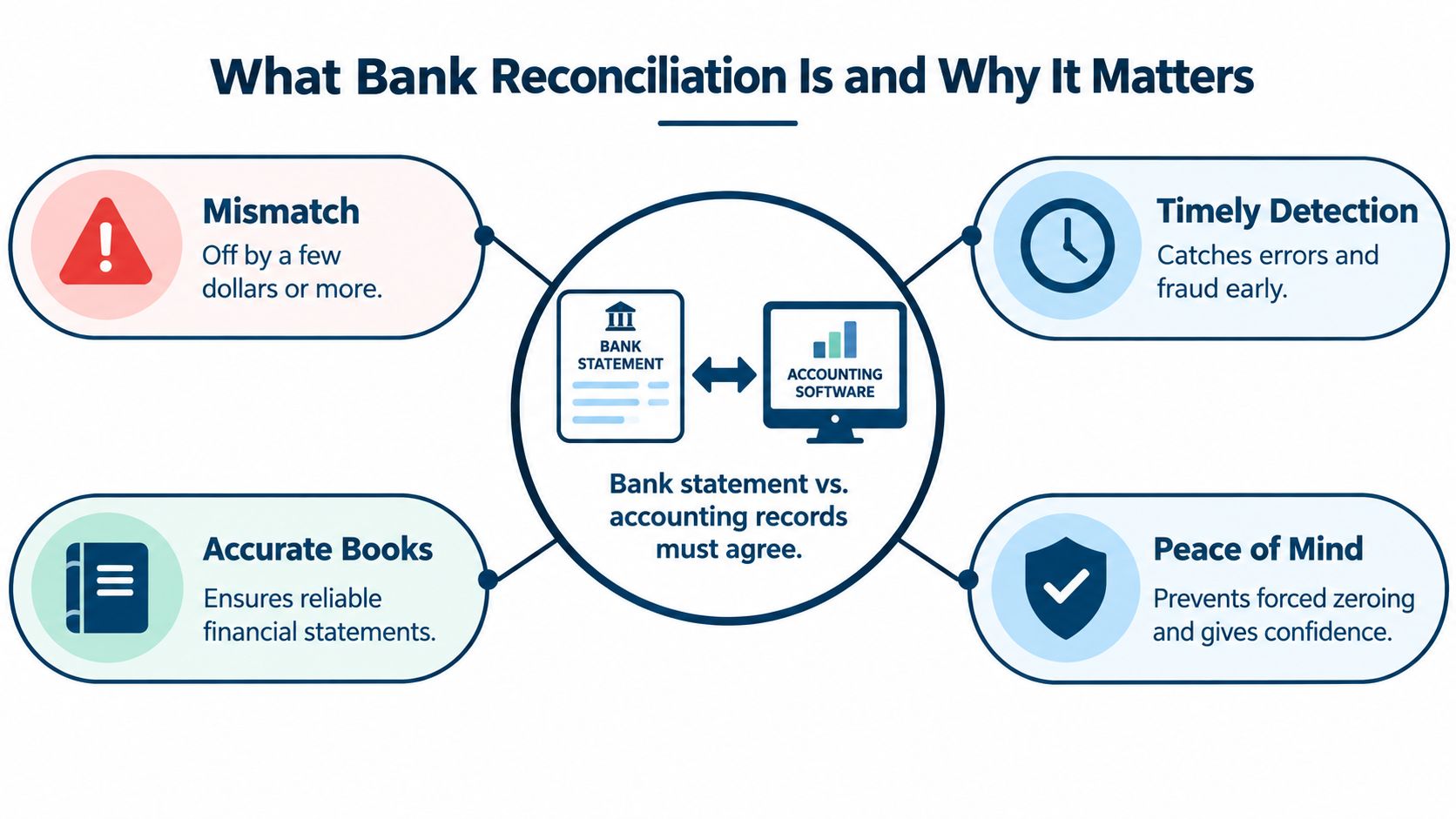
Bank reconciliation is the process of comparing your bank statement to your accounting records and explaining every difference until the adjusted balances agree. The standard accounting approach starts by comparing deposits and checks, then identifying deposits in transit and outstanding checks on the bank side, along with book-side items like bank charges or automatic payments that haven't yet been recorded in the ledger. That's the core flow taught in accounting training and used in practice (Lumen Learning).
It's not just about matching numbers
A lot of owners think reconciliation is bookkeeping cleanup. It's more than that.
The University of Washington's internal-control guidance says a reconciliation should also include things like reviewing canceled check endorsements, accounting for all pre-numbered checks including voids, reviewing checks made out to cash or to the custodian, and keeping support for reconciling items such as outstanding checks and in-transit deposits (University of Washington internal control guidance).
That means the bank reconciliation process helps catch more than math errors. It can uncover duplicate entries, unsupported payments, missing deposits, and unusual transactions before they snowball.
Practical rule: If a reconciliation “works” only because someone forced the balance to zero, it didn't work.
Why it matters to a small business
Cash decisions happen fast. You hire, buy software, order inventory, or approve payroll based on what you think is available. If your books are wrong, those decisions get risky fast.
This is also why month-end close quality matters. If your reconciliation process is weak, your close is weak too. If you want a practical companion resource, these accurate month-end close tips are worth reviewing alongside your cash reconciliation routine.
The short version is simple. If you haven't reconciled recently, you don't fully know your cash position. And if you don't know your cash position, you're making business decisions with a blind spot.
Getting Your Numbers Ready Before You Start
A reconciliation can fail before anyone matches the first transaction.
That usually happens when the bank account looks simple on the surface, but the cash activity behind it is not. One bank deposit might combine card batches, ACH receipts, and a same-day wire. One withdrawal might cover payroll, bank fees, and a returned item. If intercompany transfers hit one entity today and the other entity tomorrow, or a bank feed skips two days of activity, the books can look close while still being wrong.
Preparation is what keeps reconciliation from turning into cleanup.
Pull the records that explain cash movement
Start with the bank statement and the cash ledger for the exact same period. Then gather the support that explains anything the statement will not explain on its own.
That usually includes deposit detail, check images, merchant processor summaries, ACH reports, transfer logs, loan activity, and any documentation for intercompany entries. If your business collects money through more than one rail, such as checks, cards, ACH, wires, or payment apps, do not rely on the bank line alone. The bank shows what settled. It does not show how the total was built.
Public-sector reconciliation guidance also stresses a disciplined order: obtain the statement and ledger, confirm the math, match activity, identify reconciling items, investigate older exceptions, and keep support with evidence of review and sign-off (Washington State Auditor best practices).
Know what a usable starting point looks like
Usable books are current enough to test. They do not need to be flawless. They do need to be coherent.
A usable ledger has posted transactions, understandable descriptions, recorded fees, and transfers entered on both sides. It also has a way to explain composite deposits and partial payments. If a customer paid one invoice in two installments, or one payment covered several invoices, that support should already exist before reconciliation starts.
A weak starting point shows up fast. You see uncategorized bank feed items, stale outstanding checks, processor deposits with no batch detail, or intercompany entries with no matching record from the other entity.
| Record condition | What it looks like |
|---|---|
| Clean starting point | Transactions are posted, dates align to the statement period, fees and transfers are recorded, deposit detail is available |
| Messy starting point | Missing entries, vague memos, uncategorized feed items, prior periods still unresolved |
| High-risk starting point | Broken bank feeds, processor net deposits not tied to gross activity and fees, partial payments without support, intercompany cash movement missing backup |
If your records already fit the second or third column, fix the books first. This bookkeeping clean up checklist is a practical starting point for old unreconciled periods and incomplete support.
Reconciliation shows where bookkeeping broke. It does not repair weak source records on its own.
Check the problem areas before you start matching
A short pre-check saves a lot of false leads.
- Opening balance: Confirm the prior period closed. If last month contains an unresolved difference, it rolls forward.
- Bank feed completeness: Make sure the feed imported the full period. Missing days create fake reconciling items.
- Multi-rail deposits: Review whether card settlements, ACH collections, and wires were grouped into single bank deposits. You may need batch reports to break them apart.
- Partial and net payments: Check whether customer receipts were posted at the gross amount, net amount, or split across invoices. This is a common source of small unexplained differences.
- Intercompany transfers: Verify both entities recorded the same transfer amount and date, or at least document the timing difference.
- Unusual timing items: Returned payments, reversals, and month-end transfers often belong to the period, even if the bank posts them a day or two later.
I see one mistake often in cleanup work. Teams try to reconcile several old months at once, then start posting plugs because the differences blur together. A better approach is to finish the posting, confirm the support, and reconcile one period in order.
The Bank Reconciliation Process Step by Step
Let's use a plain example.
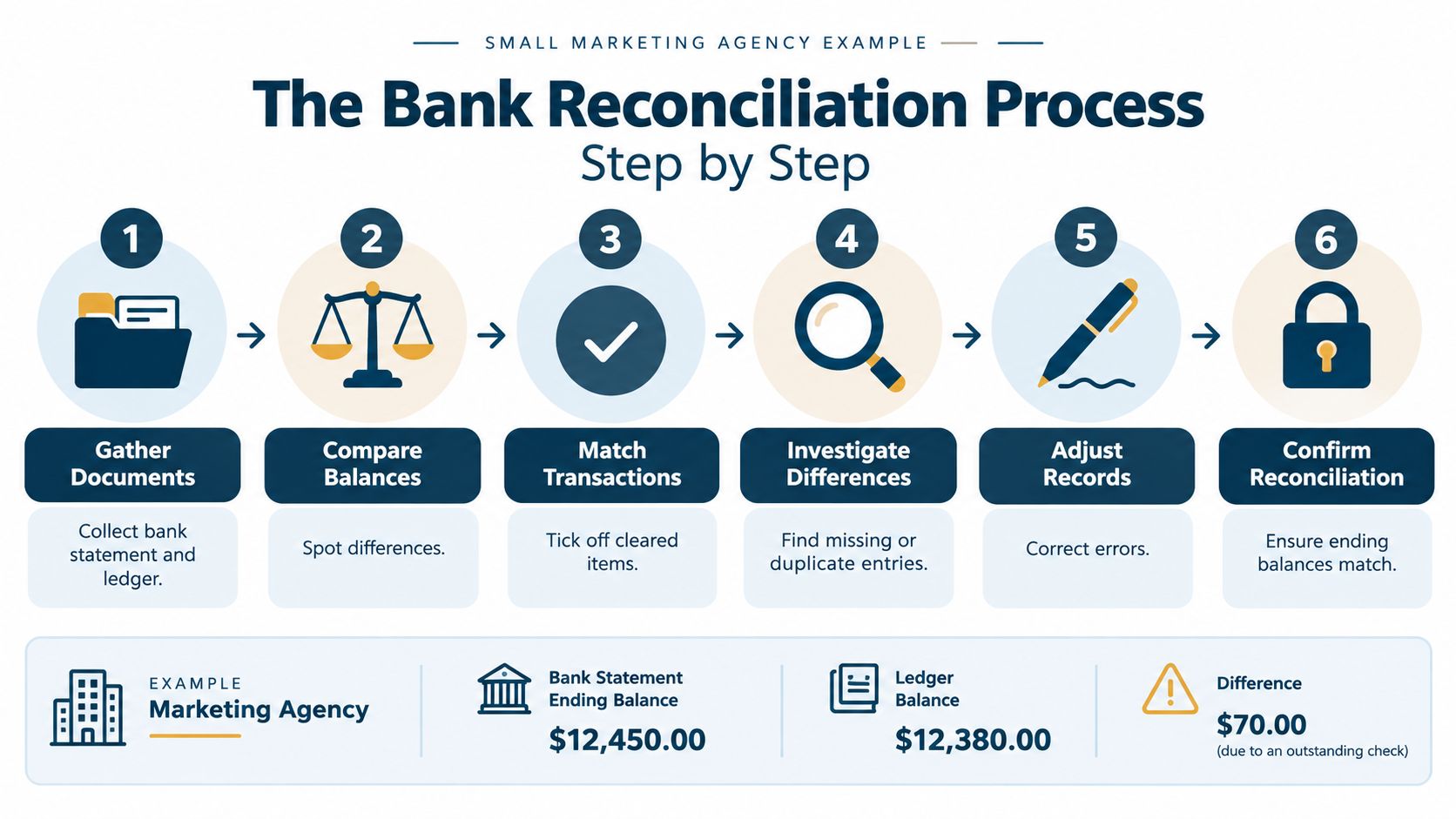
You run a small marketing agency. At month-end, the bank statement ending balance is $12,450.00 and your ledger balance is $12,380.00. The balances are close, but they don't match. That's normal. Your job is to find out why.
Step 1 Gather the statement and the ledger
Put the bank statement and the cash account detail side by side. If you use QuickBooks, Xero, NetSuite, or a spreadsheet, the software matters less than the discipline here.
Start with the ending balances for the same period. If the periods don't line up, stop and fix that first.
Step 2 Match cleared transactions line by line
Go through deposits and withdrawals one by one.
Mark every item that appears in both places. This sounds basic, but it's where many issues first show up. A payment may have been entered twice in the books, or a bank transaction may have posted with a description your team didn't recognize.
Step 3 Identify deposits in transit and outstanding checks
Some differences are just timing.
A deposit in transit is money you recorded before the bank posted it. An outstanding check is a check you issued that hasn't cleared yet. Accounting training materials explain the bank side this way: start with the bank statement ending balance, add deposits in transit, and subtract outstanding checks to reach the adjusted bank balance (Lumen Learning deposit and check example).
In this example, suppose the only open timing item is one outstanding check for $70.00.
Bank side math:
- Bank ending balance: $12,450.00
- Less outstanding check: $70.00
- Adjusted bank balance: $12,380.00
Now the adjusted bank balance matches the ledger.
Step 4 Record book-side items if needed
Sometimes the books need updating too.
Common book-side adjustments include:
- Bank service charges: Fees on the statement that nobody posted yet
- Interest earned: Small credits the bank recorded first
- Automatic payments: Loan drafts, subscriptions, or utility pulls
- Direct debits and credits: Items the bank knows about before your team does
If those exist, update the books with proper support and descriptions. Don't bury them in a vague “recon adjustment” line.
A clean reconciliation explains the difference. It doesn't hide it.
Step 5 Recheck the adjusted balances
At this point, both sides should agree after valid reconciling items and any needed book entries.
If they still don't match, the remaining difference usually falls into one of these buckets:
| Possible issue | What to look for |
|---|---|
| Data entry mistake | Wrong amount, duplicate posting, wrong date |
| Missing transaction | Statement item absent from books, or vice versa |
| Feed problem | Import gap, duplicate sync, broken connection |
| Complex matching issue | Split deposits, processor netting, partial payments |
Step 6 Save the support and sign off
This part gets skipped too often.
A proper bank reconciliation process keeps the statement, the reconciled report, support for every open item, and evidence of who prepared and reviewed it. That file becomes part of your close record, not just a temporary worksheet.
For a simple account, this may take minutes. For a business with card settlements, ACH pulls, transfers between related entities, and multiple cash apps, the same process still applies. There are just more places where one transaction can appear differently across systems.
When Numbers Don't Match Up Common Discrepancies
Some mismatches are routine. Others point to broken process.
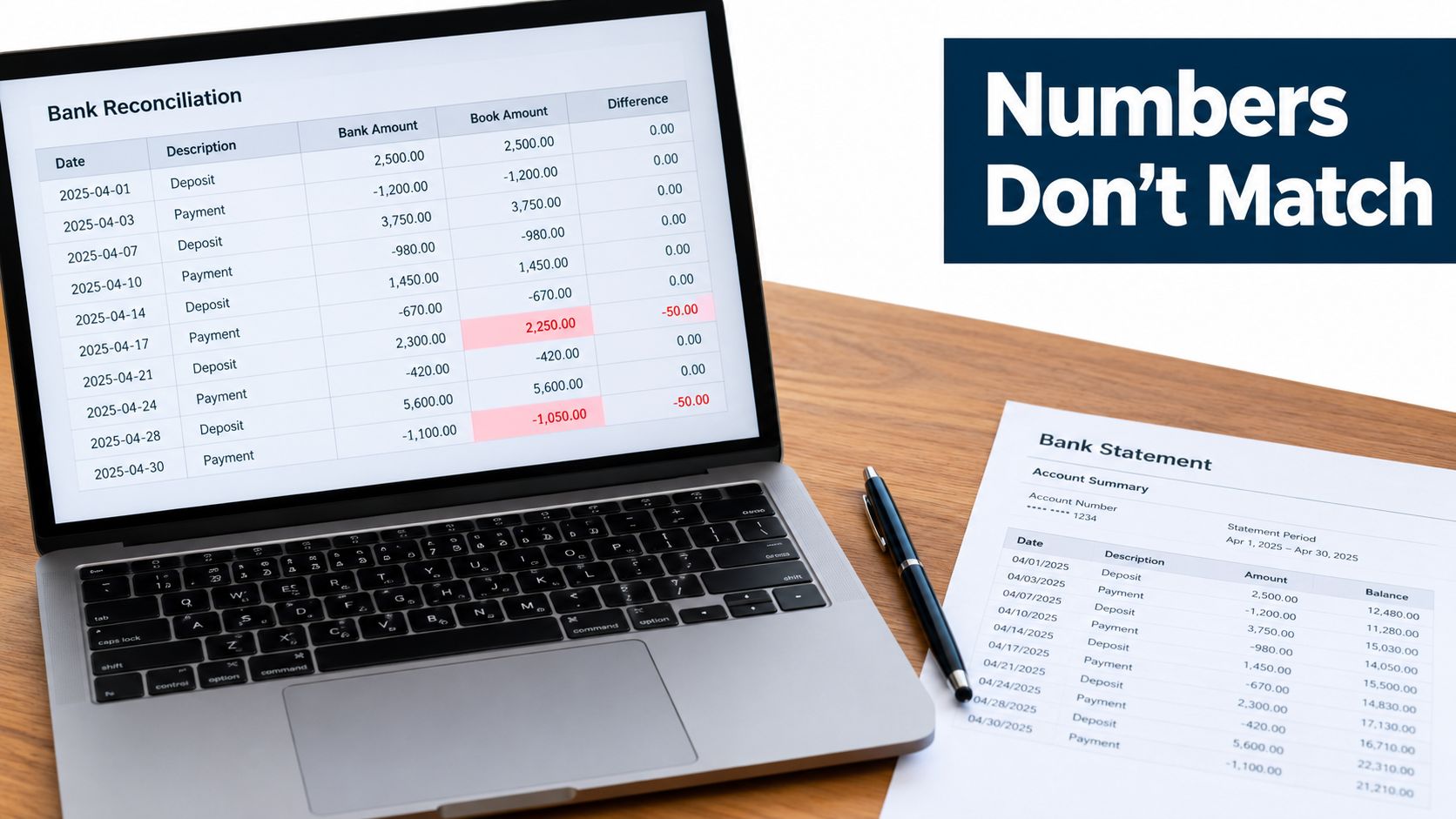
The worst move here is forcing an entry so the reconciliation “finishes.” The better move is to classify the discrepancy, age it, and resolve it with support.
Timing items that stay open too long
Training materials for monthly reconciliation stress a basic but important rule: review prior month outstanding checks and deposits in transit against the current statement. If they still haven't cleared, they remain on the reconciling list and must be researched (Paychex overview of monthly carryforward items).
That matters because timing items can turn into real issues.
- Outstanding checks: A check can sit open because a vendor never cashed it, it was lost, or it was replaced and nobody cleared the original correctly.
- Deposits in transit: A deposit that doesn't clear in the next period may point to a posting error, a returned item, or a processor delay that needs support.
If an item keeps aging, don't leave it on autopilot. Call the vendor. Review the deposit slip. Check the processor batch. Ask who posted it.
Errors people make by hand
Manual work creates avoidable mistakes. One 2026 industry analysis cites 10-15% initial matching error rates in manual reconciliation, while another source reports 0.8%-1.8% manual balance-sheet reconciliation error rates. The practical takeaway from that same discussion is that stale unreconciled items and delayed review are the main failure modes, so unresolved items should be aged and escalated instead of forced to zero (manual reconciliation pain points and control takeaway).
A few patterns show up over and over:
| Discrepancy | What it usually means | Best next step |
|---|---|---|
| Duplicate entry | Same payment or deposit entered twice | Trace who posted it and reverse the extra entry |
| Transposed amount | Digits were entered in the wrong order | Check nearby entries and supporting documents |
| Missing bank fee | Statement has charges books don't | Post the fee with the right date and account |
| Bank-side oddity | Statement item seems wrong | Pull support and contact the bank if needed |
The hidden problems basic guides skip
Many small business guides fall short. They explain checks and deposits, then stop.
In real businesses, the hard cases often involve:
- Partial payments: A customer pays one invoice across multiple transactions, or one payment covers several invoices.
- Intercompany activity: One entity records the transfer today, the other records it later, or uses a different reference.
- Processor netting: A card processor sends one net deposit that combines sales, fees, refunds, and chargebacks.
- Broken bank feeds: The sync fails, duplicates transactions, or skips a date range entirely.
These aren't rare edge cases anymore. They're common once a business grows beyond one account and one payment method. If you need a plain-language overview of how teams try to streamline SME reconciliation with Zynthoro, that resource gives useful context on the broader accounting side.
Old outstanding items are not harmless. They're unanswered questions sitting in your cash account.
Making Reconciliation Easier With Automation and Software
Manual reconciliation still works for some businesses. It also breaks down faster than many owners expect.
Once you have multiple bank accounts, processor deposits, ACH activity, wires, card settlements, or transfers between entities, software stops being a luxury and starts being basic infrastructure. The key is knowing what software helps with, and what it still can't solve on its own.
What good software changes
Modern systems don't treat reconciliation as a one-time matching task. They treat it as an auditable record.
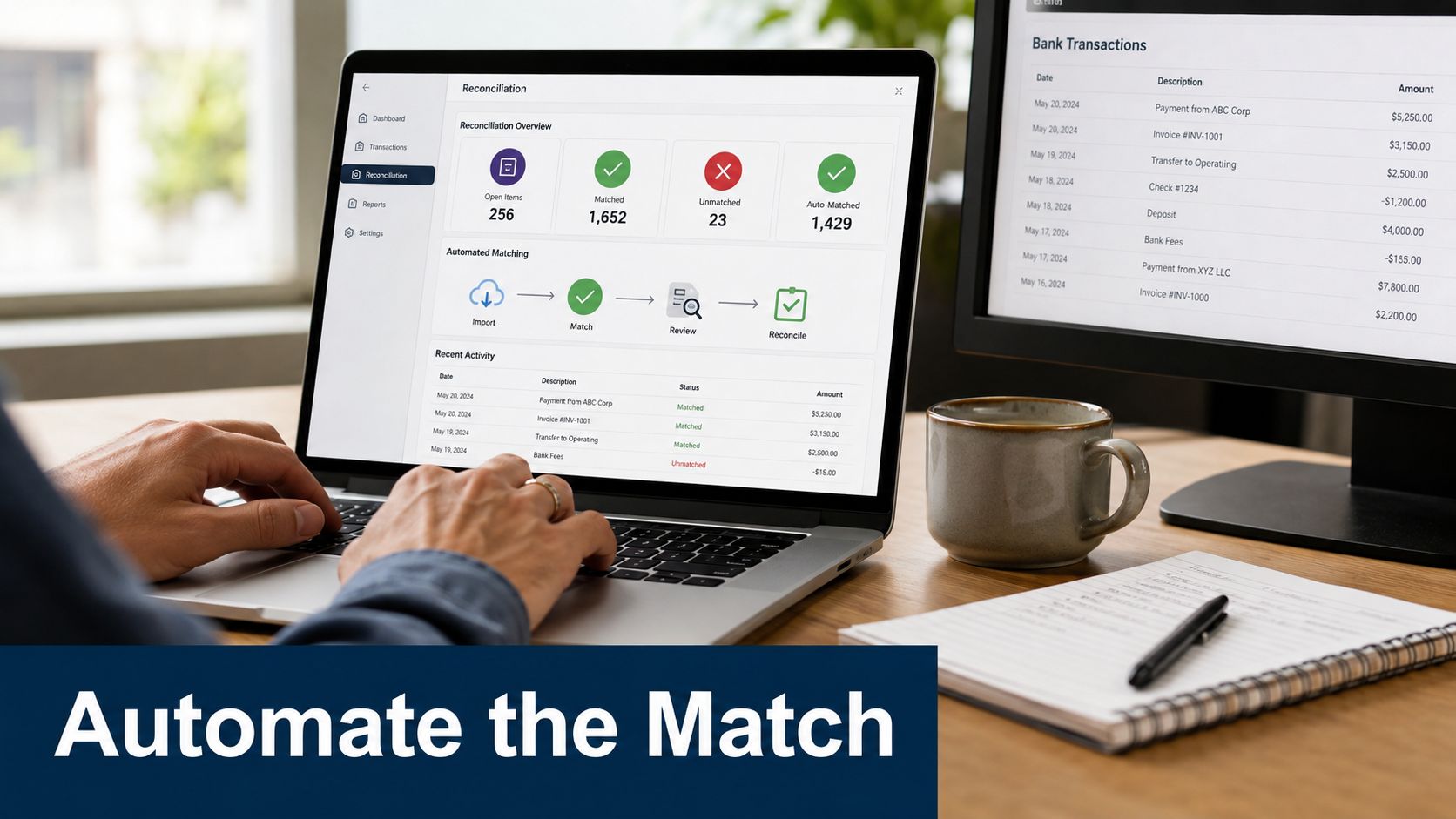
Oracle NetSuite's reconciliation history report preserves completed reconciliations by bank account and shows the statement date, statement balance, amount reconciled for that statement, previous reconciled balance, and differences. Microsoft Dynamics GP also notes that transaction and reconciliation history can be stored for an unlimited number of years, which turns each completed reconciliation into a durable control trail (Oracle NetSuite reconciliation history reference).
That matters because a good system lets you reopen, review, and compare past reconciliations instead of treating each month as a fresh mystery.
Some tools go even further. Light's reconciliation history view records the date and time of each reconciliation, who ran it or whether it was automatic, the number of transactions processed, the number of matches found, and success or failure status. Light also states that reconciliation records should typically be kept for at least 7 years for audit purposes (Light reconciliation reports).
Manual, semi-automated, and automated
Here's the trade-off in plain terms:
- Manual: Fine for low volume, but slow and easy to mess up when transaction counts rise.
- Semi-automated: Good fit for many SMBs. Bank feeds import data, but a person still reviews exceptions and posts tricky items.
- More automated workflows: Better for higher volume and more complex cash movement, especially when there are multiple systems feeding the ledger.
A lot of larger organizations have already moved in this direction. Recent 2026 coverage says 78-82% of large financial institutions in North America and Europe had adopted some form of automated bank account reconciliation technology by June 2026, and one report projects the automation segment will grow at a 12.6% CAGR from 2026-2034. The same coverage points out the pain points automation still struggles with: partial payments, intercompany activity, reference-number inconsistencies, and broken bank connections across ACH, wire, card, RTP, FedNow, and Zelle environments (multi-rail reconciliation and automation adoption).
Where automation still needs a human
Software matches patterns. People resolve context.
If your processor batches several customer payments into one net deposit, software may not know whether that difference is fees, refunds, a reserve hold, or a setup problem. If one subsidiary records an intercompany transfer with a different memo than the receiving entity, matching rules may miss it.
That's why integration matters as much as automation. If you're evaluating feeds, APIs, and workflow handoffs, this practical guide to accounting integration is useful background, along with this accounting software integration resource for SMB teams sorting out systems.
For businesses that want outside help instead of building the workflow alone, MyOfficeOps is one example of a firm that handles bank and credit account reconciliation as part of ongoing bookkeeping and accounting support.
Building Internal Controls and Staying Consistent
Friday close looks fine until one merchant payout lands net of fees, an intercompany transfer clears in one entity but not the other, and the bank feed drops a day of activity. The reconciliation still has to hold up.
That is why consistency matters as much as technique. Plenty of reconciliation problems start with ordinary process drift, not exotic accounting. A skipped month turns into a backlog. Old outstanding items keep rolling forward. Small bank charges never get posted. By the time someone notices, the account balance may be right for the wrong reasons.
Set a cadence that fits the account
Monthly reconciliation is the baseline. For some accounts, it is not enough.
Operating cash, payroll clearing, merchant settlement, and any account receiving ACH, card, wire, RTP, or internal transfers often need review during the month, not just after statement close. A quiet reserve account may only need a standard monthly cadence. The trade-off is simple. More frequent reviews take staff time, but they catch broken feeds, duplicate imports, net settlement errors, and missing entries before month-end turns into cleanup work.
The best cadence catches problems while the details are still easy to trace.
Build review into the process
A reconciliation should not be prepared and approved by the same person without any independent check.
Even small teams can split responsibilities in a practical way:
- Preparer: Completes the reconciliation and attaches support for each open item
- Reviewer: Checks aged exceptions, unusual adjustments, and whether the explanation fits the transaction
- Owner or outside advisor: Resolves repeat issues, especially items tied to intercompany activity, payment processors, or feed failures
If one person has to do most of the bookkeeping, add a periodic review by an owner, controller, or outside accountant. The point is not bureaucracy. The point is catching the quiet errors that software and habit both miss.
Keep support clear and age every open item
Open items need evidence and a next step. That includes deposit detail, processor reports, transfer confirmations, fee notices, screenshots from failed bank syncs, and notes on partial payments that cleared in pieces.
A useful monthly checklist usually includes:
- Start with prior reconciling items: Clear what should have cleared, and question what did not
- Use the final statement: Reconcile to the closed-period bank statement, not a live activity screen that can still change
- Document each new difference: Record what it is, why it exists, and who owns the follow-up
- Age exceptions: A 60-day-old deposit in transit or intercompany mismatch deserves attention
- File support with approval: Keep the reconciliation, backup, and reviewer sign-off together
For teams that want a cleaner review trail, this audit-ready reconciliation support checklist gives a practical way to organize backup and sign-off.
Retention matters too. Keep reconciliation reports and support long enough to answer audit, tax, lender, or due diligence questions later. Most accounting systems make that easier now, but only if the records are stored consistently.
The businesses that stay out of trouble usually are not the ones with the flashiest tools. They are the ones with a repeatable routine, clear ownership, and enough skepticism to investigate items that do not make sense.
If your reconciliations keep slipping past month-end, or you are sorting through processor deposits, intercompany transfers, and books that never fully tie out, MyOfficeOps can help. They provide bookkeeping, accounting, payroll integration, and advisory support for small and midsize businesses that need clean records, reliable close routines, and a clearer view of cash.