
You know the feeling. It's late, you're staring at bank balances, payroll is coming up, and you're trying to decide whether to hire, hold, or hope next month goes better. That moment is where financial planning basics stop sounding like a classroom topic and start feeling like a survival skill.
For a lot of small-business owners, money management gets buried under client work, vendor calls, and the daily fire drill. The good news is that the basics are not mysterious. They're the same few habits over and over, knowing where you stand, deciding where you want to go, and putting guardrails around what can knock you off track.
The Moment Every Business Owner Recognizes
The stack on the kitchen table looks harmless until you start opening it. One statement shows a healthy month, another shows a tax payment due, and a third reminds you that payroll lands before the next client check clears. That's the exact moment most owners realize they're not short on effort, they're short on a system.
A lot of people think financial planning belongs to wealthy families or people with a full-time finance person. It doesn't. A study from the Consumer Federation of America and CFP Board found that about 9 in 10 U.S. households said they did at least some financial planning, yet only 19% were detailed planners, while 38% were basic planners and 33% were limited planners. The same research showed why structure matters, 85% of detailed planners had at least three months of emergency savings, compared with 58% of basic planners, 27% of limited planners, and 15% of non-planners, while 91% of detailed planners saved for retirement versus 70% of basic planners and just 32% of non-planners. Consumer Federation of America and CFP Board study
For a business owner, that's the lesson. Planning isn't a fancy spreadsheet. It's a way to answer three honest questions every month.
Practical rule: if you can't explain where the money came from, where it went, and what it's protecting, the plan is still missing.
That's why the basics of financial planning feel so useful once they're stripped down. You look at where you are, you name where you're going, and you identify what could get in the way. That same pattern works whether you're managing a household, a consulting firm, or a shop with four employees.
The stress usually comes from trying to do all of it at once. Start with the raw numbers you already have, bank balances, invoices, bills, and debt. The rest is just organizing the facts so the next decision isn't a guess.
The Core Building Blocks of Any Plan
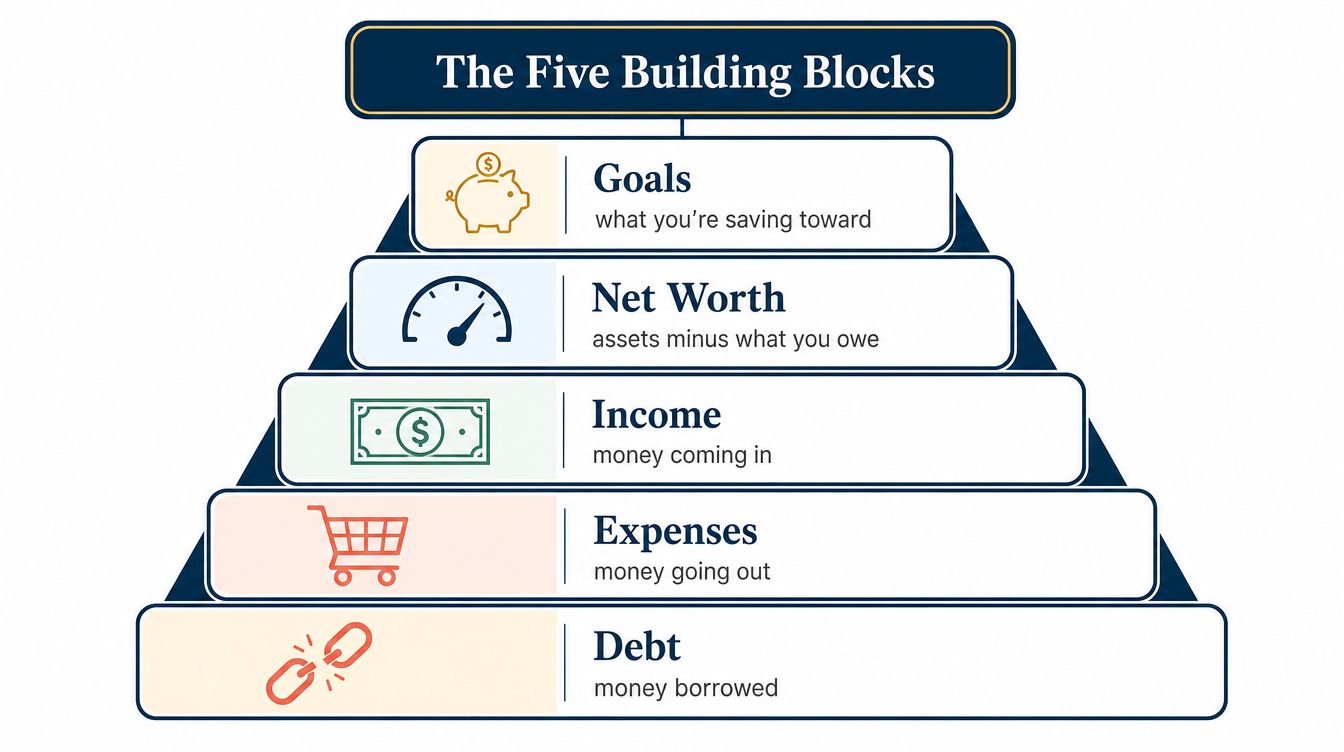
A solid plan starts with five pieces, goals, net worth, income, expenses, and debt. For a business owner, that is the same as checking the label on every dollar that comes through the door. Goals show what the money is supposed to do, net worth shows what has been built so far, income shows what is entering the business, expenses show what is leaving it, and debt shows what still needs attention.
The cleanest place to begin is the place that tells the truth. Charles Schwab describes a net worth statement as a baseline built from assets minus liabilities, which helps you measure whether financial health is improving over time, not just whether one account looks healthy today (Schwab's financial planning guide). For SMB owners, that matters because a large deposit can look reassuring while unpaid taxes, slow customer payments, or lingering loan balances still weaken the overall picture.
A shop owner sees this in plain English. The checking account may look comfortable after a busy week, yet the monthly rent, payroll, and tax payment still sit in the background waiting for their turn. A plan that starts with net worth and cash flow keeps those future bills from hiding in the shadows.
The order that keeps the plan from getting messy
- List what you own and what you owe. That gives you net worth.
- Estimate what comes in and what goes out. That is cash flow.
- Write down every debt. Credit cards, loans, tax balances, anything with a due date.
- Choose the next best use for every extra dollar. Savings, debt paydown, taxes, or growth.
- Review the numbers each month. If they change, the plan should change too.
That sequence keeps you from doing budget math in your head while also trying to run the business. A basic financial plan usually follows a practical order, identify goals, figure out net worth, estimate income and expenses, review debt, allocate savings, balance income and expenses, implement the plan, then review and modify it as needed (financial planning basics primer).
Net worth is the scoreboard. Cash flow is the heartbeat.
For business owners, that difference matters. Net worth shows whether the business is building value. Cash flow shows whether you can keep the lights on next Friday. If you only track one, half the story goes missing.
When evaluating growth capital, it helps to compare startup funding sources so you can see the trade-offs between equity and debt before you commit. That same habit fits the rest of the plan too, because every funding choice affects the balance between what you own, what you owe, and how much room you have to breathe.
If you want a simple way to connect the money view with daily operations, start with your internal metrics too, especially if you are already tracking performance with tools like this KPI resource. A plan works better when the financial picture and the operating picture are talking to each other.
Budgets, Cash-Flow Forecasts, and KPI Dashboards That Actually Work
A budget is where a lot of owners start, but a budget alone won't save a business that gets paid unevenly. You need three tools side by side, a monthly budget, a rolling cash-flow forecast, and a KPI dashboard. Each one answers a different question, and together they keep you from confusing profit, cash, and momentum.
A budget keeps spending honest
A simple monthly budget can be written as income minus fixed expenses minus variable expenses minus profit set-aside. It doesn't have to be fancy. If you're running a West Chester agency, for example, the fixed costs might be software, rent, and salaries, while the variable costs are contractors, ads, or client gifts. If the profit set-aside happens first instead of last, you stop treating profit like leftovers.
If you want a template, the structure in this budgeting guide is easy to adapt for both households and businesses. The point isn't perfection. It's getting a realistic number on paper so you can see whether your spending matches your priorities.
A cash-flow forecast shows the timing
A budget can be right and still not protect you from a short-term squeeze. That's why a 13-week rolling cash-flow forecast matters. It tracks what hits the bank each week, which is especially useful for a healthcare clinic waiting on reimbursements or a contractor collecting payment at milestones. The money may be earned, but if it isn't in the account yet, payroll still needs to be covered.
Useful habit: forecast the timing of cash, not just the size of invoices.
A KPI dashboard tells you what's changing
A one-page KPI dashboard keeps the business focused on a handful of signals that matter. For many owners, that includes gross margin, days sales outstanding, utilization or billable hours, and runway in weeks. If you want a clean example of how a dashboard is framed, Cyndra's KPI dashboard guide is a helpful reference point for how leaders use one-page visibility without drowning in reports.
| Three SMB Planning Templates at a Glance | |||
|---|---|---|---|
| Template | What it tracks | Best cadence | Small-business example |
| Budget | Planned income, fixed costs, variable costs, profit set-aside | Monthly | Agency owner comparing payroll and software spend to incoming retainers |
| 13-week cash-flow forecast | Weekly deposits, bills, payroll, taxes | Weekly | Clinic owner watching reimbursement timing |
| KPI dashboard | Margin, collections speed, billable capacity, runway | Weekly or monthly | Contractor checking job profitability |
A real dashboard makes tradeoffs obvious. If gross margin slips while billable hours look full, the pricing problem is probably hidden somewhere else. If runway is shrinking, the answer isn't “work harder,” it's to slow spending, collect faster, or both.
Why the Standard Emergency-Fund Rule Needs a Small-Business Twist
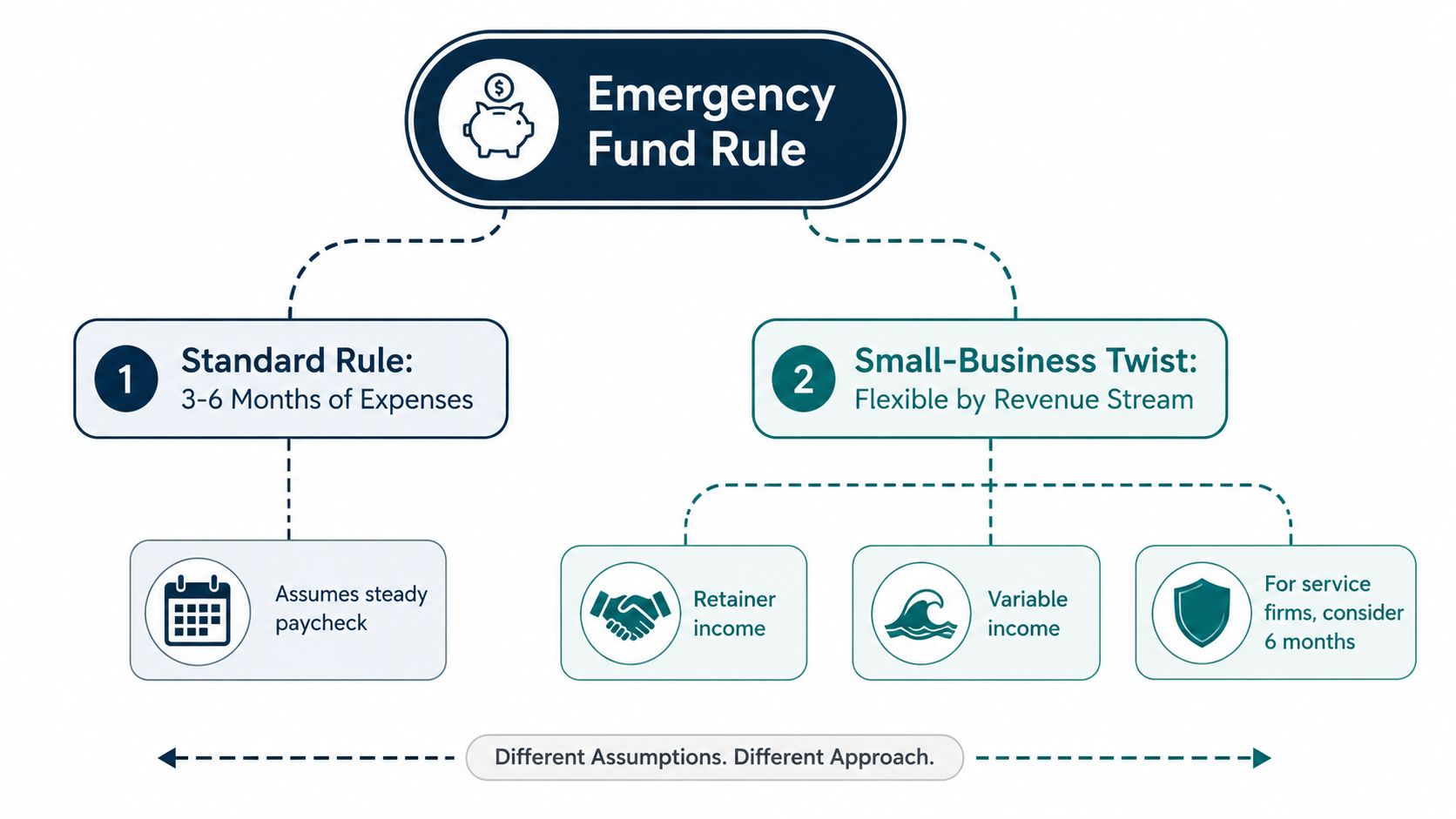
The usual advice says to save 3 to 6 months of living expenses, and that's a decent starting point for many households. But it can be too blunt for a business owner whose income doesn't arrive like a paycheck. A payroll-based service firm, a clinic waiting on reimbursements, and a contractor tied to project milestones all face different kinds of timing risk.
The data around liquidity makes this even more important. A recent industry summary said only 31% of U.S. households had a documented long-term financial plan in 2025, while 29% had more credit card debt than emergency savings heading into 2026. Separate FINRA Foundation data found that the share of U.S. adults saying they had enough money to cover three months of living expenses fell to 46% from 53% in 2021. Fortunly's 2025 personal finance statistics summary That's a reminder that a plan isn't just about ambition, it's about whether cash is there when life gets noisy.
A better buffer is tied to your revenue pattern
If your revenue is stable and recurring, a smaller reserve can still be workable. If your revenue is lumpy, seasonal, or tied up in receivables, a larger reserve makes more sense. The right answer is the one that lets you sleep and still make payroll.
The Society of Actuaries has described the middle market as vastly underserved, with little savings and limited access to financial services that support security, and CFPB research on economically vulnerable consumers points to income volatility, bill timing, and liquidity constraints as major causes of instability rather than a simple lack of budgeting knowledge (SOA research on the middle market). That lines up with what owners already know, a flat rule can be unrealistic when the cash comes in waves.
Buffer-building tricks that actually stick
- Sweep a fixed share of each deposit. Move part of every client payment into a separate reserve account before it gets absorbed by operating costs.
- Pre-fund taxes weekly. Don't wait for a quarterly surprise to hit the checking account.
- Use a payroll-only subaccount. If payroll is your biggest fear, isolate that money so it's easier to protect.
- Build the fund in layers. Start with a bare-bones target, then grow it as revenue steadies.
That's the small-business twist. You're not ignoring the emergency-fund rule, you're translating it into something you'll use. A plan only works when the owner trusts the number enough not to break it under pressure.
Five Common Pitfalls That Quietly Wreck Good Plans
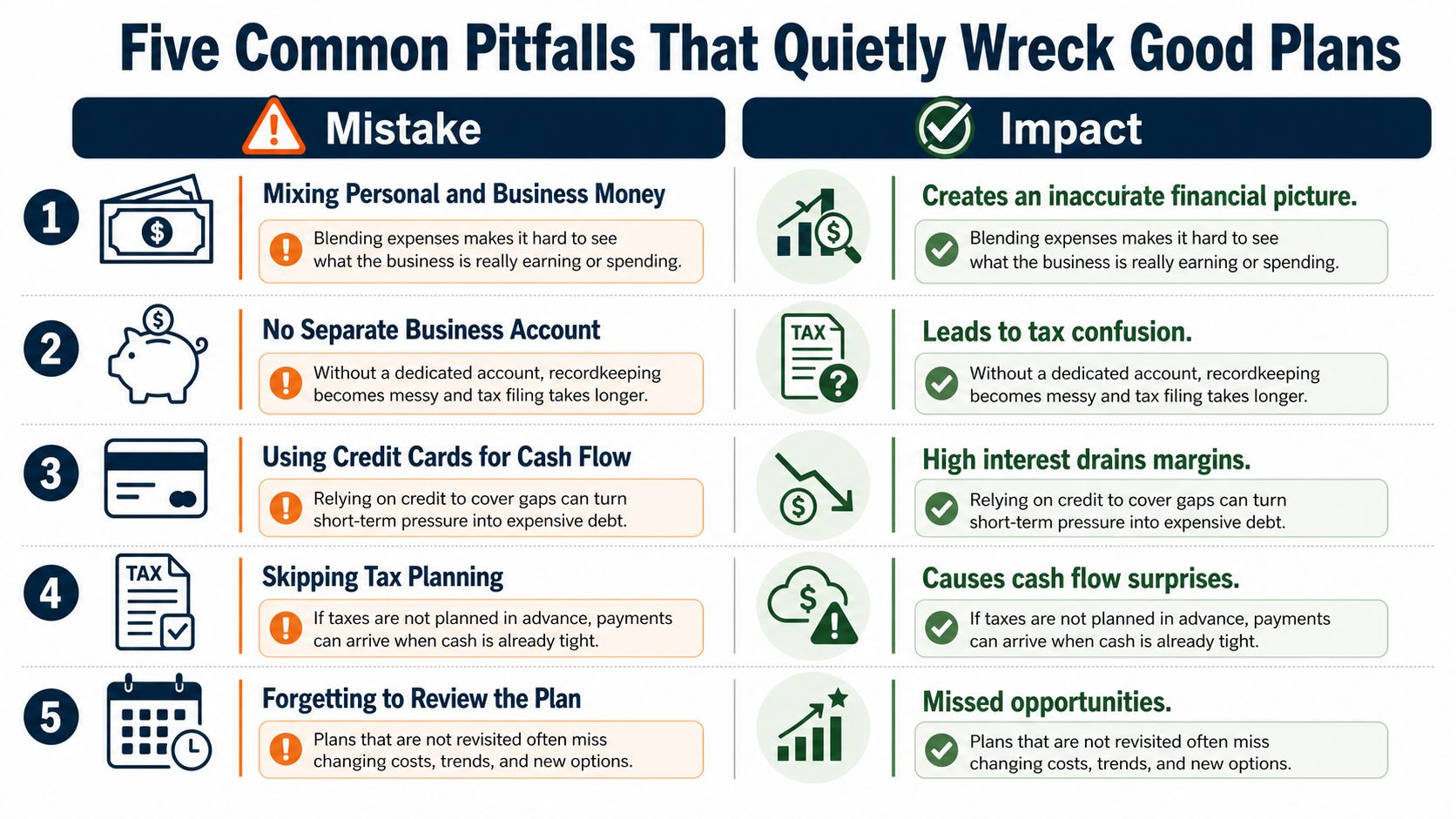
The worst planning mistakes usually don't look dramatic at first. They look like convenience. A founder pays a personal bill from the business account, skips a monthly review, or assumes revenue means there's money available to spend. Then tax season, payroll, or a slow month exposes the gap.
The mistakes that cause the most damage
- Mixing personal and business money. It makes the true picture harder to read, and it turns tax prep into detective work.
- Ignoring the balance sheet. If you only watch revenue, you can miss debt, unpaid obligations, or shrinking reserves.
- Treating the budget as a one-time exercise. A budget that never gets reviewed becomes a stale guess.
- Chasing vanity numbers. High revenue feels good, but cash and margin are what keep a business alive.
- Growing without runway. An agency that doubles headcount without checking cash can end up doubling stress too.
Those patterns show up in different industries, but the story is often the same. A business owner sees money coming in and assumes the account balance means it's safe to spend. Then the bills hit all at once, and the “profit” vanishes.
A simple planning habit can prevent most of this. Keep personal and business accounts separate, review the balance sheet, and make the monthly check-in mandatory. If you're using short-term borrowing just to smooth cash flow, that's a sign the forecast, pricing, or collection process needs attention.
Growth is only good if the business can survive the month after it grows.
The bigger issue is that many owners skip the boring steps because they don't feel urgent. But the boring steps are the protection. They keep a strong month from turning into a weak decision.
A 30-60-90 Day Roadmap to Get Your Plan Off the Ground
The easiest way to begin is not with a giant makeover. It's with three short phases that give the business enough structure to move. If you're behind, this is still manageable.
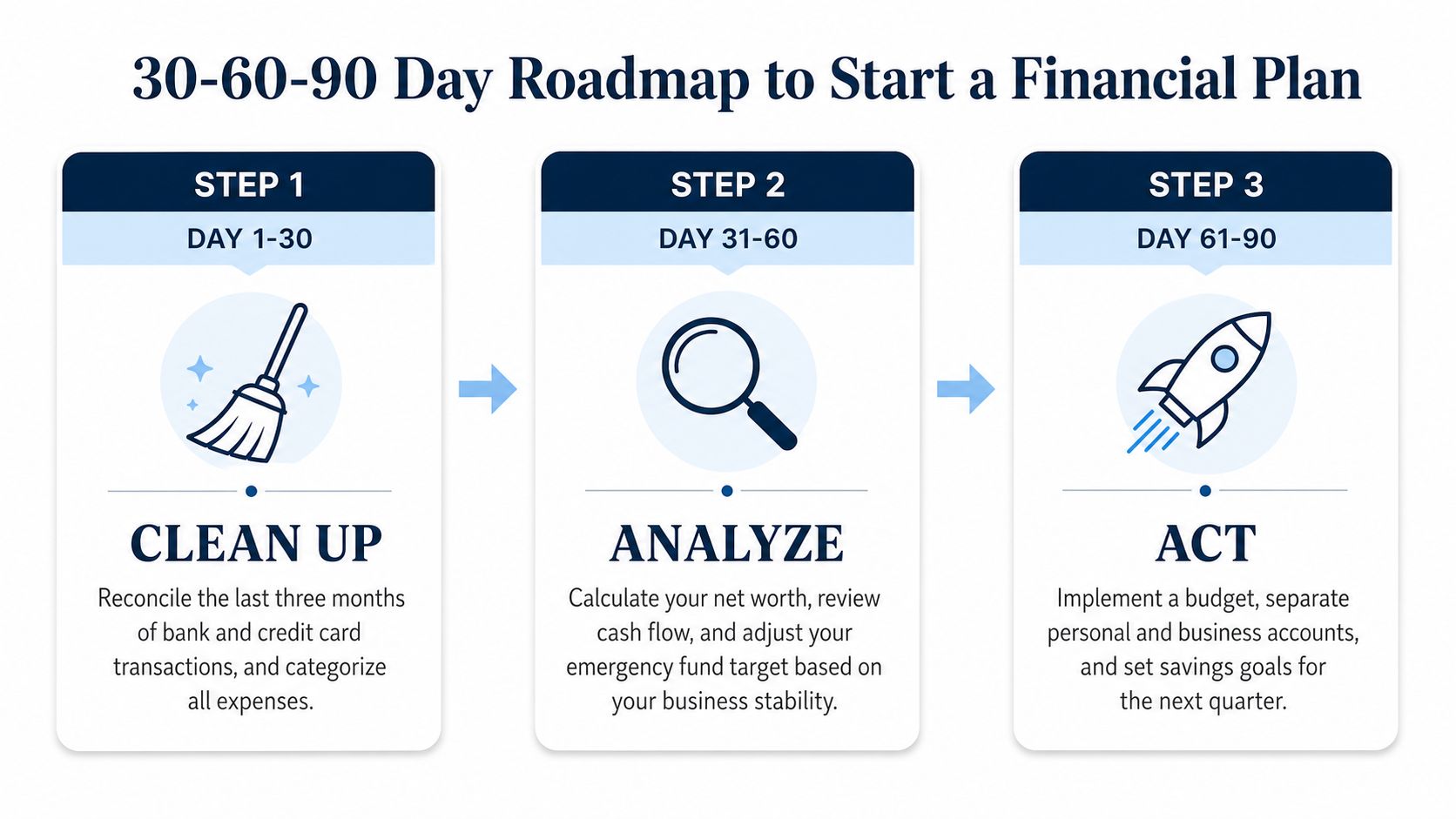
Days 1 to 30 focus on cleanup
Start by reconciling the last three months of transactions. Then build a current net worth statement and make one list of all business accounts so you've got a single source of truth. If the books are messy, this first pass is about getting honest, not perfect.
Days 31 to 60 focus on timing
Add a 13-week cash-flow forecast and put a monthly review on the calendar. Keep the review short, one hour, same day each month, with the same agenda. Look at cash in, cash out, debt due, and what changed since last month.
Days 61 to 90 focus on decisions
Bring in the KPI dashboard and tie pricing, hiring, and compensation to the numbers on it. If the business can't support a raise, a new hire, or a new tool, the dashboard should make that plain. If it can, the numbers should show why.
A family business owner once described it to me like this, “I stopped asking whether I felt okay and started asking whether the plan said I was okay.” That's the shift. Planning becomes useful when it tells you what to do next, not just what happened last month.
If you want a guide for bringing in outside help during this phase, the overview on outsourced bookkeeping for small business is a practical place to compare what support usually covers. The right help should make the numbers easier to act on, not harder to understand.
When It's Time to Bring in Outsourced Bookkeeping or CFO Support
A lot of owners wait too long to get help because they think needing help means they failed. It doesn't. It usually means the business crossed a line where the old system can't keep up anymore. That line looks different in every industry, but the triggers are easy to spot.
A professional services firm can stay DIY for a long time until the owner is spending evenings untangling receipts instead of serving clients. A healthcare practice often reaches a point where reimbursements, payroll, and compliance all need steadier oversight. Construction and real estate add another layer, because timing, project costs, and financing decisions can get complicated fast.
The clearest warning signs are pretty plain. Payroll and multi-state taxes get harder, the books fall months behind, financing or a sale starts to matter, decisions turn into guesses, or one bad month could seriously hurt the business. At that point, software alone is usually not enough.
That's where the support model matters. DIY software works when the business is small and the owner has time. Outsourced bookkeeping fits owners who need clean books and regular reporting. Part-time or fractional CFO support makes sense when the business needs forecasting, pricing guidance, or help thinking through growth and financing.
Good question to ask a provider: what decisions will I be able to make faster after we work together?
The answer should be concrete. If you're getting better books but still can't tell whether a job, client, or service line is worth keeping, the support is incomplete. If you're getting clear reports, quicker closes, and a calmer monthly review, you're moving in the right direction.
MyOfficeOps is one example of a firm that provides bookkeeping, accounting, payroll integration, financial analytics, and CFO-level advisory for small and midsize businesses. That kind of support can fit owners who need less noise and more clarity around cash flow, profitability, and planning.
Putting It All Together and Your First Step This Week
The basics of financial planning come down to four habits that don't need fancy language. Know your numbers every month. Plan cash before profit. Review the plan on a fixed cadence. Get help before the numbers get scary.
That's true in a household, and it's just as true in a business. The owner who checks net worth, watches cash timing, and keeps reserves separate is usually making calmer decisions than the one running on instinct alone. The difference isn't intelligence, it's routine.
If you only do one thing this week, open a fresh spreadsheet and list every business account balance in one place. Under each balance, write one plain sentence about what that money is for, payroll, taxes, operating cushion, debt payoff, or growth. That tiny exercise turns vague money into assigned money, and assigned money is easier to protect.
From there, keep the plan alive by revisiting it monthly and adjusting when reality changes. You don't need a perfect system to start. You need a small one that you'll keep using.
If you want help turning the basics of financial planning into a working system, MyOfficeOps can help with bookkeeping, financial reporting, cash-flow planning, and CFO-level advisory that fits a small business rhythm. Visit MyOfficeOps to see how a cleaner set of books can make your next decision easier and your next month less stressful.