
If you’ve ever had that stomach-dropping moment staring at a bank balance that’s way lower than you expected, you know the stress of managing cash flow. For years, small businesses used spreadsheets. But that’s like driving a car by only looking in the rearview mirror—it tells you where you’ve been, not where you're going. The best cash flow management software moves you out of the past and gives you a clear view of the road ahead.
Moving Beyond Spreadsheets for Cash Flow
For most small businesses, the trusty spreadsheet is where financial tracking begins. It’s familiar, seems simple, and gets the job done—at first. But as your business grows, that manual approach starts showing its cracks. It can quickly become a source of stress and a huge waste of time.
You end up spending hours just typing in numbers, hunting for information from different places, and wrestling with formulas you hope are right. And a single typo? One wrong decimal point can wreck your entire plan, pushing you toward a bad decision without you even knowing it.
The Real Risks of Manual Tracking
I’ve seen it happen. Picture a construction company owner getting ready for payroll on a Friday. He pulls up his spreadsheet, but a formula was accidentally broken last week. The numbers look fine, but they aren't real. He nearly misses payroll, causing a panic that damages trust with his whole crew. This isn’t a made-up story; it’s a risk you run every day with manual tracking.
The hidden dangers of spreadsheets are very real:
- Time-Consuming Updates: You’re burning hours on data entry that could be spent finding new customers or making your services better.
- High Risk of Errors: People make mistakes. One simple error can lead to a financial surprise you can’t afford.
- No Real-Time Picture: Spreadsheets are old news the second you save them. You're always making decisions based on old information.

For so many business owners, the spreadsheet has become a bottleneck. It stops them from seeing their business’s true financial potential and keeps them stuck putting out one fire after another.
Why Businesses Are Making The Switch
It’s no surprise that businesses are moving away from spreadsheets. The global cash flow management software market was valued at $3.99 billion in 2024 and is expected to hit $9.65 billion by 2032. That growth tells a clear story: business owners know that better tools aren’t a luxury. They’re needed to survive and grow.
Upgrading from a spreadsheet isn't just about getting new tech. It's about protecting your business, buying back your time, and finally getting the clarity to focus on growth instead of just staying afloat.
While a spreadsheet can be a good starting point—and our cash flow forecasting template is a great way to get organized—real financial control comes from special software. To understand how to connect your daily work to a financial plan, it helps to review a guide on the best accounting software for small business.
When you start looking for cash flow software, it’s easy to get lost. The feature lists are a mile long, and every salesperson will tell you their tool is a "game-changer." But after helping hundreds of business owners make these decisions, I can tell you it really comes down to just four things.
These are the features that separate a glorified spreadsheet from a tool that actually gives you control. Get these right, and everything else is just a bonus.
Cash Flow Forecasting: Your Financial Weather Report
This is, by far, the most important feature. It’s the whole reason these tools exist.
Think of it like a weather forecast for your bank account. The software takes your current cash, adds expected income (like client invoices), and subtracts scheduled expenses (like payroll and rent). What you get is a clear prediction of your cash balance weeks or even months from now.
This is how you stop reacting to money problems and start planning ahead. When you can see a cash crunch coming six weeks away, you have time to do something about it. You can push to collect a late payment, delay a purchase that isn't urgent, or arrange a line of credit. It's about making decisions from a position of strength, not panic.
This ability is so important that the market for it is exploding. The global cash management system market is on track to hit $30.56 billion by 2031, with the forecasting part alone growing at 18.95% a year. That’s not just tech hype; it shows that predicting cash is a must-have for survival and growth. You can explore the full report on cash management market trends to see just how important this has become.
Accounts Receivable and Payable Automation
This is a fancy term for a simple idea: the software helps you get paid faster and manage your bills smarter, often without you lifting a finger. It saves a ton of time.
- Accounts Receivable (AR) Automation: The system can automatically send polite reminders to clients about upcoming or overdue invoices. No more awkward follow-up calls or that nagging feeling you forgot to chase a big payment.
- Accounts Payable (AP) Automation: It also pulls all your bills into one place, so you can see what’s due and when. This helps you schedule payments to avoid late fees while holding onto your cash as long as possible.
For a small business owner, automating AR and AP can feel like hiring a part-time assistant whose only job is to manage your money—freeing you up to focus on your customers.
Smart Integrations That Connect Your Tools
Integrations are a must-have. A cash flow tool has to connect smoothly with your accounting software, whether it’s QuickBooks or Xero.
If a tool doesn’t "talk" to your other systems, you're right back in the spreadsheet nightmare of typing everything in by hand. That means wasted hours and a high risk of mistakes, making your forecasts useless. Good integrations automatically pull in the latest financial data, making sure your cash flow picture is always accurate and up-to-date. It just works.
A Clear and Simple Dashboard
Finally, all this powerful data is worthless if you can't understand it at a glance. A good dashboard is like a simple, visual report card on your company's financial health.
Instead of digging through long reports, you should see a clear chart of your cash forecast, your biggest upcoming bills, and your expected income on one screen. Think of it like the dashboard in your car—it gives you the most important info (speed, fuel level) instantly, without distracting you with how the engine works. That clarity is what lets you make quick, confident decisions.
Comparing The Top Cash Flow Software Options
Choosing the right cash flow tool can feel overwhelming. I’ve watched business owners get stuck looking at endless feature lists, trying to pick a "winner." But here’s the secret: there is no single "best" software. The best tool is the one that solves your biggest problem.
You wouldn't use a sledgehammer to hang a picture frame. It’s the same with software. Let’s break down three of the most popular options—Float, Dryrun, and Jirav—and look at what job each one is built to do.
Float: For Visual, Day-To-Day Cash Tracking
If you’re a visual person who just wants to know where your cash stands day-to-day, Float will feel like a breath of fresh air. It’s known for having a very clean, easy-to-read layout. Float plugs right into your accounting software, like QuickBooks or Xero, and pulls in your actual bills and invoices to create a live, rolling forecast.
It's like seeing your bank account projected onto a calendar. You can literally watch your cash balance go up as invoice due dates approach and dip when payroll or rent is due. It’s designed to answer simple, but critical, questions: "Can we afford to buy this new equipment next month?" or "What happens to our cash if that big client pays two weeks late?"
Float is a great fit for agencies, consultants, and other service businesses with fairly predictable income and expenses. Its entire focus is on short-term, operational cash management. If your main goal is to get rid of surprises and see a clear picture of the next few weeks or months, Float delivers.
Dryrun: For Project-Based Businesses And 'What-Ifs'
Now, let's talk about Dryrun. This tool is a favorite for businesses that have to juggle a lot of moving parts—think construction companies, manufacturers, or event planners. Its real superpower is scenario planning.
Imagine a general contractor bidding on three different jobs. With Dryrun, she can build a separate forecast for each possibility: What if we win Job A? What if we win Jobs A and C, but lose B? How does each outcome affect our cash flow, our hiring needs, and our ability to buy materials over the next year?
Dryrun lets you create and layer these "what-if" models without touching your main forecast. It helps you make smart moves by showing you the real financial impact of your choices.
Dryrun pushes you beyond just tracking your money; it becomes a tool for making decisions. It’s less about what your cash balance will be and more about what it could be depending on the choices you make today.
This is a huge help for any business where money comes in large, lumpy amounts tied to specific projects.
These tools are all built on a few core ideas: forecasting to see the future, automation to save time, and a clear dashboard to understand it all.
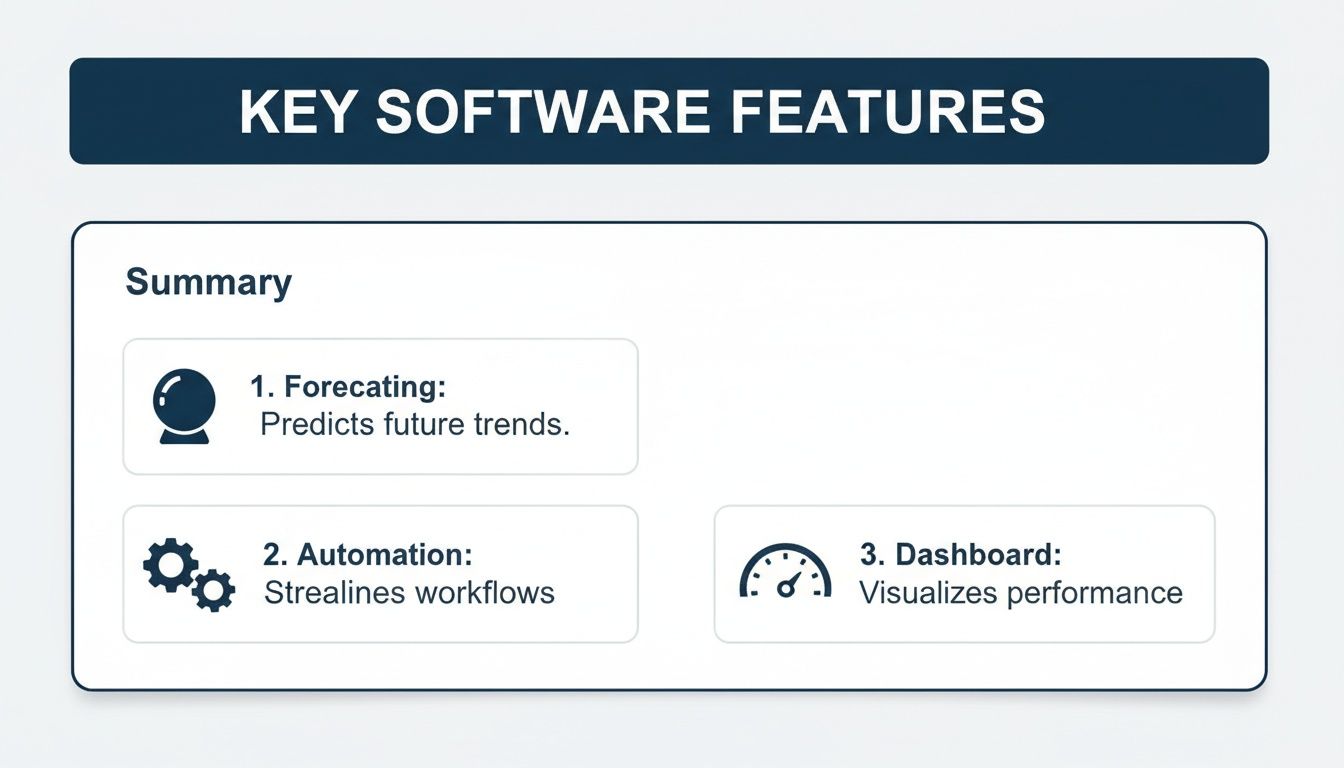
This picture shows how these three pieces work together. You're looking ahead, saving time on manual work, and getting an instant read on your business's financial health.
Jirav: The Powerhouse For Long-Term Modeling
Finally, there's Jirav. If Float is for daily cash clarity and Dryrun is for decision-making, Jirav is a full financial modeling engine. This is the heavy-duty option for businesses planning for major growth, looking for investors, or dealing with complex finances.
Jirav goes way beyond simple cash flow. It helps you build a complete financial model, linking your profit and loss, balance sheet, and cash flow statement together. It also lets you plan out your workforce and track how different departments are doing. For instance, you could model the financial impact of hiring three new salespeople, including their salaries, commissions, and the sales they might bring in over the next two years.
This is the level of detail you need when you're talking to investors or a bank. They don't just want a cash forecast; they want to see a full, well-thought-out financial plan. While your business is unique, looking at a list of the top real estate investment software can give you a sense of the features common in deep financial tools.
Jirav is best for startups raising money, high-growth companies, or any business that needs to present a sophisticated financial story. It takes more time to learn, but the power it gives you for long-range planning is unmatched.
At a Glance Comparing Top Cash Flow Software
To help you see the differences side-by-side, here's a quick breakdown of what makes each tool special. This table cuts through the marketing fluff to show you where each platform really shines.
| Software | Best For | Key Strength | Pricing Model | Integrations |
|---|---|---|---|---|
| Float | Service businesses needing daily cash clarity | Simple, visual, real-time tracking of operational cash | Based on number of users and forecast scenarios | QBO, Xero, Sage |
| Dryrun | Project-based businesses & complex scenarios | Powerful 'what-if' modeling for strategic decision-making | Based on revenue size and number of scenarios | QBO, Xero |
| Jirav | Companies seeking investment or in high-growth mode | Comprehensive financial modeling (P&L, Balance Sheet) | Tiers based on company revenue & feature complexity | QBO, Xero, NetSuite |
This comparison should give you a solid starting point for figuring out which direction to go.
Remember, even the best software is only as good as the data it uses. Before you buy a new tool, make sure your basic accounting is clean and organized. Our guide to the best accounting software for small business is a great place to start. In the end, the right tool is the one that solves your most pressing problem, whether that’s seeing tomorrow’s bank balance or planning next year's expansion.
Which Software Is Right for Your Business Type?
A tool is only as good as its fit for your specific business. I’ve seen owners pick cash flow software based on a flashy feature list, only to give up on it months later because it didn't solve their unique problems. A marketing agency’s money headaches look nothing like a construction contractor’s.
So, let's forget generic comparisons and look at how these tools work in the real world. We’ll walk through a few examples to show how the right software offers direct solutions to the cash flow pains in different industries.
For Marketing Agencies With Project-Based Income
If you run a small marketing agency, you know the deal. You have a mix of clients—some on monthly retainers, others paying you when a project is done. This makes predicting your monthly income really difficult.
One month, two big projects finish at once, and cash feels great. The next, you're back to just retainer income, and things get tight. This is a classic cash flow problem for any professional services firm.
The Common Problem: Unpredictable monthly income makes it tough to know if you can afford to hire that new designer or buy expensive software.
A Software Solution (Float): This is exactly where a tool like Float shines. It was built for visual, day-to-day cash tracking. Once you connect it to your accounting software, it maps out your expected income from both retainers and project invoices on a simple calendar.
For an agency owner, this means you can see your projected bank balance for every single day of the next month. You can immediately spot the week where cash will be lowest and decide to push a client to pay an outstanding invoice before that dip happens.
This isn’t about getting lost in complex models. It's about getting a clear, immediate answer to the question, "Will we have enough cash to cover payroll next Friday?" It turns a stressful guessing game into a simple visual check.
For Healthcare Practices With Slow Insurance Payments
Now, let's picture a physical therapy clinic. Your income is almost entirely dependent on insurance payments, which are known for being slow and unpredictable. You might provide a service today but not see the cash from it for 60 or even 90 days.
Meanwhile, your expenses are fixed and urgent. You have rent, payroll, and you might be trying to save up for a new piece of medical equipment that costs $50,000.
The Common Problem: You have long, unpredictable delays between earning money and actually getting the cash, making it risky to plan for big purchases.
A Software Solution (Jirav): For a situation this complex, a simple cash tracker won't cut it. You need something more powerful, and a tool like Jirav is designed for this kind of deeper financial modeling. It lets you build a forecast that actually accounts for those long payment cycles.
You can set a rule that, on average, insurance payments arrive 75 days after you bill for them. The software then models your cash flow based on this reality. It shows you exactly how your current patient load will translate into actual cash in the bank three months from now. This gives you a real answer on whether you can afford that new equipment in October, or if you need to wait until December.
For Construction Contractors Juggling Job Costs
Finally, think about a construction contractor. Your business is a constant juggle of job costs, material purchases, subcontractor payments, and client payments. A single project can have dozens of moving financial parts.
You’re always bidding on new work, and you need to know if you have the cash to take on a new project without putting your current jobs at risk.
The Common Problem: Managing multiple, overlapping project timelines with unpredictable payment schedules creates huge cash flow uncertainty.
A Software Solution (Dryrun): This is the perfect job for Dryrun’s scenario planning. It lets you create "what-if" models without messing up your main forecast. For example, you can build a separate scenario for that big residential project you just bid on.
- What happens to our cash if we win it?
- Can we handle the upfront material costs?
- How does it affect our ability to pay our crew on time for our other two active jobs?
Dryrun lets you layer these scenarios on top of each other, giving you a clear picture of the financial impact of every potential decision. It moves you from just tracking cash to using your cash flow data to make smarter choices.
As more businesses in these sectors adopt such tools, the market keeps expanding. The cash flow management software market is projected to grow from $19.8 billion in 2025 to $54.2 billion by 2035, driven by this exact need for real-time visibility. You can read more about these cash flow market projections to understand the full scope of this trend.
When Software Is Not Enough

Here's the honest truth almost no software company will tell you: buying the software is the easy part. The best cash flow management software in the world can't fix messy books or a broken business model.
Think of it as an amplifier. If your numbers are clean and your plan is solid, it will amplify your success. But if your financial records are a disaster, it will only give you a clearer, faster, and more expensive picture of that disaster.
A shiny new GPS won't get you to your destination if your car's engine is busted. The GPS is a fantastic tool, but only if the car runs. Your business's "engine" is its bookkeeping. Without clean, accurate, and current financial data, any forecast the software creates is junk.
Garbage In, Garbage Out
This isn't just a catchy phrase; it's the golden rule of financial software. Before any tool can give you real insight, your foundation has to be solid. An alarming 82% of small businesses that fail point to poor cash flow management as a key reason. Much of that starts with simply not having a reliable picture of the money coming in and going out.
This means you need a few things locked down before you even consider new software:
- Clean Books: Your transactions must be put in the right categories. If your personal Amazon Prime subscription is mixed in with business software costs, no forecasting tool can help you.
- Up-to-Date Records: Your books need to be checked and balanced regularly, ideally every month. Making decisions on numbers from six months ago is like driving with an old, torn map.
- A Clear Process: You need a repeatable system for invoicing clients and paying your bills. If invoices only go out when you "get around to it," you're creating chaos before the software even enters the picture.
When You Need More Than Just a GPS
Okay, let's say your books are clean. You buy the software, connect your accounts, and suddenly you have a beautiful cash flow forecast. You have your GPS.
But what happens when it shows a massive cash shortfall three months from now? The software tells you what is coming, but it can’t tell you why or what the smartest way to fix it is.
This is where a human expert becomes so important. The software is the dashboard; a financial partner—like a fractional CFO or an advisory firm—is your experienced co-pilot.
The software shows you the map and points out the roadblocks. The co-pilot helps you read the map, get around the trouble, and maybe even find a better, faster route you didn't know existed.
A financial expert does things software can't. They look at your forecast and ask the tough, strategic questions. Is your pricing too low? Are your project costs getting out of control? Are you spending too much to get new customers? They help you see the story behind the numbers. For a deeper dive, you might find it helpful to explore proven cash flow management strategies that combine both tools and human insight.
Deciding What You Really Need
So, how do you know if you just need software or if you need a human partner, too? Here’s a simple way to decide.
You might only need software if:
- Your business is straightforward and predictable.
- You are comfortable reading financial reports and making decisions based on them.
- Your main problem is just not being able to see everything—you simply need the numbers laid out clearly.
You probably need a partner if:
- You look at a profit and loss statement and your eyes glaze over.
- You need help with bigger strategic decisions, like pricing, hiring plans, or adding new services.
- You know there's a problem with your cash flow but have no idea what's causing it or how to fix it.
Ultimately, software is a tool for visibility. An expert is a partner for strategy. The most successful businesses I've seen use both. This creates a powerful combination that gives them a clear view of today and a smart plan for tomorrow.
Answering Your Top Questions About Cash Flow Software
When it comes to cash flow software, it's easy to get lost. I've heard the same questions from hundreds of business owners trying to separate the marketing hype from what actually works.
Let's cut through the noise. Here are straight answers to the most common questions I hear.
How Much Does This Software Usually Cost?
Let’s talk about the price tag. The cost really depends on what you need the software to do.
Simpler tools aimed at freelancers or very small businesses can start as low as $30 to $50 per month. But for growing companies that need serious forecasting and reporting, you're more likely looking at $200 to over $500 monthly.
The price is usually tied to your company’s revenue and how complex your needs are—things like detailed scenario planning or combining reports from multiple business accounts. The goal isn’t to find the cheapest tool; it’s to find the one that delivers the most value.
Think of it this way: if a $250/month tool helps you avoid just one major cash crunch by giving you a heads-up, it has already paid for itself for years to come.
Is It Hard to Set Up?
Most modern platforms are surprisingly simple to get going. They connect directly to your accounting software like QuickBooks or Xero with just a few clicks. You can often have the basic setup done in under an hour.
The real work isn't in the software—it's in your books. If your financial records are a mess, your forecasts will be worthless. Garbage in, garbage out. This is the single biggest roadblock I see. Getting your bookkeeping clean before you add new software is the only way to get accurate, trustworthy predictions.
Can I Just Use QuickBooks for Cash Flow?
You can try, but it has some big limits. Your accounting software is a historian. It's great at telling you with perfect accuracy what already happened with your money.
Dedicated cash flow software is a fortune teller. Its entire purpose is to predict what will happen to your cash. It’s built to answer the important "what-if" questions that drive business decisions.
- "What happens to our cash balance if I hire a new employee next month?"
- "What if that big client pays us 30 days late?"
- "Can we afford that new piece of equipment in the fall?"
Think of your accounting software as the history book and the best cash flow management software as your financial crystal ball. To run your business well, you need both.
When Do I Actually Need Cash Flow Software?
Here's my rule of thumb: you need cash flow software the moment you can no longer hold all your upcoming bills and payments in your head.
If you find yourself getting "surprised" by a low bank balance or spending your weekends trying to map out bills and invoices, it's time.
The goal is to stop reacting to money problems and start planning your financial future. As a business owner, you have more than enough to worry about. Knowing exactly where your cash stands shouldn't be one of them. The right software gives you the peace of mind to focus on what you do best: growing your business.
Feeling overwhelmed by your numbers and not sure where to start? The right software is a great first step, but sometimes you need a human co-pilot to help you read the map. At MyOfficeOps, we combine powerful tools with expert advice to give you total clarity and control over your finances. Schedule a discovery call today to see how we can help you move from just surviving to truly thriving.