
Many advisors will tell you to start business financial forecasting with a yearly sales target and a single budget. That advice sounds tidy, and it fails owners every month. A profitable month on paper can still miss payroll if the invoices have not been paid. I would start with the cash dates, the bills, and the payroll calendar, then build the profit view after that. A sales goal is a wish until the money hits the bank.
Why Most Business Forecasts Miss the Mark
Say an owner plans a 20% jump in sales, hires two people, and finds out in month four that the jump was 8%. The extra wages are already running. That is the usual shape of a bad forecast. It leans hopeful.
A review of 35 studies published between 1954 and 2002 looked at capital spending estimates and found the misses were often one-sided. Firms understated costs or overstated benefits. One early study by Dean, published in 1954, found that about one-third of projects at a U.S. company differed from their estimates by about 25%. Small firms do the same thing on a smaller scale. Hiring, equipment, pricing, and borrowing all lean on the forecast. A rosy plan can hide a cash gap even when the bookkeeping is clean.
In 2025, 85% of surveyed CFOs named forecasting accuracy as a primary area needing improvement, according to FTI Consulting's Global CFO Report of 655 senior finance executives. Design studios hit the same trap when project hours drift from the plan. A simple way to catch that drift is tracking design requests and project KPIs the same way you track cash.
Practical rule: Write the assumptions down, plan three cases instead of one, and compare the forecast with actual results every month.
The common traps are easy to name. You anchor on the number you want. You show too much detail. You treat one budget as a promise. A forecast is a decision tool, not a guarantee. The habits above are what make it trustworthy.
Choosing Between Top-Down, Bottom-Up and Rolling Forecasts
Top-down starts with a total. Last year's revenue, or a rough slice of your local market, becomes this year's plan. It is the fastest first guess. It also hides how the money is made. You cannot see which service, therapist, or job type carries the number.
Bottom-up builds the number from units. Clients times average invoice. Billable hours times rate. Jobs times margin. A six-person physical therapy clinic can count visits per therapist per week and multiply by its average payment per visit. That number will not match a market guess, and that is the point. You can see which lever moved.
Rolling forecasts keep a 12 to 18 month window moving. Each month you drop the closed month, add a new month at the end, and revise the months in between. A static annual budget goes stale by spring. A rolling view stays current only if you update it consistently. A short guide to the habit is on the page about rolling forecasts.
The decision rule
| Method | Use it when | Where it breaks |
|---|---|---|
| Top-down | Records are thin and you need a first pass | The sales split is a guess |
| Bottom-up | You have at least 12 months of clean unit data | Messy units make a fake precision |
| Rolling | Either method is already built | A skipped monthly update kills it |
Most small firms should combine bottom-up revenue with a rolling update cycle. Top-down is fine for a lender packet when the books are new. I would not hire from a top-down number alone.
A clinic with clean visit counts should not stay on a market slice. A brand-new contractor with three jobs and no history should not pretend the unit math is solid. And a rolling file that nobody opens in March is just last year's budget with extra columns.
Gather the Data and Tools You Need First
Pull these files before you type a formula. Dirty inputs make a pretty model that lies. The rows for bank balances, receivables, bill due dates, payroll, and fixed payment dates feed the cash view you build first. Contracts, backlog, and price plans feed the profit view that sits on top of it.
| Input | Where to get it | How often to refresh |
|---|---|---|
| Bank balances and balance sheet | Bank feeds and accounting software | Weekly for cash, monthly for the full sheet |
| Accounts receivable aging | Invoicing or accounting system | Weekly |
| Bills and payment due dates | Bill pay tool or payables list | Weekly |
| Payroll calendar and headcount plan | Payroll provider and HR records | Each pay cycle |
| Signed contracts and project backlog | CRM, job board, or contract files | Weekly |
| Loan payments, rent, leases, and tax dates | Loan statements, lease files, and tax calendar | Monthly |
| Planned prices, rate changes, and hires | Owner decisions and rate sheet | Quarterly |
Two decisions before any math
First, pick cash or accrual timing and stick to it. The IRS Publication 334 explains the split. Under the cash method, you generally report income when you receive payment and deduct expenses when you pay them. Under the accrual method, you report income when you earn it and record expenses when you incur them, even if cash moves later.
A consulting firm can finish a $10,000 project in December and get paid in January. Accrual books show the revenue in December. The cash forecast shows the money in January. A profitable December does not pay January payroll by itself.
Second, clean the books before you model. Reconcile every bank account. Clear or write off old unpaid invoices you will never collect. Confirm that payroll tax payments in the books match what was paid.
The IRS guidance on accounting periods and methods says you choose your method when you file your first income tax return, you must use a method that clearly shows income, and you generally must use the same method for taxable income and your books. You usually need approval before you change methods. Write the method on the first tab of the forecast and leave it there. Switching mid-model makes profit look higher or lower only because the timing changed.
Tools that fit a small firm
Excel or Google Sheets handles most firms under about 20 people, with accounting software such as QuickBooks supplying the actuals through exports. Contractors who bid jobs should keep job costs in a dedicated estimator, and Exayard construction estimating software is one place those quantities can start before they hit the forecast. Dedicated planning software earns its cost only after the weekly cash routine already runs. For owners who want the 13-week cash file built from the books rather than fed into a second system by hand, MyOfficeOps is one option.
Do not buy software to skip the cleanup.
Why Cash Timing Matters More Than Sales
A 2025 QuickBooks survey found that 56% of small businesses were owed money on unpaid invoices, affected firms were owed an average of $17,500, 47% had some invoices more than 30 days overdue, businesses with more overdue invoices were more likely to report cash-flow problems at 50% versus 34%, and firms using longer payment terms reported more cash-flow difficulty than those requiring immediate payment at 60% versus 40%.
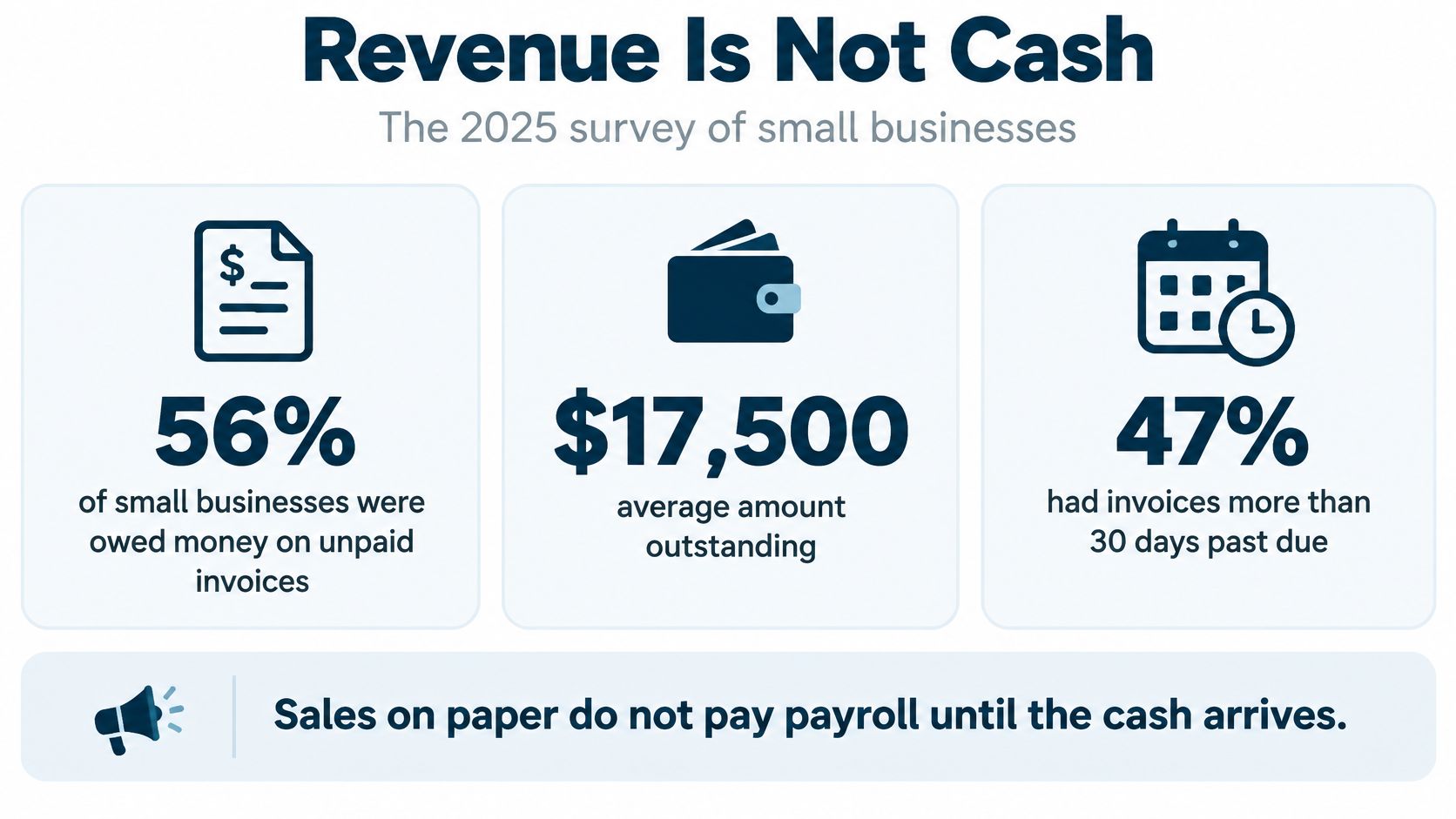
The sale can be real and still arrive after payroll. Cash timing is the forecast.
Move one invoice through the weeks
List each open invoice with the customer, the due date, and that customer's usual delay. Place the dollars in the week they will probably land, not the week you sent the bill. If a client pays about half the time on time and half the time two weeks late, put half the amount in each week. Discount the balance only when history says some of it never arrives.
Set a minimum cash floor. One payroll plus two weeks of rent is a plain starting floor for many service firms. Mark the first week the forecast falls under that floor. That week is the decision date, not the week you bounce a check.
If one client is 40% of open invoices, put that client on its own line. Their delay is not an average. It is the forecast.
What you do when the floor breaks
- Pause hiring: A signed offer letter is a cash promise. Wait until the late invoices land.
- Chase collections: Call the largest overdue balances first, not the newest small ones. The accounts receivable collections playbook lays out a practical sequence for that work.
- Ask for deposits: New work should fund itself before you staff it.
- Draw credit: Use a line only for a dated gap you can repay, not for a permanent shortfall.
| Payment terms | Cash lands | Effect on the April 1 payroll |
|---|---|---|
| Net 15 | March 16 | Covers payroll with room to spare |
| Net 30 | March 31 | Covers payroll with no buffer |
| Net 45 | April 15 | Misses payroll; must cover about two weeks from reserves |
| Net 60 | April 30 | Misses payroll and the April 15 bills; may need credit |
That is one $15,000 invoice dated March 1. Same sale. Four different payroll outcomes. Terms set the size of the gap before pricing, margins, or sales effort enter the picture.
An unpaid invoice is a promise with timing risk. A signed contract becomes cash when the deposit clears. If you want the weekly routine written out, start with cash flow management.
How to Build Your Forecast Step by Step
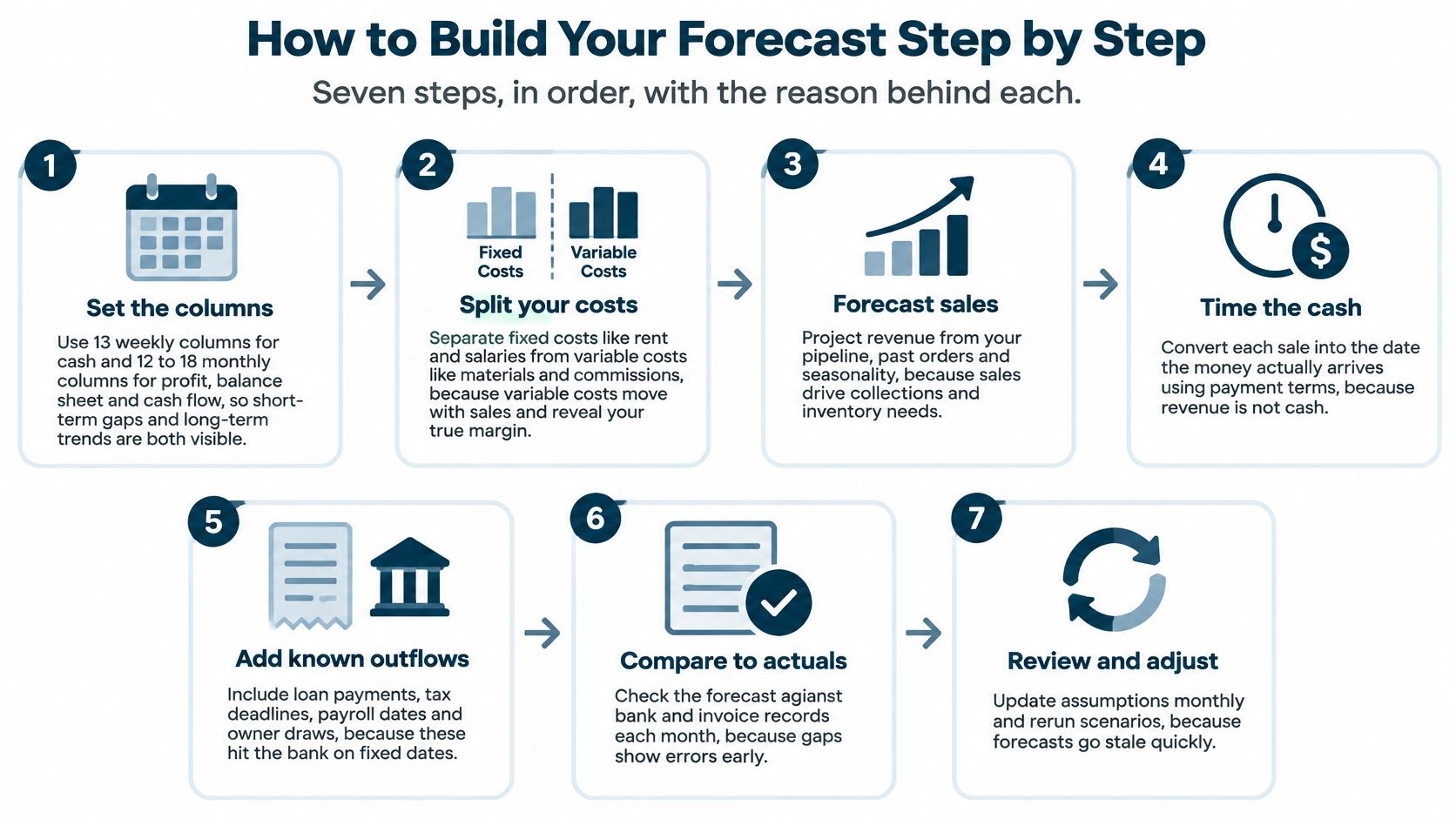
A useful model splits the business into drivers, then ties each driver to cash. Research on judgmental forecasting points to decomposition, clear data, feedback, and combined forecasts as ways to cut error. Unstructured judgment is weaker. The working setup I recommend is a rolling 13-week cash forecast updated weekly, plus a 12 to 18 month profit, balance sheet, and cash-flow forecast updated monthly.
Use a landscaping firm as the worked example. It has 14 crews, 3 jobs per crew each week, and a $420 average job price. Winter weather is assumed to cut revenue 12%.
The seven steps
- Set the columns. Use 13 weekly columns for cash, and 12 to 18 monthly columns for profit, the balance sheet, and cash flow. Weeks catch a payroll miss. Months show whether the year still works.
- Split revenue into drivers. For a landscaping business, that is crews times jobs times price, then a separate line for how fast customers pay. Do not type one revenue total and call it done.
- Split costs into three piles. Fixed items are rent, salaries, and insurance. Variable items are materials, subcontractors, and card fees. One-off items are equipment and tax payments. Lumping every cost into one line hides the margin.
- Write each assumption before you see results. Put today's date in a notes column. "Winter volume down 12%" belongs there, not in your head.
- Build three cases. Most likely, optimistic, and pessimistic. Change only the drivers so the cases stay consistent. If volume drops, materials should drop with it. Wages for crews you already hired should not.
- Build cash first, then profit. Start from the receivables schedule and the bill dates. Then build the monthly profit view. Check that assets equal liabilities plus equity. If the cash line, profit, and balance sheet disagree, a formula is wrong.
- Save the version and book the review. Have a second person, often your bookkeeper, read the assumptions. Put a monthly review on the calendar before you close the file.
Where people cheat the model
The two slips I watch for are lumping costs, and tweaking cells until the answer looks the way you wanted. Anchoring on a preferred outcome, skipping linked assumptions, and treating one number as the plan are the failures the forecasting research flags. Name a trigger now, such as a 10% volume drop, slower collections, wage inflation, or losing a major customer, and write the action next to it.
The pessimistic case for this landscaping business is not “revenue down 12% and nothing else changes.” Fewer jobs also mean some customers pay later, and fuel still hits on the card date. Change those together.
Running Scenarios and Checking Accuracy Each Month
A forecast is useful only if its assumptions move together. A 10% drop in work may also mean slower customer payments. Cut sales without changing collection timing, and the cash forecast will be fiction.
| Scenario | Key assumptions | Trigger to watch | Action decided in advance |
|---|---|---|---|
| Base | Volume and collections match the last six months | Revenue within 5% of plan | Keep the hiring plan |
| Downside | Volume down 10% and collections 15 days slower | Revenue more than 10% below plan for two months in a row | Pause hiring, cut discretionary spend, ask big clients about deposits |
| Severe downside | Largest client leaves, about 25% of revenue | Written notice of cancellation or non-renewal | Cut a set dollar amount of cost and arrange credit before cash drops below the floor |
| Upside | Two new contracts at current rates | Signed pipeline above 60% of target | Add capacity only after first payments arrive |
Agree on actions before a weak month arrives. If payroll is due, there may be little time to debate cuts or arrange credit. A business scenario planning walkthrough shows how to connect assumptions, triggers, and decisions.
The monthly accuracy check
Close the books and lock the actuals. Compare them with the saved forecast, not a file changed after the results came in.
Track three measures:
- MAPE: the average size of each miss, as a percentage.
- Bias: whether the forecast is consistently too high or too low.
- MdAPE: the typical percentage miss, with less influence from an unusually large miss.
Review each measure by line and forecast horizon. A company-wide average can look tidy while one job or clinic location is far off. Large-company accuracy studies offer only a rough guide for a small business. Customer concentration, project timing, seasonality, and limited data can all widen the gap.
Sort each miss into a cause: customer volume, pricing, job mix, payment timing, or execution. Then revise the relevant assumption and save a new forecast version.
If a remodeling company misses labor cost by 9% every quarter, that recurring gap points to a biased assumption. Raise the labor estimate rather than carrying the same miss into the next forecast.
Use ranges for uncertain drivers instead of relying on one precise-looking estimate. A low, middle, and high case makes uncertainty visible and shows how linked risks could affect the result. False precision, stale assumptions, and overlooking the connection between risks can all make a forecast less useful.
Pick Your Industry Playbook and Start This Week
The first number is not the same in every business. Forecast the thing that actually moves cash.
| Industry | Forecast first | Update cadence | Metric to watch |
|---|---|---|---|
| Professional services | Billable hours and project pipeline | Weekly cash, monthly profit | Utilization rate and days to collect |
| Healthcare practices | Payer collections and payroll | Weekly cash, monthly profit | Collection rate and days in receivables |
| Construction and trades | Job-by-job revenue, cost, and retention | Weekly cash, monthly job review | Margin on each job |
| Real estate | Rent roll, vacancies, lease costs, and deal timing | Monthly, plus each deal milestone | Occupancy and net operating income |

Agencies, law firms, and IT shops live on hours that have not been billed yet, and on clients who pay on their own calendar. Clinics get paid by insurers at uneven speeds, so payroll can outrun collections even in a full schedule. Contractors should forecast job by job, including retention held back until the project ends. A job that looks profitable can still starve the operating account. Real estate firms should watch rent roll and vacancies, because one delayed sale can move the whole year.
A start you can finish
This week, pull 12 months of profit and loss and the receivables aging. Build a 13-week cash forecast with three cases. Pick the one trigger you will watch, such as cash under the floor or revenue more than 10% below plan for two months.
In 30 days, run the first variance review and label each miss. In 90 days, extend the model into a rolling 12-month forecast. Do not add software, new hires, or a second scenario set before that first review exists.
Build the 13-week cash forecast before you sign the next hire or the next equipment lease.
That is the decision. A yearly sales target can wait. Payroll cannot.
MyOfficeOps builds cash-flow forecasts, budgets, and plain-language reports for small and midsize firms, including professional services, clinics, contractors, and real estate owners who need the cash view before the profit view. If you want a bookkeeping partner in the Philadelphia and West Chester area to set up the 13-week file and keep it current, visit MyOfficeOps and book a discovery call.