
For most small businesses, outsourced accounting starts around $500 to $1,500 per month for basic bookkeeping, and it can rise to $5,000 per month or more as your reporting, payroll, and oversight needs get more complex. If your company is under $1 million in revenue, you'll usually land near the lower end. If you're growing fast, managing job costs, or need controller-level help, the number climbs.
That's usually the moment owners call us. The books are late, payroll feels stressful, and the monthly reports don't answer the essential question: are you making money, or just staying busy? In Philadelphia, West Chester, and the surrounding suburbs, I see this a lot with law firms, healthcare groups, and contractors. The work is coming in, but the financial picture is muddy.
That's why cost is the right first question. Not because accounting should be cheap, but because the price tells you what level of clarity you're buying. A low monthly fee may cover data entry. It usually won't fix broken workflows, clean up old errors, or help you understand which jobs, providers, or clients are carrying the business.
Why Asking About Cost Is Your First Smart Move
A business owner in Chester County doesn't usually wake up wanting outsourced accounting. They wake up wanting answers. Can we hire? Are we charging enough? Why is cash tight when sales look fine?
Those questions often show up when the bookkeeping has become a patchwork of QuickBooks entries, bank feeds, and guesswork. One month looks strong. The next month feels thin. Nothing lines up cleanly enough to make a confident decision.
Cost usually follows complexity
Outsourced accounting isn't priced at random. It tends to move with the size and complexity of the business. Basic bookkeeping for firms under $1 million in revenue usually runs $500 to $1,500 per month, while more complete accounting with controller oversight for firms in the $1 million to $5 million range often moves to $1,500 to $5,000 per month, according to Consero Global's outsourced accounting cost overview.
That range matters because two companies with the same revenue can still need very different support. A small consulting firm with a simple payroll and clean books is one thing. A growing contractor with progress billing, retainage, and messy job coding is something else.
Practical rule: If you're only asking, “What's the cheapest monthly price?” you'll probably buy less clarity than your business needs.
What owners are really paying for
When owners ask how much does it cost to outsource accounting, they're often comparing it to doing nothing. That's the wrong comparison. The actual comparison is between unclear numbers and useful numbers.
Useful numbers help you:
- See real profit: Not just cash in the bank, but which services, jobs, or locations make money.
- Spot problems earlier: Payroll drift, margin compression, and billing delays show up faster.
- Make hiring decisions with less guesswork: You can tell whether the business can support another salary.
If your books are only good enough for tax season, the cost of accounting will feel like overhead. If your numbers help you run the business every month, the same cost starts to look like an operational advantage.
The Different Ways Accounting Firms Charge
Most firms charge the way phone plans used to work. You either pay as you go, or you pay a monthly amount for a defined package. The right model depends on whether your needs are occasional, steady, or all over the place.
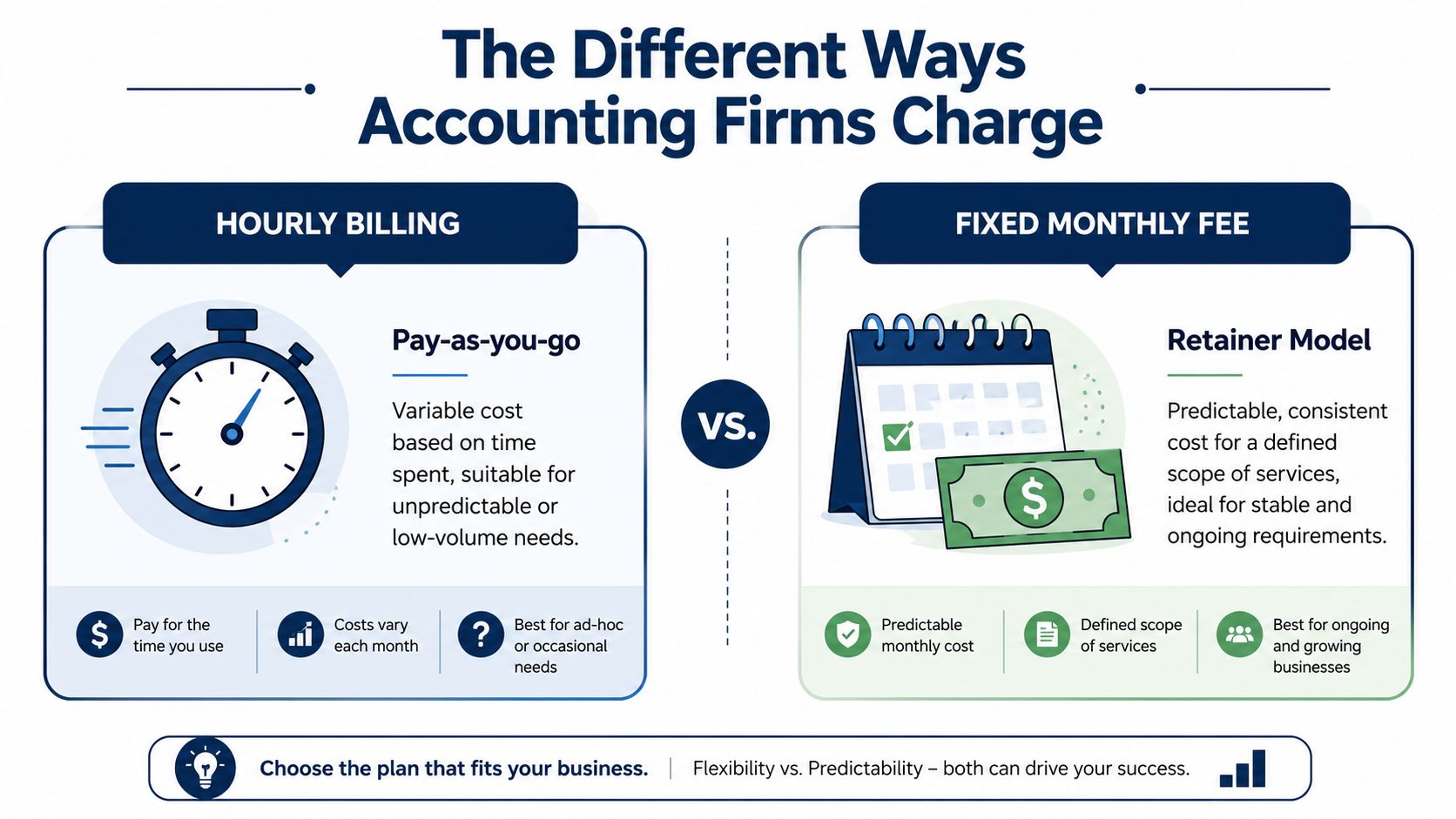
Hourly billing works best for one-off work
Hourly billing makes sense when the scope is hard to pin down. Think cleanup work, a software migration, or a backlog that needs attention before anyone can quote a steady monthly fee.
Domestic CPA and accounting rates can range from $50 to over $500 per hour, depending on expertise and location, based on SSCO Global's pricing breakdown for outsourced accounting. That's a wide spread, and it tells you something important. You're not buying the same level of work at every rate.
Hourly billing is usually a fit when you need:
- Cleanup before monthly service starts
- A second set of eyes on a specific issue
- Project work with an unclear timeline
The downside is simple. If the work sprawls, so does the bill.
Fixed monthly fees are easier to budget
Most small businesses prefer a monthly retainer. It gives you a known number each month and a defined list of deliverables. That might include bank reconciliations, monthly close, payroll review, reporting, and owner meetings.
This model works well when your business has a normal rhythm. If you process a fairly steady level of transactions each month, a flat fee usually makes sense. It also forces both sides to define what's included.
A lot of firms improve pricing accuracy when they pair fixed fees with better internal workflow data. If you want to see how firms tighten that process, tools like automated time tracking for accountants can help show where work is being done. That matters because vague scope is what causes fee surprises.
Tiered pricing sits in the middle
Some providers offer tiers instead of one flat package. You might see a bookkeeping level, a controller level, and a CFO advisory level. That's often more realistic than a one-size-fits-all quote.
For businesses that still want regular in-person support along with outsourced structure, on-site accounting support can also be part of the mix. That hybrid setup can make sense when the owner wants local help with paper flow, payroll coordination, or office-level financial tasks.
A good quote should tell you what happens if volume rises, payroll changes, or cleanup work appears. If it doesn't, the “fixed” fee may not stay fixed for long.
What Really Drives Your Accounting Costs
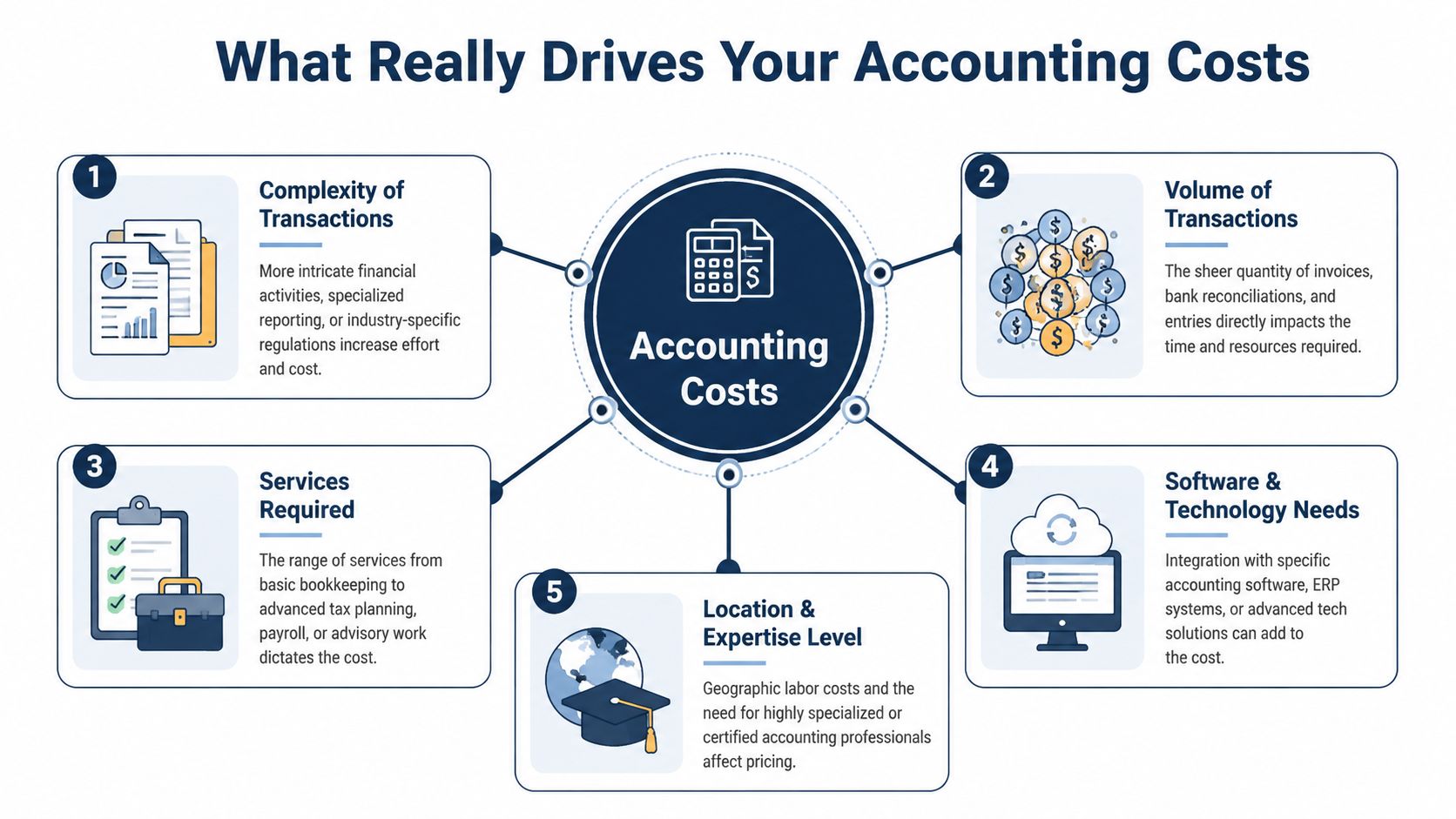
Two businesses can get very different quotes even if their revenue looks similar on paper. The reason is workload. Accounting cost follows the amount of decision-making, cleanup, coordination, and review your records require.
Volume matters, but it's not the whole story
More transactions usually mean more work. More bank accounts, more credit cards, more invoices, and more payroll activity all add time. But volume alone doesn't explain everything.
A business with clean systems and steady coding can move smoothly. A smaller business with messy records can take far more effort.
Here's what tends to move the price:
- Transaction volume: More monthly entries usually mean more reconciliations and more review.
- Payroll complexity: Multiple pay types, benefits, commissions, or provider compensation models create extra work.
- Number of accounts: More bank and credit card accounts mean more monthly reconciliation work.
- Reporting needs: If you need job costing, departmental reporting, or cash forecasts, the service level rises.
- Historical cleanup: Old mistakes are expensive because someone has to unwind them before good reporting can start.
Complexity is where local industry knowledge matters
Generic providers often struggle with specialized requirements. A construction company doesn't just need bookkeeping. It may need job costing that ties to field activity. A healthcare group may need clean payroll mapping across providers and departments. A professional services firm may need better visibility into project profitability and partner distributions.
That's why cost rises when the books need more than categorization. The provider is spending more time judging, reconciling, and organizing data into something management can trust.
If you're trying to reduce some of that manual burden before it hits your accounting bill, expense management automation can help by tightening how receipts, approvals, and coding flow into the books.
Clean inputs reduce accounting cost. Messy inputs push the same team into cleanup mode, and cleanup always costs more than maintenance.
Software and integrations also shape the quote
The accounting fee often goes up when your systems don't talk to each other. Payroll, point-of-sale, billing platforms, and practice management tools can save time when they're mapped correctly. They can also create a mess when they aren't.
That's why a good quote usually reflects more than bookkeeping hours. It reflects the work needed to make the numbers dependable each month.
Sample Pricing Scenarios for Local Businesses
A Philadelphia contractor can post a strong month on paper and still come up short on cash because retainage is tied up, union payroll hit early, and a change order has not been billed cleanly. A Main Line medical practice can show steady collections and still have reporting problems if provider compensation, payroll, and location-level results are not lining up. That is why outsourced accounting quotes vary so much from one business to the next.
For small and midsize businesses, outsourced accounting can range from basic monthly bookkeeping to a full outsourced controller or CFO function. Industry guides from Merritt Bookkeeping's overview of outsourced accounting costs note that pricing typically rises as services expand from transaction processing into payroll, reconciliations, reporting, and finance oversight.
Three local-style examples
The ranges below are practical starting points, not menu prices. In our market, the key question is how much judgment the accounting team has to apply each month, and how expensive mistakes would be if nobody catches them early.
| Business Profile | Key Needs | Estimated Monthly Cost |
|---|---|---|
| Small law firm in West Chester | Monthly bookkeeping, payroll, partner-ready reports, trust account awareness | $500 to $1,500 |
| Growing construction contractor in Philadelphia | Job costing, AP/AR support, union and non-union payroll coordination, WIP support, management reporting | $2,500 to $5,000+ |
| Mid-sized healthcare practice in the suburbs | Provider payroll coordination, reconciliations, location reporting, controller review | $2,500 to $5,000+ |
A small law firm in West Chester
A small law office usually has a manageable transaction count, but the owner still needs timely closes, clean payroll, and reports that show what the practice produced after compensation and overhead. If the billing cycle is consistent and the historical books are clean, this work often stays in the lower range.
The hidden cost shows up when nobody is watching timing and detail. One misposted owner draw, one trust-related issue, or one month of delayed reconciliations can create more cleanup work than the monthly fee ever saved.
A growing construction contractor in Philadelphia
This is the profile where cheap bookkeeping often creates expensive confusion.
A Philly-area contractor may be dealing with Philadelphia L&I paperwork, job-by-job permit timing, certified payroll on certain projects, and different payroll treatment for union and non-union crews. Add subcontractor compliance, retainage, and change orders that sit too long before billing, and the accounting work becomes part recordkeeping and part job management discipline.
That is why the monthly cost usually runs higher. You are not paying only for transaction entry. You are paying for accurate job costing, cleaner WIP support, billing follow-up, and reporting that helps you see which jobs are making money before the project is over. For many contractors, the primary ROI is catching margin erosion early enough to fix it.
A mid-sized healthcare practice
Healthcare groups often look straightforward until you get under the surface. Provider pay formulas, benefits allocations, multiple locations, and timing differences between practice systems and the general ledger can all create reporting problems.
That extra review time affects the quote. If the practice owner wants dependable monthly financials, compensation support, and reports by provider or location, the accounting team usually needs controller-level oversight, not just basic bookkeeping.
The budget question is fair. The bigger risk is underbuying, then paying later through cleanup, missed billing issues, weak cash visibility, or reports you cannot use to run the business.
Special Cost Factors for Philly Area Industries
Philadelphia-area businesses often ask for “bookkeeping,” but what they need is industry-specific accounting judgment. That's why the quote changes so much from one business to the next.
For professional service firms, healthcare practices, and construction contractors, outsourced accounting that includes AP/AR coordination and payroll typically falls in the $1,500 to $3,500 per month range, while controller-level support with CFO help often reaches $3,500 to $7,500 per month, according to SDC CPAs' outsourced accounting cost benchmarks.
Professional services need visibility by client and project
Law firms, agencies, consultants, and IT companies usually don't struggle because they have too many transactions. They struggle because they can't see margin clearly. One client may look great on revenue and weak on labor. Another may create steady profit but get ignored.
The accounting work gets harder when the owner wants answers like:
- Which clients are worth more attention
- Which service lines create the best margin
- Whether headcount is paying off
That's not basic categorization. It takes cleaner reporting logic.
Healthcare needs tighter payroll and cleaner reconciliations
In healthcare, the issue is often coordination. Provider payroll, benefits, location-level reporting, and system mismatches can all create friction. A generic bookkeeper may close the books. They may not structure the reports in a way that helps the practice owner make good decisions.
That's why healthcare accounting can sit in a higher service tier even when the company itself isn't huge.
Construction needs accounting that speaks job cost
Construction and trades businesses can't afford accounting that only works at the general ledger level. Owners need cost visibility by job, by phase, and sometimes by crew or project manager.
What doesn't work is handing that kind of business to a provider who has never dealt with:
- Retainage and progress billing
- Job coding drift
- Subcontractor paperwork and payment timing
In this market, local context matters. A firm that understands how regional contractors bill and get paid will usually protect more value than a low-cost provider trying to learn on your books.
Is Outsourcing Worth It A Simple ROI Analysis
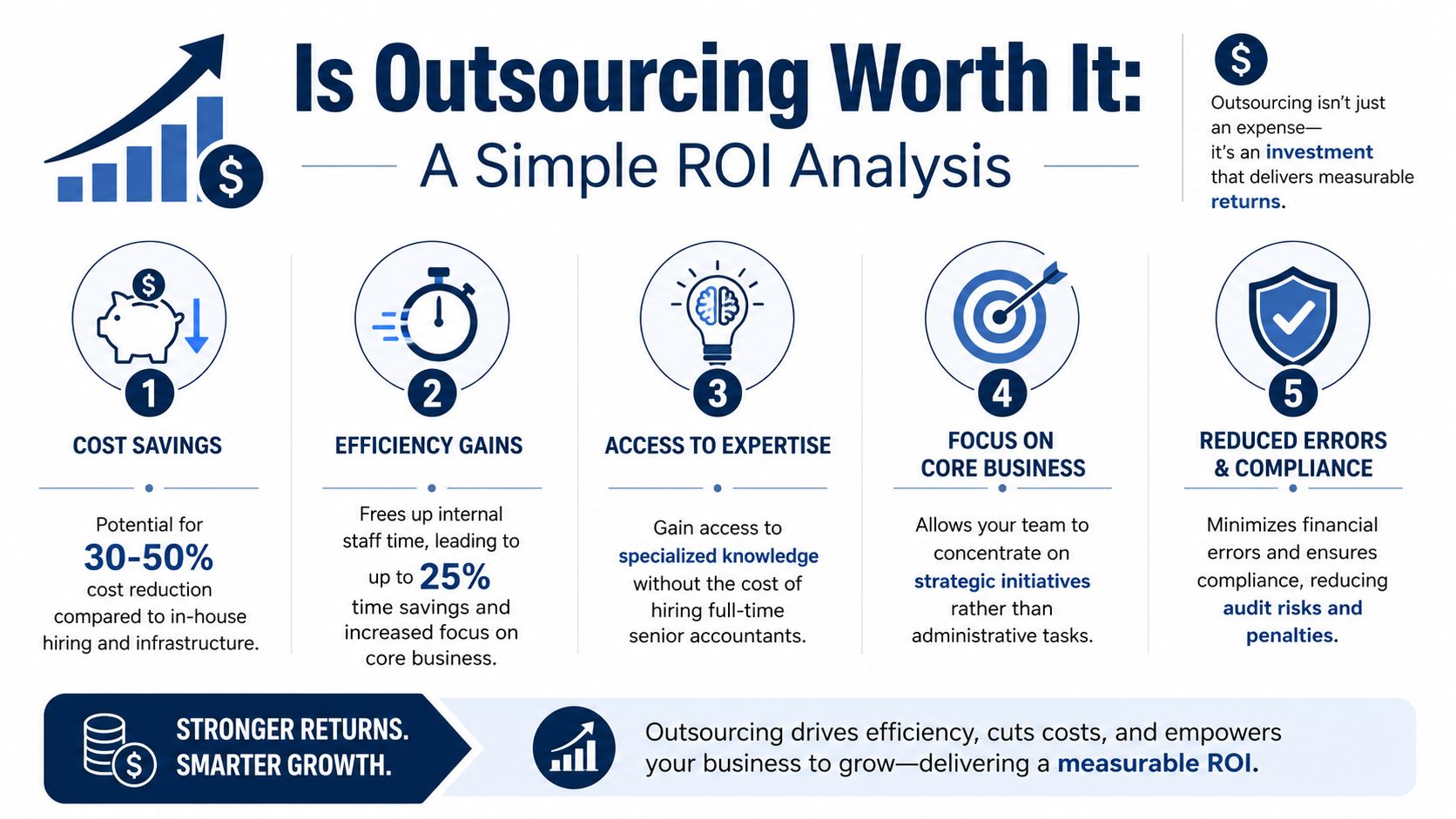
To judge whether outsourcing pays off, compare it to the actual cost of keeping accounting in-house, including the owner time and operational drag that rarely show up on a salary line. In Philadelphia, I see this mistake often with small professional service firms, medical practices, and contractors. They compare an outside monthly fee to zero, when the current setup is already costing them time, delayed decisions, and preventable errors.
Compare it to the full in-house cost
Dedicated offshore accountants can cost $600 to $2,500 per month, while domestic U.S. CPA firms often charge $1,200 to $6,000 per month. That same source compares those options with a full-time U.S. employee costing $120,000 to $180,000+ with benefits, based on Insignia Resource's research on outsourcing rates by country.
Those ranges explain part of the appeal, but price alone is not the decision. A construction company in Bucks County that needs tight job-cost reporting has a very different risk profile than a two-partner law firm in Center City that mainly needs monthly close, partner draws, and cash visibility. Lower labor cost helps, but poor handoff, missed details, or weak review can wipe out those savings quickly.
Here is the practical test we use. If your current approach depends on you or an office manager answering accounting questions at night, fixing coding mistakes before bank meetings, or waiting too long for numbers you can trust, outsourcing is already competing against a costly internal process.
ROI shows up in time, control, and fewer expensive mistakes
The return usually comes from a few places.
You avoid the full burden of a hire
Salary is only one piece. You also pay for recruiting, onboarding, software access, management oversight, PTO coverage, and the disruption that comes when the person leaves and your books sit still.
You get more than one level of skill
One in-house employee may be solid at transaction work but weaker on reporting, close management, or cash forecasting. An outsourced team can split those responsibilities across bookkeepers, controllers, and reviewers so the work gets checked before it reaches you.
You get back owner time
This is usually the hidden cost that matters most. If you spend five to ten hours a month untangling payroll issues, chasing missing reports, or explaining the same billing workflow again, the accounting function is pulling you away from sales, operations, and client service.
You reduce decision lag
Good accounting shortens the gap between what happened and what you can do about it. For a medical practice, that may mean spotting payroll pressure sooner. For a consultant, it may mean seeing which clients are tying up staff time without enough margin. For a contractor, it may mean catching cost overruns before the job is nearly finished.
I also tell owners to count the cost of choosing the wrong model. A cheap provider who needs months to understand your workflow can create more cleanup than relief. If you are still deciding who should own the day-to-day work, this guide on how to find a bookkeeper for your business can help you sort out whether you need basic support, controller oversight, or a broader outsourced team.
Some companies compare accounting outsourcing with other staffing approaches across finance and operations. If you are weighing where specialized help belongs, AI staff augmentation is one example of how businesses are filling skill gaps without adding every role to permanent headcount.
If your books are cleaner but you still cannot make decisions faster, the service is too shallow. Good accounting should give you usable numbers, clear ownership, and less friction in how the business runs.
How to Get an Accurate Quote and Not Overpay
Most bad accounting quotes have the same problem. The provider is pricing blind, and the owner is buying blind. That's how businesses end up with a low monthly number that grows once cleanup, payroll issues, and reporting problems show up.
One of the most overlooked costs is transition friction. Some outsourced teams need a 2 to 4 month ramp-up period, and during that time they can require 15 to 25 hours of your staff time per month, adding $3,000 to $6,000 in unquoted labor cost, according to Eagle Rock CFO's research on outsourced accounting transition friction.
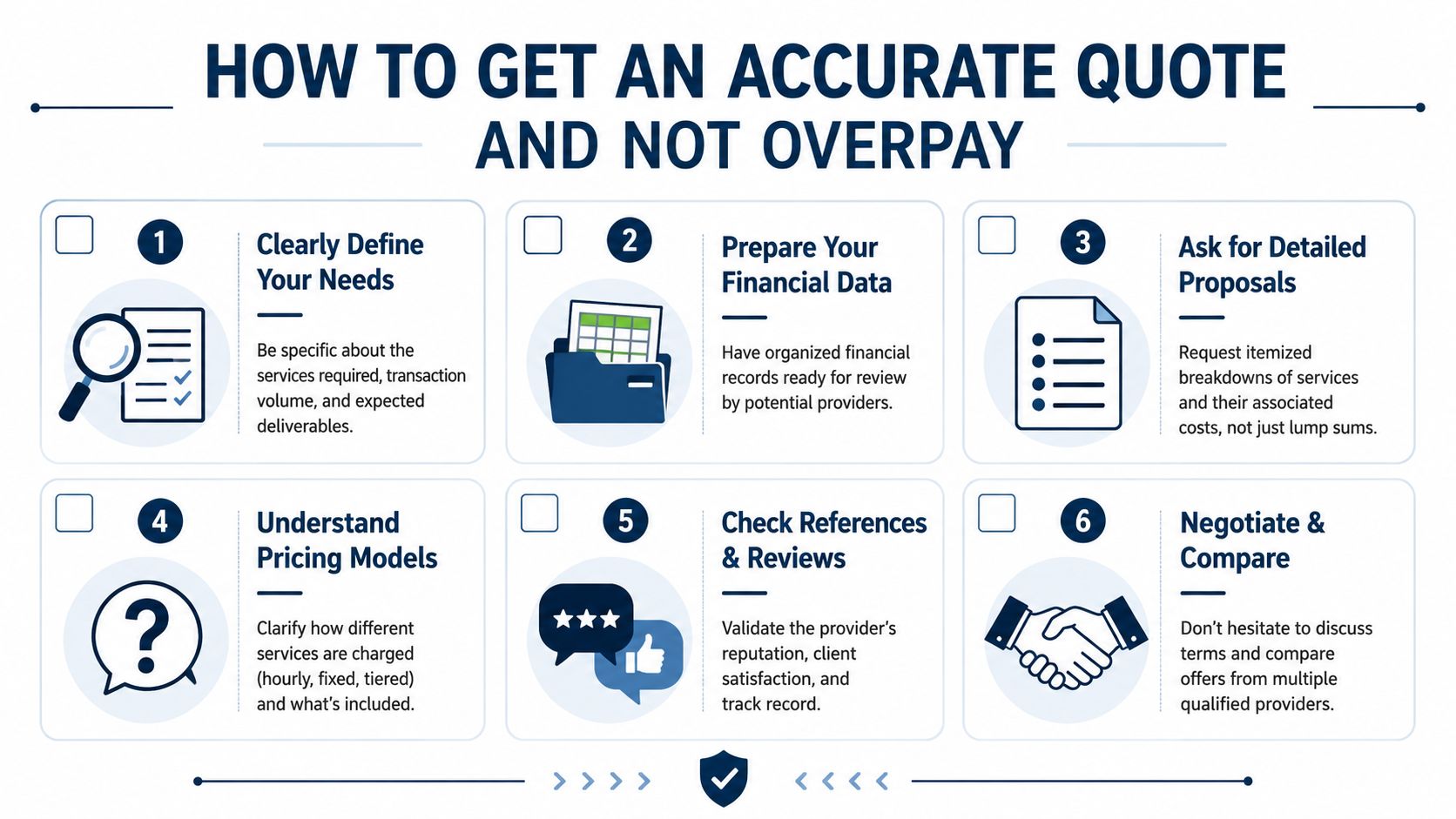
What to gather before the first call
Before you ask for pricing, pull together the basics. If you don't, the quote will be padded or incomplete.
Bring these into the conversation:
- Your current bookkeeping system: QuickBooks Online, QuickBooks Desktop, Xero, Sage Intacct, or whatever you use now.
- Recent financial reports: Profit and loss, balance sheet, and cash flow if available.
- Payroll details: Number of employees, pay schedules, and any complexity around bonuses, commissions, or provider comp.
- Bank and credit card count: This helps estimate reconciliation workload.
- Any backlog or cleanup issue: Old unreconciled accounts, uncategorized transactions, prior-year mistakes.
If you're still sorting out what kind of help you need, this guide on how to find a bookkeeper is a useful starting point before you start comparing firms.
Questions that expose the real fit
Ask direct questions. Soft questions get soft answers.
- How do you handle historical cleanup if the books are wrong?
- What's included in the monthly fee, and what triggers extra charges?
- Who reviews the work before reports go out?
- How do you handle job costing, provider compensation, or project profitability in businesses like mine?
- How much of my team's time will onboarding require?
Watch for these pricing traps
A quote may be too low if it avoids detail. That usually means the provider hasn't priced the hard part yet.
Watch for:
- Unclear scope: “Monthly bookkeeping” without naming deliverables.
- No onboarding discussion: Someone will pay for setup effort, even if it isn't listed clearly.
- No industry language: If they can't talk through your workflow, they probably can't price it correctly.
- One person doing everything: That can work for very small books, but it often breaks under growth.
A fair quote is specific. It names the work, the review level, the handoff points, and what happens when your needs change.
If you're trying to price outsourced accounting for a law firm, healthcare practice, contractor, or growing service business in Greater Philadelphia, MyOfficeOps can help you sort out the complete scope before you commit. The goal isn't to push you into a package. It's to give you a clear quote, clean handoff, and a level of support that matches how your business operates.