

If you're thinking about selling your practice, slowing down, bringing on a partner, or just trying to understand what you've built, you're probably asking a simple question with a frustrating answer: what is this thing worth?
Most physicians don't struggle because they're bad at business. They struggle because people give them three different answers. One buyer talks about revenue. Their CPA talks about profit. A broker throws out a multiple. None of it seems to match what they know the practice does every day.
A doctor close to retirement usually doesn't need more theory. They need a clean way to read the numbers. A medical practice valuation is really the story your financials tell about earnings, risk, and how transferable the business is to the next owner.
If your books are messy, that story gets distorted. That's why before you even think about a number, it's smart to get a handle on medical practice bookkeeping basics. Buyers don't pay for guesswork. They pay for clean, believable earnings.
Thinking of Selling Your Practice? Start Here
A lot of owners reach this point.
You've spent years building patient trust, hiring staff, dealing with payroll, fighting with payers, replacing equipment, and doing the work. Then one day the question shows up. Maybe you're tired. Maybe a buyer called. Maybe you want to know whether you should keep growing or start planning an exit.
What makes this hard is that the answer isn't sitting in your checking account or on the front page of your tax return.
Your numbers tell the story
Think about two family practices that collect similar revenue. One is organized, has stable staffing, a steady patient base, and clean financial records. The other has personal expenses running through the business, inconsistent collections, and everything depends on one doctor. On paper, they may look alike at first glance. In a sale, they won't be treated the same.
That's why a real valuation starts with context, not a shortcut.
Most doctors I speak with have heard at least one rule of thumb that sounds simple but doesn't fit their practice once you look under the hood.
The useful question isn't just, "What do practices like mine sell for?" The better question is, "What would a buyer believe about my future earnings after they clean up my numbers and assess the risk?"
What owners usually get wrong
Many physician-owners assume value comes from years in business, patient loyalty, or expensive equipment. Those matter. But buyers focus heavily on whether the earnings are real, repeatable, and likely to continue after you step back.
A practical valuation usually comes down to a few things:
- Earnings quality: Is the practice consistently profitable after normal adjustments?
- Transferability: Can the business keep operating without being tied completely to you?
- Risk: How exposed is the practice to payer pressure, staffing issues, or weak systems?
- Documentation: Can a buyer verify the numbers quickly?
That last point matters more than people think. If your records are incomplete, buyers assume risk. And when buyers see risk, they lower price or tighten terms.
The Three Valuation Methods and Which One Matters Most
You'll usually hear about three ways to value a business. All three have a place. For most profitable medical practices, one matters more than the others.

If you want a broader primer outside healthcare, this overview of business valuation methods for small business is a useful companion.
Asset approach
This method asks a simple question. What are the practice's assets worth, minus liabilities?
That includes equipment, furniture, supplies, and sometimes certain identifiable intangibles. The problem is obvious in healthcare. A busy, profitable practice is worth more than its exam tables, computers, and leasehold improvements. The asset approach can make a real operating business look smaller than it is.
It tends to matter more when a practice is underperforming, winding down, or heavily tied to hard assets.
Market approach
This one looks at comparable sales. In plain English, what did similar practices sell for?
That sounds useful, and it can be. You may also hear broad rules like most medical practices are valued between 0.5x and 1.0x annual revenue, while high-margin specialties can reach up to 1.5x based on 2026 industry benchmarks. The trouble is that "similar" often breaks down fast. Two practices in the same specialty can have very different margins, payer mix, doctor dependence, and local demand.
So market data can help frame a range, but it rarely gives the final answer by itself.
Income approach
This is the method serious buyers lean on most. It values the practice based on earning power.
For a physician-owner, this is the method that usually answers the key question. Not "what are my assets worth?" but "what is a buyer willing to pay for the cash flow this business can produce after normalizing the numbers?"
Practical rule: For a profitable practice, value usually follows earnings more than revenue.
That is why buyers focus on adjusted EBITDA. They want to know what the practice earns after removing noise, owner-specific choices, and one-time costs.
If you've ever looked into expert financial advisory, you've probably seen the same idea in other industries. Buyers don't pay top dollar for gross collections alone. They pay for durable earnings they believe they can keep.
Here's the plain-English version:
| Method | Best use | Main weakness for medical practices |
|---|---|---|
| Asset | Weak or asset-heavy businesses | Misses the value of ongoing earnings |
| Market | Sense-checking a range | Comparables are often messy |
| Income | Profitable operating practices | Requires clean adjustments and judgment |
If you want to know how to value a medical practice in a way that stands up in a real sale process, the income approach usually carries the most weight.
How to Calculate Your Practice's Real Earnings
The profit on your tax return is not the number a buyer uses.
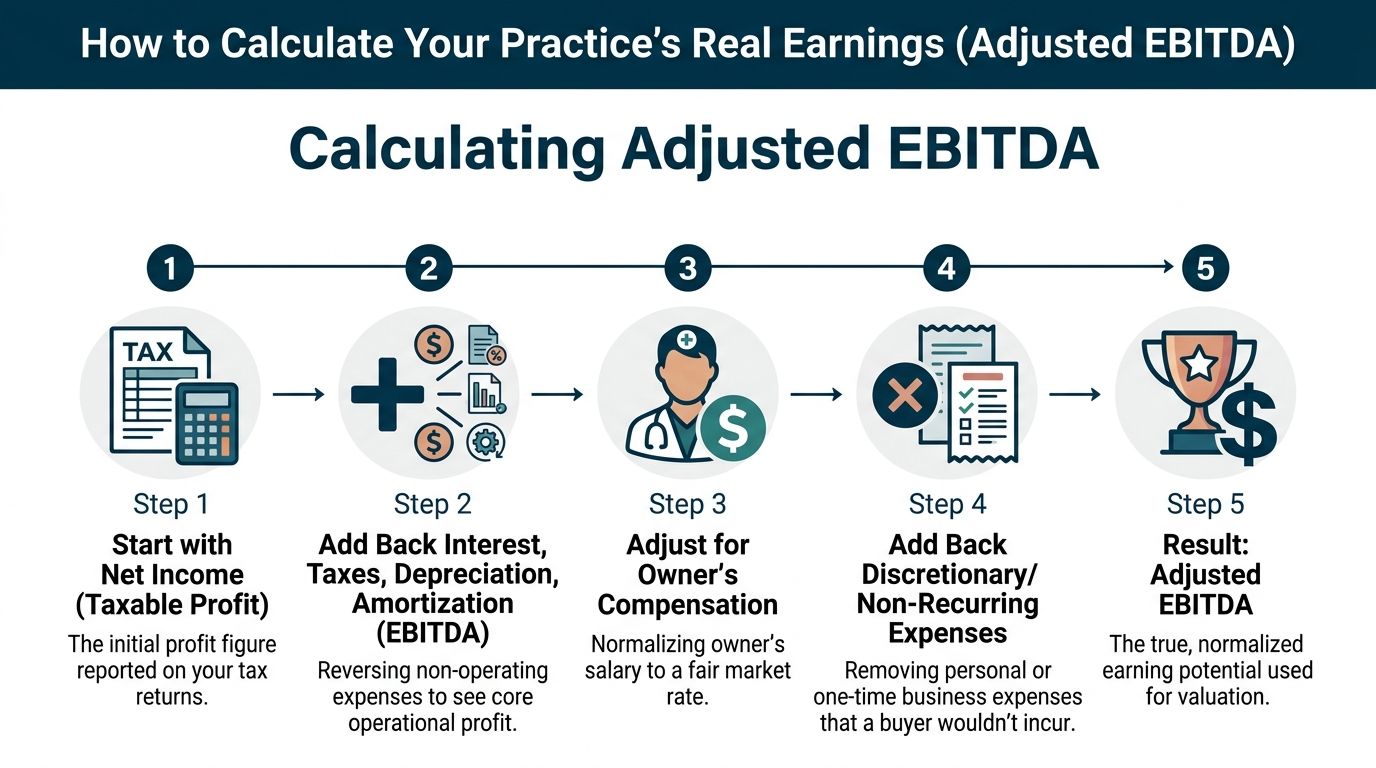
A buyer wants to know the practice's real operating earnings after cleaning up anything unusual, personal, or non-recurring. That number is usually called adjusted EBITDA.
Start with the reported profit
Begin with net income from your profit and loss statement or tax return. That's your starting point, not your final answer.
Then move toward EBITDA by adding back interest, taxes, depreciation, and amortization. Those items matter for accounting and tax purposes, but they don't always reflect the practice's core operating performance.
Normalize what won't continue
The key adjustment comes next. According to this physician-focused valuation guide, you value a medical practice more precisely by normalizing EBITDA. That means resetting physician-owner compensation to a fair-market replacement rate, removing one-time expenses, taking out personal costs run through the business, and adding back non-cash charges like depreciation before applying a specialty-specific multiple.
That sounds technical, but it's straightforward once you break it apart.
Common adjustments include:
- Owner pay above market: If you pay yourself more than a replacement physician would cost, buyers adjust that.
- Personal expenses: A car lease, family cell phone plan, or travel that ran through the practice but won't continue under new ownership.
- One-time legal or consulting bills: If they were unusual and tied to a specific event, they may be added back.
- Non-cash charges: Depreciation and amortization are usually added back in the EBITDA calculation.
A simple family practice example
Let's say a small family practice shows modest profit on the books. The owner assumes that's the earnings number. A buyer reviews the financials and notices the practice also paid for the doctor's personal vehicle, included above-market owner compensation, and recorded a legal bill tied to a lease dispute that won't repeat.
Once those items are normalized, the practice's true earnings can look stronger than the tax return suggests.
That doesn't mean every add-back will survive scrutiny. Buyers push back on anything that looks like a normal operating expense. If you try to add back too much, you lose credibility fast.
Buyers usually accept adjustments they can verify. They question adjustments that feel convenient.
What to pull before anyone values the practice
If you're preparing for a valuation, gather the same materials a serious buyer will request early:
- Tax returns and P&Ls: Ideally for multiple years so someone can spot patterns.
- Owner compensation detail: Salary, bonuses, distributions, and perks.
- General ledger support: Personal or one-off expenses often appear here.
- Payer mix history: Buyers want to see how revenue is sourced over time.
- Patient trend data: Month-over-month volume tells a story about stability.
- Operational notes: Staffing changes, service line changes, and unusual events.
Operational discipline matters here too. If your schedule has a no-show problem, that can hurt revenue consistency and the buyer's confidence in forward earnings. A practical operations read like Call Loop's guide to cutting no-shows can help tighten the basics before you bring your numbers to market.
A quick adjustment checklist
Use this when reviewing your own statements:
| Review item | Ask yourself |
|---|---|
| Owner compensation | Is my pay above or below fair-market replacement cost? |
| Personal spending | Did anything non-business run through the practice? |
| One-time costs | Was there a legal, consulting, repair, or setup expense that won't recur? |
| Non-cash entries | Have depreciation and amortization been identified clearly? |
| Documentation | Can I prove every adjustment with records? |
Getting adjusted EBITDA right is where many valuations are won or lost. If the earnings aren't believable, the multiple won't save you.
Finding the Right Multiple for Your Practice
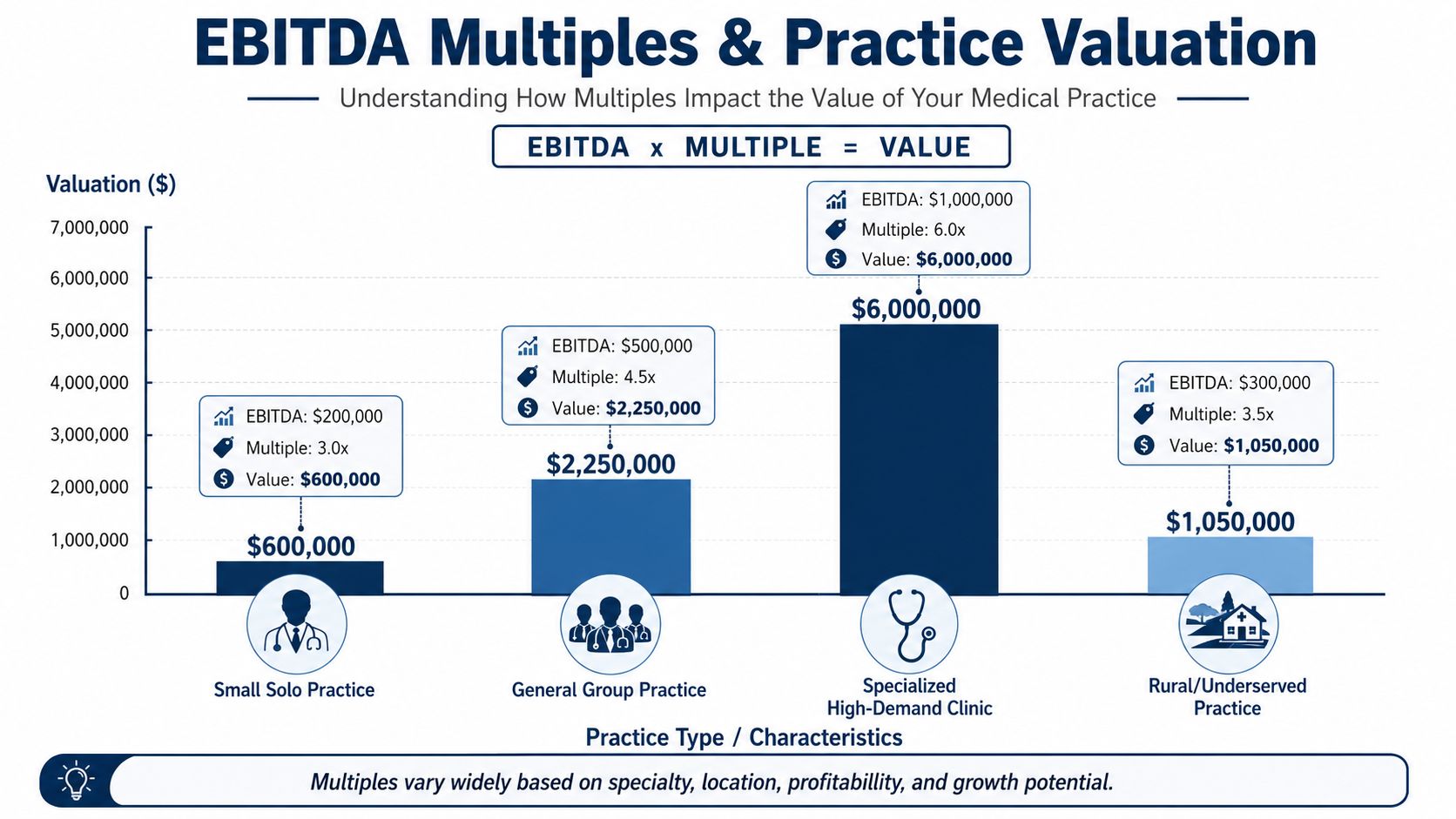
Once adjusted EBITDA is clean, the next question is the multiple. Owners often get tripped up at this stage, because the formula looks simple but the judgment behind it isn't.
For a wider view of how multiples vary across sectors, this reference on business valuation multiples by industry is helpful background.
Specialty drives a lot of the range
Not all medical practices get valued the same way. Perch Equity Group's 2026 guide notes that medical practices are most commonly valued using adjusted EBITDA multiples, typically 4x to 8x for private equity-backed organizations. That same guide notes dermatology and ophthalmology can reach up to 8x, while primary care often falls in the 3x to 5x range.
That gap isn't random. Buyers often view certain specialties as more scalable, more profitable, or easier to integrate into a larger platform.
What pushes a multiple up or down
Even within the same specialty, the multiple changes based on risk and quality.
A few examples:
- Payer mix: Heavy dependence on lower-reimbursement or less predictable reimbursement sources can pressure value.
- Provider dependence: If the whole practice revolves around one physician-owner, a buyer sees transition risk.
- Growth profile: Stable patient flow and room to expand usually help.
- Operational discipline: Clean billing, reliable staffing, and organized reporting support a stronger case.
- Local market conditions: Competition, referral patterns, and buyer demand still matter.
A multiple is really a pricing shortcut for risk. Lower risk usually earns a better multiple.
Think in ranges, not perfect precision
Owners often want someone to tell them the exact multiple on day one. That's not how real deals work.
A buyer first decides whether your EBITDA is credible. Then they look at specialty, risk, and how easy the practice will be to transition. The multiple comes out of that mix. It's less like using a calculator and more like underwriting a loan. The cleaner and more dependable the practice looks, the stronger your position.
Here is a practical perspective:
| Practice characteristic | Likely buyer reaction |
|---|---|
| Strong specialty demand | Better pricing interest |
| Heavy dependence on one doctor | Discount for transition risk |
| Stable operations and clear reporting | More confidence in earnings |
| Weak systems or messy records | Lower multiple or tougher terms |
If you're trying to learn how to value a medical practice on your own, don't get stuck treating the multiple like a fixed industry code. It's a judgment call shaped by what buyers believe they'll inherit.
Common Valuation Pitfalls That Cost Doctors Millions
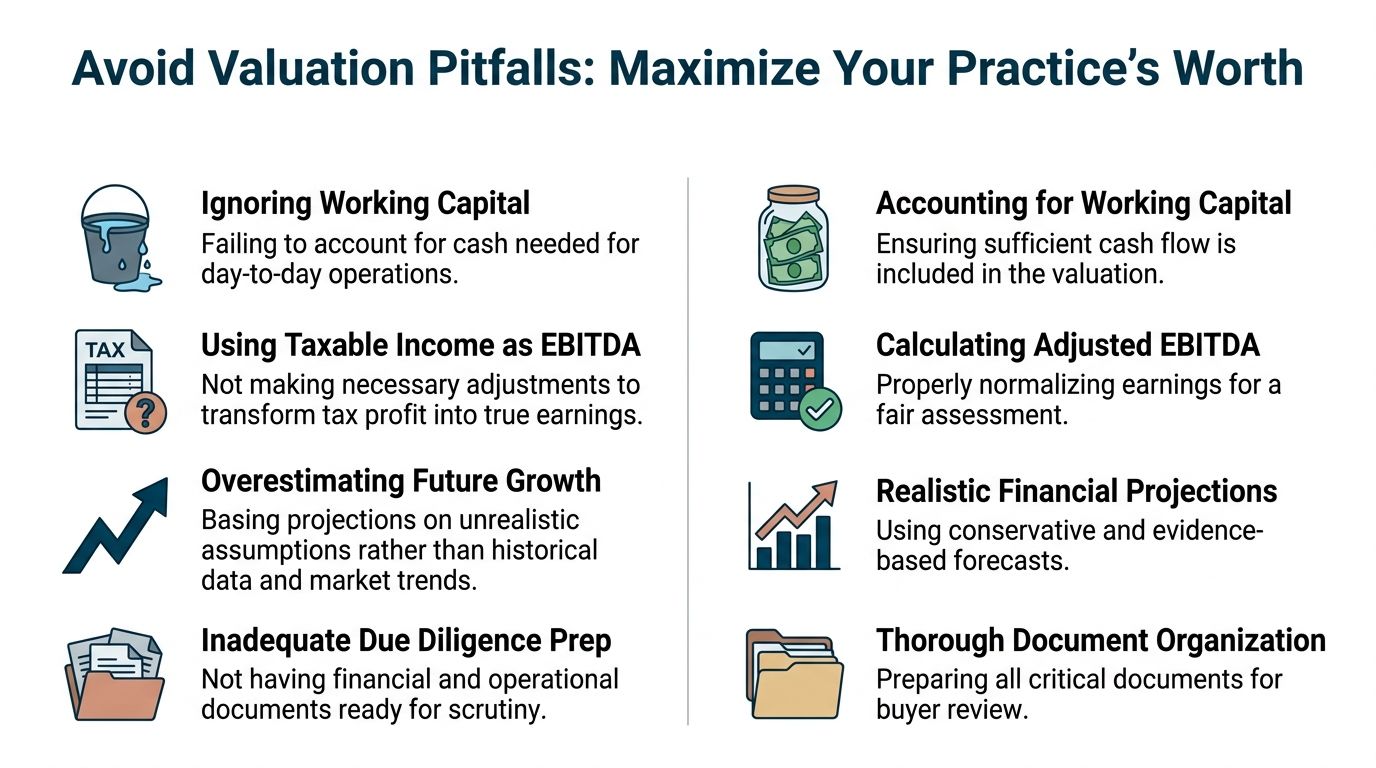
The biggest valuation mistakes aren't usually dramatic. They're ordinary. A doctor uses the wrong yardstick, accepts a rough estimate from someone who doesn't know healthcare deals, or assumes a tax return tells the whole story.
That's how owners leave money on the table.
The revenue multiple trap
Revenue rules sound easy. They also break down quickly.
A detailed clinic valuation discussion from The Sorsó warns that relying on revenue multiples instead of adjusted EBITDA multiples can lead to 30 to 50 percent lower valuations. That's because revenue ignores margin quality and operating efficiency. Two practices can produce the same top line and have very different take-home economics.
If your practice is profitable and well-run, a lazy revenue shortcut can undervalue it badly.
Owner comp mistakes create buyer leverage
This one shows up all the time. An owner either pays themselves far above market, far below market, or mixes salary with perks and distributions in a way that makes the numbers hard to read.
When compensation isn't normalized properly, buyers use that confusion against the seller. They challenge earnings, ask for more diligence, and argue for a lower price.
Watch this closely: If a buyer has to guess what a replacement doctor would cost, they'll usually guess in their own favor.
Goodwill isn't fluff
A medical practice isn't just equipment and supplies. Patient relationships, reputation, referral patterns, and brand recognition carry real value.
If goodwill is handled poorly in the valuation or deal structure, the practice can look weaker than it is. It can also create problems later when the parties allocate value in the transaction documents.
A short list of mistakes worth catching early
- Using revenue as the main metric: Easy to quote, weak for a profitable practice.
- Skipping normalization: If the books include personal spend or unusual owner pay, the valuation won't hold up.
- Treating all profits as equal: Buyers care about sustainable earnings, not a lucky year.
- Showing up disorganized: Missing statements, weak support, and sloppy records create doubt.
A bad valuation doesn't just reduce the headline number. It alters the balance of power in the discussion.
From Your Valuation Number to a Sale-Ready Plan
A valuation number feels concrete. In a sale, it often isn't.
The number you hear first is usually enterprise value or headline value. That's not the same as cash in your bank account at closing. Many owners learn this too late, after they've already anchored emotionally to a big offer.
Headline price versus real proceeds
A buyer may offer what looks like a strong price, then split that consideration into pieces. Some cash comes at closing. Some may sit in escrow. Some may be paid through a seller note. Some may depend on future performance, physician retention, or revenue after closing.
Auxo Capital Advisors notes that up to 30 to 40 percent of a practice's headline value may be deferred or contingent on post-closing performance metrics like earnouts. That's a major reason sellers end up with unrealistic expectations about liquidity.
The practical point is simple. A lower all-cash offer can be better than a higher offer loaded with conditions.
Questions worth asking before you sign anything
When reviewing a letter of intent or early offer, ask:
- What is paid at closing: Not eventually. At closing.
- What is contingent: Earnouts, retention targets, or future collections.
- What is deferred: Seller notes, escrow holdbacks, or rollover equity.
- Who controls the outcome after closing: If your earnout depends on decisions the buyer makes, that's risk to you.
- What records need to be ready: Diligence delays often become price pressure.
Good preparation helps here. If you're assembling files for a deal process, practical tools like these essential due diligence checklists can help you organize financial, legal, and operational documents before buyer requests start piling up.
Build the plan before the process starts
A strong exit doesn't start when an LOI lands in your inbox. It starts earlier, when you clean up earnings, document adjustments, understand your likely multiple, and decide what deal terms you will and won't accept.
That changes the conversation. You're no longer reacting to a buyer's model. You're negotiating from your own.
If you want to know how to value a medical practice the right way, don't stop at the valuation formula. The ultimate finish line is sale-ready numbers, realistic expectations, and deal terms that convert paper value into actual proceeds.
If you want help turning messy books into clean, sale-ready financials, MyOfficeOps helps business owners and healthcare practices get clear reporting, stronger financial visibility, and practical guidance for growth, valuation, and exit planning.