

It's late, and you're checking the bank app again. There's money in the account, but payroll is coming, a customer hasn't paid, and you can't remember whether that tax payment has cleared. You don't need another dashboard. You need someone to help you work out what you can safely spend.
Outsourced accounting for startups should give you that answer. The useful version combines reliable books, a cash forecast, and named people responsible for preparing, reviewing, and approving the work. You keep the decisions that shape the company without spending your evenings sorting receipts.
What a Startup Should Hand Off First
Start with the work you keep postponing. Unmatched bank transactions, missing receipts, and overdue invoices are good candidates for a handoff because they repeat and follow a process. Pricing, hiring, and deciding whether a purchase makes sense still belong with you.
Hand off the preparation, not your authority. An accountant can prepare a payment list, but you confirm that the bills are legitimate and approve large payments. They can show what a new employee would cost, but you decide whether to hire.
Match the help to the work
Say you run a two-person software studio with about 40 transactions a month. You sell subscriptions, pay for hosting, and occasionally reimburse a founder. In that scenario, you need clean monthly books and clear treatment of founder spending, not a full-time controller supervising a finance department.
Start with transaction coding, bank and credit-card reconciliations, monthly reports, and a list of upcoming deadlines. Reconciliation means checking that the accounting records agree with the bank or card statement. It's how someone catches a missing charge or a payment entered twice.
A clinic hiring its first employee in April faces a different handoff. Under the IRS employer guidance, it must collect Form W-4, calculate withholding, deposit federal employment taxes electronically, generally file Form 941 after each calendar quarter, and retain employment-tax records for at least four years. The provider can handle the process, while the clinic owner confirms pay rates and approves payroll.
What to keep and what to outsource by stage
Mark the row closest to your business. Treat the triggers as planning rules, not legal thresholds or promises about how quickly a provider will work.
| Stage | Founder still decides | Hand off now | Add more when |
|---|---|---|---|
| Pre-revenue, founder only | Prices, spending approval, personal versus company money | Monthly bookkeeping and a receipt habit | Books are messy or an outside investor asks |
| First paying customers | Invoice approval and who you sell to | Close, reconciliations, sales-tax setup, accounts-receivable reminders | The month can't close by your agreed deadline |
| First employees | Who to hire and the offer amount | Payroll, W-4, tax deposits, Form 941 | The first W-2 hire starts |
| Raising or borrowing | The story and the ask | Accrual books, runway model, investor package | A term sheet, lender, or buyer is coming |
| Busier company or second entity | Strategy and big bets | Controller close plus forecast support | A board, another entity, or a shrinking cash cushion requires closer oversight |
Outsourcing this work isn't unusual. A 2019 YouGov survey found that 37% of small businesses outsourced accounting, excluding payroll, and 65% of organizations outsourcing accounting cited a lack of qualified or relevant internal staff.
Remote work also needs a shared setup. Cloudvara's guide to cloud collaboration for bookkeeping and accounting offers context for arranging access to the tools and files both sides need.
Practical rule: Give away a repeatable task with a clear output, not a vague request to handle the finances.
Write down three tasks you'll stop doing yourself this month. For each, name what you expect back: reconciled accounts, an approved payroll draft, or a list of unpaid customer invoices.
How to Choose an Accounting Partner
Open the first call with a direct question: Who prepares the books, who reviews them, and who may move money? A useful answer names people and separates their jobs. A vague answer about a dedicated team doesn't tell you who will fix a problem.
Then describe a task that matters to your startup. Ask how the firm would record founder expenses, handle an investment, or explain a customer's overdue balance. Listen for a clear process rather than a long list of software badges.
Compare the work, not the proposal
Consider a founder choosing the cheapest package. After signing, they discover that equity entries aren't included. When an investor asks why the funding doesn't match the balance sheet, the question lands back on the founder.
That package may be perfectly suitable for another business. The mismatch is between its scope and this startup's needs. A better arrangement names a bookkeeper for routine work and a CPA or advisor to review the issues that need judgment.
Use this visual as a reminder of the roles to identify during the call.
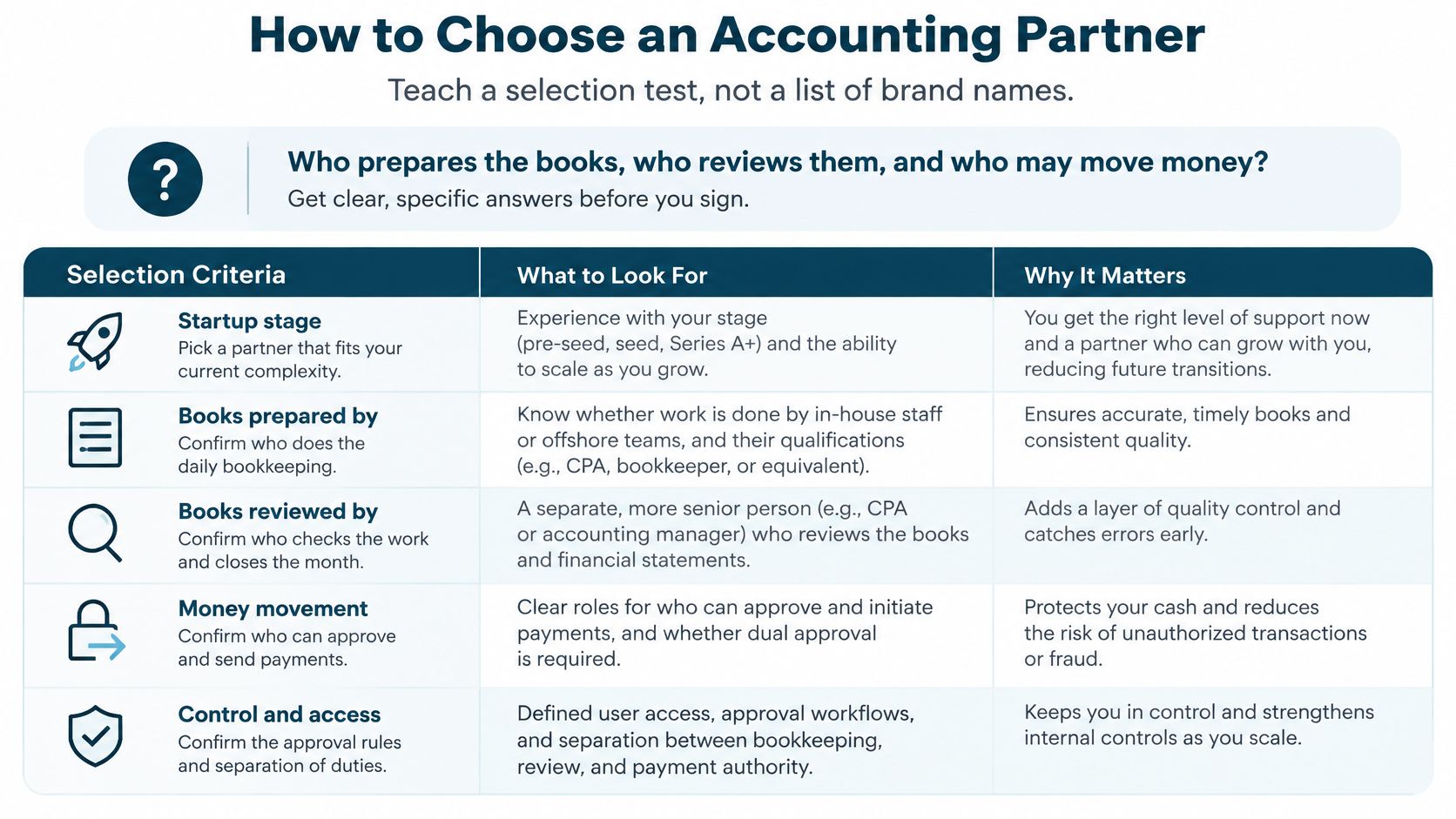
Partner scorecard for a first call
| Check | Good sign | Walk away if |
|---|---|---|
| Who does the work | Named bookkeeper plus a reviewer | Only a rotating inbox with no owner |
| Startup fit | Has handled equity, founder expenses, and simple investor reports | Only serves mature companies with a full finance staff |
| Tools | Works in your cloud system or helps you choose one | Forces a tool you can't see or export |
| Close speed | Written calendar with an agreed delivery date | No date for when last month is done |
| Money controls | You approve wires and payroll; they prepare | They want sole control of payments on day one |
| Response | Clear response commitment and an escalation contact | Silence after the proposal and no backup contact |
Ask to see the output
Request a sample close calendar and a plain-language report with identifying details removed. The calendar should show when your documents are due, when the firm checks the accounts, and when you receive the finished reports. The report should make sense without someone translating every label.
Also request references from businesses with similar complexity. A clinic with payroll and insurance collections has different needs from a consulting founder who sends occasional invoices. Ask those references how the firm handles questions and corrects mistakes, not just whether they like the team.
In BILL's 2025 Finance Leader Outlook survey, conducted with Logica Research, 38% of finance leaders, primarily at small and midsize businesses, said their company worked with an outsourced accounting firm. A short scorecard helps you compare the actual work rather than the polish of each proposal.
Before signing, confirm whether payroll processing, tax returns, equity entries, and cleanup are included. Similar package names can hide very different responsibilities.
Use a simple pass-fail rule: if the firm can't explain the monthly close in everyday words, or wants unrestricted bank authority immediately, keep looking.
How to Onboard and Keep Control
Treat onboarding as a controlled handoff, not a file dump. Sending a folder of statements doesn't tell the accountant which bills are disputed, which founder payment was a loan, or who can approve payroll.
The setup should leave you with a visible chain of responsibility. The provider prepares the work, a named reviewer checks it, and the right person at your company approves decisions.
Build the handoff in order
Map where money moves. List cash accounts, payroll, customer billing, purchases, taxes, loans, and equity. Include company costs paid on a founder's personal card. Note the tool, responsible person, and supporting document for each path.
Build a short chart of accounts. This is the list of categories used in your books. Separate everyday operating costs, customer acquisition, product development, founder transactions, and financing. Keep the labels useful enough to explain spending without creating a category for every receipt.
Name the preparer, reviewer, and approver. Put actual names beside the roles. The person entering a vendor bill shouldn't be the only person able to approve and pay it. Small-business accounting-systems research identifies job separation, ongoing monitoring, and checks of cash and inventory as useful internal controls.
Set access before connecting tools. Begin with read access to banking where possible. Require separate preparation and approval for wires and payroll changes. Keep account ownership, recovery details, and administrator access with the company.
Clean unresolved items. Review unpaid customer invoices, outstanding vendor bills, and old transactions that never cleared. Tell the provider which invoices customers dispute. Don't let an old mistake become the opening balance everyone assumes is correct.
Run a trial close. Reconcile bank and card accounts, check customer and vendor balances, record payroll and other unpaid costs, and review debt and equity. Lock the period after review, with a controlled process for corrections. Keep an exceptions list showing the issue, owner, due date, and evidence of resolution.
Check the accounting method immediately after that first close. The IRS small-business tax guide says the first tax return generally establishes the business's accounting method, which must be applied consistently; changing it later usually requires IRS approval. Cash accounting generally follows money received and paid, while accrual accounting records income and expenses when earned or incurred. Don't confuse an investor-reporting change with permission to change your tax method.
- Agree on the ongoing calendar. Write down document deadlines, report delivery, review dates, and the backup contact. The control-and-close methodology supports a documented close calendar, reconciliation evidence, and an exceptions log rather than speed without checks.
The setup should make responsibilities easy to see.
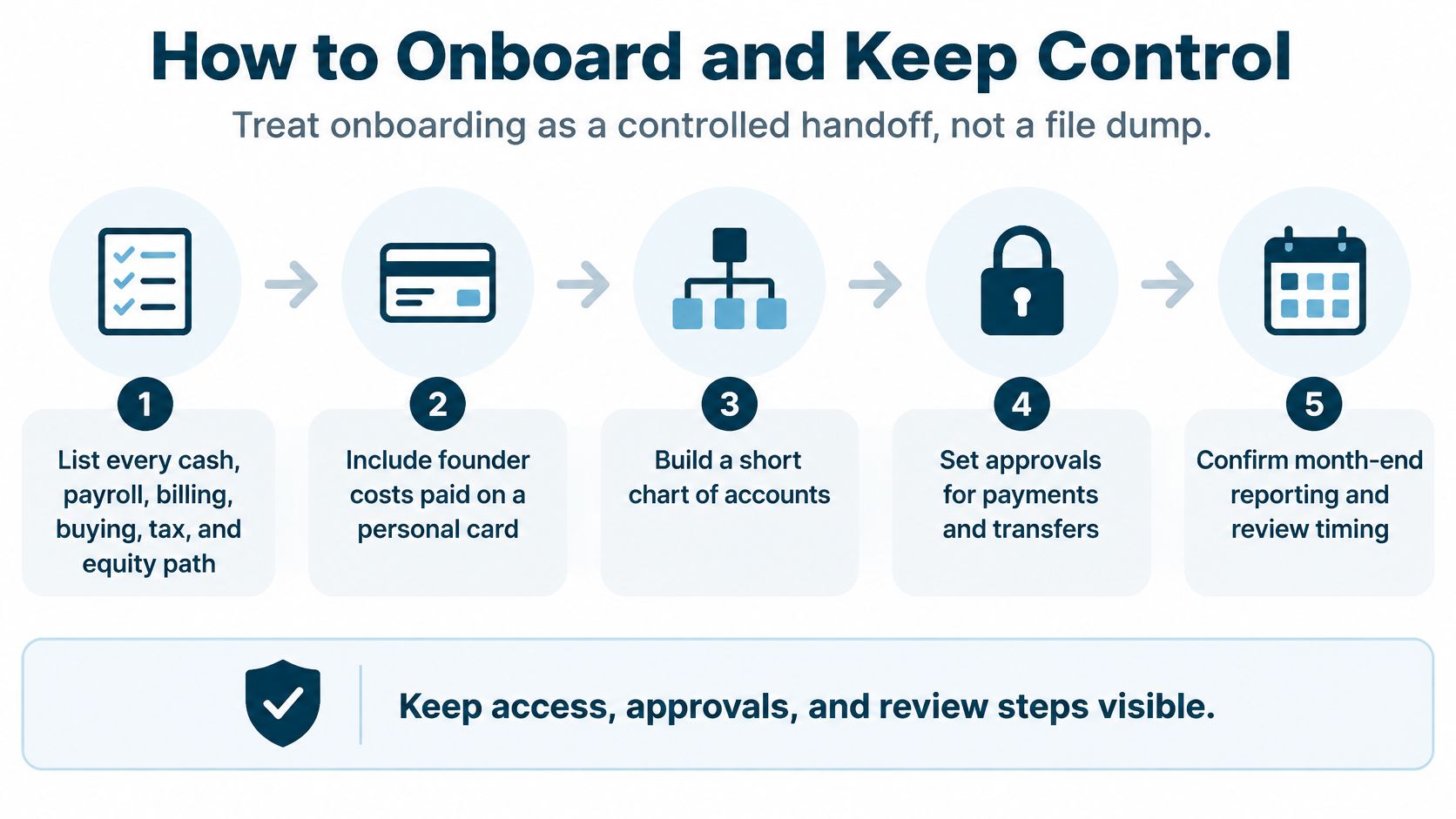
Check the handoff before calling it finished
For a healthcare startup, vendor setup may also affect billing and collections. Lucentive's guidance on coordinating EMR vendor activation with finance is a useful prompt to connect system activation, contract charges, and finance responsibilities.
Use these account-management questions to prepare for the responsibility discussion. At MyOfficeOps, we manage the entire transition when a client switches from their current accountant, rather than leaving the client to coordinate the transfer alone.
We can begin virtual CFO work within a week. Confirm the start date and access requirements in writing rather than assuming every part of a handoff will be ready on that schedule.
The proof of successful onboarding is a signed-off first close you can read, with unresolved questions clearly assigned.
What Outsourced Accounting Usually Costs
Three quotes can arrive for the same startup and still describe three different jobs. One covers bank coding only. One adds the monthly close. One includes a rolling cash forecast. The lowest number wins the comparison on paper, then loses the first month when payroll questions land back on the founder's desk.
Service levels to compare when pricing outsourced accounting
| Level | What you get | Fits when |
|---|---|---|
| Software only | The tool, while you still do the work | Very few transactions and no payroll |
| Bookkeeping package | Coding, reconciliations, simple reports | Early revenue, founder still approves everything |
| Full-cycle accounting | Close, bill support, invoice follow-up, payroll coordination | Employees, vendors, and a due-date calendar |
| Controller support | Reviewed close, controls, basic forecast | The team is growing and errors are getting costly |
| Fractional CFO | Runway, hiring, pricing, and fundraising help | A big decision or outside money is on the table |
These are service levels, not price quotes. Get written quotes against the same task list before comparing monthly fees, because the scope behind each price matters more than the number itself.
A low monthly fee can cover basic transaction coding while leaving you responsible for the close, payroll questions, and customer collections. A larger fee may include that work, or more transactions. Ask who owns bill payments and who signs off on the close at each level. A package that leaves those owners unnamed pushes the work back onto your calendar.
What changes the fee
Give each firm the same picture of your business. Transaction count matters, but so do payroll headcount, the number of entities, the condition of the records, and the judgment required.
- Transaction workload: Include bank accounts, cards, invoices, bills, and payment platforms, not just your main bank feed.
- Payroll complexity: Describe employees, contractors, locations, and who currently processes payroll.
- Reporting needs: Name the reports you need for management, investors, or lenders.
- Cleanup: Identify missing months, unreconciled accounts, and uncertain opening balances.
- Decision support: Separate maintaining the books from building hiring scenarios or supporting a fundraising process.
Ask for the recurring fee and any catch-up project to be shown separately. A founder with three months of unreconciled books will see a catch-up charge before the steady monthly fee begins. If the two are blended, a costly first month may look like the ongoing price, or an appealing monthly fee may hide unfinished cleanup.
Software doesn't replace the reviewer
A University of Florida journal study of 44 startup businesses found that 29 respondents used QuickBooks, and approximately two-thirds of those users also worked with an accounting person or firm. That small study illustrates a practical combination: software records the activity, while a person checks and interprets it.
For example, QuickBooks can import a transfer from your personal account. It can't reliably decide, without context, whether you intended a founder loan or an equity contribution. Someone needs your answer and the supporting paperwork.
Buy a defined result, such as reviewed monthly accounts, rather than an undefined amount of accounting help.
Use the guide to outsourcing accounting costs to prepare your pricing questions. Ask whether tax returns, payroll fees, software subscriptions, equity work, and cleanup sit inside or outside the quoted scope.
Price the level that fits your current stage. Then request a separate price for the next step up, so you know what changes when you need more help. The best comparison shows ongoing work, one-time work, exclusions, and the rule for changing the fee.
Tips for Cash Runway and Monthly Reviews
Ask your accounting partner for a 13-week rolling cash forecast, refreshed against actual bank activity each week. Put customer receipts on the dates you expect the money, not the dates you send invoices.
Start with available cash, then list payroll, taxes, vendor payments, debt payments, equipment, and planned hires. Mark each assumption as committed, probable, or optional. This makes it easier to see which spending you can delay without breaking an obligation.
Use this checklist to make sure the forecast includes more than customer revenue and payroll.
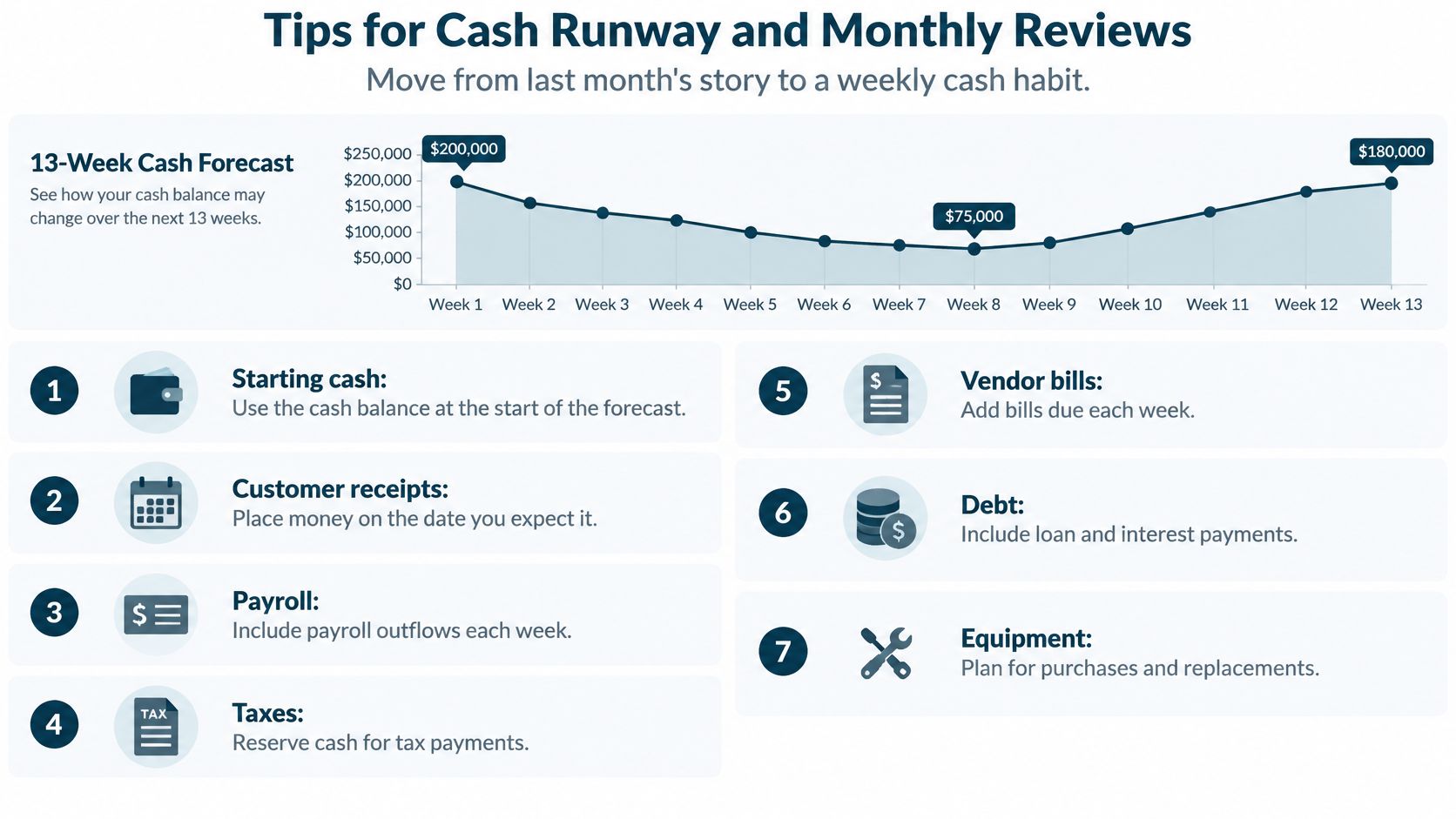
Set a trigger before cash gets tight
Choose a written action threshold with your advisor. For example, you might decide that runway below six months triggers a pause on optional hiring and a fresh downside forecast. That's a management rule you choose, not a universal safety line.
Then separate a timing problem from a business-model problem. A delayed payment from a dependable customer may create a temporary gap. Repeatedly spending more to deliver the work than customers pay you requires a different response, such as repricing, reducing costs, or changing the offer.
Say customers pay in 60 days while payroll goes out every two weeks. In that scenario, your income statement could show a profit while the bank balance falls. Your accountant should show both the expected collection dates and what happens if those customers pay late.
Keep the monthly page short
Choose a small set of measures you'll use:
- Gross margin: What remains from revenue after direct delivery costs.
- Burn: How much cash the business uses; agree whether the report shows spending before or after customer receipts.
- Runway: How long available cash lasts under the forecast assumptions.
- Customer payment time: How quickly customers turn invoices into cash.
- Payroll share of revenue: How staffing costs compare with sales.
- Customer or project profit: Which work leaves money after its costs.
Use this explanation of business burn rate to settle the definition before comparing periods. A number isn't useful if the founder and accountant calculate it differently.
Keep founder funding separate from operating performance. The SBA's Small Business Finance FAQs report that 80% of employer businesses and 76% of nonemployer businesses used personal savings for startup capital. Document whether each transfer is a loan, equity, or reimbursement-related transaction so it doesn't distort the picture.
Meeting rule: Leave with a decision and a named owner, not just a better explanation of last month.
Hold a short monthly review focused on the largest differences between forecast and actual results. Decide what changes, who acts, and when you'll check the result.
At MyOfficeOps, our accounting services are designed to grow with clients from startup through expansion. Our bookkeeping services handle day-to-day transactions, while CFO advisory provides higher-level strategy, forecasting, and guidance. Keep routine work with the bookkeeping team and add forecasting support when hiring, fundraising, or uncertainty calls for it.
Run the Partner Relationship and Plan an Exit
Keep the relationship easy to review and possible to leave. At each check-in, request the close calendar, open items with named owners, and the figures that need your attention. Discuss missed commitments directly rather than letting them become normal.
Your contract should protect access to your records, not just describe the monthly work.
Put ownership and access in writing
- Records: State that your company owns its books and define how you receive a complete ledger export.
- Communication: Agree on response expectations, urgent contacts, and a backup person.
- Departure: Record notice requirements, transfer responsibilities, and any exit charges.
- Access: Use named logins and keep company-controlled copies of payroll reports, tax filings, bank statements, and supporting documents.
Schedule access reviews and remove departed users promptly. Don't leave a former employee's login active because nobody knows whether an integration depends on it. Have the provider replace shared credentials with a documented setup.
Test whether you can leave
Request an export while the relationship is healthy. Check that you can open it, understand the account labels, and match supporting documents to the records.
An exit plan is useful even when you never use it. It confirms that you still control your financial records.
Set written triggers for a review of the relationship: repeated late closes, an unauthorized payment, or unanswered questions that affect a decision. Before switching, prepare a status note with unresolved items, upcoming tax deadlines, account balances, and the chart of accounts.
A well-prepared transfer gives the next accountant a starting point. It doesn't guarantee an instant start, especially when the old records need repair.
Book a First Call With a Clear Ask
Before booking a call, write a half-page description of your business and the help you need. A clear starting point makes it easier to judge whether the firm understands the work. You don't need to clean up every problem before asking for help.
Include your company stage, an estimate of monthly transactions, payroll status, and your accounting method if you've filed a return. Name the tasks you want to hand off and the cash question you can't answer. Bring recent bank statements and a list of tools such as QuickBooks, your payroll platform, and your billing system, but share sensitive documents through an agreed secure channel.
Bring questions that need concrete answers
- Who does the work? Get the names or roles responsible for preparation and review.
- How does the close run? Ask what you must provide and when you'll receive usable reports.
- What does the first month cost? Separate onboarding and cleanup from recurring work.
- What stays in my hands? Confirm spending decisions, approvals, and account ownership.
Send the brief ahead of the meeting. Judge the answers by whether the person uses plain words and turns your concerns into a workable handoff.
At MyOfficeOps, we start by listening to your challenges and goals, then explain how bookkeeping can give you back time and support growth. If the scope and answers fit, agree on onboarding. If they don't, your brief is ready for another conversation.
Visit MyOfficeOps for a free consultation with our accounting experts about the work you want to hand off and the cash decisions you need to make. Fill out the contact form with your challenges and goals, and an experienced accountant will get back to you. Bring your half-page brief so the conversation starts with your business, not a generic package.