
Running a small business is a lot. You’re the boss, the salesperson, the marketing team, and sometimes, the janitor. The last thing you want to deal with is messy books. But here's the deal: getting your accounting right isn't just about making tax time easier. It's about knowing if you're actually making money, seeing where every dollar goes, and making smart choices to grow.
Forget the confusing words and complicated spreadsheets. This guide gives you simple, useful small business accounting tips that feel less like a chore and more like a clear map for your business. We'll cover everything from picking the right accounting method to managing your cash and getting ready for taxes without the last-minute panic.
Think of it like this: if your business is a car, your accounting is the dashboard. It tells you how fast you're going, how much gas you have left, and warns you if the engine is getting too hot. It gives you the control you need to take turns and speed up with confidence. Let's get you in the driver's seat.
1. Pick the Right Accounting Method: Accrual vs. Cash
Choosing between accrual and cash accounting is one of the first big decisions you'll make. It changes how you see your company's health. Cash accounting is simple: it only tracks money when it actually comes in or goes out of your bank account.
Accrual accounting is different. It records money when you earn it and expenses when you get them, even if the cash hasn't moved yet. This gives you a much truer picture of how well you're doing. If you ever want to get a loan, find investors, or just make smarter plans, you'll need to use the accrual method.
Why Accrual Accounting Matters
Imagine you're a web designer. You finish a $5,000 website for a client in June and send the bill. The client pays you in July.
- With Cash Accounting: Your books say you made $0 in June and $5,000 in July. This makes June look bad and July look great, but that's not the whole story.
- With Accrual Accounting: Your books show you earned $5,000 in June, the month you actually did the work. This shows what really happened.
Key Takeaway: Accrual accounting matches the money you earn with the costs it took to earn it. This gives you a clear, real-time look at your business performance.
How to Do It
Switching to or starting with accrual accounting is easier than it sounds.
- Use Good Software: Tools like QuickBooks Online or Xero are built to handle accrual accounting easily.
- Set Clear Rules: Decide exactly when a sale is "earned." For a roofer, this might be when a specific part of the job is done. For a doctor, it's when a patient is treated.
- Track Who Owes You: Keep an eye on your Accounts Receivable (A/R) report. This list shows you who owes you money and for how long, which is super important for managing your cash.
2. Keep Business and Personal Money Separate
One of the most important small business accounting tips is to draw a clear line between your money and your business's money. Mixing them up is a common mistake that creates a huge mess, makes you look bad in a tax audit, and can even put your personal savings at risk if your business gets into trouble.
Keeping your accounts separate is the foundation of clean bookkeeping. It makes sure every dollar is tracked correctly, so you can see how much your business is really making. This clarity is key for filing taxes and making good financial decisions.

Why Separating Finances Matters
Let's say you own a small landscaping company. You use your personal credit card for a new lawnmower and your business card for a family dinner. When tax season comes, untangling all that is a nightmare.
- Mixed Up: Your bookkeeper spends hours trying to figure out what was a business expense. You might miss out on real deductions or accidentally claim personal stuff, which can trigger an IRS audit.
- Separate: With a business-only card, the lawnmower is clearly a business expense. This makes tax prep a breeze and gives you clean data to work with.
Key Takeaway: Having separate bank accounts and credit cards is a must. It protects you legally, keeps you on the right side of the IRS, and helps you see your finances clearly. It turns a mess into a simple system.
How to Do It
Setting this up is easy and one of the best habits you can form.
- Open a Business Bank Account: As soon as you form your business, open a separate checking account. Use your business's tax ID number (EIN) to do this.
- Get a Business Credit Card: Use this card only for business purchases, from software to coffee with clients. This makes tracking expenses simple.
- Have a System for Paying Yourself: Don't just take cash out of the business account. Set up a formal way to pay yourself, like a regular owner's draw or a salary.
3. Track Expenses with a Chart of Accounts
A well-organized Chart of Accounts (CoA) is like the filing cabinet for your accounting system. Instead of throwing all your spending into one big "expenses" box, a CoA gives you specific categories so you can see exactly where every dollar is going.
This organized system is a big deal for creating good financial reports, staying right with your taxes, and making smart decisions. It turns a long list of transactions into a clear story, letting you see what things cost, which parts of your business make the most money, and where you can find tax deductions.
Why a Chart of Accounts Matters
Let's say you run a small catering business. Without a good CoA, you just see a big chunk of money spent each month. With one, you can see exactly how much you spent on food, staff, marketing, and kitchen supplies.
- Messy Method: Your books show you spent $10,000 last month. You know you made a profit, but you don't know how or what you could do better.
- CoA Method: Your books show $4,000 on food, $3,000 on staff, and $1,500 on marketing. You realize your food costs are higher than you thought, so you can adjust your prices for future events.
Key Takeaway: A detailed Chart of Accounts is the difference between guessing and knowing. It gives you the financial clarity you need to control costs, price your services right, and grow your business.
How to Do It
Setting up a good CoA is a key step to getting your finances under control. You can learn more about this by checking out this guide on what is a Chart of accounts.
- Start with a Template: Most accounting software like QuickBooks or Xero has templates for different industries. Use one as a starting point and change it to fit your business.
- Keep It Simple: You don't need a thousand categories. Aim for 50-100 accounts. Too few won't give you enough detail, but too many will just be confusing.
- Train Your Team: Make sure anyone who records expenses knows which category to use. To make this easier, you could use receipt management tools that connect to your accounting software.
4. Check Your Bank Accounts Every Month
One of the most important habits for keeping your books accurate is to regularly match the transactions in your business records with your bank and credit card statements. This process is called "reconciliation," and you should do it every single month. It's your best defense against mistakes, fraud, and cash flow surprises, making sure the numbers in your software match reality.
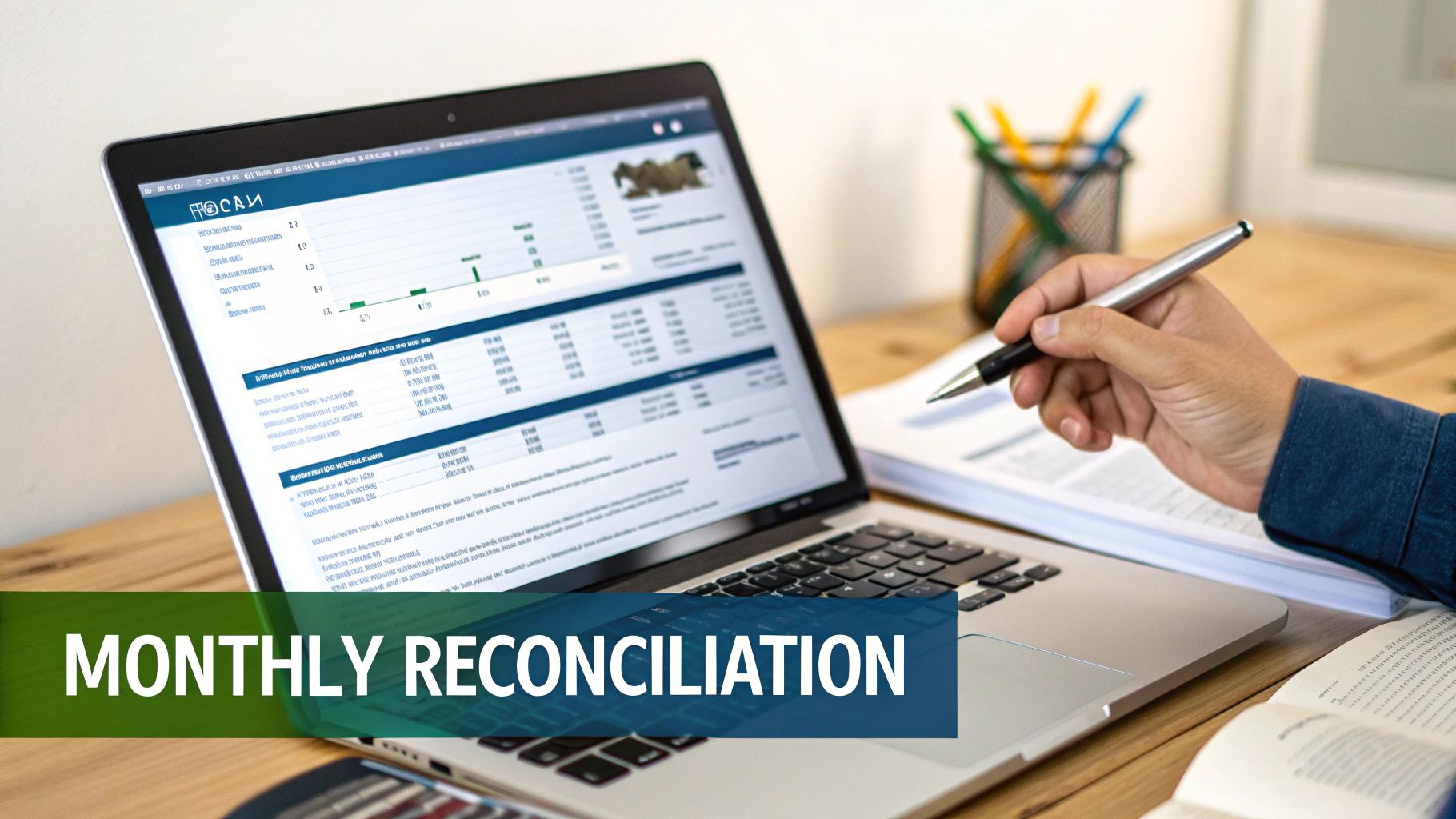
If you skip this step, you might be making big decisions based on bad information. For any small business, learning how to reconcile bank statements effectively can be the difference between financial clarity and total chaos.
Why Monthly Reconciliation Matters
Think of it like balancing your personal checkbook, but for your whole business. I once heard about a business owner who found an employee was using a company card for personal shopping—totaling over $12,000! They only caught it because they were carefully checking their statements each month.
- Catch Mistakes: It helps you find duplicate charges or missing payments before they become big problems.
- Stop Fraud: It helps you spot weird charges or suspicious activity right away.
- Manage Your Cash: It gives you a true cash balance, so you know exactly how much money you have to work with.
Key Takeaway: Monthly reconciliation is a basic step that confirms your financial data is correct, protects your cash, and gives you a solid foundation for all your financial reports.
How to Do It
Making this a regular habit is simple with the right tools and process. This is one of those small business accounting tips that pays for itself almost right away.
- Set a Date: Do your reconciliation within the first 10 days of the new month. This keeps everything fresh in your mind.
- Use Software: Use accounting software like QuickBooks Online or Xero. They can connect to your bank, pull in transactions automatically, and suggest matches, which makes the whole thing much faster.
- Check for Differences: If your numbers don't match, figure out why. Don't just ignore small differences; they can be signs of bigger problems.
- Keep Your Reports: Save a record of your monthly reconciliation reports. You'll need them if you ever get audited or need a business loan.
5. Watch and Predict Your Cash Flow
Profit is great, but cash pays the bills. This is one of the most important small business accounting tips to get. Cash flow forecasting is basically predicting how much money will come in and go out of your business in the future. It helps you see problems coming, plan for big purchases, and avoid the scary situation of being profitable on paper but not having enough cash to pay your employees.

Unlike profit, which can include things that aren't cash (like depreciation), cash flow is the actual money you have on hand. A simple forecast is your best tool for staying in business and planning ahead. You can learn more about how to get started by reading about what financial forecasting is on myofficeops.com.
Why Cash Flow Forecasting Matters
Imagine a plumbing company finishes a big job. They send the client a bill, but the client has 60 days to pay. In the meantime, the company has to pay its suppliers in 30 days and its plumbers every Friday.
- Without a Forecast: The owner sees a big profit from the job but suddenly runs out of cash to pay his suppliers and team. The whole business is now at risk.
- With a Forecast: The owner sees the 60-day cash gap coming. He talks to his suppliers about paying a little later and makes sure he has enough money in the bank to cover payroll until the client pays.
Key Takeaway: Forecasting helps you stop reacting to problems and start planning for them. It's an early warning system that gives you time to make changes before a cash shortage becomes a crisis.
How to Do It
Starting a forecast is easier than you think and can help you right away.
- Start with 13 Weeks: A rolling 13-week (or one quarter) forecast is easy to manage and gives you a good short-term view of your cash. Update it every week.
- Use Your Software: Tools like QuickBooks and Xero often have cash flow forecasting features. You can also use a simple spreadsheet.
- Be Realistic: When you guess how much money will come in, remember that clients don't always pay on time. Look at how long it usually takes to get paid and use that as your guide.
- Test Your Numbers: Ask "what if?" What if your biggest client pays a month late? What if your main piece of equipment breaks? It's smart to build in a little extra cash buffer for surprises.
6. Handle Payroll and Taxes Correctly
Payroll is usually a small business's biggest expense and a place where mistakes can be costly. Getting it wrong can lead to big penalties from the IRS, problems with state laws, and unhappy employees. Doing payroll accounting the right way means you withhold the correct amount of taxes, send them in on time, and record your labor costs accurately.
Many business owners don't realize how tricky payroll can be, especially as they hire more people or work in different states. It's not just about writing checks; it's a key task that has to be done perfectly. Getting this right is one of the most important small business accounting tips for protecting your business.
Why Proper Payroll Accounting Matters
Imagine you run a painting company with employees working in two different states. Each state has different rules for income tax.
- Wrong Payroll: You use the tax rules for just one state for all employees. Now you owe the other state thousands in unpaid taxes, plus penalties.
- Right Payroll: Your system correctly calculates taxes based on where the work was done. You stay out of trouble, avoid fines, and your employees' tax forms are correct.
Key Takeaway: Doing payroll right is something you absolutely have to do. It saves you from huge fines and legal problems and makes sure your biggest expense is tracked correctly for better planning.
How to Do It
Setting up a good payroll system is a basic step for any business with employees.
- Use Payroll Software: Don't try to manage this with a spreadsheet. Use a service like Gusto or ADP. They automatically handle the calculations, tax payments, and paperwork.
- Keep Good Records: Keep detailed records of hours worked, pay rates, and tax payments for at least four years. This is your proof if you ever get audited.
- Check Payroll Monthly: At the end of each month, make sure the payroll costs in your accounting software match the reports from your payroll service. This helps you catch mistakes early.
- Plan for Tax Payments: The money you withhold from your employees' paychecks for taxes isn't yours. Set it aside in a separate account so it's ready when it's time to send it to the government. Learn more about our dedicated payroll services to see how an expert can make this easier.
7. Create Clear Financial Reports and Track Your Numbers
Just doing your taxes once a year isn't enough to guide your business. Making a habit of creating clear financial reports is one of the best small business accounting tips because it gives you the map you need to make smart decisions. By regularly looking at your financial statements and tracking a few key numbers (called KPIs), you can go from reacting to problems to actively managing your business.
This means regularly looking at your main financial reports: the Profit & Loss (P&L), the Balance Sheet, and the Cash Flow Statement. These reports, along with a few numbers that are important for your industry, give you the clarity to see trends, check your progress, and change your plan before it's too late.
Why Financial Reporting Matters
Imagine you own a small marketing agency. You feel busy, but you're not seeing much growth in your bank account. By tracking your profit on each project, you might find that your social media projects have a 40% profit margin, while your website design projects only have a 15% margin.
- Without Reporting: You keep taking on all kinds of jobs, not realizing you're spending too much time on less profitable work.
- With Reporting: You see the data clearly and decide to focus more on getting social media clients, which boosts your overall profit.
Key Takeaway: Regular financial reports and tracking your key numbers turns guesswork into smart planning. It helps you see what's really making your business successful and where your weaknesses are.
How to Do It
Building a reporting habit doesn't have to be hard. The key is to start simple and do it consistently.
- Start with the Big Three: Learn how to read your monthly P&L, Balance Sheet, and Statement of Cash Flows. They're the foundation of understanding your finances.
- Pick 5-7 Key Numbers (KPIs): Don't try to track everything. A doctor's office might track the number of patient visits, while a coffee shop would track the average customer sale.
- Set a Rhythm: Pick a day, like the 10th of every month, to review last month's numbers. Compare your results to your goals and to last year to see what's changed.
8. Plan for Taxes All Year, Not Just in April
One of the worst surprises for a small business owner is a huge, unexpected tax bill. This usually happens because they didn't pay estimated taxes throughout the year. If you think you'll owe more than $1,000 in tax for the year, you have to make these quarterly payments. It's not a suggestion—it's a rule to avoid penalties.
Good tax planning is more than just making those payments. It's about setting up your business and finances all year long to legally pay as little tax as possible. By thinking ahead about deductions, business structure, and retirement savings, you can avoid cash flow problems and keep more of the money you earn.
Why Proactive Tax Planning Matters
Imagine a freelance consultant expects to make $100,000 in profit but doesn't make any estimated tax payments. Come April, she gets hit with a $30,000 tax bill plus a $2,000 penalty for not paying on time.
- Reactive (No Planning): The consultant has a huge cash crisis and might need to take out a loan just to pay the IRS. This hurts her business and stops her from growing.
- Proactive (With Planning): By planning ahead, she would have paid about $7,500 each quarter. This turns one giant bill into four smaller, manageable payments and keeps her cash flow healthy.
Key Takeaway: Thinking about taxes all year, instead of just once in the spring, protects your cash, saves you from expensive penalties, and can lower your overall tax bill.
How to Do It
Making tax strategy part of your regular financial routine is a small business accounting tip that really pays off.
- Calculate and Pay Quarterly: Use IRS Form 1040-ES to figure out what you owe. Put the due dates on your calendar (usually April 15, June 15, September 15, and January 15 of the next year).
- Create a "Tax" Savings Account: Every time you get paid, automatically move a percentage of that money into a separate savings account. This way, the money is there when your quarterly payments are due.
- Schedule a Fall Tax Meeting: Meet with your accountant in October to look at how your year is going. This gives you time to make smart moves before the year ends, like buying new equipment to get a deduction.
- Consider an S-Corp: If your business is making good money (say, over $60,000 in profit), ask your accountant if changing your business structure to an S-Corporation could save you money on self-employment taxes.
8-Point Comparison: Small Business Accounting Tips
| Practice | Implementation Complexity 🔄 | Resource Requirements ⚡ | Expected Outcomes ⭐📊 | Ideal Use Cases 📊 | Key Advantages & Tip ⭐💡 |
|---|---|---|---|---|---|
| Implement Accrual Accounting vs. Cash Basis | High — requires GAAP knowledge and period matching 🔄 | Moderate–High — accounting software + trained bookkeeper/CPA ⚡ | More accurate profitability and forecasting; investor/lender ready ⭐📊 | Growing businesses, service firms, inventory-heavy or seeking funding 📊 | Reveals true performance; start accruals early and use software (QuickBooks/Xero) ⭐💡 |
| Separate Personal and Business Finances | Low — simple policy and account setup 🔄 | Low — business bank accounts, cards, basic discipline ⚡ | Clean books, clearer tax reporting, better liability protection ⭐📊 | All small businesses and sole proprietors; owners prone to commingling 📊 | Prevents bookkeeping issues and audit risk; open business accounts immediately ⭐💡 |
| Track and Categorize Expenses with a Chart of Accounts | Medium — requires design and consistency 🔄 | Low–Moderate — time to set up + accounting software mapping ⚡ | Granular spend visibility; job/department profitability and tax readiness ⭐📊 | Construction, professional services, healthcare—any business needing cost detail 📊 | Use industry templates; limit accounts (50–100) and train staff ⭐💡 |
| Reconcile Bank and Credit Card Accounts Monthly | Low–Medium — routine control process 🔄 | Moderate — staff time or outsourced reconciliation tools ⚡ | Early error/fraud detection and accurate cash position ⭐📊 | Any business with regular transactions; high-value or high-volume firms 📊 | Reconcile within 5–10 days month‑end; document reconciling items ⭐💡 |
| Monitor and Optimize Cash Flow with Forecasting | Medium–High — modeling and scenario planning 🔄 | Moderate — historical data, forecasting tools, weekly updates ⚡ | Anticipate shortfalls, plan borrowing/investment, avoid liquidity crises ⭐📊 | Seasonal businesses, growth-stage firms, companies with long AR periods 📊 | Start with a 13‑week rolling forecast and build buffers (10–20%) ⭐💡 |
| Implement Proper Payroll Accounting and Tax Withholding | High — multi-jurisdiction compliance and reporting 🔄 | High — payroll software or provider, HR processes, tax filing resources ⚡ | Compliance, accurate labor cost reporting, reduced penalty risk ⭐📊 | Any employer, especially multi-state operations and firms with many employees 📊 | Use dedicated payroll service and reconcile monthly to avoid costly errors ⭐💡 |
| Establish Clear Financial Reporting and KPIs | Medium — cadence, KPI selection, and data quality 🔄 | Moderate — reporting tools, dashboarding, analyst time ⚡ | Strategic visibility, faster decisions, performance accountability ⭐📊 | Growing firms, companies seeking investor/debt financing, managers needing oversight 📊 | Track 5–8 core KPIs; produce monthly P&L, balance sheet, cash flow and review regularly ⭐💡 |
| Plan for Quarterly Estimated Taxes and Year‑End Tax Strategy | Medium — forecasting and tax planning discipline 🔄 | Moderate — CPA support, accurate profit tracking, tax savings planning ⚡ | Avoid penalties, smoother cash flow, capture tax-saving strategies ⭐📊 | Self-employed owners, profitable small businesses, S‑Corp candidates 📊 | Set aside estimated payments monthly; review tax strategy with CPA each quarter ⭐💡 |
Ready to Trade Accounting Headaches for Real Growth?
Managing your business's money can feel like you're juggling way too many things. You started your company to do something you love, not to get lost in spreadsheets and receipts. The small business accounting tips we've covered aren't just about checking off boxes; they are about building a stronger, more predictable, and more profitable business. Each tip is like a single gear, but when they all work together, they create a powerful engine for growth.
Think of it this way: separating your business and personal money is like setting up a clean workspace. Checking your bank statements every month is your quality control, making sure no mistakes slip by. Mastering your cash flow gives you a roadmap, so you can see financial bumps or opportunities up ahead. This isn't just about bookkeeping; it's about being smart with your business.
From Good Habits to a Real Advantage
The real magic happens when you move past the basics and start using your financial numbers to make smarter decisions. Here’s a quick recap of the journey:
- The Foundation: Start with clean habits like separate accounts, a detailed chart of accounts, and reconciling every month. This is the solid ground you build on to make sure your information is accurate.
- The Engine: Handle payroll properly and plan for your quarterly taxes. Getting these right keeps you out of trouble and prevents nasty financial surprises that can slow you down.
- The Dashboard: Develop clear financial reports and track your key numbers. This is where you turn raw data into real insights. You stop guessing and start knowing exactly what makes you money.
The goal is to change how you think about your finances. Your books shouldn't be a source of stress or something you only look at during tax season. They should be your most valuable tool, giving you the clarity you need to confidently price your services, decide when to hire your next employee, or invest in new equipment. Following these small business accounting tips lets you be the forward-thinking leader your business needs, not just a manager putting out fires.
When you have a firm grip on your numbers, you have control over your business's future. You can answer big questions with confidence: Can we afford to expand? Is this client actually profitable? Are we on track to hit our goals? This financial clarity is what separates businesses that just get by from those that truly succeed. It gives you back your time and energy to focus on what you really love: serving your customers and growing your company.
Feeling overwhelmed? You don't have to manage it all alone. MyOfficeOps provides the expert bookkeeping and CFO-level guidance that construction contractors, healthcare practices, and professional service firms in the Philadelphia area rely on to achieve financial clarity and scale their operations. Schedule a consultation with MyOfficeOps today and turn your financial data into your greatest asset.