
A rolling forecast is a financial plan that's always looking ahead—usually for the next 12 to 18 months. Every time a month or quarter ends, you add a new one to the end of the forecast. This keeps your financial view fresh and relevant, unlike a normal yearly budget that can feel old a few months after it’s made.
Your Financial GPS For Business

Think of it like using GPS on a road trip. The app is always updating your route based on live traffic, detours, and how fast you're going. It's always looking ahead to give you the best path forward right now. That’s what a rolling forecast does for your business.
A traditional, static budget? That’s like printing out a paper map before you leave. It’s a good starting point, but it's useless the second you hit a surprise road closure. Your business is always changing, and a fixed plan from months ago just can’t keep up.
How A Rolling Forecast Works
The idea is pretty simple. Let's say you have a 12-month forecast from January to December. When January ends, you don't just have 11 months left. Instead, you drop January from the beginning and add the next January to the end.
Your forecast now runs from February of this year to January of next year, always giving you a full 12-month view. This process repeats every month or quarter, which is why we call it "rolling." It makes you regularly update your plans based on what’s actually happening in your business.
A rolling forecast isn't about perfectly predicting the future. It’s about creating a living plan that helps you adapt quickly and make smarter, more timely decisions about hiring, spending, and growth.
This is a key part of healthy financial planning. If you want a deeper dive, you can check out our complete guide on what financial forecasting is and why it matters.
To help make the idea even clearer, here's a quick summary of what a rolling forecast is all about.
Rolling Forecast At A Glance
| Feature | Simple Explanation |
|---|---|
| Time Horizon | Always looks forward a set period (e.g., 12 months) from the current date. |
| Frequency | Updated regularly, usually monthly or quarterly. |
| Flexibility | Adapts to new information and actual business performance. |
| Focus | Prioritizes being quick and making timely decisions over rigid, long-term plans. |
| Goal | Provides a realistic, up-to-date view to guide smart choices. |
This approach keeps your strategy grounded in reality, not wishful thinking from last year.
And it seems the business world agrees. A whopping 62% of organizations now use rolling forecasts, with many updating them monthly or quarterly to stay nimble. This shows that more companies are trading in their old paper maps for a live financial GPS.
How Rolling Forecasts Beat Traditional Budgets
Let's talk about the old way of budgeting versus this newer, more flexible way. A traditional annual budget is like a single photograph taken on January 1st. It captures just one moment in time, and that’s it.
But your business isn't a single photo. It’s a live video—always changing with new customers, unexpected costs, and surprise opportunities. A rolling forecast is that live video feed, giving you an updated view of what’s ahead.
The Problem With a Fixed Plan
A static annual budget is set in stone. You make your best guesses for the entire year, and then you’re supposed to stick to that plan, no matter what. This can force bad decisions.
Imagine your budget, made nine months ago, didn’t plan for a new piece of equipment that could double your output. With a static plan, you might pass on that chance because the money wasn't "in the budget."
A static budget forces you to manage based on outdated assumptions. A rolling forecast encourages you to plan based on current reality.
This old way of thinking can also cause stress. A department might freeze all spending in the last quarter just to meet a yearly number, even if that spending is important for future growth. You’re basically running your business by looking in the rearview mirror.
Why a Rolling Forecast Is a Better Map
A rolling forecast, on the other hand, helps you adapt. It encourages ongoing planning based on what’s actually happening, not what you guessed would happen last winter. This changing view is key for managing your cash and responding to the real world.
For example, if a local cafe's sales are higher than expected for two months because a new office building opened nearby, their forecast will show this. This gives the owner the confidence to hire another barista to keep up. On the flip side, if a major client leaves, you can see the impact right away and adjust spending before it becomes a crisis.
Some companies are even moving away from traditional budgets entirely. In fact, 14% of organizations have ditched their annual plans completely, favoring more agile methods like the rolling forecast. You can find more details in this breakdown of agile planning methods.
Let's break down the core differences in a simple table.
Rolling Forecast vs Traditional Budget A Clear Comparison
Here’s a simple comparison that shows why so many growing businesses are making the switch.
| Aspect | Traditional Annual Budget | Rolling Forecast |
|---|---|---|
| Timeframe | Fixed (e.g., January to December). | Continuous (e.g., always the next 12 months). |
| Flexibility | Rigid and rarely changed. | Flexible and updated regularly. |
| Focus | Measures performance against a static plan. | Guides future decisions with current data. |
| Decision Speed | Slow, as it relies on old information. | Fast, as it uses the latest results. |
Ultimately, one method keeps you stuck in the past, while the other helps you handle the future. For a small business where being quick is everything, the choice is pretty clear.
Why Your Growing Business Needs a Rolling Forecast
Let’s be honest: for a growing business, the yearly budget you worked so hard on last December is probably already useless. Things change too fast. You land a big new client, a key employee quits, or a supplier raises their prices overnight.
Any one of those events can turn your static budget into a work of fiction. This is why a rolling forecast isn’t just some fancy financial tool—it’s a must-have for navigating the real world. Instead of reacting to surprises after they’ve happened, a rolling forecast gives you a clear, constantly updated view of the road ahead.
It’s the difference between driving by looking in the rearview mirror and looking through the windshield. One tells you where you've been; the other helps you see where you're going.
Stay Ahead of Your Cash Flow
Imagine you run a construction company. You have big projects with huge upfront costs for materials and labor, but you might not get paid by the client for months. Your old budget might show a healthy profit for the year, but it won’t scream, "Warning! You’re going to be dangerously low on cash in May!"
A rolling forecast, updated monthly, would show you that dip coming. This is a game-changer. It gives you time to arrange a line of credit or negotiate better payment terms. It turns a potential disaster into a manageable task.
This method helps you spot potential problems early and gives you the confidence to act on new opportunities.
It's this forward-looking view that lets you manage your money well. You’ll have the cash on hand when you actually need it, not just on paper.
Make Smarter Growth Decisions
Here’s another common situation: a marketing agency is growing like crazy. The owner has a gut feeling they need to hire another designer, but when is the right time? Hire too early, and you’re just burning cash. Hire too late, and your team gets buried, and you risk losing clients.
A rolling forecast takes the guesswork out of this. By continuously projecting your income and expenses based on your actual client pipeline, you can pinpoint the month when that new hire becomes not just affordable, but necessary for growth.
This data-driven approach is how small businesses grow into stable companies. You stop relying on gut feelings and start using real numbers to plan your next move. You're making smart, timely decisions backed by a realistic financial outlook.
The main benefit is simple: a rolling forecast helps you adapt. It keeps your financial plan tied to the reality of your business, not chained to guesses you made months ago. Whether it's a sudden cost increase or a surprise sales boom, you can adjust your course with clarity.
How to Build Your First Rolling Forecast
Ready to build a rolling forecast? The good news is you don’t need a finance degree to do this. We can skip the jargon and just focus on the simple steps to create a useful planning tool for your business.
The point is to create a living document that gives you a clear view of the road ahead. Let’s walk through how to build your first one. We’ll use a local coffee shop as our example to show you it’s not as scary as it sounds.
Start With Your History
Before you can look forward, you have to understand where you've been. The first step is to gather your past financial data. You’ll want to pull your financial statements, like your income statement (or P&L) and cash flow statement, for at least the last 12 months.
This past data is your foundation. For our coffee shop, this means looking at last year's monthly sales, the cost of coffee beans, employee wages, and rent. This tells us about seasonal patterns, like a summer slump in hot coffee sales or the holiday rush in December.
Having clean, organized books is a must here. If your past numbers are a mess, your forecast will just be a wild guess. Our simple cash flow forecasting template is a great starting point to see how the numbers fit together.
Identify Your Key Drivers
Next, you need to figure out what actually makes your business tick. These are your business drivers—the things you can change that directly affect your income and costs. Don’t overcomplicate this; just focus on the big stuff.
For the coffee shop, the main drivers might be:
- Number of daily customers: This directly affects sales.
- Average sale per customer: Are people just buying a coffee, or are they adding a pastry?
- Cost of goods sold (COGS): This is the price of coffee beans and milk.
- Employee hours: This is your biggest changing expense after your ingredients.
By focusing on these drivers, you tie your forecast to real-world actions. If you plan a marketing campaign to increase daily customers by 10%, you can see exactly how that should impact your bottom line.
This is all about using good data to make smarter moves.
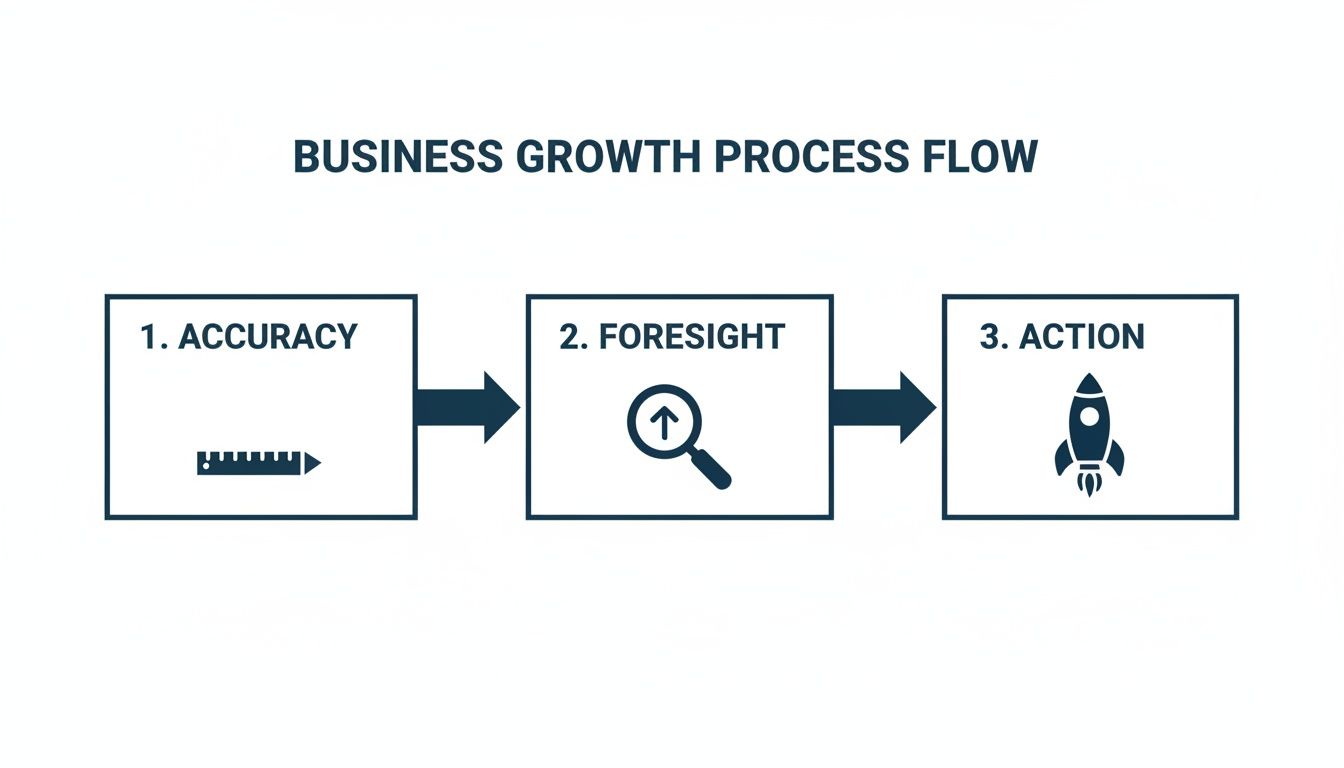
The process is simple: accurate data gives you the foresight to make smart moves, which fuels your business's action and growth.
Choose Your Timeline and Start Building
Now it’s time to decide on your forecast’s timeline. For most small businesses, a 12-month rolling forecast that you update monthly is the sweet spot. It’s frequent enough to stay relevant but not so demanding that it becomes a chore.
Building your forecast is about making educated guesses based on history and your future plans. It’s not about finding a crystal ball; it's about creating a flexible map.
Using your drivers, start projecting out the next 12 months. Our coffee shop owner would look at last January's sales, adjust for a planned price increase, and then project this January's revenue. They’d do the same for expenses. Once January is over, they’ll compare their forecast to what actually happened, learn from it, and then add the next January to the end of their forecast. That’s the "rolling" part.
You can also explore other sales forecasting techniques to see how this fits into the bigger picture of business planning.
The real power comes from this continuous cycle of planning, comparing, and adjusting. In fact, some studies show that rolling forecasts can be up to 20% more accurate than static models because they tie your financial plans to real-time decisions, like your sales efforts and market shifts.
Common Forecasting Mistakes and How to Avoid Them
Getting started with a rolling forecast is a huge step. But a few common traps can quickly turn this powerful tool into a frustrating chore. Here’s how to avoid those pitfalls so you can build a forecast that actually helps you.
One of the biggest mistakes I see is getting lost in the weeds. It’s easy to try and forecast every single tiny detail, from the cost of printer paper to the coffee in the breakroom. This is exhausting and doesn't add much value.
A great forecast is a tool for making big decisions, not a microscopic list of every small expense.
Instead of tracking every last thing, your energy is better spent on the major drivers that truly impact your bottom line. Focus on the big expenses and sales streams that will actually move the needle.
Getting Lost in the Details
When you try to forecast every single line item, you’re creating a monster that’s too complicated to maintain. You'll spend so much time updating tiny numbers that you’ll lose sight of what the forecast is trying to tell you.
Here’s a simple fix: group your small expenses into a single "miscellaneous" or "office supplies" category. For example, instead of forecasting pens, paper, and toner separately, just budget a reasonable lump sum for them. This frees you up to focus on what really matters, like your payroll, rent, and marketing spend.
Using Messy or Outdated Numbers
Another common mistake is building your forecast on a shaky foundation of messy financials. If your bookkeeping isn't clean and current, your forecast will be nothing more than a wild guess. Garbage in, garbage out—it’s that simple.
- The Mistake: Pulling numbers from last quarter's reports without checking your accounts first.
- The Fix: Make sure your bookkeeping is 100% up-to-date before you start forecasting. Every forecast has to begin with accurate, final numbers from the previous period. This is a must if you want a reliable plan.
Keeping It a Secret
Finally, please don’t create your forecast all by yourself. Your sales team knows what’s in the pipeline. Your operations manager knows about upcoming costs. Leaving them out of the process means you’re ignoring crucial, real-world information.
Involving your key team members makes the forecast much more accurate. It also creates a sense of shared ownership, which turns the forecast from "finance's numbers" into "our plan." This simple act of collaboration makes the entire what is a rolling forecast process a powerful team effort instead of just another report.
Making Sense of Your Numbers with Expert Help
If building and managing a rolling forecast sounds like a lot of work on top of everything else you do, you’re not wrong—it can be. But here’s the good news: you don't have to become a spreadsheet expert overnight to get all the benefits. This is where a financial partner can step in to do the heavy lifting.
Think of it this way: you’re the captain of the ship, focused on steering your company. A financial expert is your navigator, constantly checking the maps to make sure you’re on the best route. They start by ensuring your bookkeeping is clean and accurate, which is the foundation of any good forecast.
From there, they build, maintain, and help you understand what your numbers are telling you.
Turning Data Into Decisions
An expert partner does more than just crunch numbers. Their real value is turning that dense financial data into plain-language advice that helps you make smarter decisions.
They’re the ones who can point out trends, flag cash flow issues before they become emergencies, and help you see opportunities you might have missed. If you're looking to dig even deeper, exploring business intelligence resources can add another layer of insight.
The goal is to free you up from the financial busywork so you can get back to what you do best—leading your business.
This kind of partnership is about giving you clarity without adding another massive task to your plate. It turns your rolling forecast from a complex report into a practical tool for growth.
Knowing When to Ask for Help
As your business grows, so does the complexity of your finances. This is where bringing in a fractional CFO can be a complete game-changer, giving you high-level strategic advice without the cost of a full-time executive salary.
This level of expert support ensures you're not just looking at numbers on a page, but truly understanding the story they tell about your business’s future. If you're wondering about the right time to make this move, our guide on when to hire a CFO can help you figure out if now is the right time.
Your Top Questions About Rolling Forecasts, Answered
I get it—jumping into a new financial process always brings up a few questions. Let's tackle some of the most common ones I hear from business owners about rolling forecasts. I've kept the explanations simple to give you the info you need.
How Often Should I Update My Rolling Forecast?
For most small and midsize businesses, updating your forecast once a month is perfect. This is frequent enough to keep you on top of changes without creating a mountain of extra work. It keeps your financial picture fresh.
Now, if your industry moves at lightning speed, you might want to look at it more often. If things are pretty stable, a quarterly update can work just fine. The goal is simple: match the update cycle to the rhythm of your business.
What Tools Do I Need for a Rolling Forecast?
You can absolutely get started with a basic spreadsheet program like Excel or Google Sheets. There's no need to buy fancy software right away, especially when you're just starting.
The most important "tool," however, is accurate bookkeeping. Without clean numbers from your accounting system, any forecast you build is just a guess. This is why having consistently updated books is the first step before you do anything else.
A rolling forecast built on messy data is worse than no forecast at all. It gives you a false sense of confidence based on bad information.
Is a Rolling Forecast the Same as a Budget?
Nope, they serve different but related purposes.
Think of it like this: your budget is the destination you set for your business at the start of the year. It's the mountain you've decided to climb.
A rolling forecast is the live GPS that helps you navigate the actual terrain on your way up that mountain. It accounts for detours, bad weather, and shortcuts. Many businesses use both. The budget sets the annual goal, while the rolling forecast provides the up-to-date map to help them get there.
Ready to stop guessing and start planning with confidence? The team at MyOfficeOps can help you build and maintain a clear, actionable rolling forecast that drives smarter decisions. Let's talk about getting your financial future in focus.