
Sunday night. The kids are winding down, the Eagles game is on in the background, and you're at the kitchen table staring at QuickBooks, a spreadsheet, and a pile of receipts that somehow multiplied during the week.
You know the business is moving. Money is coming in. Bills are getting paid, mostly. But if someone asked a simple question like, “Which service line is making you money?” or “Can you afford that next hire?”, you'd have to guess.
That's where a lot of Philly-area owners live for longer than they should. I see it with agencies in Center City, contractors in Chester County, healthcare practices in West Chester, and family-run businesses all over the region. They're smart. They work hard. They've built something real. But their financial system is stuck in survival mode.
The problem usually isn't effort. It's that the owner became the backup bookkeeper, the invoice chaser, the payroll checker, and the person trying to decode reports after hours. That setup works for a little while. Then growth makes it messy.
A lot of owners think accounting outsourcing means giving up control or shipping work off to some mystery team. In practice, it's usually the opposite. It's how you get clean numbers, clear reports, and a real handle on what's happening in your business without spending your nights buried in admin.
And you're not late to this. In 2026, 96% of CFOs rely on at least one third-party finance and accounting provider, up from 79% the year before, according to Insignia Resource's accounting outsourcing statistics. That tells you something important. This isn't some niche tactic anymore. It's how a lot of serious operators run.
The Sunday Night Struggle with Spreadsheets
A business owner usually doesn't wake up one day and say, “I'd love to outsource accounting.”
What happens is more practical. The books fall behind. Payroll starts eating up too much time. Tax season becomes a scramble. The owner stops trusting the numbers because every report feels a little off, or always late.
When the books become a second job
I've seen owners do all the right things for the wrong stage of the business. They start lean, handle the books themselves, maybe hire a part-time admin, and use software to patch the rest together. Early on, that can be enough.
Then the business grows.
Now there are more invoices, more vendors, more payroll questions, more job-level details, more tax issues, and more pressure to make smart calls fast. The same system that got the business from zero to here starts breaking under its own weight.
A West Chester practice owner might spend Sunday checking payroll reports instead of planning the week. A contractor might know revenue is up but still not know which jobs are carrying the profit. An agency owner might have sales coming in and cash still feeling tight because AR is drifting.
You don't usually feel the accounting problem first in the books. You feel it in stress, delayed decisions, and that constant sense that you're flying half blind.
What changes when someone else handles it well
Accounting outsourcing starts to make sense. Not as a buzzword. As relief.
At the simplest level, it means handing off financial work to an outside team that knows how to run it properly. That can include bookkeeping, bill pay, payroll support, reconciliations, reporting, budgeting, and higher-level guidance. The point isn't to “do less accounting.” The point is to finally get useful information from it.
Here's the practical shift:
- Instead of catching up on transactions, you get current books.
- Instead of reacting to surprises, you get reports that help you plan.
- Instead of guessing at cash flow, you can see what's coming.
- Instead of carrying it alone, you've got people who do this all day.
For most owners, that's the first real win. They get their time back. The second win is better decisions.
What Accounting Outsourcing Actually Means
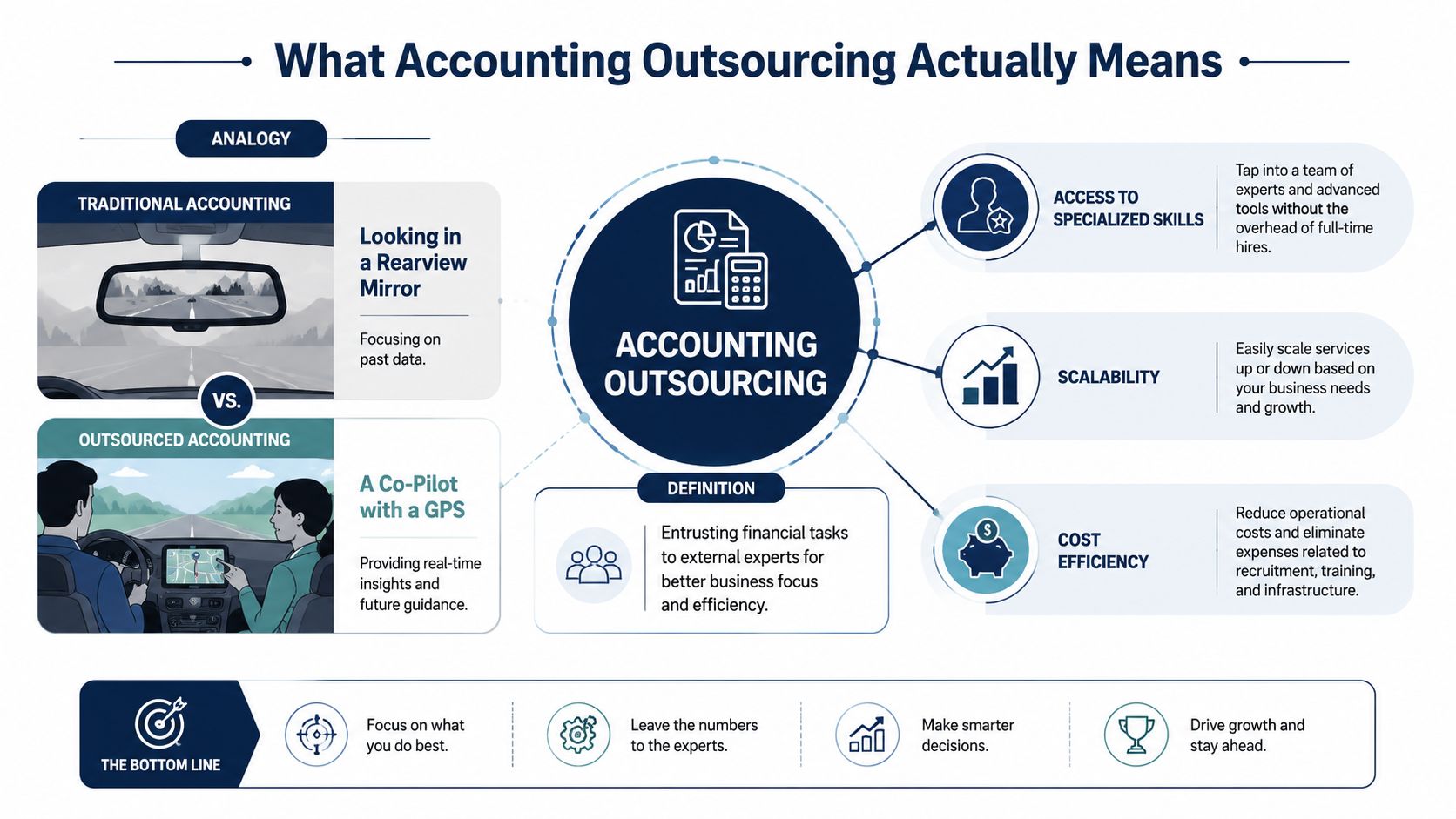
If you've been asking what is accounting outsourcing, the plain-English answer is this. You hire an outside accounting team to handle part or all of your financial work, using shared systems and cloud tools, so you can run the business with better information and less internal overhead.
That's the clean definition. But it helps to think of it another way.
Traditional accounting often feels like a rearview mirror. It tells you where the business has been. Outsourced accounting, done well, works more like a co-pilot with GPS. It helps you see where you are, what's coming next, and which turn will cost you time or money.
It's not just sending receipts to a stranger
A lot of owners still picture outsourcing as dumping a shoebox of receipts on somebody and hoping a tax return shows up later. That's old thinking.
Modern outsourced accounting usually runs through cloud systems like QuickBooks Online or NetSuite, with shared access, documented workflows, and regular reporting. The work can cover general ledger management, payroll processing, tax compliance, and cash flow forecasting. It can also include KPI trending, budgeting, and CFO-level insight, as outlined in this outsourced accounting services guide from MADRAS Accountancy.
That's why the model has changed. The service is no longer just transactional.
The CAAS shift
The better term for what many firms now do is Client Accounting and Advisory Services, or CAAS. The idea is simple. You don't just buy bookkeeping. You get bookkeeping plus controller support plus strategic advice, packaged in a way that fits your size and stage.
According to BILL's overview of outsourced accounting benefits, the modern approach has moved beyond simple bookkeeping. Firms now bundle advisory work like forecasting and M&A readiness with day-to-day accounting, turning the outsourced accountant into a strategic partner.
That's the part many business owners miss.
If you only hire for data entry, you'll get clean records but not much help making decisions. If you hire a true partner, the numbers start helping with pricing, hiring, cash flow, and growth choices. If you want a broader look at how firms structure that kind of support, LatHire on outsourced accounting is a useful outside reference.
Practical rule: If the provider can't explain your numbers in plain English, you're not buying a partner. You're buying task completion.
What Services Can You Actually Outsource
A Philly owner usually asks this after the first bad month-end close: what can I hand off without losing control?
Quite a bit. The better question is what should move first.
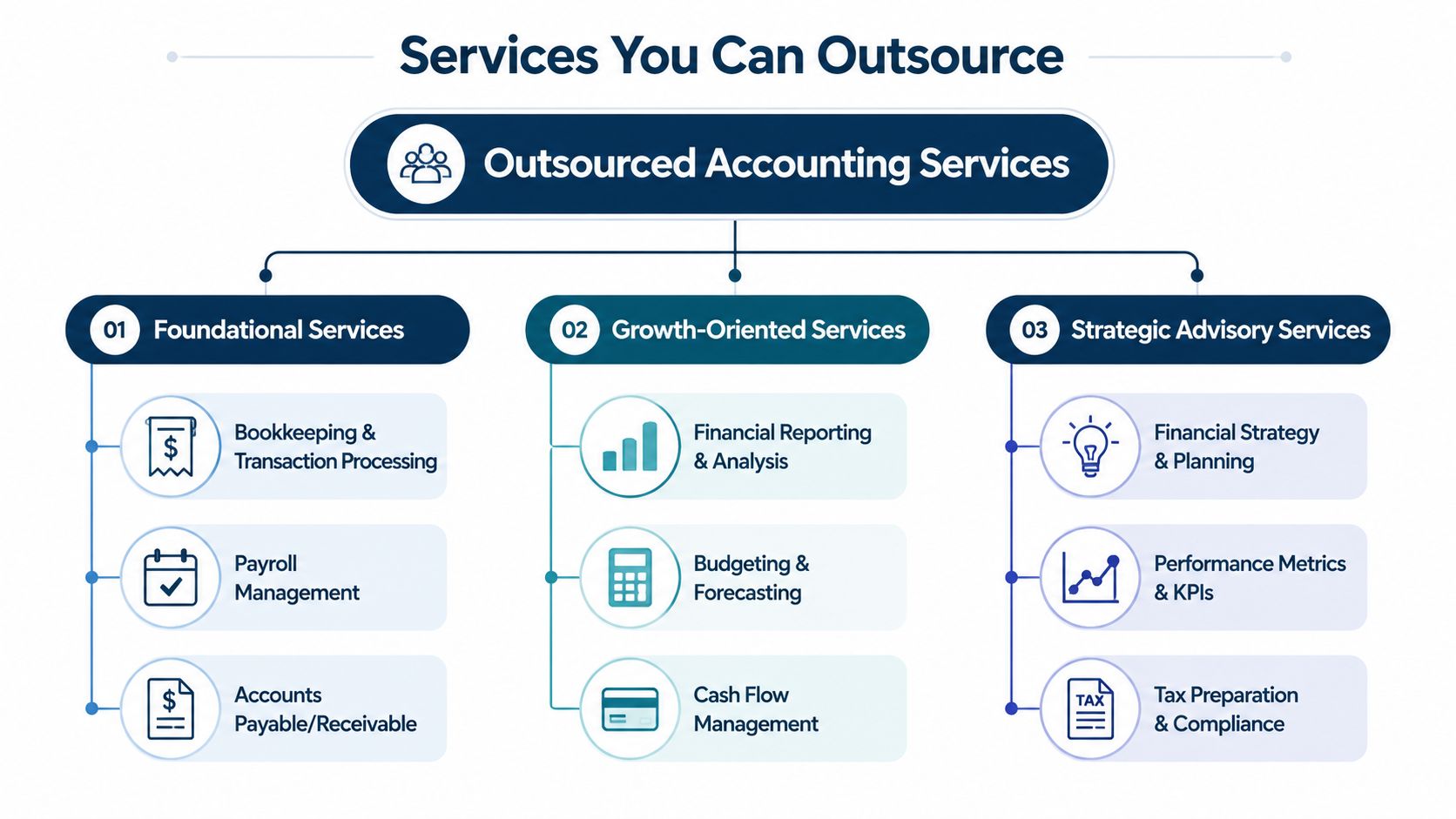
Most companies should not outsource the whole finance function at once. Start with the work that creates delays, errors, or owner bottlenecks. Then add support as the business needs better reporting, tighter cash management, and stronger decision-making. That is how the relationship shifts from task help to a real CAAS model.
Foundational services
This is the day-to-day accounting work that keeps the books usable.
| Service tier | What it usually includes | Why it matters |
|---|---|---|
| Foundational | bookkeeping, reconciliations, accounts payable, accounts receivable, payroll support, monthly close | gives you clean books and fewer fires |
| Growth-oriented | reporting, budgeting, forecasting, cash flow visibility, KPI tracking | helps you run the business with numbers instead of instinct |
| Strategic advisory | profitability analysis, planning, tax coordination, valuation prep, M&A readiness | helps with bigger decisions and long-term value |
At the foundational level, owners usually outsource work like:
- Bookkeeping and reconciliations so the bank balance, credit card activity, and accounting file match
- Accounts payable and receivables support so bills get paid on time and customer balances do not sit untouched
- Payroll coordination so employees are paid correctly and payroll entries hit the books properly
- Monthly close and reporting so you can review the month while it still matters
For a contractor around Philadelphia, that may include job-cost tracking and vendor bill coding by project. For a medical practice, it often means getting out of the year-end cleanup cycle and into a regular monthly close.
Payroll is a good example of where owners often need help sooner than they expect. If that piece is creating headaches, this guide on how payroll services work for small businesses gives a practical picture of what can be handed off and what still stays with management.
Growth-oriented services
Outsourced accounting starts affecting decisions, not just recordkeeping.
Once the books are clean, a good provider can build reporting that answers real operating questions. Why does cash feel tight even when sales are up? Which location or service line is carrying the business? Can you afford to add staff before receivables catch up?
Typical services here include:
- Budgeting and forecasting for the next quarter or next hiring decision
- Cash flow reporting so shortfalls are visible before payroll week
- Department, class, or service-line reporting so profit problems are easier to spot
- KPI dashboards so owners can track a few useful numbers instead of staring at a full general ledger
I see this matter a lot with professional service firms and multi-entity businesses in this area. Revenue may be growing, but margin slips because pricing, labor mix, or overhead is drifting. Basic bookkeeping will not catch that fast enough. Better reporting will.
Strategic advisory services
At the top end, you can outsource work that looks a lot like controller or fractional CFO support.
That can include profitability analysis, pricing support, lender reporting, tax coordination, expansion planning, valuation prep, and sale-readiness work. The role changes here. The accountant is no longer just keeping records current. They are helping ownership weigh decisions before money goes out the door.
Not every business needs this layer right away. A five-person company may only need clean books and monthly reports. A twenty-five-person company with multiple departments, outside financing, or acquisition plans usually needs more interpretation and planning.
That is why many firms, including MyOfficeOps, structure support in tiers. The owner can start with the basics, then add advisory help as complexity grows. In practice, that step-by-step approach works better than hiring one internal person and expecting them to handle bookkeeping, reporting, cash flow, payroll issues, and strategy all at once.
The Real Benefits and Common Fears
Owners usually see the upside fast. They also worry about the downside. Both reactions are fair.
The benefits are real when the fit is right. The fears are real when the setup is sloppy.
Where the value shows up
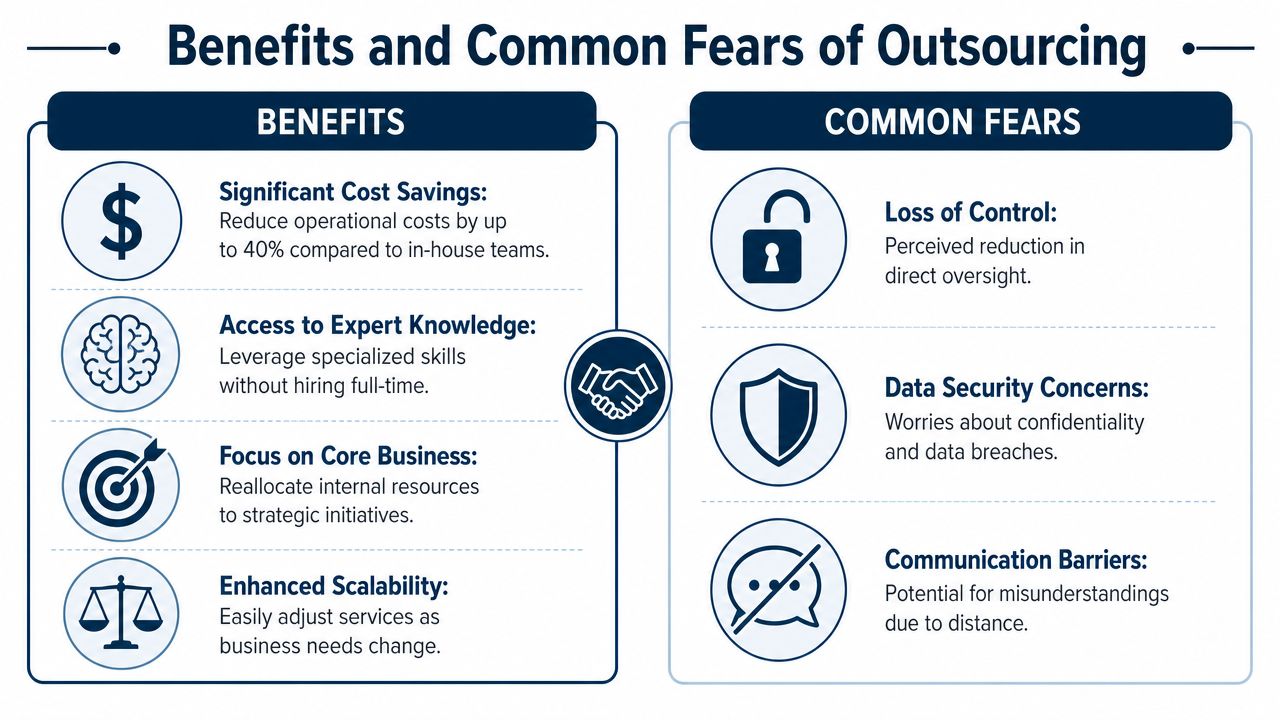
The first clear benefit is cost. Outsourcing can reduce costs by 30 to 50% compared to hiring an internal team, and a Philadelphia-based retail shop saved over $40,000 in one year by not hiring a full-time accountant, according to Datamatics CPA's finance and accounting outsourcing overview.
That matters, but cost alone isn't the full story.
The bigger advantage is usually access. Instead of one employee trying to cover bookkeeping, payroll questions, reporting, and cleanup, you get a team with different skill levels. One person may handle transaction accuracy. Another may review reporting. Another may help with budgeting or cash flow.
A few common gains show up again and again:
- Better use of owner time because nights and weekends aren't spent closing the books
- More reliable reporting so decisions aren't based on stale numbers
- Less hiring pressure when it's hard to find and keep accounting talent
- Easier scaling when workload jumps during growth or seasonal swings
If you want a plain-language look at the day-to-day upside, these advantages of outsourcing bookkeeping services line up with what many owners experience.
The fears I hear most often
The first fear is control.
Owners say, “If someone else handles the books, won't I lose visibility?” The honest answer is that you lose bad visibility and gain good visibility. If your current system gives you late reports, half-finished reconciliations, and uncertainty, you're not really in control now.
The second fear is security.
That concern is healthy. Financial data is sensitive. A serious provider should use clear permissions, secure cloud systems, NDAs, SLAs, and a documented transition plan. Those basics are part of how firms structure outsourced accounting relationships, as described in NOW CFO's explanation of outsourced accounting services.
A good outsourcing relationship should make your data more organized, not more exposed.
The third fear is communication. This one is often the deal-breaker.
If you can't get a straight answer, if nobody knows your business, or if reports arrive without context, the relationship will frustrate you no matter how technically accurate the work is. Good providers don't just close books. They answer questions in a way an owner can use.
Signs Your Business Is Ready to Outsource
A lot of owners hit this point the same way. The books are technically getting done, but not in a way that helps run the business. By the time the numbers are cleaned up, the decision has already been made, the cash has already gone out, or the problem has already grown.
That is usually the sign. Accounting has shifted from a support function to a recurring bottleneck.
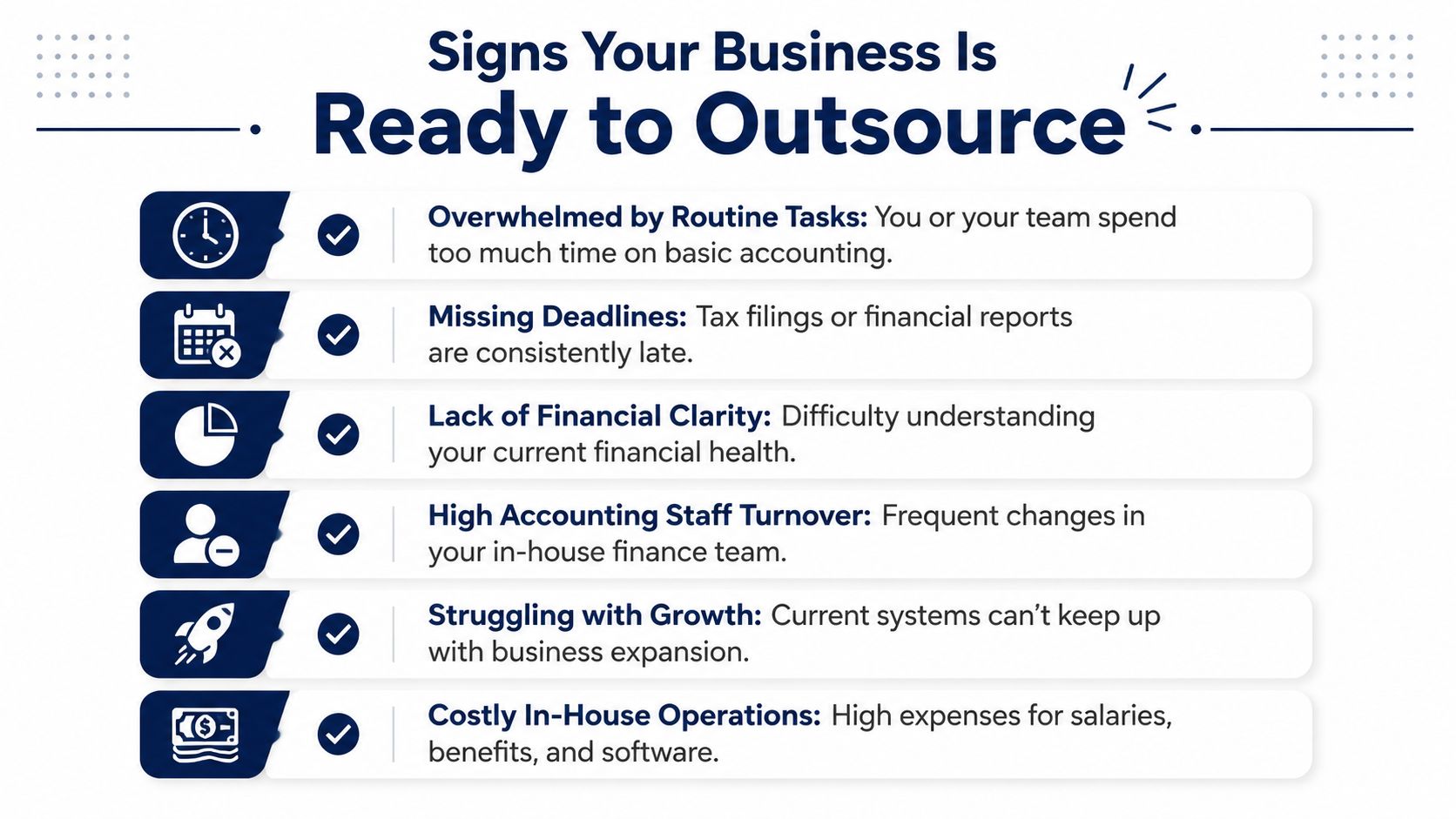
What readiness usually looks like in the real world
I see this with Philly-area owners all the time. They ask whether they are “big enough” to outsource. Revenue is rarely the best test. The better question is whether your current setup gives you timely, usable financial information without draining the owner or overloading the staff.
You are probably ready if some of these patterns keep showing up:
- Your books stay behind the business. You are reviewing last month after the next month is already underway.
- Tax time turns into a cleanup project. Instead of filing from organized records, your team is rebuilding the year under pressure.
- You are making decisions without reliable numbers. Pricing, hiring, and spending get based on instinct because the reporting is late or unclear.
- Cash keeps catching you off guard. Profit on paper does not match what is available in the bank.
- Your staff is doing accounting work by default. The office manager, operations lead, or owner becomes the fallback person for receipts, payroll questions, and reconciliations.
- Basic requests take too long to answer. A lender, investor, or outside advisor asks for reporting, and nobody can pull it quickly or confidently.
One sign gets missed a lot. The business depends too heavily on one person, usually the owner, to explain what is happening financially. That creates risk. It also makes growth harder, because every question and every exception comes back to the same desk.
The shift owners usually need
At that stage, outsourcing is not just about handing off bookkeeping tasks. The bigger value is getting a finance function with structure, accountability, and context.
That is the difference between basic outsourcing and a stronger CAAS-style relationship. Instead of asking someone to “keep up with the books,” you build a system that produces clean closes, clearer reporting, and regular conversations about what the numbers mean. For a growing company, that is a very different tool.
Owners who are comparing options often start by looking at Pennsylvania accounting firms that support growing businesses and then narrow the field based on industry fit, communication style, and how much strategic support they need.
A fair caution
Outsourcing is not a cure-all.
If the business has messy processes, weak approval controls, or constant last-minute changes, an outside team will feel those problems too. A good partner can improve the system, but they cannot fix every internal habit unless the owner is willing to change how information gets handed over and reviewed.
If your accounting only answers what happened after the fact, your business has probably outgrown its current setup.
A simple rule works here. If financial work keeps interrupting the people who should be selling, serving clients, managing jobs, or running operations, it is time to reconsider who should own the accounting function, and what that function should deliver.
How to Choose a Partner in the Philadelphia Area
Once an owner decides to explore outsourcing, the next mistake is picking based on price alone.
In this region, local context matters. Philly-area businesses deal with state issues, city issues, payroll realities, industry quirks, and the simple fact that owners often want someone who picks up the phone and speaks plainly. A national provider may be fine. A specialized remote team may also be fine. But fit matters more than the sales pitch.
What to ask before you sign
Start with practical questions:
- Do you know my industry? A contractor, a healthcare clinic, and a law firm do not need the same reporting.
- How do you handle Pennsylvania and local compliance issues? You want specifics, not vague reassurance.
- Who will be assigned to my account? Sales teams promise a lot. Operations has to deliver it.
- What does communication look like? Monthly call, email response times, shared dashboards, escalation path.
- How do you onboard? If they can't explain the handoff clearly, expect confusion later.
- What happens if a key person is out? You need continuity, not a one-person dependency.
A local example shows why this matters. A healthcare clinic in West Chester outsourced payroll and tax reporting to avoid compliance errors and free up staff to focus on patient care, as noted in Passive Secrets' outsourcing statistics roundup. That's the core goal. Better focus and fewer preventable mistakes.
What a smooth onboarding should look like
A good process usually follows a simple flow.
| Stage | What should happen |
|---|---|
| Assess | current systems, pain points, reporting needs, deadlines |
| Integrate | access to QuickBooks Online or other systems, workflow setup, contacts |
| Execute | start handling agreed tasks, clean up loose ends, establish reporting cadence |
| Monitor | review reports, refine deliverables, fix issues early |
That basic flow matches the broader onboarding logic used in outsourced accounting engagements. The key is whether the provider can make it feel organized instead of disruptive.
You should expect:
- A clear scope so nobody is guessing who owns payroll, AP, reconciliations, or reporting.
- A transition plan with dates, access needs, and responsibility by task.
- Regular reporting that makes sense without an accounting dictionary.
- Review points where both sides can adjust.
If you want a sense of how local firms frame those differences, this guide to accounting firms in Pennsylvania is a helpful starting point.
Don't hire the firm with the slickest proposal. Hire the one that can explain your next 90 days clearly.
From Bookkeeper to Strategic Partner
The biggest misunderstanding about accounting outsourcing is that it's just a way to get data entry off your plate.
That's part of it, sure. But that's not the part that changes a business.
What changes a business is moving from late, confusing numbers to timely, useful information. The owner who used to spend Sunday night wrestling with spreadsheets starts Monday with clean books, real visibility, and someone they can call before making a big decision. That's a different way to run a company.
The strongest outsourced relationships don't stop at categorizing transactions. They help you understand margin, cash flow, hiring timing, pricing pressure, and whether growth is creating value. That's why the move toward a more integrated partner model matters so much, especially for small and midsize businesses around Philadelphia that need strong financial leadership without building a full internal department.
If you've been asking what is accounting outsourcing, the answer is simple. It's not giving your finances away. It's building a better system for understanding them.
And if your current setup leaves you guessing too often, the next step isn't to buy more software or spend another Sunday cleaning up reports. It's to get clarity on what support you need, what should stay in-house, and what a good partner would take off your plate.
If you want that kind of clarity, MyOfficeOps works with Philadelphia-area and West Chester businesses on bookkeeping, payroll integration, reporting, financial analytics, and CFO-level support. The useful first step isn't a hard sell. It's a conversation about where your books stand now, what decisions you're trying to make, and whether outsourced support makes practical sense for your business.