

A Philadelphia contractor opens the month with a clean income statement. Revenue looks healthy. Payroll is paid. The bank balance isn't alarming. Yet the owner still can't answer a basic question: Are we running well, or are we just busy?
That question is where benchmarking earns its place. A report tells you what happened inside your business. A benchmark adds a reference point, so you can decide whether a margin, collection period, labor cost, or process is strong, weak, or worth investigating. The useful benchmark isn't always the industry average. It may be another department, a direct competitor, or a company in a different field that handles the same process better.
What Benchmarking Actually Means for Your Business
A small roofing company in West Chester may know that sales increased and material costs climbed. Those facts matter, but they don't explain whether pricing is keeping pace with costs or whether crews are using their time well. Without a reference point, the owner is left reacting to feelings and bank balances.
Benchmarking is the process of measuring your products, services, and processes against organizations known to lead in one or more parts of their operations, then using the comparison to find better ways to work (ASQ explains benchmarking as a process for finding better ways to work). That last part is important. Benchmarking isn't a contest for the prettiest spreadsheet. It's a way to find a gap and decide what to do about it.
A report shows the result, not the meaning
Suppose your monthly close takes longer than your team expects. Your bookkeeping system can show the date the books were finished. It can't, by itself, tell you whether the delay comes from late invoices, missing receipts, unclear responsibilities, or a process that needs redesigning.
A useful benchmark gives that number meaning. You compare the process with a suitable internal or external reference, check whether the comparison is fair, and then look for the cause. A practical benchmarking analysis guide can help organize that work, especially when you need to define the metric before collecting data.
Practical rule: Never ask only, “How do we compare?” Ask, “What decision will this comparison help us make?”
Benchmarking can guide a hiring decision, a pricing review, or a cash flow conversation. It can also show that a problem isn't where you first thought. A low profit figure may point to underpricing, but it may also reflect rework, poor scheduling, or an expensive service mix.
The best benchmark is therefore the one that fits the question. A local agency comparing project margins needs a different reference than a dental practice reviewing claim turnaround. The number matters, but the choice of reference matters first.
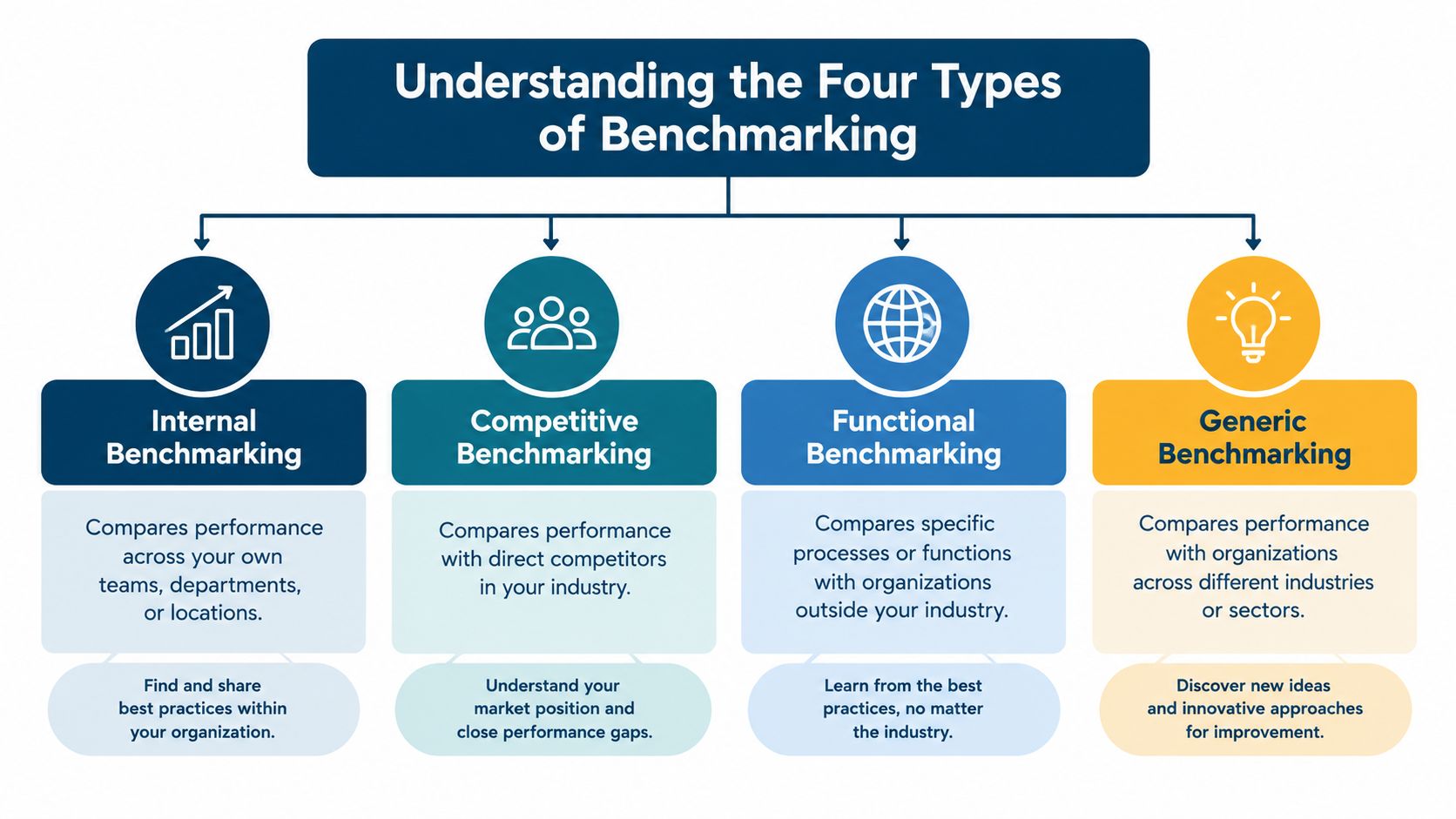
Understanding the Four Types of Benchmarking
Not every comparison answers the same business question. Start with the problem, then choose the benchmark type that can give you a useful answer.
Internal benchmarking
Internal benchmarking compares teams, departments, locations, or projects inside your own company. A contractor with several active jobs might compare how different project managers control change orders. A medical practice could compare scheduling performance between offices.
This is often the easiest place to start because your systems, accounting rules, and business model are more consistent. It won't tell you whether the whole company leads the market, but it can reveal a strong process already available inside the business.
Competitive benchmarking
Competitive benchmarking compares your business with direct rivals. A Philadelphia law firm might study billing practices, collection processes, or the range of services offered by firms serving similar clients.
This approach can be useful for pricing and market positioning, but competitor data is often incomplete or difficult to verify. A public price list may not show discounts, client mix, staffing costs, or the actual scope of service. Treat competitor comparisons as clues, not final answers.
Functional benchmarking
Functional benchmarking looks at a specific process in a different industry. A healthcare clinic might study how a hotel manages check-in flow, then apply the lesson to patient scheduling. The industries differ, but the process problem is similar.
This type works when you're trying to improve a workflow, not copy an entire business model. It can expose ideas your direct competitors haven't adopted.
Generic or external benchmarking
Generic benchmarking compares a broad business practice with an outside leader, while external benchmarking includes comparisons with competitors, industry groups, or other organizations. The line between these labels can vary, so define your terms before you begin.
Xerox helped make benchmarking a formal management practice in the late 1970s, comparing processes and performance with industry leaders and competitors while facing pressure from Japanese copier makers such as Canon and Ricoh (EBSCO describes Xerox's role in benchmarking history). For an SMB, the practical lesson is simple: use internal comparisons to find consistency, competitive comparisons to understand position, and functional comparisons to improve a process.
Ratio analysis can support the comparison, but the ratios still need context. This guide to ratio analysis is useful when you need to connect financial relationships with operational questions.
Key Metrics and How They Drive Decisions
Numbers become useful when they change a decision. A gross margin, collection period, or labor measure shouldn't sit in a dashboard without an owner and a next step.
For many SMBs, these measures are a practical starting set:
- Gross profit margin: Helps you test whether pricing covers the direct cost of delivering work.
- Days sales outstanding: Shows how quickly customers pay after you issue invoices.
- Labor utilization: Helps service firms see whether available staff time turns into billable work.
- Cash conversion: Shows how money moves from spending on work to collecting from customers.
- Job or project profitability: Helps contractors separate busy projects from profitable ones.
A contractor might see a margin that feels acceptable, but the number means little without a comparable reference. If similar firms with a similar service mix operate differently, the gap deserves investigation. The right response might be a price change, tighter purchasing, better estimating, or more careful selection of jobs.
A professional services firm may notice that clients are paying more slowly. That observation becomes more useful when the owner compares collection performance with a relevant peer group and checks the causes inside the firm. Late approvals, weak invoice descriptions, and inconsistent follow-up require different fixes.
Use the metric to choose the action
Benchmarking should connect to a decision such as:
- Pricing: Compare project or service profitability before changing rates. A low result may come from scope creep rather than the headline price.
- Hiring: Review labor utilization and workload by role before adding staff. A busy team may still have unused capacity in the wrong area.
- Cash flow: Compare collection timing, payment terms, and billing habits. Faster collections may come from cleaner invoices rather than harder conversations.
- Growth investment: Check whether the process gap is large enough to justify new software, training, or outside help.
A sound study first defines its purpose and scope, selects comparable indicators, collects internal and external data, normalizes the results, and then monitors whether the gap narrows (Troy University outlines a practical benchmarking process). That prevents a common mistake: collecting attractive numbers without understanding what caused them.
The same discipline applies to technology and operational dashboards. Teams reviewing monitoring for SaaS teams will recognize the principle. A metric needs a clear definition, a reliable source, and a person who knows what to do when it moves.
For a broader KPI framework, use this resource on understanding key performance indicators. Keep the list short enough that managers can review it and act on it.
Industry Examples That Show Benchmarking in Action
A benchmark only makes sense when the businesses being compared have enough in common. A law firm shouldn't measure itself against a roofing contractor because both have the same revenue. Their staffing, billing, costs, and cash patterns are different.

Professional services
A Philadelphia IT consultancy may compare project margin, realization, utilization, and overhead. A law firm may focus on billing discipline, collections, matter profitability, and the share of work handled by each level of staff.
These firms shouldn't treat revenue per employee as a complete answer. A firm with specialized work may have a different pricing model and staffing mix from a general practice. The comparison should match service type, client type, and how the firm delivers work.
Healthcare practices
A dental or medical practice may track appointment volume, schedule fill, claim processing, reimbursement timing, and labor cost. The useful question is not just whether more patients were seen. It may be whether the practice is using available appointment time well while keeping claims and cash moving.
A practice that compares itself with the wrong group could make poor choices. A specialist clinic, a primary care office, and a dental practice may all record patient visits, but the work behind each visit differs.
Construction and trades
A general contractor can compare estimates with actual job costs, labor hours by project phase, material variance, change orders, and equipment use. Internal benchmarking is especially useful when one project manager consistently keeps work organized while another loses time to late purchasing or unclear scope.
External data can add context, but the company must normalize for project type, location, subcontractor mix, and job complexity. A Main Line renovation isn't automatically comparable to a large commercial build in Philadelphia.
Real estate
A property management firm may review leasing speed, maintenance response, repair cost, and vacancy patterns. The right peer group depends on property type, neighborhood, tenant mix, and the level of service promised.
The National Academies describes benchmarking as a comparative measurement system using compatible measures and data, with the benchmark serving as the reference standard that defines the gap to close (National Academies guidance on comparable benchmarking). That distinction keeps owners from chasing a number that doesn't fit their operating model.
How to Select the Right Benchmarks for Your Business
Choosing a benchmark starts with a decision, not a spreadsheet. Ask what you need to decide in the next planning cycle. Are you reviewing prices, adding staff, improving cash flow, or preparing the company for a future sale?
Start with the business question
Write the question in plain language. “Are we profitable?” is too broad. “Which service line produces enough margin to justify more sales effort?” gives you a better direction.
Then choose the measure that can answer it. A contractor reviewing job selection needs project-level profitability and cost detail. A professional services firm reviewing hiring needs workload, utilization, payroll cost, and expected demand.
Build a fair comparison
Look for sources that match your:
- Business model: Compare a recurring service firm with similar recurring service firms, not a product company.
- Size and structure: A small roofing contractor may face different purchasing and staffing conditions than a much larger contractor.
- Location: Labor, rent, taxes, and customer expectations vary across the Philadelphia region.
- Service mix: A firm offering high-touch consulting shouldn't use a benchmark built around standardized work.
- Data timing: A current internal result may be misleading beside an older external figure.
Normalization is the step owners skip most often. Make sure the formulas, periods, categories, and definitions match before drawing conclusions. If one business counts subcontractor costs as direct labor and another doesn't, their margins aren't comparable.
Move from gap to plan
A commonly used benchmarking model has 10 steps, from identifying what to benchmark and selecting comparison companies through data collection, gap measurement, goal setting, action planning, implementation, and recalibration (the University of Cambridge outlines the 10-step benchmarking model). The final step matters because a benchmark must change as your business and market change.
If you're comparing software or marketing tools, evaluate the comparison method itself. A careful Semrush vs SE Ranking review is a reminder that different tools may define features, costs, and use cases differently. The same caution applies to financial benchmarks.
Set one target, assign one owner, and choose a review date. A benchmark identifies the gap. Your operating plan closes it.
Turning Benchmark Insights Into Real Results
Benchmarking without action is expensive homework. Once you find a gap, resist the urge to fix every issue at once. Pick the problem that affects cash, profit, customer service, or your most important growth decision.
A construction company may discover that material costs are running high. The number points to a problem, but it doesn't explain the cause. The project manager may know that purchase orders are late, crews are waiting on deliveries, or estimates aren't using current supplier prices.
Diagnose before you prescribe
Use the benchmark to guide conversations with the people doing the work. Ask:
- What happens before the metric moves?
- Which step creates the delay or extra cost?
- Does the issue affect every client, job, or location?
- Is the result caused by the process, the customer mix, or the way the business records data?
- What small change could test the suspected cause?
This protects you from fixing the wrong thing. A billing problem may look like a collections problem. A labor problem may be a scheduling problem.
Give the response an owner
Turn the finding into a short action plan. Name the change, the person responsible, the expected result, and the date for review. A useful plan might involve clearer invoice approvals, a purchasing checklist, revised service pricing, or a weekly review of unbilled work.
Track the result with consistent definitions. If the formula changes halfway through the exercise, you won't know whether performance changed or the reporting changed. A budget versus actual reporting resource can help owners compare planned spending with real results and focus attention on meaningful variances.
A benchmark is useful only when someone changes a process because of it.
The practice also supports better business planning and valuation. Clean records, consistent KPI definitions, and a clear history of management decisions help an owner explain how the company operates. That matters whether you're pursuing growth, preparing for a transition, or just trying to run a healthier business.
Start this week with one question and one metric. Choose a comparison that matches your business model, verify that the data is fair, and schedule a review after the first change. You don't need a giant dashboard. You need a trustworthy reference and the discipline to act on what it shows.
MyOfficeOps helps Philadelphia-area SMBs turn clean bookkeeping, payroll data, financial analytics, and CFO-level advice into useful benchmarks for pricing, hiring, cash flow, and profitability. Visit MyOfficeOps to discuss your numbers and build a practical reporting plan around the decisions you need to make.