
Your profit-and-loss statement looks healthy. Customers owe you money, the new equipment is already installed, and sales are moving in the right direction. Then payroll is due, a supplier wants payment, and your bank balance says you need to make a decision today. That uncomfortable gap is exactly why cash flow analysis matters.
Cash flow analysis tracks when money enters and leaves your business. It shows whether your operations can fund daily costs, whether working capital is trapping cash, and whether borrowing is covering a real timing issue or hiding a deeper problem. The practical answer to what is cash flow analysis isn't complicated: follow the money, understand the timing, and use that information to act before cash gets tight.
Why Profitable Businesses Still Run Out of Cash
A small marketing agency finishes a strong month. It records profitable projects on its income statement, but most clients pay after invoices are due. At the same time, the agency pays employees every week, settles software bills monthly, and puts a large annual insurance payment on the calendar. The owner sees profit in the books but can't comfortably make payroll.
That isn't a contradiction. Profit measures accounting performance, while cash flow measures actual cash movement. A sale can count as revenue before the customer pays. An expense can appear in the accounts before the money leaves the bank. Cash flow analysis connects those accounting entries to the dates when money is available.
The timing problem
Three timing gaps create most small-business cash pressure:
- Receivables: You deliver work and issue an invoice, but the cash arrives later.
- Payables: Vendors may require payment before your customers settle their bills.
- Inventory: You spend cash on materials or products that may sit for weeks before generating a sale.
That gap is a working-capital issue. Owners who want a plain-language explanation of the assets and obligations tied up in daily operations can review this guide to what working capital means.
Cash shortages are a serious business risk. A widely cited U.S. Bank study has been summarized as linking 82% of small-business failures to poor cash flow management, as reported in this cash flow statistics summary. The same source notes that Bluevine reported in 2025 that 38.7% of U.S. small-business owners didn't have enough cash to cover one month of operating expenses, while another industry summary reported 39% of SMBs had less than a month of reserves.
Practical rule: A profitable business can survive a slow sales month. It can't survive a missed payroll or unpaid supplier bill for long.
Cash flow analysis became a formal accounting practice in the United States after the Financial Accounting Standards Board issued SFAS 95 in November 1987. That standard established the modern statement of cash flows and separated operating, investing, and financing movements. International reporting later formalized the concept through IAS 7, first issued in December 1992 and adopted by the IASB in April 2001, as described in this accounting history reference.
The statement matters, but don't stop there. A static monthly report tells you what happened. A useful cash flow analysis tells you what happened, why it happened, and whether next week's obligations can be paid.
The Three Buckets of Cash Flow
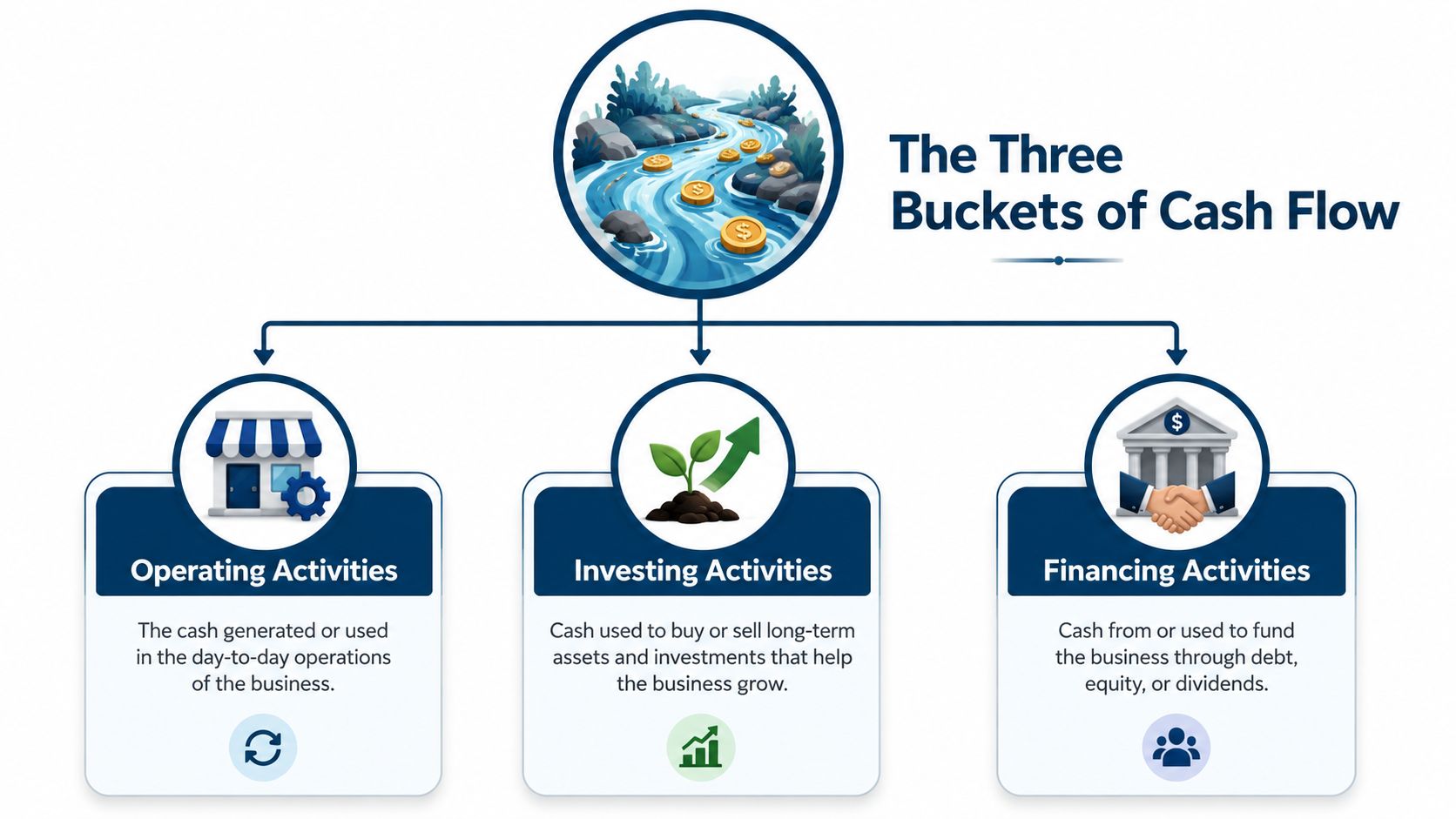
Sort every cash transaction into operating, investing, or financing activities. Think of them as three separate bank accounts. One handles the daily business, one handles long-term assets, and one handles how the business is funded.
Operating activities
Operating cash flow covers the work that keeps the business running:
- Customer payments
- Payroll and contractor payments
- Rent, software, insurance, and utilities
- Supplier payments
- Taxes tied to normal operations
A consulting firm collecting client invoices and paying its team is generating and using operating cash. A healthcare practice receiving patient payments and paying clinical staff is doing the same. This bucket answers the most important operating question: does the core business produce enough cash to support itself?
Investing activities
Investing cash flow covers long-term assets and investments. A construction company buying a work truck, a clinic purchasing diagnostic equipment, or an agency selling old computers belongs here. The cash may leave today, but the decision supports the business over a longer period.
A negative investing balance isn't automatically bad. It may reflect a deliberate purchase that improves capacity. The concern is whether the business understands the purchase, can fund it, and expects it to support its plan.
Financing activities
Financing cash flow shows how money moves between the business and its lenders or owners. Loan proceeds, loan repayments, equity contributions, dividends, and owner draws belong in this bucket.
Suppose a contractor draws on a line of credit to cover materials while waiting for a project payment. That draw is financing cash, but the reason for it may be an operating timing gap. Classifying both sides correctly helps you see whether financing supports growth or repeatedly patches weak collections.
Once you mentally sort transactions into these three buckets, bank statements become more useful. You can see whether cash came from customers, asset sales, or borrowing, and that distinction matters far more than the ending balance alone.
Direct vs Indirect Cash Flow Methods
There are two accepted ways to calculate operating cash flow. The direct method lists actual cash receipts and payments. The indirect method starts with net income and adjusts it for non-cash items and changes in working capital.
The direct method speaks the language most owners want to hear: cash collected from customers, payroll paid, rent paid, and vendors paid. It gives you a clean view of daily cash activity, but it requires reliable transaction records and consistent categorization.
The indirect method fits naturally with standard accounting records. It begins with profit, then adjusts for items such as depreciation and changes in receivables, payables, inventory, and other working-capital accounts. It's usually easier to prepare from an accrual-based general ledger, but it can hide the specific cash receipts and payments that drive a weekly decision.
| Criteria | Direct Method | Indirect Method |
|---|---|---|
| Starting point | Actual cash receipts and payments | Net income |
| Main strength | Clear view of where cash came from and went | Efficient connection to the income statement and balance sheet |
| Main weakness | Requires detailed cash tracking | Can make cash timing harder to understand |
| Best use | Internal cash management and weekly forecasting | Formal reporting and reconciliation |
| Good fit | Owners who need operational clarity | Businesses with established accrual accounting records |
Which method should you use?
For most small businesses, I recommend using both in different ways. Use the indirect method when preparing the formal statement from your accounting records. Use a direct-method-style forecast for management, because owners need to know which customers will pay and which bills will come due.
A professional services firm shouldn't rely on net income to decide whether it can hire. It should review expected client receipts, payroll dates, tax obligations, and planned purchases. A construction company should track payment applications, retainage, material bills, subcontractor commitments, and debt payments by expected week.
The method isn't the main decision. The quality of the data and the frequency of review matter more. If your books don't distinguish customer receipts from loans or equipment purchases, neither method will give you a trustworthy cash story.
Key Cash Flow Metrics Every Business Owner Should Track
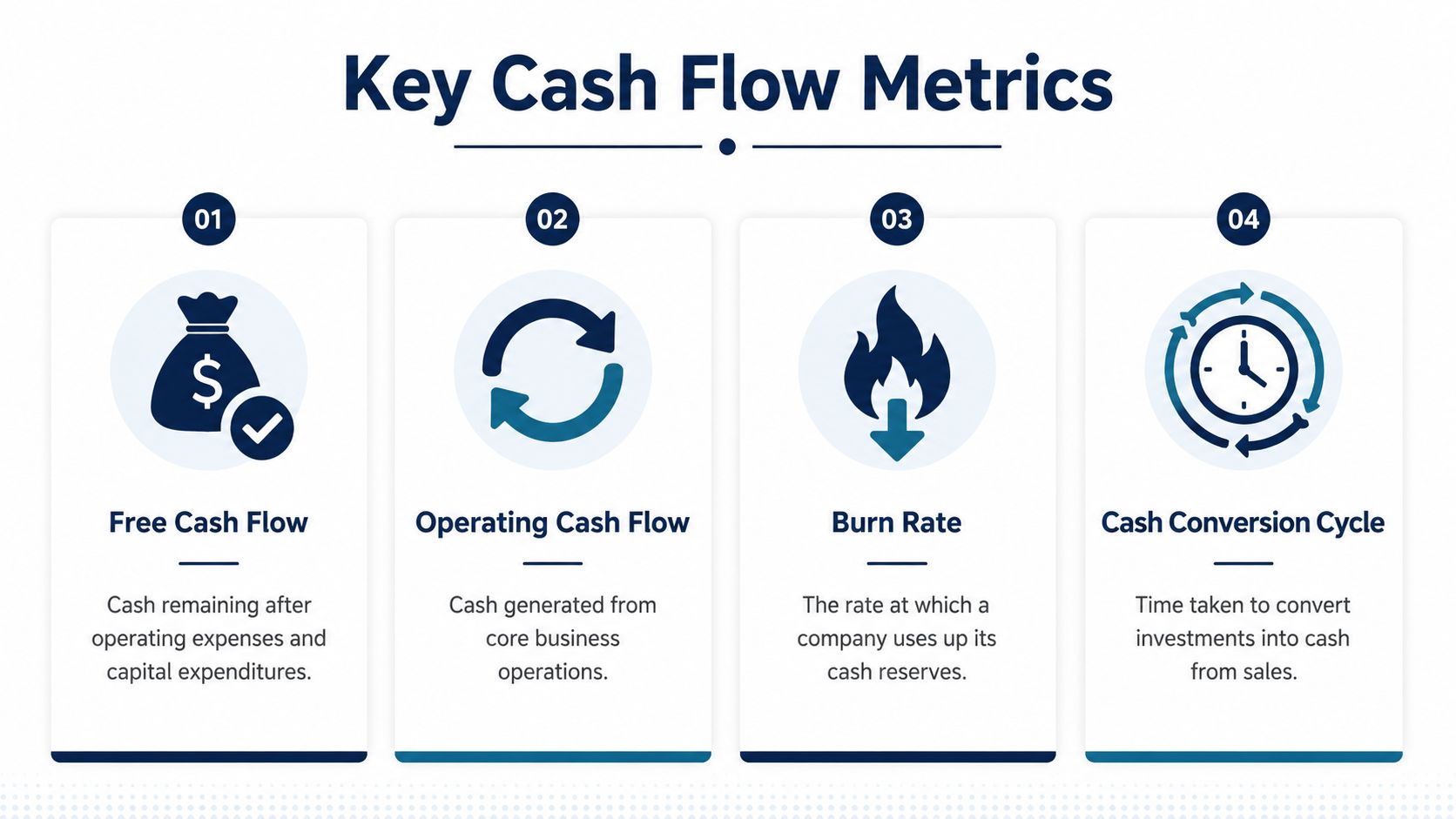
A dashboard should answer four questions. Does the business generate cash from operations? What's left after necessary investment? How quickly are reserves being used? And how long does cash stay tied up before returning from sales?
Free cash flow
Formula: Operating cash flow minus capital expenditures.
Free cash flow is what remains after the business funds normal operations and buys or maintains necessary long-term assets. Positive free cash flow gives you room to repay debt, build reserves, hire, or invest. Negative free cash flow may be sensible during an equipment upgrade, but you need to know how the business will fund the gap.
Operating cash flow
Formula: Cash generated from core business operations.
This is the health check for the business model. If operating cash flow stays weak while reported profit looks strong, inspect collections, inventory, payment terms, and unpaid expenses. The business may be selling successfully but converting sales into cash too slowly.
Burn rate
Formula: Cash used over a defined period when outflows exceed inflows.
Burn rate shows how quickly the company is consuming its cash reserves. It matters most when a business is investing heavily, operating through a slow season, or relying on outside funding. Track the trend, not just a single period. A rising burn rate demands a specific response, such as cutting discretionary spending, improving collections, or arranging funding before the balance becomes urgent.
Cash conversion cycle
Formula: Days inventory outstanding plus days sales outstanding minus days payable outstanding.
The cash conversion cycle measures how long cash remains tied up in inventory and receivables after considering supplier payment timing. A shorter cycle generally means the business recovers operating cash sooner. For a property or investment decision, a separate cash on cash return calculator can help compare cash invested with cash returned, but it shouldn't replace operating cash analysis.
Don't chase a single “good” number. A clinic, agency, contractor, and retailer have different payment patterns. Track each metric against your own history, your obligations, and the cash needs of your operating model.
How to Conduct a Cash Flow Analysis Step by Step
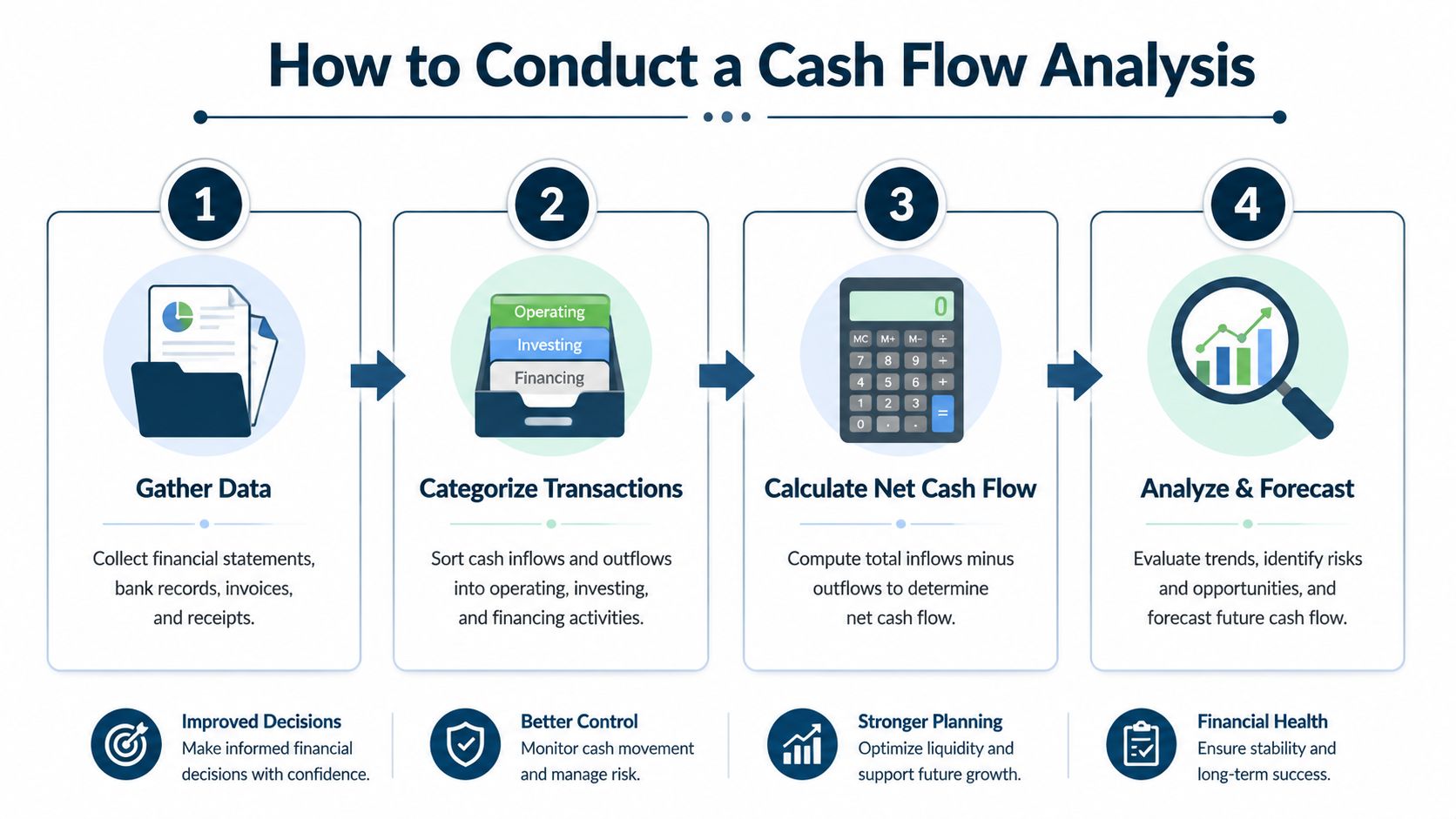
Monthly statements are useful for reporting. They aren't enough for cash management. Build a rolling 13-week cash flow forecast that lists expected inflows and outflows by week, then update it as actual transactions happen.
Start with evidence
Gather current bank balances, bank statements, accounts receivable aging, accounts payable aging, payroll dates, tax obligations, debt schedules, planned purchases, and recurring expenses. Don't forecast from memory. Pull the dates that will affect the bank account.
For construction companies, include project billings, approved payment applications, retainage, material commitments, subcontractor payments, and practical details such as a partial lien release guide when payment documentation affects the release of funds.
Build the weekly view
Create columns for each of the next thirteen weeks. Add the opening cash balance, expected customer receipts, other inflows, payroll, vendors, taxes, debt payments, owner draws, equipment purchases, and other outflows. Calculate net cash flow for each week, then carry the closing balance into the next week as its opening balance.
Your forecast should show the week when cash falls below the amount needed for obligations. That warning gives you time to call a customer, delay a nonessential purchase, negotiate a vendor date, or arrange a financing bridge.
For a deeper explanation of how historical statements support this work, use this cash flow statement analysis resource.
Stress-test the plan
Run at least three versions of the forecast:
- Expected case: Your best current estimate for receipts and payments.
- Strong case: Faster collections or stronger sales than expected.
- Weak case: Delayed customer payments, lower sales, or an unexpected expense.
Don't use a line of credit to make a weak forecast look healthy. Treat it as a bridge with a repayment plan. A working-capital buffer is also context-specific. Neutral guidance commonly recommends two to three months of operating expenses as a minimum, three to six months for stable recurring-revenue firms, and six to twelve months for cyclical or customer-concentrated businesses, as summarized in this cash buffer guide.
Update the forecast every week. Replace estimates with actuals, explain major variances, and roll the horizon forward. That living document will help you make decisions long before a monthly report catches up.
Common Cash Flow Mistakes and How to Avoid Them
The most dangerous cash flow mistakes usually sound reasonable. That's why experienced owners make them, too.
Mistaking profit for available cash
An unpaid invoice can increase reported revenue without adding money to the bank. The fix is simple: review expected collection dates beside your income statement, not after it.
Ignoring the calendar
Seasonal businesses often know when sales slow down, but they still budget from an average month. Map the low-revenue periods, large renewals, tax payments, insurance bills, and annual purchases into the forecast. Cash problems often come from a calendar nobody reviewed.
Treating borrowing as a solution
A credit line can bridge a short timing mismatch. It can't repair poor pricing, weak collections, or permanently negative operating cash flow. Record every draw, its purpose, its expected repayment, and the operating change that will prevent repeated borrowing.
Reviewing only at tax time
Tax filings explain the past. They don't tell you whether next Friday's obligations can be paid. Review the bank position weekly, compare expected receipts with actual receipts, and investigate changes while you still have choices.
Building a forecast nobody trusts
A spreadsheet with stale bank balances and unexplained assumptions creates false confidence. Reconcile the accounts, document assumptions, assign one owner, and make every change visible. If the team can't explain a number, don't use it to make a major commitment.
Practical Tactics to Improve Your Cash Position
Cash flow improves when three routines work together: clean books, a rolling forecast, and a focused dashboard.
Bookkeeping hygiene comes first. Reconcile bank accounts, categorize transactions consistently, keep receivables and payables current, and remove old reconciling items. Without that foundation, the forecast is built on guesses.
Next, update the forecast weekly. Compare expected and actual customer receipts, flag late invoices, review upcoming vendor payments, and move discretionary spending when the cash calendar demands it. A forecast should drive a conversation, not sit in a folder.
Finally, put the right measures in front of the right people. An owner may need closing cash, upcoming payroll, receivables due, projected low point, and free cash flow. A project manager may need billing status, material commitments, and job-level cash timing. MyOfficeOps combines bookkeeping, forecasting, financial analytics, and CFO-level advisory for small and midsize businesses, with reporting built around decisions such as pricing, hiring, collections, and spending.
Use these cash flow analysis examples to turn the concepts into a repeatable review process.

MyOfficeOps can clean up your books, build a rolling cash flow forecast, and turn your numbers into clear weekly decisions. Visit MyOfficeOps to start a conversation about bookkeeping, cash flow analysis, and CFO-level support for your business.