
Thinking about buying a business? You’ve seen the numbers, heard the sales pitch, and it all looks great. But how do you know if you're seeing the whole picture?
Imagine buying a used car. You wouldn't just take the seller's word for it. You’d look under the hood, kick the tires, and probably hire a mechanic you trust to check it out.
Financial due diligence is that mechanic's inspection, but for a business. It’s the process of looking under a company's financial hood to check the facts, find any hidden problems, and make sure the price you're paying is fair for the business you’re actually getting.
A Simple Guide to Financial Due Diligence

This process isn't just about checking the math on a spreadsheet. It’s about digging deeper to understand the real story behind the numbers.
For example, are the sales real and something you can count on, or did the company just have one lucky year that won't happen again? Are there hidden debts or surprise bills waiting for you after the deal closes? Is the business really making money, or have the books been presented in a… creative way?
Financial due diligence is a key step in any business sale where buyers get to look closely at a company's financial records, cash, debts, and sales. It's all about finding risks and checking the seller's claims before you sign anything.
For the small business owners we work with here in West Chester, PA—whether they're in professional services or construction—buying another company is a huge decision. Skipping due diligence could mean you pay way too much or, even worse, take on huge debts that could sink your own business.
The Core of the Investigation
The process is like putting together a puzzle of all the financial pieces to get a complete, honest picture. A big part of this is looking at company records, which is why a good understanding document analysis is so important. Think of it as detective work, hunting for clues in financial reports, customer contracts, and tax forms.
To get a clearer idea, let's break down what this financial "health check" really looks at and why each part is important.
Financial Health Check: What It Is vs. Why It Matters
| What We Check | Why It Matters in Plain English |
|---|---|
| Profit & Loss Statements | Is this business actually making money? We're looking for steady profit, not just a one-time win. |
| Balance Sheets | What does the company own, and what does it owe? This tells us if it’s on solid ground or has a lot of hidden debt. |
| Cash Flow Statements | Does cash regularly come in the door? A business can look profitable but still go broke if it has no cash to pay its bills. |
| Customer Contracts | Is all the money coming from just a few big clients? If one leaves, does the whole business fall apart? |
| Tax Filings | Has the company been paying its taxes correctly and on time? You don't want to get a surprise bill from the IRS. |
| Employee Agreements | Are there expensive promises to employees that will become your problem after you buy the business? |
| Debt & Loan Agreements | What are the details of any loans? Are there any nasty surprises that pop up when the business is sold? |
This table just scratches the surface, but you get the idea. It's about turning confusing financial papers into simple, important answers.
In the end, financial due diligence helps answer three big questions:
- Is the business as profitable as it seems? This means checking if the money it makes is real and something you can expect in the future.
- What are the hidden risks? This could be anything from a major customer who is about to leave to a lawsuit or an unpaid tax bill.
- Is the price fair? Everything you find during this process helps you decide on the final price and the terms of the deal.
At the end of the day, this process gives a buyer confidence. It's the difference between making a smart investment and just hoping for the best. Without it, you're not buying a business; you're buying a mystery box.
Why Due Diligence Matters for Buyers and Sellers
Financial due diligence isn't just for the person writing the check; it’s a big deal for both people at the table. Basically, it’s about making sure everyone knows exactly what is being bought and sold, with no ugly surprises later.
For a buyer, this process is all about managing risk. Think of it as your best insurance policy against a bad investment.
Imagine a local healthcare group looking to buy a smaller clinic. On paper, the clinic looks great. But without looking deeper, the buyer might miss that the clinic’s biggest insurance contract is about to end. They might not realize its important medical equipment is old and will cost a lot to replace next year. These are the kinds of discoveries that turn a great deal into a money pit.
Due diligence is the buyer's tool for checking the facts. It answers the most important question: "Is this business really what the seller says it is?" It protects you from overpaying and inheriting problems.
Why It’s Just as Important for the Seller
Now, let's look at the other side. If you're selling your business, getting ready for due diligence is your chance to protect your company's value and have a smooth, fast sale. It’s your best tool for getting a good price.
A seller who shows up with clean, organized books builds trust right away. When a buyer asks a tough question, you can answer it with clear information to back it up. This almost always leads to a higher sales price and a much quicker deal.
On the other hand, messy financial records are a huge red flag. It makes buyers suspicious and can scare them away or lead to a low offer just to get the deal done.
In the world of business sales, what is financial due diligence if not the check-up that separates good deals from bad ones? This process looks at everything from profits to day-to-day cash needs. For small and medium-sized business owners in the Greater Philadelphia area—whether they run a healthcare clinic or a construction company—it's the difference between a smart exit and a nightmare of hidden debts.
In the end, sellers who take the time to prepare their finances show they have a well-run business. This preparation is a big part of getting a good result, and it often affects the final business valuation services that decide what your company is worth. For the seller, being prepared is power; for the buyer, checking the facts is safety.
The Key Areas of a Financial Review
So, you're ready to look under the hood of a business. But what parts are you actually supposed to check? Financial due diligence isn't about grabbing random papers; it's a focused inspection of the specific areas that tell the real story of a company’s financial health.
Think of it like a mechanic inspecting a used car. You don't just kick the tires. You check the engine, look at the service records, and take it for a test drive. In business, the financial statements are those vital signs and service records.
The whole process is a structured investigation. The buyer brings a magnifying glass to check every detail, and the seller organizes their information to protect their company's value.
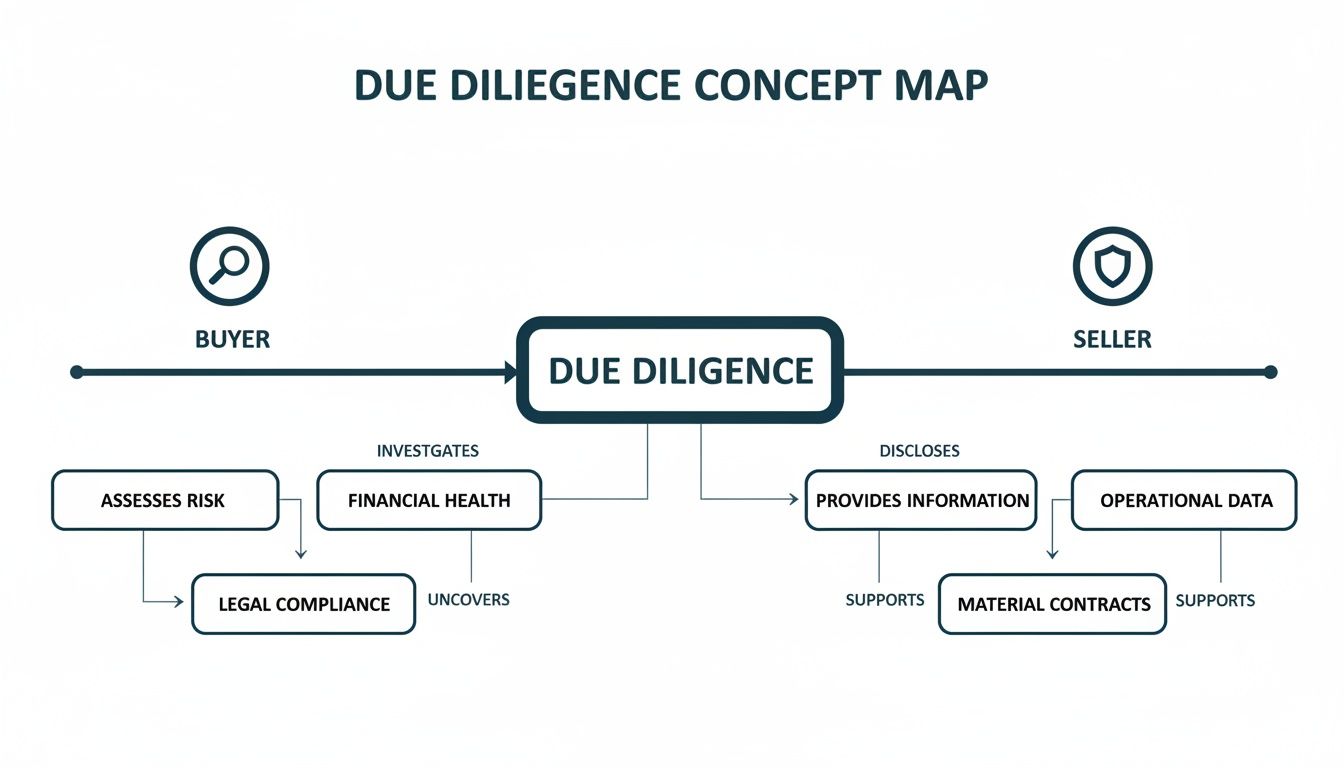
Ultimately, the buyer's deep dive and the seller's organized preparation are two sides of the same coin. Both are aiming for a fair and honest deal.
The Big Three Financial Statements
The journey always starts with the three main financial reports. These papers work together, each telling a different part of the story to give you a complete picture.
The Income Statement: This is the company's report card for a certain period. It shows you how much money the business made (revenue) and how much it spent (expenses) over a few months or a year. The bottom line tells you if it made a profit or a loss.
The Balance Sheet: If the income statement is a movie of the company's performance, the balance sheet is a single picture. It’s a snapshot of what a company owns (assets) and what it owes (liabilities) on one specific day. It must always "balance"—meaning assets have to equal liabilities plus the owner's investment (equity).
The Cash Flow Statement: This one is my favorite because cash doesn't lie. It’s like looking at the company’s bank account, showing exactly where cash came from and where it went. A company can look profitable on paper but still run out of cash, and this statement tells you why.
These three documents are the foundation, but a real investigation goes much deeper.
Digging Beyond the Main Reports
Once you understand the story from the main statements, it’s time to start asking tougher questions. The real "aha!" moments often come from digging into the details behind the big numbers.
A good due diligence process isn't just shuffling paper—it’s a tough check that confirms a company's true financial situation, spotting red flags in taxes, hidden debts, and whether the profits are really sustainable. For the business owners we work with in construction or IT around West Chester, this is key. It helps them get the most value out of their business when they sell. To get a sense of how these checks are getting more detailed, you can explore the full research on due diligence services.
What is financial due diligence if not a search for the truth? It’s about making sure the story the seller tells is backed up by cold, hard facts found in the financial records.
To find that truth, you need to check a few more key areas.
Other Critical Areas to Investigate
Here are the other puzzle pieces that buyers will definitely look at—and that sellers need to have ready.
Quality of Earnings: This is a big one. It asks, "Is the profit real and can it happen again?" A business might show a huge profit one year because they sold a building. That's a one-time thing, not a sign of a healthy business. A buyer wants to see profit that comes from normal, day-to-day business, because that’s the engine they are actually buying.
Working Capital: Think of this as the cash a business needs to keep the lights on every day. It’s the difference between its short-term assets (like cash and products to sell) and its short-term bills (like bills due next month). If a company is short on working capital, the new owner might have to put in their own cash right away just to keep it going.
Tax History and Compliance: Nobody wants a surprise bill from the IRS. A buyer will carefully check years of tax returns to make sure everything was filed and paid correctly. Any past problems or audits will get a close look. This is all about making sure there are no tax problems hiding in the closet.
By looking at all these areas together—the big three statements, the quality of earnings, working capital, and tax history—a clear and honest picture of the business starts to form. For a buyer, this is how you build confidence. For a seller, this is how you prove your business is worth the asking price.
Common Red Flags to Watch Out For
Think of due diligence as a financial home inspection. You’re not just looking at the new paint; you're in the basement with a flashlight, checking for cracks in the foundation. Your job is to spot the clues that something might be wrong—what we call “red flags.”
These aren’t always deal-breakers. Often, they're just signs to slow down, ask more questions, and dig a little deeper. Catching them early can save you a lot of trouble and money, whether you're buying or just getting your own business ready to sell.
Messy and Inconsistent Records
This is the first and biggest red flag. If a seller can’t give you clean, easy-to-read reports when you ask for them, it’s a major warning sign. Messy books almost always hide bigger problems.
Imagine asking for a simple sales report and getting back a mix of handwritten notes and confusing spreadsheets. That lack of organization tells a story. It suggests the business doesn't have a good handle on its own performance. If they can’t track their money properly, what else are they missing?
Inconsistency is just as bad. If sales jump up and down from month to month—huge sales one period, then nothing the next—you need to know why. Is the business built on one-off projects, or is there a serious problem in how it makes money?
A business with clean, consistent records tells a story of a stable and professional company. Messy books tell a story of chaos, and that’s a story no buyer wants to be a part of.
Over-Reliance on a Single Customer
This is a classic trap. You might see a company with great profits, but a quick look shows that 80% of its money comes from one huge client. This is incredibly risky.
Just think about it. What happens if that one customer leaves, gets bought out, or changes its mind? The business's value could disappear overnight. A healthy business has a good mix of customers, so losing any single one won’t sink the whole ship.
This is where you need to get specific. Ask for a list of sales by customer to see just how big the risk is. If any single customer makes up more than 10-15% of total sales, you should stop and ask some tough questions.
Strange or Unexplained Transactions
As you look through the records, you might find payments that just don’t make sense. These could be large payments to the owner or their family with vague descriptions, or unusual expenses that don’t seem related to the business.
For example, you might see a $50,000 "consulting fee" paid to the owner's cousin who doesn't seem to have done any work. Or maybe the company is paying for a luxury car that’s clearly for personal use. These kinds of payments can make the company's profit look smaller than it is, but they could also be hiding more serious issues.
You also have to look for unrecorded debts. It’s amazing how often a seller might "forget" to mention a loan from a friend or an unpaid bill with a key supplier. These hidden debts become your problem the day you take over. A thorough check of who the company owes money to is a must. You can get a better handle on this with our accounts receivable aging report template.
Declining Performance or Margins
Finally, pay close attention to the direction the business is heading. Are sales slowly going down year after year? Are profit margins getting smaller? This could be a sign that the company is losing its edge or that its costs are out of control.
Here are a few specific warning signs to watch for:
- Shrinking Gross Margins: This happens when the cost to make a product or provide a service is rising faster than the price you can charge. It means the core business is getting less profitable.
- Increasing Customer Churn: If the company is losing customers faster than it’s getting new ones, that’s a clear sign of a deeper problem.
- Stagnant or Falling Revenue: One bad year can happen. But a steady downward trend over several years is a major red flag that the business is in decline.
Spotting these red flags isn't about killing the deal. It’s about going into the negotiation with your eyes wide open, ready to adjust the price and terms to match the reality of the business you're buying.
Your Practical Checklist for a Smooth Sale
Selling your business can feel like studying for a final exam you didn't know you had. Suddenly, a potential buyer wants to look at every financial move you've made for the last five years. The key to passing this test? Start preparing long before you even think about selling.
Think of it this way: you wouldn't try to clean your entire house in the ten minutes before guests arrive. That's stressful, and you're sure to miss something. Preparing for financial due diligence is the same idea—it’s about turning a frantic, last-minute rush into a calm, organized project.
This isn't just about looking good, either. It's about building trust. When a buyer sees clean, organized records, their confidence in you and your business goes way up. That confidence almost always leads to a better offer and a much smoother deal.
Getting Your Financial House in Order
The best time to start getting ready for a sale is right now, even if selling is just a far-off idea. This approach gives you time to fix any problems and show your company in the best possible light. For a deeper dive into long-term preparation, our guide on business exit planning strategies is a great place to start.
Here's a quick checklist to get you on the right track.
- Gather Your Past Docs (3-5 Years): Buyers need to see a solid track record. Start collecting your financial statements (P&L, balance sheets, cash flow statements), tax returns, and bank statements for the last 3 to 5 years. Keeping these in a neat, digital folder makes you look professional and ready.
- Clean Up Your Bookkeeping: This is a must. Every single transaction needs to be recorded correctly. If your books are a mess, a buyer will assume your business is too. Now is the time to make sure your numbers are spotless and tell a clear story.
- Explain the Odd Things: Did you buy a huge piece of equipment one year? Or maybe you had a one-time legal bill? Create a simple document with notes explaining any large or unusual payments. This smart step answers a buyer's questions before they even ask.
By handling these things early, you turn due diligence from a stressful audit into a chance to show off your well-run company.
Reviewing Your Business Relationships
Financial due diligence isn't just about your internal numbers; it’s also about the contracts and agreements that affect your sales and costs. A buyer has to understand the stability of your business relationships to feel good about the purchase. For buyers, a detailed private school acquisition checklist is a perfect example of the kind of thorough check they'll perform on both finances and operations.
Getting ready for due diligence is really about being transparent. You are building a bridge of trust with the buyer, and that bridge is built with clear, provable information.
To build that bridge, you need to have a good handle on your most important contracts.
- Review Major Customer Contracts: Take a hard look at the agreements with your biggest customers. When do they end? Are there any clauses that would let them leave if the company is sold? A buyer needs to know that your sales are secure.
- Examine Key Supplier and Vendor Agreements: In the same way, review contracts with your important suppliers. Are your costs locked in, or could they jump up for the new owner? Stable supplier relationships are a huge sign of a healthy business.
- Check Employee and Lease Agreements: Don't forget about promises to your team and your landlord. Get all employee contracts, confidentiality agreements, and property leases organized and ready for review.
Starting this work today doesn't just prepare you for a future sale—it makes you a better business owner right now. It forces you to understand your company on a deeper level, making sure you're ready for whatever comes next.
Your M&A Readiness Checklist
Getting your ducks in a row can feel like a lot, but a checklist makes it manageable. Use this table to organize your documents and tasks, turning a mountain of work into simple steps. This is your roadmap to a smooth and successful due diligence process.
| Document or Task | Why It's Important | When to Start |
|---|---|---|
| Historical Financials (3-5 Years) | Shows a consistent track record of performance and financial health. | 12-24 months before sale |
| Clean, Up-to-Date Bookkeeping | Builds buyer trust and proves your numbers are accurate and reliable. | Immediately (ongoing) |
| Major Customer & Vendor Contracts | Verifies the stability of your revenue streams and cost structure. | 6-12 months before sale |
| Corporate Records & Bylaws | Confirms the legal structure and ownership of the business is clean. | 6-12 months before sale |
| Employee Agreements & Leases | Outlines key operational commitments and liabilities for the new owner. | 3-6 months before sale |
| Tax Returns (3-5 Years) | Proves compliance and validates the financial data presented in your statements. | 12-24 months before sale |
| List of Assets & Inventory | Provides a clear picture of what the buyer is actually purchasing. | 3-6 months before sale |
| IT & Intellectual Property Info | Details ownership of critical software, domains, trademarks, and patents. | 6 months before sale |
| Explanation of Non-Recurring Items | Proactively addresses strange items in your financials, preventing surprises for the buyer. | 3 months before sale |
Tackling this checklist piece by piece will not only prepare you for a successful sale but also give you invaluable peace of mind. You'll know your business is ready for a close look, allowing you to negotiate from a position of strength and confidence.
How Expert Help Simplifies the Due Diligence Process

For any business owner, the due diligence period can feel like trying to perform surgery on yourself while also flying a plane. You're expected to manage a deep financial review while still running your company every day. It’s an impossible balancing act for one person.
This is where bringing in expert help isn't a luxury—it's a must. You need a dedicated support team to manage the process, allowing you to stay focused on keeping the business running smoothly. This team acts as your guide through one of the most stressful times of your career.
Assembling Your Due Diligence Team
Navigating a sale is a team sport. Each player has a specific role, working together to get you the best possible result. You’ll typically need a few key advisors in your corner.
- Lawyers: They handle the legal side, from writing the Non-Disclosure Agreement (NDA) to checking the final sale contract. They make sure all the details protect you.
- M&A Advisors or Brokers: These are the deal-makers. They help find the right buyer, negotiate the big-picture terms, and keep everything moving forward.
- Accountants and Financial Partners: This is your financial quarterback. They prepare your books for inspection, manage the flow of information, and help you answer the tough questions a buyer will ask.
This last role is where a partner like MyOfficeOps becomes so important. An outsourced accounting and CFO partner does more than just hand over reports; they become the command center for your entire financial story.
Trying to manage due diligence alone while running your business is a recipe for burnout and costly mistakes. Expert help isn't an expense; it’s an investment in a smoother process and a better final price.
Your Financial Quarterback in Action
Think of an outsourced accounting partner as your “due diligence quarterback.” They know the playbook because they’ve run it dozens of times before. Their main job is to get your financial house in such perfect order that a buyer’s review is just a simple confirmation of what you’ve already told them.
This means making sure your books are spotless and ready for inspection. They help you present your financial data in a clear way that answers a buyer’s questions before they’re even asked. When a buyer sends a long list of requests, your partner manages that process, gathering the right documents and making sure nothing gets missed.
For example, when a buyer asks to see a breakdown of your top ten customers over the last three years, you don't have to stop everything to dig through old files. Your outsourced team pulls the report, explains it, and delivers it quickly. They translate the confusing jargon and defend your numbers with confidence.
By guiding you from the initial valuation all the way through closing, these partners solve the biggest headaches for business owners. They save you an incredible amount of time, dramatically reduce your stress, and help you get a much better, more profitable deal in the end.
Common Questions About Financial Due Diligence
Buying or selling a business brings up a ton of questions. Let's tackle some of the most common ones that come up during the financial due diligence process, explained in a simple way.
How Long Does Financial Due Diligence Usually Take?
There's no single answer here—it really depends on the size and complexity of the business.
For a smaller, well-organized company with clean records, the process might take anywhere from 30 to 90 days. But if the business is larger, has messy books, or has complicated contracts and tax situations, it can easily take much longer. The best way for a seller to speed things up is to have every document neatly organized before a buyer even shows up.
How Much Does Financial Due Diligence Cost?
The cost can vary quite a bit. For a buyer looking at a very small business, the fees for accountants and advisors might only be a few thousand dollars. For a more complex, midsize company, those costs can climb into the tens of thousands.
A helpful rule of thumb is to budget around 1% of the total deal value for due diligence expenses. I know that can sound like a lot of money, but it’s a small price to pay to avoid the huge mistake of buying a business with hidden, million-dollar problems.
Think of due diligence costs as an insurance policy. You're paying a small fee upfront to protect yourself from a much larger, unexpected financial disaster down the road. It’s an investment in peace of mind.
What Happens If a Problem Is Found?
Finding a problem during due diligence is actually pretty normal and rarely means the deal is dead. How it's handled just depends on the size of the issue.
If it’s a small, fixable problem, the buyer might just ask the seller to correct it before the deal closes. For a more serious financial issue, the buyer will likely want to renegotiate the purchase price to account for the new risk. In some cases, they might ask to hold back a portion of the payment in a special account to cover any potential future costs related to the problem. The goal is always to find a fair solution for both sides.
As a Seller, Do I Have to Share Everything?
In a word, yes. Being transparent is absolutely key to building trust with a potential buyer. You will be asked for a lot of sensitive financial information, which is why a Non-Disclosure Agreement (NDA) is always signed first to legally protect your data.
Trying to hide problems almost always backfires. They have a way of coming out eventually, and when they do, it can destroy all trust and kill the deal instantly. It is always better to be upfront about any issues and be prepared to discuss them openly.
Feeling overwhelmed by the thought of preparing for due diligence? You don't have to do it alone. MyOfficeOps provides expert bookkeeping and CFO-level advisory to get your financials in perfect order, helping you navigate the sale process with confidence. Let's build your exit strategy together.