
Gross margin percentage is a key number for your business. It tells you how much money you have left from each sale after paying for the costs to make your product or service.
Think of it as the first, most basic way to see if what you sell is actually making money on its own, before you pay for rent, ads, or salaries.
What Is Gross Margin Percentage In Simple Terms
Let's break it down without the confusing words. Imagine you have a lemonade stand and sell each cup for $1.00. To make that lemonade, the lemon, sugar, and cup cost you a total of $0.40.
The $0.60 you have left over? That's your gross profit. Gross margin percentage just turns that number into a percentage. It answers the question: "What percent of my sales money is left after I paid for the stuff I sold?"
For our lemonade stand, that means 60% of every dollar you earn from a sale is profit from the product itself. It’s an important number that shows if your products are profitable, whether you're selling lemonade, websites, or construction projects.

Why This Number Is So Important
This one number gives you a quick health check for your business. A high gross margin percentage is a great sign—it means you're keeping a good chunk of cash from every sale.
This is the money you'll use to cover all your other business costs, such as:
- Rent for your office or shop
- Marketing and advertising
- Salaries for your team (and yourself!)
- Software and bills
On the other hand, a low gross margin percentage is a warning. It might mean your prices are too low or your costs to make things are too high. Even if you sell a lot, a small margin can leave you with almost nothing left to run the business. This is why this number is shown on key financial reports. To get more comfortable with these, you can learn more about how to read an income statement in our guide.
Lemonade Stand Example Breakdown
Here's a simple look at how gross margin works with our example.
| Item | Amount |
|---|---|
| Sale Price (Revenue) | $1.00 |
| Cost of Ingredients (COGS) | $0.40 |
| Gross Profit | $0.60 |
| Gross Margin Percentage | 60% |
In short, for every $1.00 sale, you keep $0.60 to run the rest of your business.
Understanding this is the first step toward making smarter choices about your prices, costs, and overall business plan. It’s the foundation of your company's financial health.
How To Calculate Your Gross Margin Percentage
Alright, let's do the math. Don't worry, you don't need a finance degree for this. The way you calculate gross margin percentage is simple, but what it tells you about your business is powerful.

The formula is pretty straightforward. It's built on just three key numbers from your business.
Gross Margin Percentage = (Revenue – Cost of Goods Sold) / Revenue
To turn the answer into a percentage, you just multiply it by 100. Let’s break down where you'll find each of these numbers.
Step 1: Find Your Revenue
First up is Revenue. You might know it as total sales. This is all the money your business makes from selling its products or services over a certain time, like a month or a quarter.
Think of it as the top number—the total amount you've earned before you subtract any costs. For this formula, you want the total sales figure.
Step 2: Figure Out Your COGS
Next, you need your Cost of Goods Sold (COGS). Honestly, this is one of the most important numbers for any business owner to track. COGS includes only the direct costs of making your product or providing your service. It's what you have to spend just to have something to sell.
What goes into COGS can be different depending on your business:
- For a product business: This is pretty clear. It’s the cost of materials and the direct labor used to make the product. If you run a t-shirt shop, your COGS would be the cost of the blank shirts, the ink, and the pay for the person running the printing press.
- For a service business: This is a little different. It usually includes the pay for the employees doing the work clients are billed for. For example, a marketing agency would include the salaries of the people working directly on client projects.
These direct costs are separate from your general business expenses like office rent, marketing software, or your assistant's salary. Those come later. If you want to get this right, check out our guide on what is cost of goods sold for a full breakdown.
Step 3: Put It All Together with an Example
Let's use a real-world example. Imagine a local catering company had a busy month, bringing in $20,000 in revenue from events.
To figure out their COGS, they add up all the direct costs for that month's events:
- Food ingredients: $6,000
- Wages for chefs and servers: $4,000
- Total COGS = $10,000
Now, we just put these numbers into our formula:
- Gross Profit = $20,000 (Revenue) – $10,000 (COGS) = $10,000
- Divide by Revenue = $10,000 / $20,000 = 0.50
- Multiply by 100 = 0.50 x 100 = 50%
The catering company’s gross margin percentage is 50%. This tells the owner that for every dollar in sales, they have 50 cents left over. That 50 cents is what’s available to pay for all other business expenses—rent, marketing, insurance, and hopefully, leave some profit at the end. To get a better handle on your own numbers, it helps to understand the core product margin calculation formula that this is based on.
Why This Single Number Is So Important
Gross margin percentage isn't just another number for your accountant. It might be the most important number for understanding the health of your business. Think of it like a vital sign from the doctor.
It tells you, very simply, how much cash you make from each sale before you pay for anything else—no rent, no marketing, no salaries. It’s the fuel your business creates to run and grow.
A strong gross margin is a sign of a healthy business. It means you have plenty of money left from every sale to cover your other costs and make a profit. A weak margin? That’s a big warning. You could be selling tons of products but still find yourself struggling to pay the bills.
This one number gets to the heart of your business’s ability to make money. It tells you if your pricing is right, if your costs are under control, and if you have a real chance of building a lasting company.
A Tale of Two Coffee Shops
To see how important this is, let’s imagine two coffee shops, “Bean & Brew” and “Daily Grind.” They’re in the same neighborhood and seem like the same business. Each one makes $30,000 in sales a month.
But when we look at their gross margin percentage, we see a totally different story.
Bean & Brew: The Thriving Shop
The owner of Bean & Brew is smart about supply costs. They found a great local roaster who gives them a good price on beans and negotiated better deals for milk and cups.
- Monthly Revenue: $30,000
- Cost of Goods Sold (coffee, milk, cups): $9,000
- Gross Profit: $21,000
- Gross Margin Percentage: 70%
For every dollar in sales, Bean & Brew keeps 70 cents to pay for everything else—rent, barista salaries, marketing, and profit. They have enough money to try new things, buy better equipment, and maybe open a second shop. They are doing great.
Daily Grind: The Struggling Shop
The owner of Daily Grind isn’t paying attention to their costs. They’re buying beans from an expensive national company and haven't looked for better prices on anything else.
- Monthly Revenue: $30,000
- Cost of Goods Sold (coffee, milk, cups): $18,000
- Gross Profit: $12,000
- Gross Margin Percentage: 40%
For every dollar Daily Grind earns, they’re left with just 40 cents. After paying the baristas and the rent, there’s almost nothing left. They can’t afford to fix their broken espresso machine, let alone think about growing. They’re just getting by, month to month.
Both shops have the same sales, but Bean & Brew's healthy gross margin gives them a big advantage and a clear path to grow. Daily Grind is trapped by its poor margin and is always short on cash. This is exactly why knowing your gross margin percentage is so important—it separates the businesses that last from those that don't.
What Is a Good Gross Margin for Your Industry
So you’ve figured out your gross margin percentage. The big question every business owner asks now is, “Is my number any good?” The honest answer I always give is: it depends on your industry. A number that’s great for one business could be a big problem for another.
Think about it. A builder has huge costs for lumber, concrete, and workers for every single project. A software company, on the other hand, pays its developers once and can then sell the same code thousands of times with little extra cost. Their idea of a “good” margin is totally different.
This is why comparing your gross margin to others in your industry is so important. It gives your number context and helps you answer the real question: "Am I on the right track, or am I leaving money on the table?"
Benchmarks For Key Industries
Knowing what’s normal for your field helps you see how you compare to others. Is your margin lower than average? That’s a sign your costs might be too high or your prices are too low. A higher-than-average margin? That’s a great sign you're efficient and have strong prices.
A construction business, for example, deals with high material and worker costs. It’s no surprise that their average gross margins might be between 10-20%. In fact, broader data shows construction firms average just 13.85% gross margin. It’s a tough business where every dollar has to be watched.
On the other hand, healthcare product companies often have healthy margins over 50%, while a service business like a marketing agency might see something closer to 31.7%. If you’re curious, you can explore more data on profit margins across different industries to get a clearer picture of where you stand.
The goal isn't just to have a "high" number—it's to have a healthy and competitive number for your specific industry. This tells you if you have room to improve your pricing or need to find ways to cut your direct costs.
This simple comparison shows just how much cost control impacts how much money you make, even when the sale price is the same.
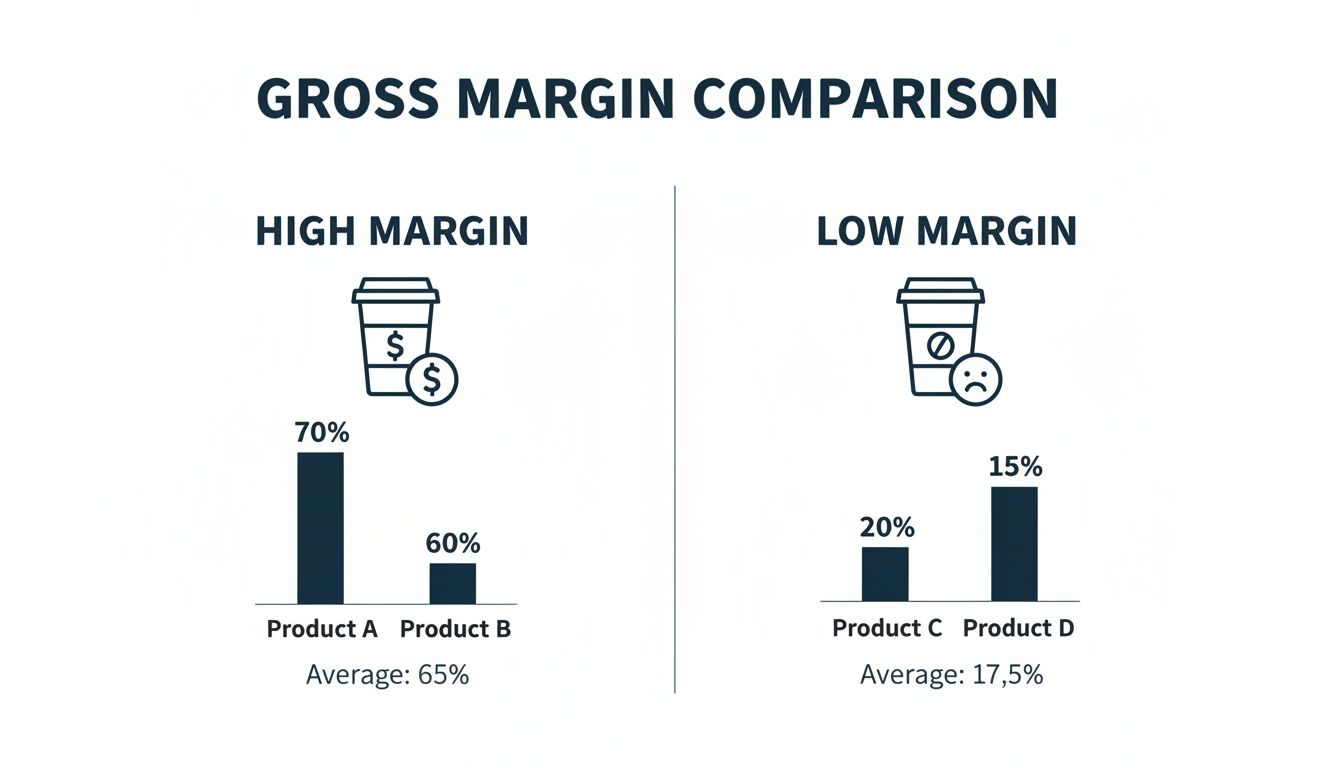
The real takeaway? Even with the same sales, controlling your direct costs makes a huge difference in how much cash you actually get to keep.
Average Gross Margin Percentage By Industry
To give you a better idea, let's look at some average gross margin percentages. Use this table to see how your business compares to others in your field. Remember, these are just averages, and your own numbers might be different based on your location and how you run your business.
| Industry | Average Gross Margin % | What This Means |
|---|---|---|
| Construction & Engineering | 13-20% | High material and labor costs mean tight cost control on every single job is necessary to survive. |
| Professional Services (Staffing) | ~32% | This business is all about labor costs. Making a profit depends on how well you use your team's billable time. |
| Healthcare (Products) | ~54% | These businesses often have high markups on products, leaving a healthy amount to cover sales, marketing, and research. |
| Real Estate (REITs) | ~77% | They own a lot of assets, but their direct costs per dollar of revenue are often low, leading to very strong margins. |
Seeing these numbers next to each other makes it clear why you can't compare a construction company to a real estate company. They’re playing completely different financial games.
By knowing your industry's average, you stop guessing. You can set real goals, spot problems, and make smarter decisions about where to take your business next.
Simple Ways To Improve Your Gross Margin
So, you've calculated your gross margin percentage, and the number is lower than you’d like. Don't worry. Think of this number as a signal telling you it’s time to take action. Improving your margin isn't just about making your numbers look better; it's about making your business stronger. A healthier margin means you keep more cash from every sale, and that cash is the fuel for growth.

When it comes down to it, there are only two main things you can do to improve your gross margin: charge more for what you sell, or lower the direct costs of making it. Let's break down some ways to do both.
Re-Evaluating Your Prices
The idea of "raising your prices" can feel scary, but it's not the only way to get more money from each sale. Getting creative with how you price can make a huge difference without scaring away customers. A good first step is to use optimal pricing strategies that match your costs and what people are willing to pay.
Consider these ideas:
- Create Product or Service Tiers: Instead of one price, offer good, better, and best options. This lets customers pick what fits their budget while pointing them toward higher-margin choices.
- Bundle Products or Services: Combine a high-margin item with a lower-margin one that's in high demand. For example, a landscaper could bundle a basic lawn mowing service (lower margin) with a more profitable fertilization treatment (higher margin).
- Add Value, Then Charge for It: Can you add a small, low-cost feature that makes your service more valuable? A consultant could offer a "quick-start" guide with their package to justify a slightly higher price.
Cutting Down Your Direct Costs
The other way to improve your margin is to lower your Cost of Goods Sold (COGS). Even small changes here can make a big difference. This is all about working smarter, not just harder.
Your goal isn't to be the cheapest, but to be the most efficient. Reducing waste, whether it's time or materials, goes straight to your bottom line.
A construction contractor I know saved thousands of dollars a year just by shopping around for a new lumber supplier. The quality was the same, but the new company offered better prices for buying in bulk and had more reliable delivery, which also cut down on project delays.
Here are a few more ideas:
- Negotiate with Your Suppliers: Don't be afraid to ask for better prices. Can you get a discount for paying early or buying more at once? Your business is valuable to them.
- Reduce Waste: For a construction job, this means cutting materials carefully to reduce scrap. For a clinic, it might mean better inventory tracking to prevent expensive supplies from expiring.
- Improve Team Efficiency: Track how long jobs actually take versus what you estimated. If a task always takes more time than you budgeted, it’s a sign you need to fix the process or provide more training.
Improving your gross margin percentage is a process of making small, smart changes over time. Our complete guide on how to improve your gross profit margin offers more ideas you can use.
For some businesses, like those in healthcare, high-value services can lead to strong margins. Research shows the healthcare products industry averages a 54% gross margin, giving them more room to cover other costs. You can find more industry margin data from NYU Stern to see how you compare in your own field.
Common Questions About Gross Margin
Once you start to understand your business's money, questions pop up. Gross margin is a powerful number, but it’s easy to mix it up with other numbers or get stuck wondering what a “good” number even is. Let's clear up a few of the most common questions I hear.
Getting these ideas straight will make you feel more confident when you look at your company's financial reports.
What Is the Difference Between Gross Margin and Net Margin?
Think of it this way: your gross margin is the profit you make from a sale after subtracting only the direct costs of that specific product or service. It's the profit on the thing itself.
Your net margin is what’s left after you pay for everything. That includes direct costs plus all your other business expenses—rent, marketing, salaries, taxes, everything.
Gross margin tells you if your product or service is profitable. Net margin tells you if your whole business is profitable. You have to watch both, because they tell you two very different things about your company's health.
I’ve seen companies with a great gross margin of 60% go out of business. How? Their marketing and rent costs were so high that their net margin was negative. Their product was a winner, but the business as a whole was losing money with every sale.
Can My Gross Margin Be Too High?
While a high gross margin is almost always good, a very high number compared to others in your industry can be a quiet warning. It’s worth asking yourself a few questions.
- Are my prices so high that I'm scaring away customers and slowing down my own growth?
- Am I using cheaper materials or cutting corners on service in a way that’s going to hurt my reputation later?
- Could this just be a mistake in my numbers, like putting a cost in the wrong category?
The goal isn't just to have the biggest number. It's about finding a healthy, competitive margin that lets your business grow while giving customers real value that keeps them coming back.
How Often Should I Calculate My Gross Margin?
For most small businesses, checking your gross margin monthly is a perfect habit. It's often enough to spot problems early—like a sudden rise in material costs—before they can hurt your cash flow. But it’s not so often that you get lost in the daily details.
Now, if you're in a business where costs change fast, like construction or event planning, you should check it more often. Calculating it for each project gives you instant feedback on how well you're estimating costs for every job.
Is a Negative Gross Margin Possible?
Yes, a negative gross margin is possible, and it’s a huge red flag. It means you are spending more to make a product or provide a service than you are charging for it.
Simply put, you are losing money on every single sale before you even pay for your office, your marketing, or your own salary. This can't last. If you find your business in this spot, you need to act fast to either raise your prices or cut your direct costs. There's no other way.
At MyOfficeOps, we help business owners move beyond just tracking numbers to actually understanding what they mean for growth. Our bookkeeping and advisory services give you the clear, jargon-free reports you need to make smarter decisions on pricing, costs, and profitability. Get the financial clarity you need to grow your business.