
Standard costing is a way to set a should-cost for a job before the work starts, then compare it with the actual cost after the job is done. It's similar to using a recipe to estimate the grocery bill, then checking the receipt when you get home to see what changed.
If you run a business, that matters because surprise costs are usually what crush profit, not one huge disaster. A project can look healthy on paper, then finish with a thinner margin than expected, and you're left guessing whether the problem was labor, supplies, or overhead.
What Standard Costing Means for Your Business
You don't need a factory floor to use standard costing. If you've ever finished a service, a client project, or a repair job and thought, “We made money, but not as much as we should've,” you've already felt the problem it solves.
Standard costing is a pre-set unit cost system where management defines expected costs for direct materials, direct labor, and overhead before production, then measures actual results against those standards. That setup supports management by exception, which means you focus on the jobs that drift off target instead of staring at every line of every bill (management by exception in standard costing).
A simple way to think about it
A better mental model is a kitchen, not a ledger. If you know a cake should take a certain amount of flour, sugar, and time, then a higher grocery bill or a longer bake time tells you something went wrong.
That same idea helps with pricing. If a job should take a certain amount of labor and support costs, then a higher actual bill gives you a clear place to investigate. For a business owner, that's the primary value, a cleaner way to spot where profit leaked out.
If you're trying to bring more order to your books and planning, it helps to use financial tools that keep the numbers organized from the start. A resource like Wisely's unified financial solutions can be useful when you want cleaner tracking across accounting and decision-making.
Practical rule: if you can define a repeatable job, you can usually define a standard cost for it too.
Standard costing isn't about making every job perfect. It's about giving yourself a reliable baseline so the next time a project underperforms, you can ask the right question fast, not three weeks later.
The Three Building Blocks of a Standard Cost
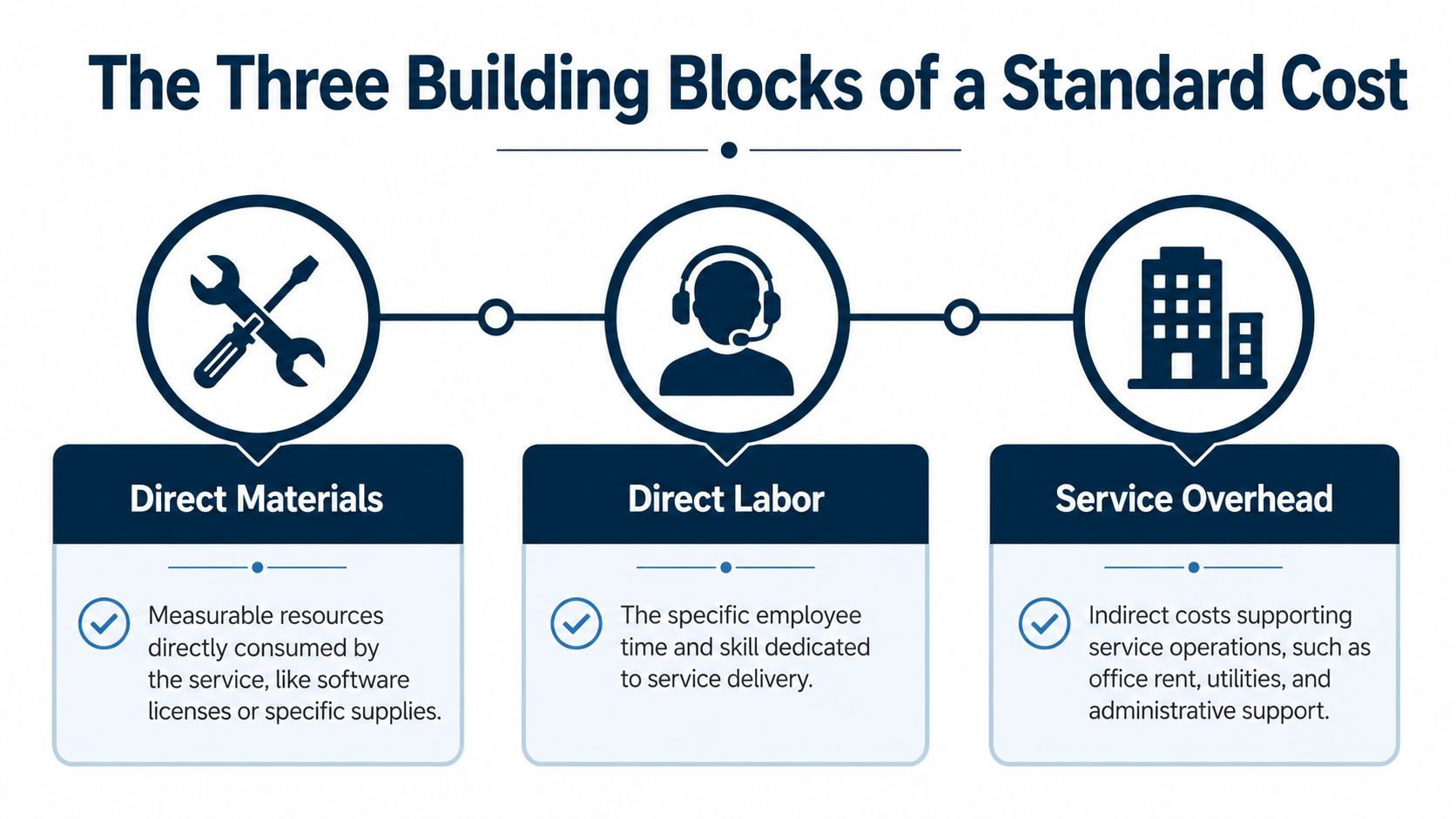
Every standard cost has the same three parts, even if your business doesn't make physical products. The labels may sound industrial, but the logic works just as well for an agency, clinic, or contractor.
The accounting framework breaks total unit cost into material, labor, and overhead standards, usually built from technical estimates, historical performance, and normal operating assumptions (standard cost components and benchmarking). That makes the standard a stable reference point, not a guess.
Direct materials
For a service business, direct materials are the measurable items tied to the job. A marketing agency might treat paid software licenses for a specific deliverable as part of the job cost, while a contractor might treat lumber, drywall, or fasteners that go into one project as direct materials.
The goal is simple, know what the job should consume. If the same type of project always needs the same supplies, you can set a standard from prior jobs, supplier prices, or technical estimates. The point isn't perfect precision, it's having a repeatable baseline that keeps small overruns from disappearing into the background.
Direct labor
Direct labor is the time and skill spent on the actual work. In a law office, that might be attorney or paralegal time on a fixed-scope matter. In a clinic, it might be practitioner time for a routine visit. In a construction crew, it's the labor hours tied directly to the task.
A useful standard here is not “what did we pay everyone last month,” but “how long should this job take under normal conditions?” That shift helps you see whether the issue is wage rate, scheduling, training, or rework.
Service overhead
Overhead covers the support costs that keep the work moving, rent, utilities, admin support, software, insurance, and other indirect costs. These don't belong to one job in a neat way, but they still have to be covered by each project or client.
For a busy owner, overhead is often the quiet leak. A job can look profitable until you remember the share of the office, software, or admin time that had to support it. That's why overhead belongs in the standard from the start, not as an afterthought.
Here's a clean way to budget one service job, use the standard as your unit cost target, then compare what the job consumed. That's also where a basic cost-of-sales view can help, so it's worth reviewing a plain explanation of what counts in cost of goods sold.
Finding the Story in Your Numbers with Variance Analysis
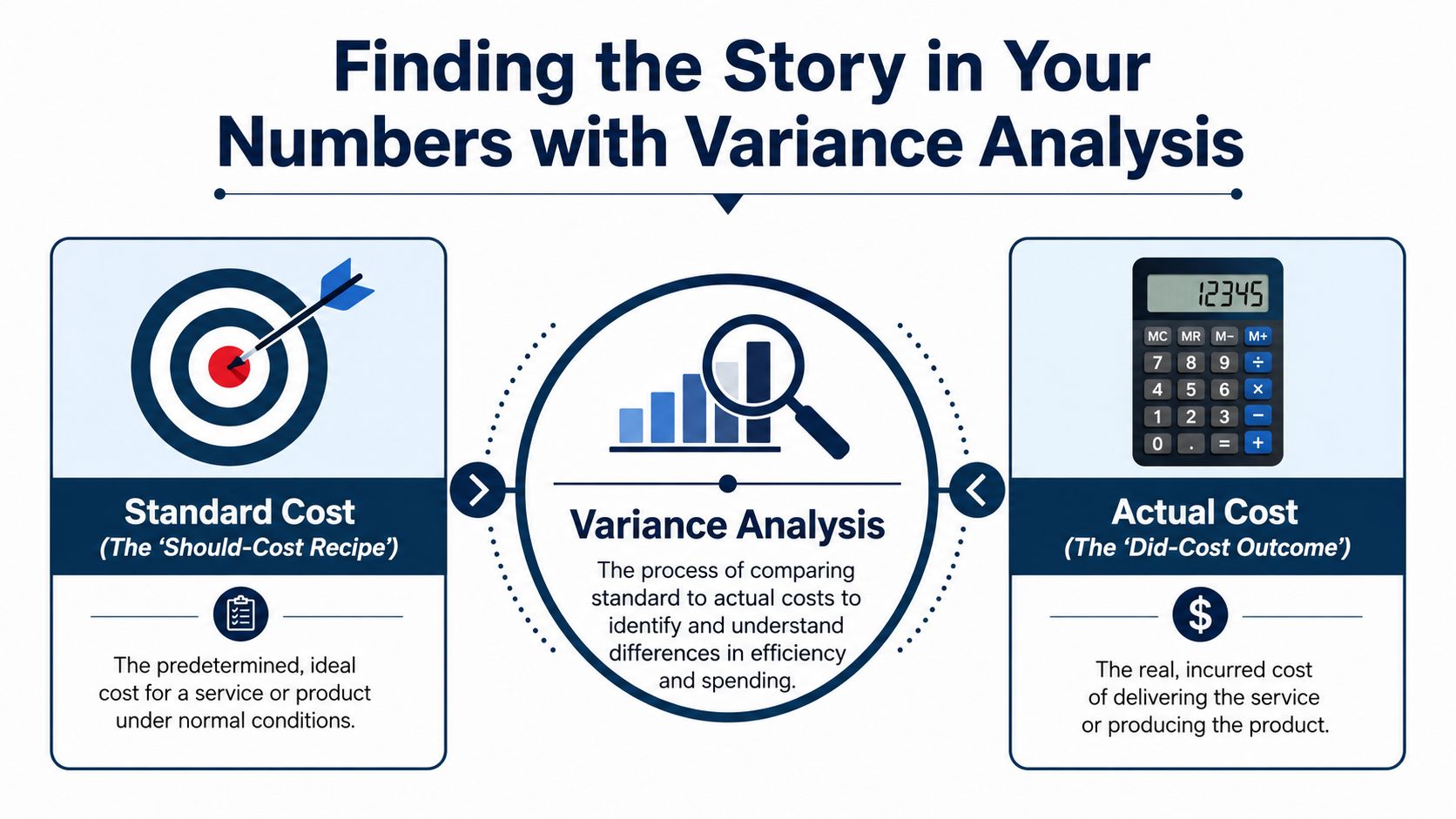
Variance analysis is just the gap between what you expected and what really happened. If your standard cost is the recipe, variance analysis is the receipt check.
The useful part is that it forces two questions. Did we pay the right price? and Did we use the right amount? That's why the method is so practical for owners who don't have time to review every invoice line by line.
What the numbers are doing
A simple product example makes the idea easy to see. If direct materials cost $10 per pound and a product requires 20 pounds, the standard materials cost is $200. If direct labor is $150 and overhead is $50, the total standard cost is $400 (standard costing example with materials, labor, and overhead).
That same math works in service businesses, even if the “materials” are mostly time and support costs. The important thing isn't the format, it's the comparison.
A variance is a signal, not a verdict. A bad number might point to a price increase, a waste issue, a scheduling problem, or a quoting mistake.
The two main questions to ask
A price variance tells you that a cost item came in at a different rate than expected. Maybe a supplier changed pricing, or maybe a senior employee was used for work that should've gone to a junior team member.
A quantity or efficiency variance tells you that you used more than expected. That can mean more hours, more supplies, more rework, or slower delivery. In plain English, one variance is about the rate, the other is about the amount.
If a project runs long, don't jump straight to blame. Look for the cause. Was the scope unclear, was the team undertrained, or did the client keep changing the brief? Variance analysis works best when it leads to a practical fix, not a postmortem.
For a simple budgeting lens on this process, it can help to compare it with variance analysis in budgeting. The idea is the same, just applied to real jobs instead of a spreadsheet in the abstract.
Standard Costing Examples for Service Businesses

Most explanations of standard costing stop at manufacturing, which leaves service owners to guess at the rest. That gap matters, because the primary danger in services is often margin leakage, not inventory waste (standard costing for service businesses).
Professional services
For an agency, consultant, or IT firm, the cleanest standard is usually a repeatable job type. A “standard” website project, for example, can be built around expected design hours, development hours, and the software or stock assets needed to deliver it.
The labor piece is usually the biggest driver. If your team has to revisit the same pages, rewrite the same copy blocks, or handle avoidable client revisions, the job cost moves fast. Standard costing gives you a way to separate a well-run project from a messy one, without waiting until month-end to notice the margin is off.
If you run a firm like this, it helps to keep your chart of accounts and job tracking clean enough to see patterns by client and project. A useful place to start is accounting for professional services firms.
Healthcare clinics
In a clinic, the “unit” might be a routine patient visit. The standard could include practitioner time, basic supplies, and a share of admin support for scheduling, billing, and records.
That matters because a visit can look profitable if you only think about the provider's time. Once you include prep work, paperwork, and overhead, the picture changes. Standard costing helps a practice see whether the visit type is priced correctly and whether staff time is being used the way it should be.
Construction contractors
For a contractor, the unit might be a defined task like installing a fixed area of drywall. The material standard includes the sheet goods, fasteners, and any consumables tied to the task. The labor standard covers the crew time needed to install, finish, and clean up.
What makes construction tricky is that no two jobs are identical. Still, recurring tasks can be standardized enough to help with bids, change orders, and profit checks. The more repeatable the task, the stronger the standard.
Good standards don't need to be perfect. They need to be close enough that a meaningful gap stands out when something goes wrong.
How to Implement Standard Costing in Your Business
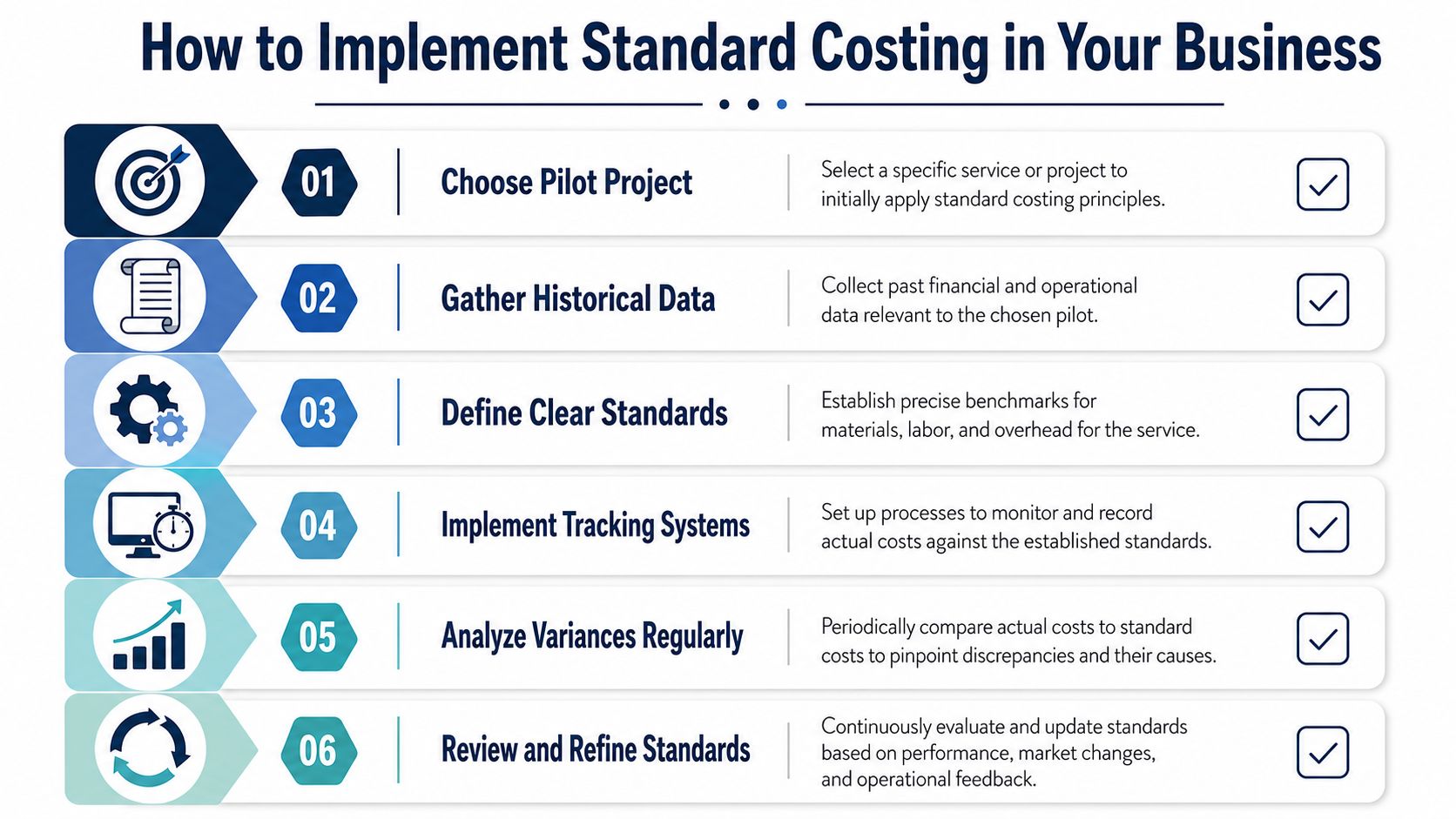
The easiest way to start is small. Pick one service, one project type, or one recurring job, then build from there.
Start with one repeatable job
Choose a job you already do often enough to recognize patterns. A routine client package, a standard patient visit, or a common repair job works better than a one-off custom engagement.
Then collect the basic history. Look at time logs, supply purchases, and overhead that repeatedly shows up around that work. You're not hunting for perfect data, just enough to establish a first standard without guessing blind.
Set standards, then test them
Build your first standard from what the work usually takes under normal conditions. Use the information you already have, then compare actual results against that baseline for a short period.
Once you do that, the variances start telling a story. Maybe the labor standard is fine but the material cost has drifted, or maybe the job is always taking longer because the handoff process is weak. That's where the system becomes useful, because it pushes you toward the actual cause.
Keep the system flexible
Standard costing works best when you review it often enough to stay honest. In a volatile environment, fixed assumptions can get stale quickly, especially if wages, supplies, or support costs move around.
The framework itself is useful, but it can get rigid if you treat it like a permanent rule. It also works best for repeatable work, so highly custom jobs need a lighter touch and more judgment. One practical guide for keeping cost controls current is preventing money leaks in your business, especially when small overruns are piling up across many jobs.
A good implementation rhythm is simple.
- Pick one job type: Start where the work repeats and the data is easiest to find.
- Set a first standard: Use historical time, supply use, and normal overhead as your baseline.
- Compare actuals quickly: Check the first results before patterns harden.
- Look for cause, not blame: Separate pricing problems from usage problems.
- Revise when reality changes: If the work changes, the standard should change too.
The benefit is better pricing, cleaner performance checks, and fewer surprises. The tradeoff is that the numbers need upkeep, and that upkeep is part of the job.
Tools, Tips, and When to Get Expert Help
You can start with a spreadsheet, and plenty of businesses do. But once you have more than a few job types, manual tracking starts to blur the signal, especially when you're trying to separate labor drift from overhead creep.
Software helps most when it tracks jobs consistently and makes variances easy to review. The primary advantage is not automation for its own sake, it's fewer missed patterns and faster decisions. That matters because standard costing is a control tool, not just a costing exercise.
The other place owners get stuck is interpretation. A variance only helps if someone can tell whether it came from pricing, efficiency, scope change, or a normal one-off.
If the same variance keeps showing up and no one can explain it in plain language, the system isn't working yet.
That's when expert help pays off. An experienced bookkeeping or advisory partner can help set the first standards, build the reporting rhythm, and keep the numbers tied to decisions about pricing, staffing, and cash flow. For a small or midsize business, that support is often the difference between having data and using it.
If you want help turning your job costs into something you can use, reach out to MyOfficeOps for a conversation about cleaner books, smarter variance tracking, and a standard costing setup that fits your business.