
You know the point when bookkeeping stops being “a few admin tasks” and starts eating your week. Invoices are sitting in your inbox. Payroll is coming up. Your spreadsheet says one thing, your bank account feels like another, and tax season is hanging over everything like a storm cloud.
That's where a lot of Philadelphia business owners get stuck. The work is coming in, people need answers, and you still can't quickly tell whether a job made money, whether the practice is collecting fast enough, or whether you can afford the next hire. The problem usually isn't effort. It's that the owner, office manager, or one overextended employee is trying to do accounting between ten other jobs.
That's why outsource accounting services becomes a real question, not a buzzword. Done right, outsourcing doesn't just move data entry off your plate. It gives you cleaner books, better visibility, and a way to make decisions before small issues turn into expensive ones.
When DIY Bookkeeping Starts to Cost You More
A lot of owners start the same way. They run invoices from QuickBooks, track expenses in a spreadsheet, and tell themselves they'll clean everything up at month end. For a while, that works well enough.
Then the business gets busier.
A contractor adds crews. A medical practice adds providers. A consulting firm signs bigger clients with more complex billing. Suddenly the “simple” bookkeeping process starts breaking down. Bills get paid late. Customer balances age longer than they should. Reconciliations fall behind. Reports stop being useful because they're always old.
The real cost isn't just the admin time
The biggest cost of DIY bookkeeping usually isn't the bookkeeping itself. It's the decisions you delay because your numbers aren't ready.
If you can't answer questions like these without digging for an hour, your system is already costing you:
- Are we profitable right now: Not just on paper, but by service line, provider, or job.
- Can we afford this hire: Or will payroll squeeze cash in two months.
- Who still owes us money: And which balances need follow-up today.
- What are we spending too much on: Software, supplies, subcontractors, overtime, or something else.
Practical rule: If you dread opening your books, the issue usually isn't motivation. It's that the system no longer fits the business.
That's when outsourcing starts to make sense. You're not “giving up control.” You're putting financial work into a process that gets done on time, every month, without stealing your evenings. If you want a realistic look at what internal bookkeeping can really cost, this breakdown of small business bookkeeping cost is a useful place to start.
A familiar Philadelphia example
A growing subcontractor might think the books are mostly fine because money is still coming in. But if job costs aren't coded consistently, one project can look profitable while another is draining margin. The owner doesn't spot the problem until weeks later, when there's less cash than expected.
That's the trap. The business looks active, but the financial picture is blurry. Once that happens, bookkeeping isn't a back-office chore anymore. It's a bottleneck.
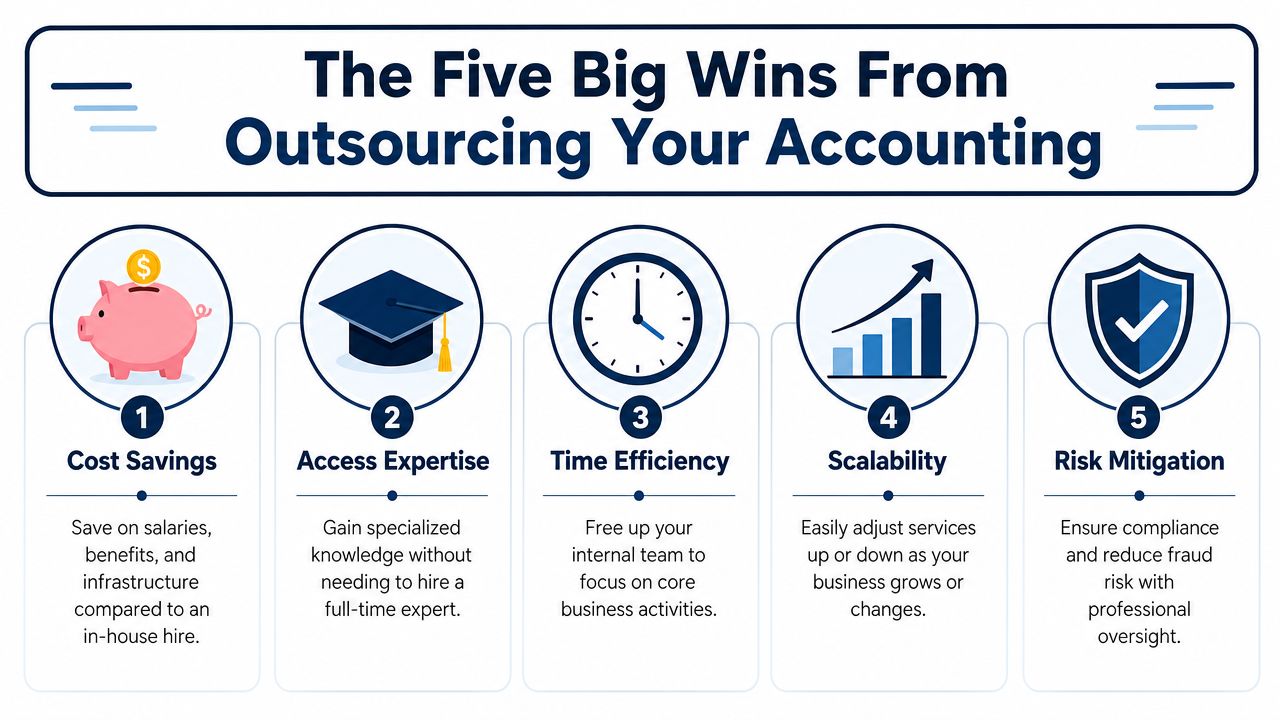
The Five Big Wins From Outsourcing Your Accounting
The reason most owners look into outsourcing is simple. They want less chaos and better numbers. Good outsourced accounting can do that in a few practical ways.
Lower cost without losing capability
Hiring in-house is a fixed cost, a lot like a car payment. The salary, payroll taxes, benefits, training time, and software stack keep showing up whether you need light support that month or heavy support.
Outsourcing is closer to a utility bill. You pay for the level of help you need. For small businesses, outsourcing accounting services delivers a verified 40–60% cost reduction compared to in-house staffing because it removes fixed overhead like salaries, benefits, and training and shifts the work to variable, project-based support, according to Insignia Resource's accounting outsourcing analysis.
For an owner, that changes the math fast. You're not carrying a full-time cost just to make sure reconciliations, payables, reporting, and cleanup happen.
Broader expertise than one employee can usually cover
One person can be solid at daily bookkeeping. That doesn't mean they're also strong at cash forecasting, payroll integration, sales tax handling, job costing, and management reporting.
That's one of the clearest answers to why outsource accounting services. You often get access to a team with different strengths instead of relying on one overworked generalist.
A healthcare practice may need someone who can keep monthly reports clean and also help make sense of provider compensation, collections timing, and payroll-related pressure points. A construction company may need strong transaction handling plus someone who understands work in progress and job profitability. Those are not always the same skill set.
More time for work that actually pays you
Owners usually don't need to be the person matching receipts, fixing duplicate entries, or tracking down why the bank rec doesn't tie.
Outsourcing gives that time back. So does taking financial reporting out of the hands of an office manager who already handles phones, scheduling, and vendor issues.
A good accounting partner should remove bottlenecks, not become another one.
If you're trying to turn raw financial data into something you can use for pricing, staffing, or cash planning, better business intelligence reporting is often the difference between “books are done” and “I know what to do next.”
Support that can grow or shrink with the business
Business doesn't move in a straight line. You may add a location, bring on more technicians, open another service line, or hit a seasonal surge. Then six months later, the workload shifts again.
An outsourced setup is usually easier to adjust than hiring, training, and reworking internal roles.
Here's the simple comparison:
| Need | In-house setup | Outsourced setup |
|---|---|---|
| Busy season | More strain on the same team | Add support hours or services |
| New reporting need | May require a new hire or consultant | Often handled inside the service model |
| Slow period | Fixed payroll cost remains | Service level can often be adjusted |
Better compliance and fewer preventable mistakes
Most owners don't want to become experts in filing deadlines, payroll processes, or reporting controls. They want the work done right.
That matters because small mistakes in bookkeeping can ripple outward. A missed vendor payment hurts relationships. A reporting error can distort cash flow planning. A messy close can turn tax prep into a fire drill.
Outsourcing won't solve every financial problem by itself. But when the process is clean, timely, and reviewed by people who do this every day, your risk drops and your confidence goes up.
Moving Beyond Bookkeeping to a Strategic Partner
Basic bookkeeping tells you what happened. A strategic accounting partner helps you decide what to do next.
That's the bigger reason many owners outsource. They don't just need reconciled books. They need someone who can look at the numbers and say, “This service line is carrying the business,” or “Your collections cycle is too slow,” or “Your labor mix is pressuring margin.”

Why hiring your way out of the problem isn't easy
A lot of owners assume they'll just hire the right accountant and keep everything internal. In this market, that's harder than it sounds. 62% of finance leaders say they cannot hire the people they need, and over 340,000 accountants in the U.S. left the field between 2019 and 2024, according to Insignia Resource's accounting outsourcing statistics.
That shortage hits small and midsize businesses especially hard. Large companies can often pay more, offer bigger teams, and create clearer career paths. A local business owner may spend months searching and still end up with a hire who can handle transactions but not higher-level analysis.
What strategic support actually looks like
A coach doesn't just record the score. They point out what's causing it.
For a Philadelphia-area contractor, that might mean seeing which jobs produce margin and which jobs tie up labor and materials without enough return. For a healthcare practice, it might mean spotting that revenue looks healthy but cash is tightening because collections are lagging behind payroll and rent.
A strategic partner should help with questions like:
- Pricing decisions: Which services are worth raising prices on, and which are already too thin.
- Hiring timing: Whether the business can support another admin, field employee, or provider.
- Cash planning: What the next few months are likely to look like based on payables, receivables, payroll, and seasonality.
- Profitability analysis: Which clients, departments, or jobs create value.
The right partner should explain the numbers in plain English. If the report is technically correct but no one knows what action to take, it missed the point.
Outsourced accounting often overlaps with advisory services. Some businesses need clean books and monthly reporting. Others also need a higher-level guide who can help with forecasting, dashboards, and owner decisions. Such scenarios call for options like fractional CFO support for small business.
Philadelphia businesses usually need industry context, not generic reports
This matters more than people think. A construction business doesn't read financial reports the same way a law firm does. A multi-provider healthcare office has different pressure points than a real estate group.
Generic bookkeeping gives you categories. Strategic accounting gives those categories meaning.
One option in the Philadelphia market is MyOfficeOps, which handles bookkeeping, accounting, reporting, and CFO-level advisory for small and midsize businesses. The point isn't that every company needs the same package. It's that many businesses need more than someone who closes the books.
How to Measure Your Return on Investment
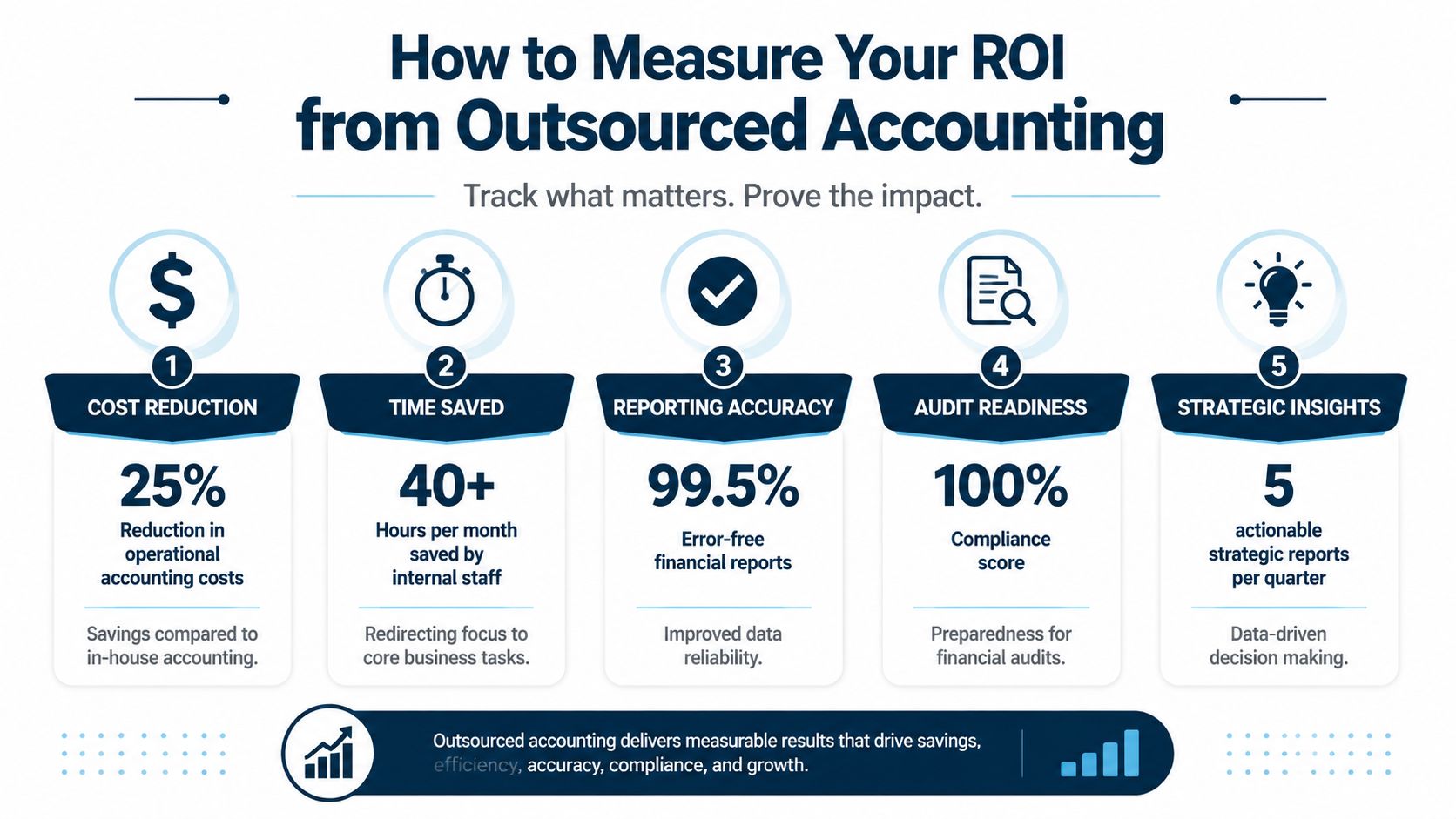
Outsourcing only makes sense if it improves the business in ways you can see. Cost matters, but it's not the only yardstick. The better test is whether the numbers get more accurate, arrive faster, and help you make decisions sooner.
Start with two operational KPIs
The clearest early signals are accuracy and speed to close.
According to Maasil's review of outsourced accounting performance, outsourced accounting teams process financial data with 99.4% accuracy, which is 2.6% higher than the 96.8% accuracy rate of in-house staff, and they finish month-end closing 4 to 6 days faster than internal teams.
That's not just a technical win. It changes how quickly you can act.
If your books close faster, you don't spend the first half of the next month looking backward. You can review labor, expenses, and collections while the information is still fresh.
Use a simple scorecard
You don't need a giant dashboard to measure ROI. A short monthly review is enough.
| KPI | What to look for | Why it matters |
|---|---|---|
| Month-end close time | Are reports ready sooner than before | Faster visibility leads to faster decisions |
| Error cleanup | Are there fewer reclasses, missed bills, and reconciliation issues | Fewer errors means less rework and less risk |
| Owner time spent | Are you spending less time answering accounting questions or fixing records | Time can shift back to sales, operations, and staff management |
| Reporting usefulness | Do reports actually help with pricing, hiring, and cash planning | Good reporting should drive action |
| Cash visibility | Can you see upcoming pressure earlier | Early visibility gives you more options |
Owner test: If reporting arrives on time but you still can't tell what needs attention, the ROI isn't there yet.
Tie the numbers to real business decisions
For a construction company, ROI often shows up in job costing. If reports are accurate and current, the owner can catch a weak project before the month is gone. For a healthcare practice, the return may show up in cleaner visibility into payroll, provider output, and collection timing.
There's a useful parallel in the way companies think about tools. The decision isn't just “what does this cost?” It's “what are we paying to build and maintain this ourselves versus getting a working solution now?” That same logic shows up in this piece on the costs and ROI of data platforms, and it applies well to accounting operations too.
A good outsourced setup should reduce wasted internal effort, shorten the path to clear reporting, and help you make better calls with less guesswork.
Common Pitfalls and How to Avoid Them
Outsourcing can work very well. It can also fall flat when the provider handles transactions but never really understands the business.
That's the part many articles skip. The risk isn't only bad bookkeeping. The bigger risk is getting neat reports that arrive too late, lack context, or don't help you make decisions.
Strategic disconnection is a real problem
This issue has a name now. Emerging data indicates that 29% of SMBs experience “strategic disconnection” when their outsourced provider operates in a different time zone or lacks real-time access to operational data, which leads to delayed KPI dashboards and reactive, rather than proactive, CFO-level advice, according to 1840 & Company's discussion of accounting outsourcing.
That finding matches what many owners feel but can't quite describe. The books may be technically done, yet the service still feels disconnected from the business's core activities.
What bad fit looks like in practice
A poor-fit provider usually shows up in ways like these:
- Slow answers: You ask a simple question about cash, payables, or payroll and wait too long for a useful response.
- Generic reporting: The P&L is clean, but no one explains what changed or why it matters.
- Weak industry context: A healthcare practice gets the same reporting rhythm as a contractor, even though the businesses run very differently.
- No operational visibility: The accounting team doesn't have timely access to the details needed to connect financial reporting with what's happening on the ground.
Fast bookkeeping with no business context is still a problem.
How to avoid the trap
The fix isn't avoiding outsourcing. The fix is choosing a provider that works close enough to your operation to stay relevant.
For Philadelphia-area SMBs, that usually means looking for three things:
Responsive communication
If they don't answer basic pre-sale questions clearly, they won't get better after onboarding.Industry familiarity
Construction needs job costing and project visibility. Healthcare needs dependable reporting around payroll, collections, and provider activity. Professional services need strong billing and margin insight.Access to current data
Your accounting partner should be working from live or near-live information from systems like QuickBooks, payroll platforms, and billing tools. If they only see a snapshot after the fact, their advice will lag behind the business.
The goal isn't to find the cheapest option. It's to find a partner who helps you stay ahead of problems instead of explaining them after the damage is done.
Finding the Right Accounting Partner in Philadelphia
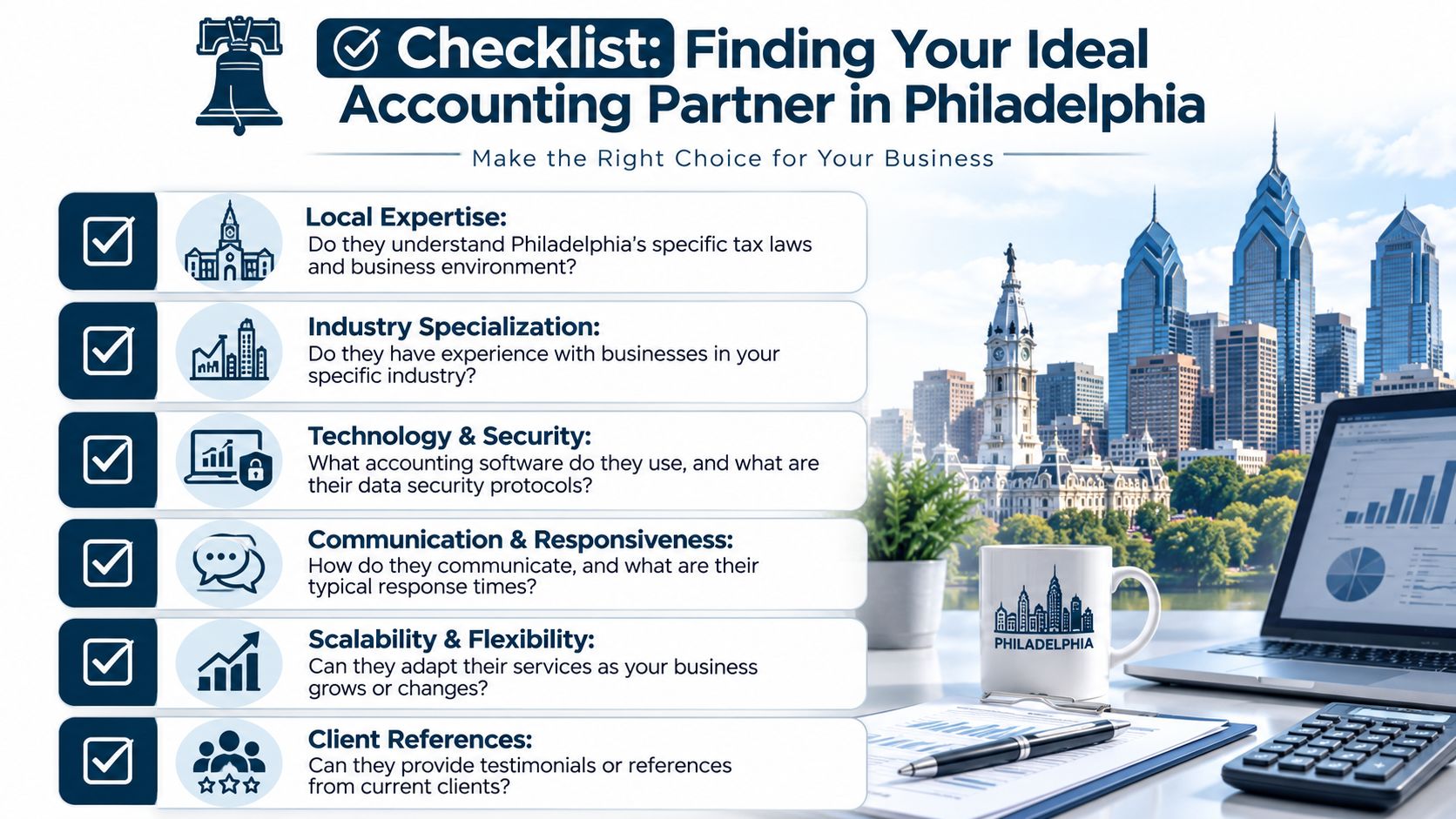
Once you know why outsource accounting services can help, the next step is picking a firm that fits your business. That choice matters more than the outsource versus in-house label.
A good partner should understand your numbers and how your business runs in the Philadelphia market.
Ask questions that reveal real fit
Don't stop at “What software do you use?” Ask questions that force specifics.
- Local knowledge: How do you handle Philadelphia business taxes such as BIRT, and what reporting issues do local owners usually miss?
- Industry depth: What experience do you have with construction job costing, healthcare reporting, or professional services billing?
- Communication style: Who answers my questions, how often will we meet, and what happens when something urgent comes up?
- System process: How do you gather documents, reconcile accounts, and deliver reports each month?
- Security and workflow: Which accounting and payroll tools do you work with, and how do you protect financial data?
Know what smooth onboarding looks like
A solid onboarding process should feel organized, not messy. Usually that means document collection, access to accounting software, cleanup of the chart of accounts if needed, a clear month-end process, and a reporting calendar everyone understands.
The first sign of a strong accounting partner is simple. They can explain the process without jargon.
If you're comparing firms, this guide to choosing an accounting partner in Philadelphia can help you vet options with more confidence. The right provider should leave you with cleaner books, better questions, and fewer surprises. They should also be easy to reach when something important comes up.
If your books are behind, your reports don't help, or you're spending too much time trying to piece together cash flow, MyOfficeOps offers bookkeeping, accounting, reporting, and advisory support for Philadelphia-area SMBs. The process is straightforward. Start with a discovery call, get a plan that fits your business, and move into a smooth onboarding that turns financial clutter into clear, usable numbers.