
Let’s be honest, "bookkeeping" probably isn’t why you started your business. Most of us don't dream of spending hours buried in spreadsheets.
But think of it this way: managing your money is like keeping score in a game. If you don't know the score, you can't tell if you're winning. The goal isn't to become an accountant overnight. It's to set up a simple system so you know where your money is going and can make smart choices.
Getting Your Finances Organized for Clarity
Putting your financial house in order is the first, most important step. This isn't just about being tidy; it's about creating a system that tells you the truth about how your business is doing.
Step 1: Separate Everything, No Excuses
The very first thing you need to do is separate your business and personal finances. This isn't just a good idea—it’s the only way to know your real numbers.
Open a business bank account and get a business credit card. All money the business earns goes into this account, and all business expenses are paid from it. It's that simple.
Doing this one thing saves you from a world of trouble. It makes tax time much easier, protects your personal money if the business gets sued, and gives you a clear picture of your business's health.
I once worked with a marketing agency that mixed its money for years. When they finally separated everything, they found thousands of dollars in tax deductions they had missed. They also realized the business was making more money than they thought.
Step 2: Get the Right Tools for the Job
Next, you need a way to track all this activity. You could use a spreadsheet, but modern accounting software is made to do this for you. Tools like QuickBooks Online are popular because they connect to your business bank accounts and automatically sort your spending.
When you set up your software, you'll create a Chart of Accounts. This is just a list of categories for your income and expenses, like "Software," "Rent," or "Sales." This list is the backbone of your financial reports.
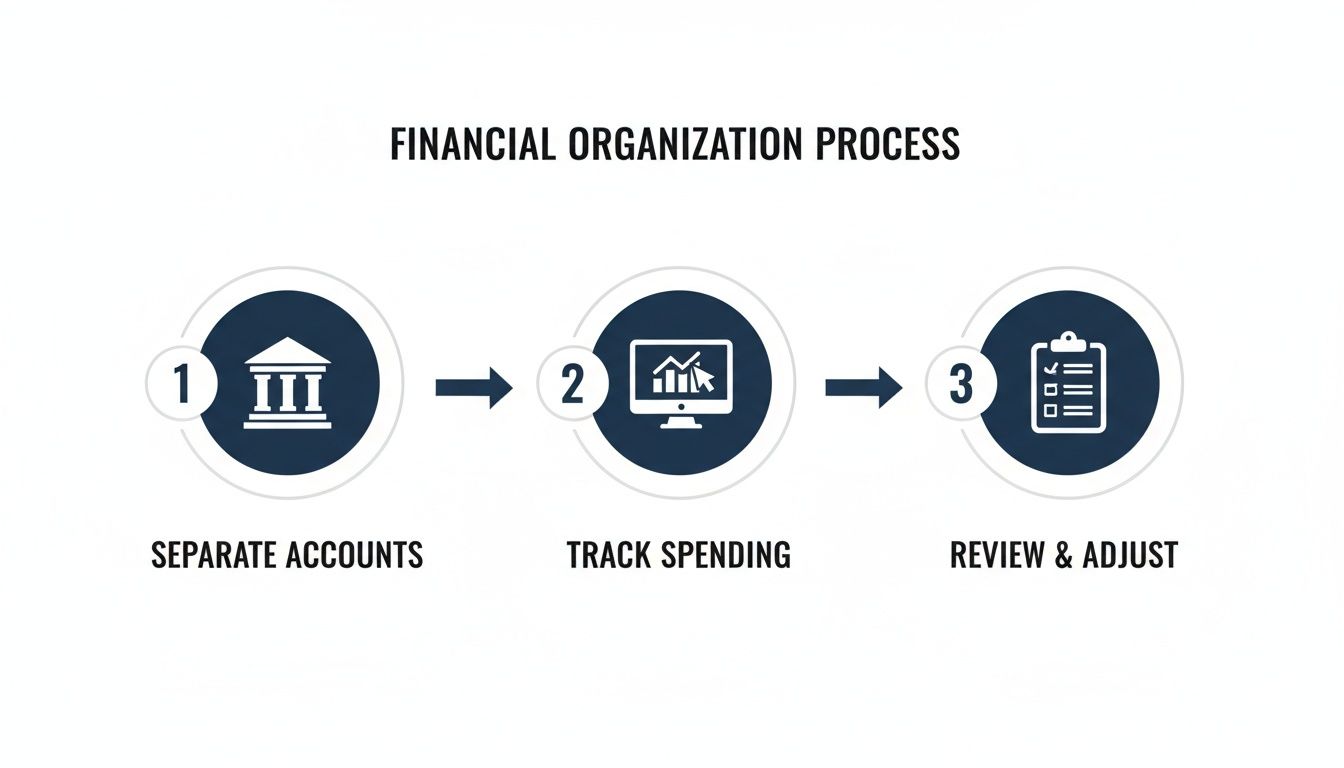
This simple flow—separate accounts, tracking with software, and reviewing—is the foundation of good financial management.
Step 3: Build a Habit, Not a Headache
Getting organized isn't a one-time thing; it's a habit. But it doesn't need to take over your life. Here’s a simple routine you can follow:
- Daily (5 Minutes): Check your bank account in your software and sort any new transactions. This keeps things from piling up.
- Weekly (30 Minutes): Look at unpaid invoices, pay any upcoming bills, and check how much cash you have. If you have paper receipts, check out our guide on how to organize business receipts to keep them tidy.
- Monthly (1-2 Hours): Run your main financial reports, like the Profit & Loss statement and Balance Sheet. This is where you see how you did compared to your goals.
Once your books are clean, you can start tracking the key numbers that tell the real story of your business's health.
Key Numbers for Your Small Business
| Metric | What It Tells You | Why It Matters for a Local Business |
|---|---|---|
| Gross Profit Margin | How much money is left from a sale after subtracting the direct costs of the product or service. | Shows if your prices cover your costs. A local contractor needs to know this to see if a job is worth taking. |
| Net Profit Margin | The money left after all expenses, including rent and salaries, are paid. | This is your true "bottom line." It shows how well you run the entire business. |
| Cash Balance | The actual amount of money you have in the bank. | This is what keeps the lights on. A local shop needs enough cash to survive a slow month or grab a good deal. |
| Days Sales Outstanding (DSO) | The average number of days it takes for clients to pay you. | A high number means your cash is stuck in unpaid invoices. A lower number means you get your money faster. |
These numbers help you stop guessing where your money went and start telling it where to go.
The point of all this isn't just to have clean books. It's to stop reacting to money problems and start planning for the future.
To get there, it’s a good idea to follow proven small business accounting best practices. These guides can help you avoid common mistakes and set up a system that works.
Mastering Your Business Cash Flow
Making a sale feels great. But I’ve seen too many business owners learn a hard lesson: sales don’t pay the bills. Cash in the bank does.
The real stress comes from timing. If you have to pay your suppliers before your customers pay you, you’re stuck in a cash flow gap. It’s a huge source of worry for business owners.
The good news? You can control this. It starts by actively managing the flow of money.

Speed Up Your Incoming Cash
The faster you get paid, the better. Don’t wait until the end of the month to send invoices. As soon as a job is done, send the bill.
You also have to make it easy for people to pay you. If you only take checks, you’re slowing yourself down. Let people pay online with a credit card or bank transfer.
Try these simple tactics:
- Offer a small discount for early payment. For example, give a 2% discount if they pay in 10 days, otherwise the full amount is due in 30 days. Many people will pay early to save money.
- Require a deposit upfront. For a big project, asking for 25% or 50% before you start is normal. This gives you cash to cover your initial costs.
- Follow up on late payments right away. Don't be shy. The day an invoice is late, send a polite reminder.
I remember a construction contractor who was always waiting for checks. We helped him switch to digital invoices and take credit card payments on the job site. It changed everything. His average payment time dropped from 45 days to less than 15.
Manage Your Outgoing Cash
Getting paid faster is only half the story. You also need to be smart about when you pay your own bills. This doesn't mean paying late. It means paying on time, but not early.
If a supplier gives you 30 days to pay, use that time. Hold onto your cash as long as you can without paying a penalty. You can also ask your regular suppliers for longer payment terms to give yourself more breathing room.
Think of cash flow like managing the water in a bathtub. You want the tap of incoming cash running steadily, while the drain of outgoing cash doesn't empty the tub too fast. Your goal is to always keep a healthy level of water in the tub.
Look Ahead with a Cash Flow Forecast
A cash flow forecast is like a crystal ball for your money. It’s a simple tool, often just a spreadsheet, that helps you predict your cash balance in the coming weeks and months.
List all your expected cash coming in (customer payments) and all your cash going out (payroll, rent, bills) for each month. This simple exercise helps you spot money troubles before they happen. If you see that cash will be tight in three months, you have time to do something about it, like run a sale or hold off on a big purchase.
These money challenges are common. One report found that cash flow issues are the second-biggest problem for 29% of small businesses. This isn't just a number; it's a daily reality for thousands of owners.
Having a handle on your cash gives you peace of mind and the power to make better choices. For a deeper look, check out our guide on cash flow management strategies.
Building a Budget That Actually Works
Let's be honest, the word "budget" can sound boring. It feels like a list of all the things you can't spend money on.
But a good budget is more like a GPS for your business. It shows you the best path to get where you want to go. It helps you decide where to spend your money without guessing.
A lot of people I work with either don't have a budget or create one that's too complicated to use. We’re going to fix that.

Look Back to Plan Forward
The best way to make a budget is to start with what you’ve already spent. Don’t just pull numbers out of thin air.
Look at your financial reports from the last year, especially your Profit & Loss statement. Group your expenses into two simple buckets:
- Fixed Costs: These are bills that stay the same each month. Think rent, insurance, or software subscriptions.
- Variable Costs: These costs change based on how busy you are. This includes things like materials for a job, shipping fees, or ad spending.
Once you add up your average monthly spending in each category, you have a realistic starting point for what it costs to run your business.
Budgeting vs. Forecasting: What’s the Difference?
It's important to know the difference between a budget and a forecast. They sound similar, but they do different jobs.
A budget is your financial plan. It’s the goal you set for your income and expenses for the year.
A forecast is your prediction. You update it regularly based on what's actually happening. It shows you where you’ll probably end up if you stay on the same path.
A budget says, "Here's what we want to happen." A forecast says, "Here's what we think is going to happen." You need both to guide your business.
Put Your Forecast to Work: A Real Example
I once worked with a healthcare practice that wanted to grow. They were nervous about the risk and didn't know if they could afford another doctor and new equipment.
Instead of just hoping for the best, we built a simple financial forecast. We looked at a few different possibilities: What if patient numbers grow by 10%? What if they stay the same? What will the new payroll and loan payments look like in six months?
The forecast showed them that with a small increase in appointments, they could easily cover the new costs in six months. That data gave them the confidence to move forward. They knew when to hire and when to buy without taking a scary risk.
Stay on Course with Regular Reviews
A budget is useless if you make it in January and then forget about it. The real power comes from comparing your budget to your actual results every month. This is called a "budget vs. actual" review.
This monthly check-in tells you where you’re on track and where you’re not. Did you spend too much on marketing? Okay, why? Did a new client bring in more money than you planned? Great, how can we do that again?
This isn’t about feeling bad for being "over budget." It’s about finding problems, understanding why they happened, and making smart changes for next month. Recent Chase data found that 55% of businesses saw costs go up by 5% or more, while 76% still expected higher profits. You can see how these trends affect businesses in their latest outlook report.
This regular review turns your budget from a document into a tool for steering your business. If you need a template to get started, our guide on how to create a business budget can walk you through it.
Understanding Your Real Profitability
Let's get one thing straight: being busy doesn't mean you're making money. A full schedule is a good sign, but it doesn't tell the whole story. I've seen many owners work really hard, only to find there’s almost nothing left at the end of the month.
To manage your business finances, you have to look past the sales number and figure out what’s actually making you money. Profit is the money you get to keep. Everything else is just activity.
From Sales to Real Profit
Let’s talk about two key ideas: gross margin and net margin. They sound like fancy accounting terms, but they’re simple ways to see how much of every dollar your business actually keeps.
- Gross Margin: This shows the profit from a single job or product. It’s the money left after you subtract the direct costs of doing the work, but before you pay for things like rent or marketing.
Think about a landscaping company that gets a $1,000 project. They spend $400 on plants, mulch, and paying the crew for that one job. The gross profit on that project is $600.
- Net Margin: This is your true "bottom-line" profit. It’s what’s left after all your business expenses are paid—rent, insurance, software, your salary, everything. It’s the final score for your whole business.
So, that $600 gross profit is nice, but what about the other costs? If you assign $200 in general business costs (like fuel, office rent, insurance) to that job, your net profit is actually $400. That's the real number.
Finding Your Most (and Least) Profitable Work
Once you look at your numbers this way, you can ask some important questions. Does every service you offer make enough money? Is every client just as valuable? The answer is almost always no.
I once worked with a local IT firm that was happy to have a huge, famous company as their biggest client. The monthly payment was large. But this client was also very needy, always asking for extra help that wasn't part of the deal.
We did a simple analysis. When we added up the real cost to serve them—including all the extra staff time and travel—we found out they were actually the firm’s least profitable client. The smaller clients who paid less but needed little support were making them more money.
This discovery was a game-changer. They didn't fire the big client. Instead, they used the data to change the contract, adding fees for extra support. This made the relationship profitable again. You can do the same by looking at the profitability of your different services or customers.
The 5 Key Numbers You Should Watch
To keep an eye on your business without getting lost in spreadsheets, you only need to track a few Key Performance Indicators (KPIs). These are just numbers that give you a quick, clear picture of your financial health.
For most service businesses I work with, these are the five that matter most:
Gross Profit Margin: This tells you if your pricing is right. If this number is low, you either need to raise your prices or lower the cost of doing the work.
Net Profit Margin: This is your business’s final report card. A healthy net margin means you have enough cash to grow the business and pay yourself well.
Customer Acquisition Cost (CAC): How much do you spend in marketing and sales to get one new customer? If you're spending $500 to get a customer who only brings in $300 of profit, your growth is actually losing you money.
Customer Lifetime Value (LTV): This is the total profit you expect to make from a customer over the whole time they work with you. You want your LTV to be much higher than your CAC (a 3:1 ratio is a good goal).
Days Sales Outstanding (DSO): How long does it take you to get paid? A high DSO means your cash is stuck in your customers' bank accounts, not yours. This can hurt your business, even if you’re profitable on paper.
Focusing on these few numbers helps you move beyond just "feeling busy." It gives you the power to make smart, data-driven decisions that increase your real profit and build a stronger business.
You didn't start a business to spend your nights wrestling with spreadsheets. The good news is, technology today can handle a lot of the financial admin work that used to be a full-time job.
Software is great at automatic tasks like tracking expenses or running payroll. But even the smartest app has limits. It can show you what happened with your money, but it can’t tell you why it happened or what to do next.
Knowing when to use technology and when to ask a person for help is a key part of managing your business finances for growth.
Your Basic Tech Tools
At a minimum, every business needs a few tech tools. These aren't fancy extras; they are basic tools that give you back your most valuable resource: time.
- Accounting Software: Tools like QuickBooks Online or Xero are a must-have. They are the center of your financial world, connecting to your bank to automatically sort spending and create the reports we've talked about.
- Payroll Service: Figuring out payroll taxes by hand is a recipe for mistakes and letters from the IRS. Services like Gusto or Rippling handle the whole process, paying your team and filing the right tax forms for you.
- Receipt Capture App: An app like Dext or Hubdoc turns your phone into a scanner. Just snap a photo of a receipt, and the app saves the information and sends it to your accounting software. No more shoeboxes full of paper.
This isn't just my opinion. A JPMorgan report shows that 61% of small businesses see technology as a key part of their future. The report also found that 38% of businesses took out loans just to pay for these tech upgrades, which shows that smart owners are investing in working smarter.
When Software Isn't Enough
Technology is great at organizing what’s already happened. But it can’t be your strategist. It won't sit down with you and map out a five-year plan or tell you what your numbers mean for the future.
That’s where a person’s knowledge is key. You should think about getting help when you see these signs:
- You're spending more than 5 hours a week on bookkeeping. Your time is better spent on sales, strategy, and serving customers.
- You’re making big decisions—like hiring or expanding—based on a "gut feeling" instead of solid financial data.
- You’re getting ready for big growth, planning to sell the business, or need to get a large bank loan.
- The thought of tax season makes you nervous every year.
Getting help isn't a sign of failure; it's a sign you're growing up as a business. It means you value your own time and know that paying for an expert lets you focus on what you're an expert at.
To get more from your data, you can look into business intelligence tools. These tools can help turn raw numbers into action plans, but they work best when guided by a financial professional who knows what to look for.
A Real-World Example of Smart Outsourcing
I worked with a service business in the Philadelphia area that was stuck. The two partners were great at their jobs, but they were losing their evenings and weekends trying to understand financial reports. They knew they were growing, but it felt like they were driving in the fog.
They decided to hire someone to handle their bookkeeping and finances. Within three months, they had clear reports in their inbox every week. More importantly, they had a monthly call with their finance team to talk about what the numbers meant and plan their next steps.
Freed from that admin work, the partners could focus on serving their clients and finding new business. They used the financial information to adjust their prices and cut a service that wasn't making much money. The result? They grew their revenue by 40% in one year and, for the first time, felt completely in control of their company.
Frequently Asked Questions About Business Finances
When you're running a business, money questions come up all the time. That’s a good thing—it means you’re paying attention.
Let's answer a few of the most common questions I hear from business owners, with straight answers to help you move forward.
How Often Should I Look at My Financials?
Think of your financials like the gauges on a car's dashboard. You wouldn't drive across the country without checking your speed or fuel, right? Running your business is no different.
A quick, five-minute look at your bank balance each morning is a great habit. But the real work happens when you set aside at least one hour every single month to sit down with your main financial reports, like your Profit and Loss statement.
This is your time to see trends, catch small problems before they become big ones, and check if you’re on track to meet your goals. It’s the difference between driving blind and knowing exactly where you’re going.
What Is the Biggest Money Mistake Small Businesses Make?
By far, the biggest mistake I see is not separating business and personal finances. It sounds simple, but mixing money causes so many problems later on. It makes bookkeeping a mess, puts your personal money at risk, and makes it impossible to see your true profit.
Just imagine trying to figure out if your coffee shop is really making money when its bank account also paid for your family vacation and your kid's dentist bill. You can't.
The moment you start a business, open a separate business bank account and get a business credit card. All business money goes in, all business expenses come out. No exceptions. This one simple step will solve a dozen future problems before they even start.
Is Hiring a Bookkeeping Service Worth the Cost?
This is a question every growing business owner asks. In the beginning, doing your own bookkeeping makes sense to save money. But you’ll reach a point where your time is worth more than the cost of hiring a pro.
Ask yourself this: How many hours are you spending on bookkeeping each month? Now, what could you do with those hours if you focused them on sales or serving your customers?
If you're spending more than five hours a week on financial admin, or if you're making big decisions based on "gut feelings" instead of hard numbers, it's probably time to make a change.
- The Cost: Stop thinking of it as a cost and start seeing it as an investment. The monthly fee is almost always less than the value of the time and focus you get back.
- The Value: A good bookkeeping partner doesn’t just sort transactions. They give you clear reports, find problems you might miss, and give you the financial clarity you need to grow your business smarter and faster. They are the co-pilot who keeps you on course.
For most businesses, hiring help is the key that unlocks the next stage of growth. It frees you up to be the CEO, not the head bookkeeper.
Feeling like you're trying to manage it all alone? You don't have to. MyOfficeOps provides Philadelphia-area businesses with the bookkeeping and advisory support needed to achieve financial clarity and drive real growth. We handle the numbers so you can get back to doing what you do best. Schedule your free discovery call today to learn how we can help.