
On-site accounting is the classic way of doing things: you hire an accountant who works in your office, just like your other employees. They become part of your team, handling all your money matters from a desk down the hall.
What On-Site Accounting Really Looks Like
When you hire an on-site accountant, you’re adding a money expert right into your company. This isn't someone who just visits once in a while. This person is on your payroll, which means you pay their salary, their benefits, and give them a place to work.
They become a familiar face in the office. If someone on your team has a quick money question, they can just walk over and ask. For many business owners, this feels safe and gives them a sense of control. Your financial information stays inside your building, and you can talk to the person managing it anytime.
Day-to-Day Responsibilities
An on-site accountant's job is to keep your company's finances running smoothly, right from your office. They are your go-to person for anything about money.
Here's what they usually do:
- Managing Daily Transactions: They keep track of every sale, expense, and payment so your books are always up to date.
- Running Payroll: They make sure everyone on your team gets paid the right amount, on time.
- Sending Invoices & Paying Bills: They handle the money coming in from customers and the money going out to pay your bills.
- Creating Financial Reports: They put together monthly reports, like a profit and loss statement, so you know exactly how your business is doing.
For example, imagine a construction company needs to know if a project is staying within its budget. They can walk over to their accountant's desk and ask them to pull up the numbers right away.
The main idea of on-site accounting is having a dedicated person in your office. You get quick answers and direct control, but you also have to pay all the costs of a full-time employee.
Before we compare everything, let's look at the basics. Here’s a simple comparison of having an accountant in your office versus one who works somewhere else.
| Feature | On-Site Accounting | Remote Accounting |
|---|---|---|
| Location | Works in your office | Works from their own office |
| Employment | Your employee on your payroll | An outside company you hire |
| Accessibility | Face-to-face, right away | Available by phone, email, or video call |
| Cost Structure | Full-time salary plus benefits | A set monthly or project fee |
Comparing On-Site Accounting To Remote And Hybrid Models
So, is having an accountant down the hall better than working with a team that's somewhere else? This choice is about more than just where they drink their coffee. It affects your company’s money, your flexibility, and the kind of financial help you can afford.
The idea of an on-site accountant is comforting. You can walk to their desk with a question and get an answer right away. But that convenience comes with the full cost of an employee, including benefits, office space, and HR tasks.
A remote team, on the other hand, is like having a whole finance department—from a bookkeeper to a high-level advisor—often for one clear monthly price. This way is built for flexibility and gives you more expertise than one person can offer. Let's see what that really means.
The Real Story on Costs and Expertise
The biggest difference is how you pay for it. With an on-site accounting person, you’re not just paying a salary. You’re also paying an extra 20-30% for things like taxes, insurance, and benefits. Plus, you have to provide them with a desk, a computer, and software. For most small or medium-sized businesses, that’s a big cost for just one person.
Remote accounting services work differently. You pay a set fee for results, not for someone's time. This means you can get top-level financial advice and solid daily bookkeeping without hiring two or three different people. You can find a deeper dive in our complete guide to outsourced accounting for small businesses.
When you're looking at your options, don't forget to check out dedicated bookkeeping services, which can give you great flexibility without the cost of hiring someone directly.
For a growing business, the remote option often makes more sense. You get a full finance team, including senior experts, for a price that’s often less than the salary of one mid-level accountant.
This infographic shows you what you get with the traditional on-site accounting model.
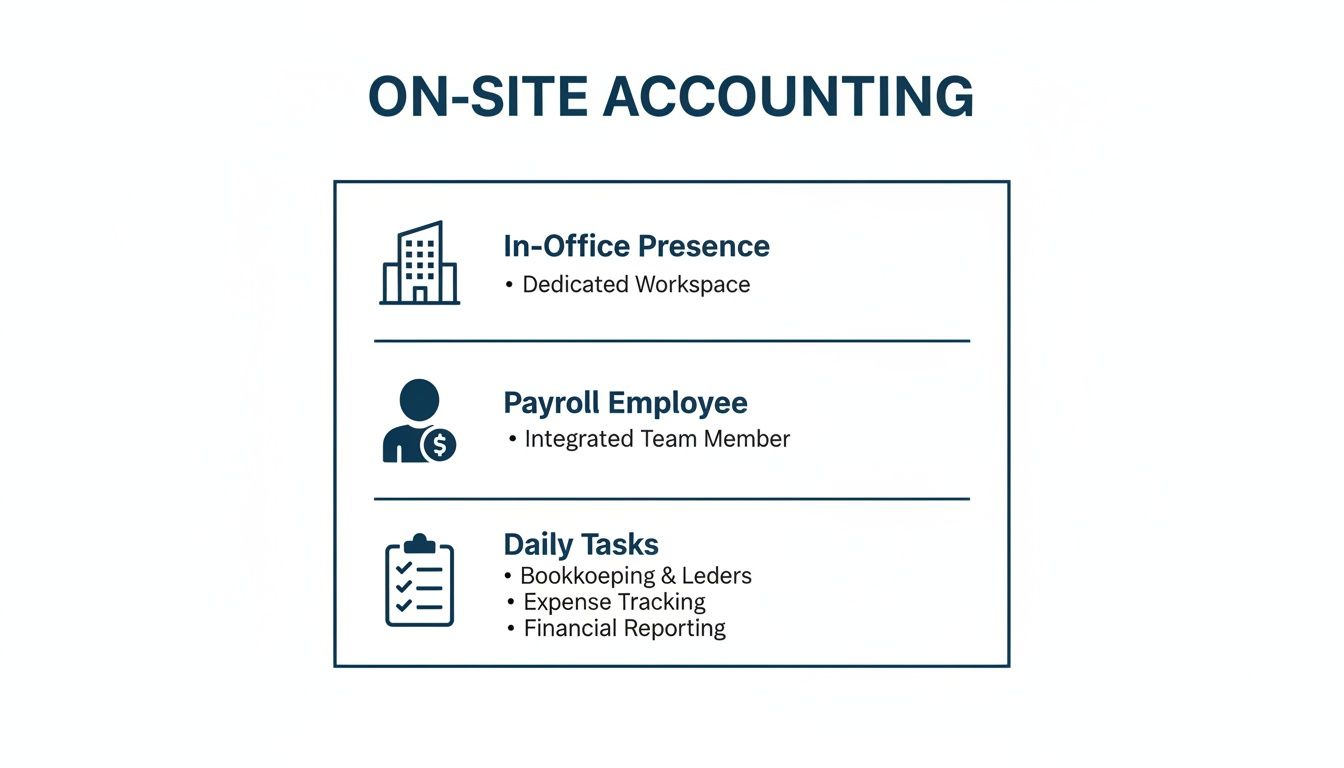
As you can see, the on-site accountant is a W-2 employee in your office who handles the daily money tasks. It’s a simple, traditional way to do things.
Responsiveness and Scalability
How fast do you need answers? An on-site person is right there, which seems great. But what happens when they’re sick, on vacation, or swamped with work? Suddenly, your "instant" access is gone. A remote team is different. They set up systems so someone is always available to help, so your business doesn't get stuck waiting on one person.
Now, think about growth. If your business suddenly gets much busier, that one on-site accountant will be buried in work. Hiring another person is slow and expensive. A remote firm, however, can add or reduce services almost instantly as your business changes. You get a flexible partner that grows with you.
On-Site vs. Remote Accounting: A Practical Comparison
To make this super clear, let's compare them side-by-side. Imagine you run a small marketing agency. You need someone to send invoices and do payroll, but you also really want advice on how to price your services to make more profit.
- The On-Site Model: You hire a full-time bookkeeper. They’re great at the daily stuff, but they don't have the experience to give you strategic pricing advice. You're paying a full salary but only getting half of what you need.
- The Remote Model: You partner with a remote firm like MyOfficeOps. Your dedicated team handles all the bookkeeping perfectly. Plus, you get a part-time expert who meets with you regularly to review your profits and help you with your pricing strategy.
This table gives you a simple, side-by-side look to help you see the differences for your own business.
| Factor | On-Site Accounting | Remote Accounting (e.g., MyOfficeOps) |
|---|---|---|
| Cost | Full salary + benefits + overhead | Predictable, fixed monthly fee |
| Expertise | Limited to one person's skills | Access to a full team (bookkeeper, controller, CFO) |
| Availability | Depends on one person's schedule | Team-based, so someone is always available |
| Scalability | Slow and expensive; requires hiring more people | Easy and quick to adjust services as you grow |
Looking at the comparison, it’s clear the "right" choice depends on what your business needs now and in the future. For many growing companies, the flexibility and deep knowledge of a remote team offer a big advantage that an on-site accountant just can't match.
The True Cost Of An In-House Accountant

Let's talk about one of the biggest mistakes I see business owners make when they think about hiring for on site accounting. They look at the salary, budget for that amount, and think they're all set.
But here’s the truth: that salary is just the beginning. An in-house accountant is a regular employee, and that means a lot of extra costs that can surprise you.
Beyond The Salary
Think of it like this: a bookkeeper with a $60,000 annual salary doesn't actually cost you $60,000. Not even close. Once you add in all the other required costs, that number goes up—fast.
Here are some of the “hidden” costs you need to plan for:
- Payroll Taxes: You have to pay your share of Social Security and Medicare taxes, which adds up.
- Health Insurance & Benefits: To get and keep good employees, you need a good benefits package. This can add thousands of dollars per employee each year.
- Paid Time Off (PTO): You're paying your accountant even when they're on vacation, sick, or on a holiday.
- Retirement Plans: If you offer a 401(k), you also have to add in any money the company contributes.
When you do the math, that $60,000 bookkeeper can easily end up costing your business over $75,000 per year. That's a 25% increase before you’ve even bought them a desk.
An on-site employee needs a desk, a computer, and expensive accounting software. A remote service comes with a clear monthly fee, and you get a whole team’s knowledge without the cost of another employee.
The Full Financial Picture
It’s important to look at the whole cost, not just the salary. Hidden costs like training, software, and office space add a lot to the true cost of an in-house team. This is a common problem, whether you're hiring for IT, marketing, or finance.
This is all happening as the accounting services market is growing quickly, expected to reach $1,275.84 billion by 2033. This growth shows that businesses know expert accounting is a key investment for success.
The question for business owners is no longer if you need expert financial help, but what's the smartest way to get it. You can learn more by reviewing the full analysis of the accounting services market.
Choosing The Right Model For Your Industry
The idea that all businesses have the same financial needs is just wrong. The right accounting setup for a marketing agency is usually the wrong one for a construction company or a doctor's office.
When you’re comparing on site accounting to a remote partner, the question isn’t which one is “better.” It’s about which one is the right tool for your industry and your specific problems.
Take a construction company. Their whole business depends on job costing. They need to know if a project is making money, down to the last penny. A general accountant in your office might be good at daily tasks, but have they ever dealt with the mess of change orders, retainage, or tracking costs across a dozen job sites? A specialized remote firm that only works with builders has seen it all and can give you advice that prevents costly mistakes.
Healthcare Practices
Now, what about a doctor's office or a clinic? Their financial world is a puzzle of insurance bills, patient payments, and strict HIPAA privacy rules.
- Key Challenge: Dealing with a maze of insurance codes and getting paid for every service.
- On-Site Pro: An in-house biller knows your practice well and has a personal connection with your patients.
- Remote Pro: A specialized healthcare accounting team knows the ins and outs of many insurance companies. They can spot payment trends or billing mistakes much better, and their data security is often way stronger than what a small office can build itself.
For any healthcare practice, a billing mistake isn’t just lost money—it can be a huge legal problem. The right accounting partner has to be a true expert in this field, not just someone who is good with numbers.
The most important question isn't "Do I want someone in the office?" It's "Do I have the special knowledge my industry needs?" An on-site accountant is convenient, but a specialized remote team gives you deep, industry-specific knowledge that can be much more valuable.
Professional Services Firms
Let’s look at a marketing agency, a law firm, or an IT consultant. For these businesses, the money story is about managing client payments, tracking hours worked, and understanding which projects are profitable.
A marketing agency, for example, might be handling dozens of monthly client fees. An on-site accountant can send the invoices, but can they advise you on how to change your prices to make more profit? Can they build a financial plan that tells you exactly when to hire another designer?
This is where a remote team with a high-level advisor often shines. They give you the kind of strategic advice that goes far beyond basic bookkeeping. The decision really comes down to whether you need someone to do financial tasks or a strategic partner who can help you grow.
A Simple Checklist To Help You Decide
If you’re trying to decide between on-site and remote accounting, you're not the only one. The best way forward isn't to find a single "right" answer, but to figure out what’s right for your business, right now.
Let's cut through the noise. Forget the fancy accounting words for a minute and be honest about what you actually need.
Getting Honest About What You Really Need
Start by thinking about what you're comfortable with and what's most important to you. There are no wrong answers here, just what’s true for you and your company.
- How much does having someone physically in the office matter to you? Be honest—if seeing your accountant down the hall makes you feel better, that’s a big point for the on-site option.
- Is saving money your absolute top priority? If your budget is the main thing driving your decision, a remote model will almost always be cheaper than a full-time employee with benefits.
- What are your plans for growth? If you’re planning to grow fast, a remote firm can grow with you instantly. A single on-site accountant can get overwhelmed quickly, which creates a new problem right when you need to focus on your business.
- Do you need high-level advice, or just someone to manage the daily books? This is a big one. Are you looking for someone to just handle transactions, or a partner who can help you make big decisions about the future?
This decision is also affected by how much technology has changed the job. The accounting software market is growing, expected to go from USD 22.72 billion to USD 37.34 billion by 2030. This tech means the job is no longer about typing in numbers by hand. A great partner, whether in your office or remote, has to be an expert at using these tools to give you real-time information. You can find the full research about the accounting software market for more details.
Think of it like this: are you buying a calculator or a financial guide? One just gives you the numbers. The other helps you understand what they mean and what to do next.
Key Questions for Any Potential Partner
Whether you’re interviewing a person for an on site accounting job or meeting with a remote firm, you need to ask the same tough questions. This is the only way to compare your options fairly. For more guidance, our detailed guide on how to find a bookkeeper is a great resource.
Here are the key questions I would ask:
- What experience do you have in my industry, and what are the common money problems you see?
- How will you do more than just make my financial reports—how will you help me understand them?
- Who will be my main contact, and what's the backup plan if they're sick or on vacation?
- If my business grows quickly, how do you handle the extra work?
- What's your process for finding mistakes or warning me about cash flow problems before they become big issues?
Going through this checklist will help you sort out your thoughts and make a choice you feel good about—one that truly helps your business grow.
When A Hybrid Approach Is The Smartest Choice

The choice between hiring an in-house accountant and outsourcing to a remote firm often feels like you have to pick one or the other. Business owners think it's all or nothing, but I've found that the best approach is often one that combines both.
A hybrid model isn't a compromise; it's a smart plan to get the best of both worlds. Imagine having the feel of an in-house team without the full-time cost. That's what a modern remote finance partner offers—they become a real part of your business, not just another company you hired.
Getting The Best Of Both Worlds
Here’s what this looks like. Many businesses keep someone in the office—maybe a trusted office manager or bookkeeper—to handle the daily, hands-on tasks. They’re right there to deposit checks, manage paper files, and answer quick questions from the team.
At the same time, you hire a remote firm for the bigger tasks. This team gives you high-level oversight, cleans up the books, and provides financial reports you can actually use. When you call, a real person who knows your business answers, ready to give you clear advice.
This setup gives you a powerful balance. You get the in-person support that makes your day-to-day work run smoothly, plus the deep knowledge of a full financial team focused on your growth.
A hybrid setup isn't about replacing your people; it's about supporting them. It lets your in-house staff focus on what they do best while a remote team provides the high-level strategy needed to grow.
A Flexible Fit For Your Exact Needs
The real power of a hybrid approach is its flexibility. It’s not a one-size-fits-all service. Instead, it’s shaped to what your business needs right now—and what it will need in the future.
- Need Basic Support? A remote team can deliver solid bookkeeping and payroll, making sure your numbers are always right and on time. This frees up your on-site person from getting stuck doing reconciliations.
- Need to Grow? As your business gets bigger, that same remote team can give you higher-level advice. They can help you figure out how to price new services, when to hire your next employee, or how to manage your cash during a slow season.
- Need to Exit? Thinking about selling your business someday? A remote partner can help you get ready, preparing your financials to get the best price when you're ready to sell.
This isn’t just about hiring someone to do the math. It's about finding a real partner who helps you understand what the numbers mean for your future. If you're curious about how this high-level support works, you can explore more about part-time CFO services and see how strategic guidance can change your business.
Frequently Asked Questions
When business owners are considering their options, the same few questions always pop up. These are the things I hear all the time from smart leaders trying to make the best choice. Let’s answer them directly.
Is On-Site Accounting More Secure Than Remote Accounting?
This is a big misunderstanding. Security isn’t about where your accountant sits; it’s about the systems used to protect your information. In fact, a good remote firm often has much stronger security—like data encryption and multi-factor authentication—than a small business can build on its own.
Think about it this way: the bigger risk is often one on-site accounting person who has access to everything. A professional remote firm separates duties, so no single person has total control. This is naturally a safer way to work.
Can A Remote Accountant Really Understand My Business?
Absolutely. A great remote partner makes it their job to know your business inside and out. It’s not just about numbers; it’s about understanding the story behind them.
Through regular calls, performance reviews, and clear communication, they become a dedicated part of your team. They learn your goals, your problems, and your vision for the future—all without needing a desk in your office. The best ones are proactive, meaning they look for problems before they happen.
What If I Already Have A Bookkeeper?
That’s a great start. This is a very common and effective setup that we call a hybrid model. Your on-site bookkeeper can keep handling the daily tasks and immediate needs of the business.
A remote accounting partner then comes in to provide the high-level oversight, strategic financial analysis, and advice that you’re missing. This setup frees up your staff to focus on what they do best while giving you the big-picture insights you need to grow your business. It's the best of both worlds.
Ready to get clarity on your finances and build a smarter growth plan? MyOfficeOps provides the expert bookkeeping and advisory support you need without the overhead of a full-time hire. Schedule your free discovery call with us today.