
A team member asks for five days off. Another has a dentist appointment next week. Your office manager says someone still has old sick days from last year. Payroll asks whether unused time gets paid out if a person leaves.
That is when a lot of owners realize they do not have a leave policy. They have habits, side conversations, and a few lines in the handbook that no one fully trusts.
The question of personal time off vs vacation sounds simple. It is not. This choice affects payroll, scheduling, morale, and your balance sheet. It also changes how employees behave. Some policies make people take real breaks. Others push people to save every hour “just in case.”
Small business owners feel this more than larger companies do. In a ten-person firm, one person being out changes deadlines. In a clinic, it affects patient flow. In construction, it can throw off the week.
Time Off Requests Are Here Is Your Policy Ready?
A lot of leave problems start with a normal request.
An employee says, “I need next Thursday and Friday off.” You want to say yes, but then the questions pile up. Is this vacation? Personal time? Sick leave? Did they already use too much? Do you handle this the same way for everyone else?

When policy is vague, managers make judgment calls. That is where trouble starts. One employee gets flexibility. Another hears no. Payroll records time one way. HR explains it another way. By the end of the quarter, no one is sure what the company offers.
What vague policies usually look like
You have probably seen one of these:
- Verbal approvals: A manager says “that’s fine” in Slack or in the hallway, but nothing gets tracked clearly.
- Mixed buckets: Vacation, personal days, and sick time exist, but employees do not know the difference.
- Old rules: The handbook says one thing, while payroll software says another.
- Culture problems: People technically have time off, but they feel bad using it.
That last point matters more than many owners think. American workers on average leave 55% of their paid time off unused, resulting in 236 million forfeited days and $65.5 billion in lost benefits annually (U.S. Travel Association). Offering leave is not the same as having a policy people use.
A leave policy is not just a rulebook. It is an operating system for staffing, payroll, and fairness.
If your process is still handled by email threads and memory, a simple guide on managing an employee time off request can help tighten the front end before bigger issues hit payroll.
If you also need a plain-English breakdown of policy basics, this internal resource is useful: https://myofficeops.com/resources/pto-and-sick-leave/
Understanding the Two Flavors of Paid Leave
The easiest way to understand this is to think about a restaurant.
A traditional vacation policy is like ordering à la carte. Vacation days are one item. Sick days are another. Personal days may be separate too. Each bucket has its own rules.
A PTO policy is like a buffet. The employee gets one combined bank of paid time and can use it for different reasons.
Traditional vacation is separate by design
With a vacation policy, time off is labeled.
Vacation is usually meant for planned breaks. Sick time is for illness or appointments. Personal days may cover family needs, errands, or other events. This gives the employer more structure and better visibility into why time is being used.
That can be helpful in businesses where coverage matters a lot. If you run a clinic or a job site, it helps to know whether an absence was planned well in advance or happened the same morning.
Traditional policies also send a message. Vacation exists for rest. That sounds soft, but it changes behavior. Employees are more likely to take actual breaks when vacation is its own category.
PTO puts everything in one bank
With PTO, the company combines some or all paid leave into one pool.
An employee may use it for a trip, a sick child, a doctor visit, or a day to handle personal matters. They do not need to sort each hour into a separate box. That is why many owners like it. It is simpler to explain, simpler to track, and usually simpler to run through payroll.
Across employers, 46% have adopted consolidated PTO policies across verified policies tracked by benchmark data (bnchmrk). That tells you this is not a niche model.
For a broader plain-English walkthrough, this complete guide to Paid Time Off gives a useful overview of how these plans work in practice.
The main difference is not just flexibility
Owners often frame this as “simple vs old-fashioned.” That is too shallow. The key difference is this:
- Traditional vacation: better category control
- PTO: better employee flexibility
- Traditional vacation: easier to protect true rest time
- PTO: easier administration
Neither one is automatically better. The right answer depends on how your team works, how often schedules change, and how closely you need to manage financial liability.
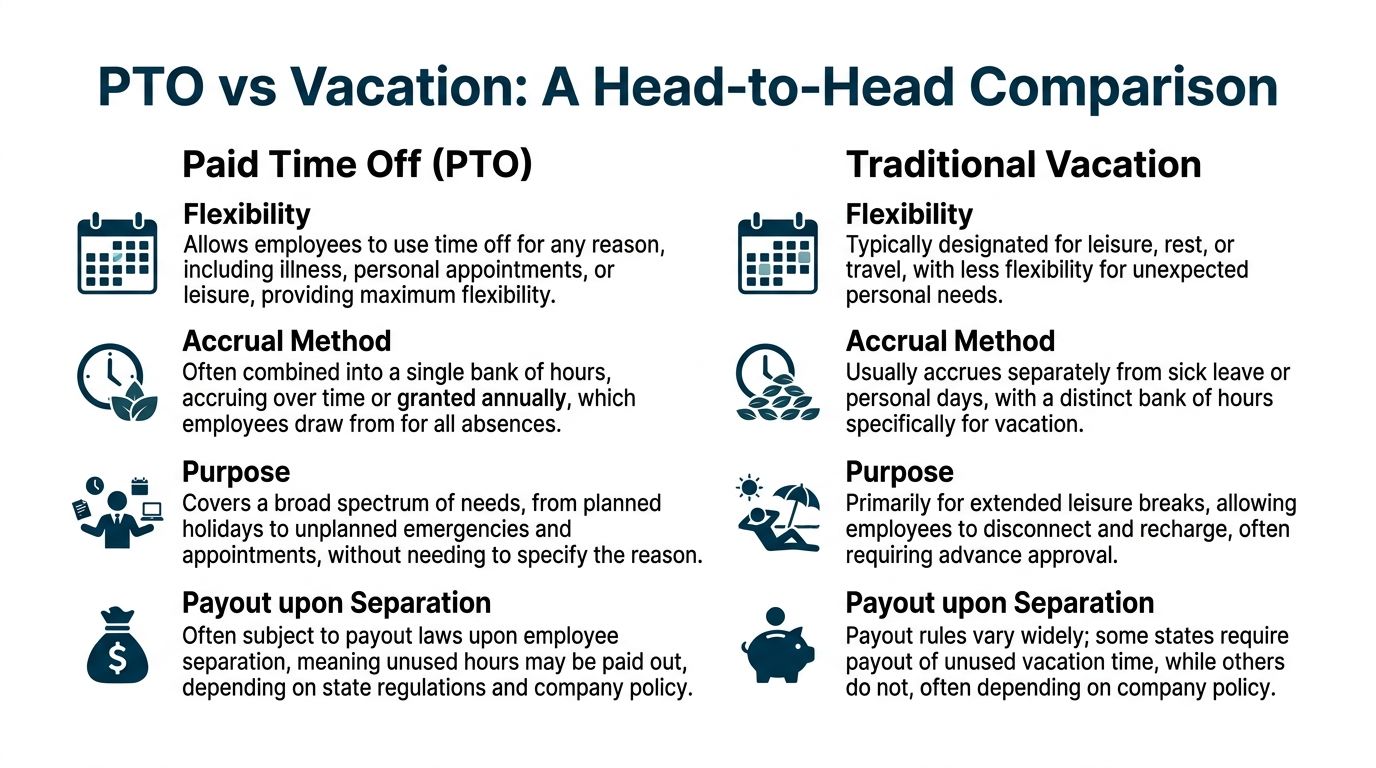
PTO vs Vacation A Head-to-Head Comparison
Before getting into payroll and accounting, it helps to compare the two side by side.
Here is the quick version.
| Attribute | Personal Time Off (PTO) | Traditional Vacation Policy |
|---|---|---|
| Structure | One combined bank for time away | Separate buckets for vacation, sick, and sometimes personal days |
| Employee flexibility | High. Employees can use time for many reasons | Lower. Time usually must match the category |
| Admin effort | Easier to track in one system | More tracking and more policy rules |
| Visibility for managers | Less detail on type of leave | More detail on leave purpose |
| Use for real rest | Can get diluted if employees save time for illness | Often better at protecting actual vacation time |
| Payout risk | Can create broader payout exposure depending on state law and policy | Often more controlled if only vacation is payable |
| Best fit | Office-based teams, flexible scheduling, simpler operations | Businesses needing tighter staffing control or clearer leave categories |
Flexibility for employees
PTO wins on flexibility.
An employee does not have to decide whether an absence is “vacation” or “personal.” They just request time. This is one reason many service firms prefer it. Fewer rules means fewer small disputes.
Traditional vacation is tighter. That can feel rigid. But in some businesses, rigid is good. If your team needs to plan around client deadlines, patient loads, or field crews, separate categories can reduce confusion.
PTO is easier for the employee in the moment. Vacation policies are easier for the company when it needs to plan around different kinds of absences.
Administrative burden
PTO usually shines here.
One bank is easier to load into Gusto, Rippling, QuickBooks Payroll, ADP, or Paychex. Payroll has fewer categories to monitor. Managers do not spend as much time asking which type of leave applies.
Traditional vacation creates more admin work. You need rules for accrual, carryover, approval, and payout by category. You also need someone to maintain consistency. In a small company, that job often lands on whoever is already overloaded.
Still, “more admin” is not the same as “bad.” If separate buckets help you run the business better, the extra setup can be worth it.
Financial implications
Owners need to slow down here.
Combined PTO can be more expensive if unused balances build up and must be paid out later. It can also be harder to control if employees treat the bank as a stored cash value. With separate vacation policies, companies often have more room to cap or define payout exposure, depending on state law and the written policy.
Unlimited PTO sounds like a clean way around accrual, but it has a different issue. It often creates ambiguity. People are not sure what is acceptable, so they may take less time than expected.
Industry benchmark data shows professional services has a 78% combined PTO adoption rate, while unlimited PTO is prevalent in 57% of tech companies. Consolidated PTO plans average 14 days after one year, scaling to 23 after 20 years, often outpacing non-consolidated plans at key tenure milestones (Workstatus).
That works in some sectors. It is not always ideal for a smaller business that needs tight control over leave balances and staffing.
Company culture and employee behavior
Policy design shapes behavior more than most owners expect.
With PTO, some employees appreciate the freedom. Others hoard time because they are worried they will need it for sickness later. That can mean fewer real vacations.
With traditional vacation, the company makes a clearer statement that rest matters. Vacation is for stepping away. Sick time is for health. Personal days are for life admin. That separation can make employees more willing to use leave for its intended purpose.
A practical summary
If you want simpler administration and a cleaner employee experience, PTO usually wins.
If you want stronger guardrails, better planning, and clearer control over how leave is used, traditional vacation often wins.
Many owners do best when they stop looking for the “modern” answer and start looking for the one their payroll team, managers, and employees can follow.
How Paid Leave Impacts Your Payroll and Balance Sheet
Most leave articles stop at employee preference. That misses the part owners feel in the bank account.
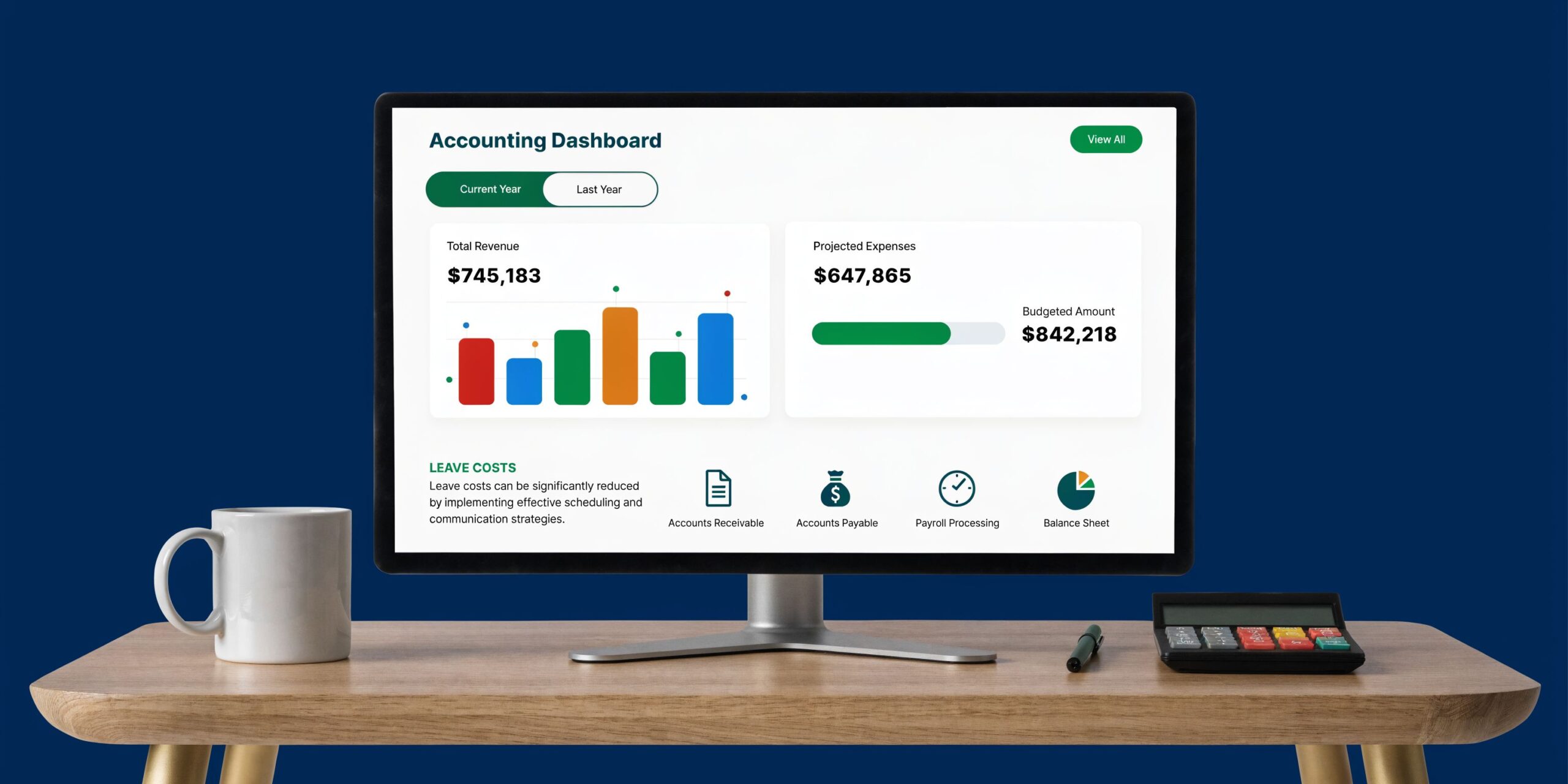
Unused paid leave can become a liability. If your policy says employees earn time and you owe payment under your policy or state law, that obligation sits in the background until someone uses it or leaves.
Why owners get surprised
The problem usually shows up in one of three moments:
- An employee resigns and expects unused time to be paid.
- Year-end reporting shows a larger accrued leave balance than expected.
- A fast-growing team racks up unused hours while managers keep delaying time off requests.
This is why leave policy is not just an HR issue. It affects payroll expense timing, accrued liabilities, and cash planning.
PTO can build a larger liability
Some analyses show PTO accrual can grow by 5% to 15% annually on the balance sheet if unused, and a 2023 SHRM study found companies with PTO policies faced 20% higher payout costs at turnover compared with companies using traditional vacation caps (Rippling).
That does not mean PTO is bad. It means you need to budget for the behavior it creates.
If employees see PTO as one valuable bank they can cash out later, many will protect it. The liability grows without clear visibility. Then one departure, or a few departures in the same quarter, turns that paper number into a real cash event.
A leave balance is not just a scheduling issue. It is money you may owe later.
Separate policies can be easier to forecast
Traditional vacation plans often give the finance side more control.
If vacation accrues separately, and sick time has different rules, you can forecast exposure more clearly. You can also see patterns sooner. For example, if vacation balances keep climbing but sick usage stays normal, the problem may be workload or manager behavior rather than weak attendance.
This matters in service businesses where labor costs drive margin. If you bill by the hour, delayed vacation can pile up during busy seasons and hit your books at the worst possible time.
What to track every month
If you want fewer surprises, track leave the same way you track other obligations.
Use a monthly review that includes:
- Accrued balance by employee: hours and estimated dollar value
- Usage trend by department: who is taking time and who is not
- Upcoming payout risk: employees with large balances and signs of turnover
- Policy exceptions: manual approvals, off-book promises, or old grandfathered terms
Your payroll system should feed this into accounting cleanly. If it does not, the problem is not just the policy. It is the process.
For owners cleaning up that workflow, this resource on payroll setup can help connect policy, software, and reporting: https://myofficeops.com/resources/how-to-set-up-payroll-for-small-business/
Pennsylvania owners need written clarity
In Pennsylvania, the key issue is not a state mandate that tells every employer exactly how to structure PTO or vacation. The issue is whether your written policy is clear and consistently applied.
That means payout language matters. Accrual rules matter. Carryover rules matter. If your handbook says one thing and payroll does another, you create avoidable risk.
A clean leave policy should answer these questions in plain language:
- Does time accrue or is it front-loaded?
- What rolls over, if anything?
- What gets paid out at separation?
- Who approves time off and how far in advance?
- Are there blackout periods or minimum staffing rules?
When owners tighten those answers, the financial side gets easier fast.
Which Leave Policy Fits Your Business Best?
A manager approves two time-off requests on Friday. By Monday, one employee calls out sick, another gives notice, and payroll is now carrying a larger payout risk than anyone expected. That is the point where leave policy stops being an HR preference and becomes a cash flow decision.

There is no single winner in personal time off vs vacation. The right fit depends on how you schedule labor, how easily you can cover absences, and how much accrued leave you are willing to carry on the books.
I usually tell owners to start with one question. Does an absence mainly create a scheduling problem, or a financial one? In service businesses, it often creates both. A policy that looks simple for employees can still create messy accruals, surprise payouts, and uneven staffing if it does not match how the business operates.
Professional services
Law firms, agencies, IT providers, consultants, and accounting firms often do well with PTO.
The reason is practical. Work is project-based, employees are often salaried, and teams can usually redistribute work with notice. A single bank is easier to explain, easier to approve, and usually easier to run through payroll. If you are reviewing options, this guide to best payroll software for small business can help you compare systems that track accruals and approvals cleanly.
PTO also creates a trade-off. In professional services, high performers often save too much time because they do not want to disrupt client work. That pushes the liability higher over time. If you use PTO in this kind of business, set caps, review balances quarterly, and make managers responsible for encouraging real time off before the balance becomes an accounting problem.
PTO usually fits best when:
- client work is scheduled in advance
- employees have flexibility in how they complete work
- teammates can cover accounts or projects
- leadership wants fewer leave categories to track
Healthcare practices and clinics
Clinics, dental offices, and other healthcare practices usually need more structure.
Separate vacation and sick time often works better because planned leave and unplanned illness affect operations differently. If a hygienist, nurse, or front-desk lead is out unexpectedly, the cost shows up fast in rescheduling, overtime, and patient experience. A combined PTO bank can blur that line and make staffing harder to predict.
This approach is often the safer choice when:
- appointments are booked tightly
- licensed roles are hard to replace on short notice
- patient coverage depends on fixed staffing
- the practice needs cleaner reporting on absence patterns
There is also a balance sheet angle. In a clinic with low turnover, a combined PTO bank can build into a sizable accrued liability if employees hold time for emergencies instead of taking vacations. Separate buckets can reduce that buildup, depending on how accrual and payout rules are written.
Construction and trades
Construction, HVAC, electrical, plumbing, and similar field businesses usually need rules that protect schedule reliability first.
Traditional vacation policies often fit better because crews need predictable staffing and many shops have clear busy seasons. If several field employees draw from one PTO bank whenever they choose, the owner ends up solving labor gaps with overtime, subcontractors, or delayed jobs. That cost is real, even if the policy looked flexible on paper.
A more structured policy helps control:
- peak-season blackout periods
- notice requirements for planned leave
- crew coverage by role or certification
- payout exposure when turnover spikes
Office staff inside the same company may still be better served by PTO. Using different leave structures for different groups can work well if eligibility, accruals, and payout terms are written clearly and applied consistently.
The best leave policy is the one your operation can support without manual workarounds, surprise payouts, or chronic understaffing.
A practical decision test
Choose PTO if your business runs on autonomy, cross-coverage, and relatively flexible scheduling.
Choose separate vacation, and usually separate sick time, if your business runs on fixed appointments, licensed coverage, shift precision, or seasonal labor pressure.
Choose a hybrid model if your office team and front-line team work in very different ways. That approach takes more setup, but it can reduce both scheduling friction and leave liability if payroll and policy are aligned.
How to Implement and Manage Your New Leave Policy
A policy can look great in a handbook and still fail in real life.
That usually happens for one of two reasons. The wording is too vague, or the culture tells employees not to use the benefit.
Some reporting has linked low PTO use to higher burnout, and one contrarian view argues that separate vacation policies can outperform PTO in usage because they normalize true leisure time (Paycor). That matters because a policy only works if people understand it and feel safe using it.
Write the policy like payroll has to use it
If a sentence can be read two ways, someone will read it the expensive way.
Keep the language direct. Your written policy should answer the operational questions first, not bury them in legal filler.
Include clear terms for:
- How time is earned: accrual by pay period, by hours worked, or annual grant
- When time can be used: immediately, after a waiting period, or after accrual
- How requests are made: through software like Gusto, Rippling, BambooHR, ADP, or another approved system
- What happens at separation: whether unused time is paid out, and under what conditions
A short sample line is often better than a long paragraph. Example: “Vacation requests of more than one day must be submitted through the payroll system and approved by the direct manager in advance.”
Train managers before you announce anything
Most leave problems are not policy problems. They are manager inconsistency problems.
One supervisor says yes to everything. Another makes employees feel guilty. A third forgets to approve requests on time. That is how resentment starts.
Talk managers through common situations:
- An employee requests planned vacation during a busy week.
- Someone calls out sick after using most of their PTO.
- Two key employees request overlapping time off.
- A worker asks whether unused time gets paid at resignation.
The manager should not guess. They should know.
If managers freelance the policy, employees stop trusting the policy.
Build the process inside your payroll stack
Do not manage leave in a spreadsheet if payroll runs somewhere else.
Use one source of truth. If your team uses QuickBooks Payroll, ADP, Paychex, Rippling, or Gusto, set up accruals, approval paths, and reporting there. Then make sure accounting sees the same balances finance is relying on.
If you are comparing systems, this guide to payroll tools is a useful starting point: https://myofficeops.com/resources/best-payroll-software-for-small-business/
Make time off normal
This is the part most companies skip.
If leaders never take vacation, staff notice. If people answer messages from the beach, staff notice that too. If every request is met with “can this wait until next month,” the policy becomes fake.
A healthier pattern looks like this:
- Leaders model it: owners and managers take time off and disconnect
- Requests get answered quickly: delay creates anxiety
- Coverage gets planned: work gets reassigned before the leave starts
- Balances are reviewed: employees with large unused banks get encouraged to schedule time
In a small business, culture is not abstract. It is what your managers reward and what your employees believe will happen if they step away.
Our Final Recommendation for Your Business
If you want the short answer, here it is.
Choose PTO when your business values flexibility, your work can be covered without major disruption, and your payroll team needs a simpler structure.
Choose traditional vacation when scheduling is tight, absences affect operations directly, and you want more control over leave categories and payout exposure.
If you are a service-based business with salaried staff and fluid workflows, PTO often makes daily administration easier. If you run a clinic, a field team, or any operation where coverage is hard to replace, separate vacation and sick time usually creates fewer problems.
The bigger point is this. The best policy is not the one that sounds most modern. It is the one that is clear, written down, tracked inside payroll, and applied the same way every time.
A bad PTO policy creates confusion fast. A bad vacation policy does the same. The structure matters, but execution matters more.
When owners get this right, three things improve at once:
- employees know what they can use
- managers know how to approve it
- finance knows what the business owes
That is the core value of a good leave policy. It protects people, but it also protects the company from preventable cash surprises and messy payroll disputes.
If you are deciding between personal time off vs vacation, start with your operation, not trends. Look at staffing coverage. Review payout language. Check how your payroll system handles accruals. Then pick the policy your business can manage well.
If you want help turning that choice into a clean, workable policy, MyOfficeOps can help. Their team supports small and midsize businesses with bookkeeping, payroll integration, financial reporting, and CFO-level guidance so your leave policy works on paper and in your numbers.