
You know the feeling. Revenue looks decent. Money is coming in. But when you sit down to answer simple questions like “Are we making money?” or “Why does cash still feel tight?” the numbers get fuzzy fast.
That usually happens when bookkeeping lives in a few different places. Some of it is in QuickBooks. Some is in email. Some is in your head. Bills get paid late, invoices go out slower than they should, and the monthly reports show up too late to help you make decisions.
That’s the gap companies like ignite spot accounting are trying to fill. They promise a remote accounting department that keeps the books clean, closes the month, and gives owners reports they can use. For a lot of small and midsize businesses, that sounds like relief.
But there’s a real trade-off here too. If you’re in the Philadelphia area, you may not just want clean books. You may want someone who answers the phone, knows your market, and can talk through an urgent issue before lunch. That’s where this gets more interesting than a simple software-and-price comparison.
What Is Ignite Spot Accounting Anyway?
You usually start looking at a firm like Ignite Spot after a frustrating month. The books are late. Cash feels tighter than it should. You ask a simple question about margins or payroll timing and nobody can give you a clean answer.
Ignite Spot is an outsourced accounting firm that works with small and midsize businesses on a remote basis. The core offer is straightforward. They take over recurring accounting work and pair it with higher-level financial support, so the owner is not stuck chasing reports, cleaning up transactions, or trying to interpret half-finished numbers alone.
What business owners are buying here is accountability around the finance function. If the current setup depends on a part-time bookkeeper, an office manager with too many jobs, or the owner checking QuickBooks at night, Ignite Spot is offering a more structured alternative.
That can be a real relief. It can also be a trade-off.
A remote firm can bring process, coverage, and a defined workflow. But if you are the kind of owner who wants to call someone who knows your business, your market, and the people behind the numbers, the experience can feel less personal than working with a local partner. That matters in Philadelphia more than some firms admit. A lot of owners here want clean books, but they also want responsiveness, context, and a relationship that feels close at hand.
What they’re really selling
Ignite Spot sells an outsourced accounting relationship built around routine financial management and decision support.
In practice, that usually means help with the work that tends to break down first inside a growing company. Bills pile up. Invoices go out late. Reconciliations slip. Month-end drags. Then the reports arrive too late to be useful.
The value is not the bookkeeping by itself. The value is getting timely numbers you can use to run the business.
Owners usually want answers to practical questions like:
- Cash flow: What is coming in, what is going out, and where is the squeeze?
- Profitability: Which customers, jobs, or service lines are making money?
- Ownership: Who is keeping the accounting process on track without pulling me back into it?
If you are still deciding whether this type of service fits your business, this guide on outsourced accounting for small business gives helpful context before you compare firms.
Good accounting should reduce uncertainty. If your reports leave you guessing, the setup is not doing its job.
That is the right lens for evaluating Ignite Spot. Look past the marketing language and ask a simpler question. Will this model give you accurate numbers, useful communication, and the level of responsiveness you want?
How Their Outsourced Accounting Model Works
A lot of owners hit the same wall here. The books are technically getting done, but no one feels fully in charge. Bills sit too long, month-end closes drag out, and simple questions turn into email chains.
Ignite Spot’s model is built to solve that with a remote team and a defined process. The appeal is consistency. Work is assigned through a shared system, the accounting tasks follow a standard rhythm, and the client is expected to operate inside that structure.
In practical terms, the service usually covers the repeatable finance work that growing businesses struggle to keep current:
- Bookkeeping: recording bills, invoices, expenses, deposits, and reconciliations
- A/P support: helping manage vendor payments and approval flow
- A/R support: invoicing customers and keeping collections from slipping
- Monthly close: cleaning up accounts and producing financial statements
- Reporting: turning the books into management reports and budget tracking
That setup works well for owners who want a clean online workflow and are comfortable using shared software. It is often less satisfying for owners who want the feel of a nearby accounting partner, especially if they like picking up the phone and getting a fast answer from someone who already knows the business. Around Philadelphia, that local-style responsiveness still matters to a lot of companies, and it is one of the biggest differences between a national remote model and a more hands-on regional firm.
If you are comparing those approaches, it helps to understand what on-site accounting support looks like in practice. The day-to-day communication can be very different.
What onboarding probably looks like
Ignite Spot describes its work through an Accounting Playbook, which suggests a structured onboarding process rather than a loose handoff. That is usually a good sign. Outsourced accounting goes better when roles, timelines, document flow, and review points are set early.
A typical rollout for a firm using this kind of model often looks like this:
| Phase | What happens | Why it matters |
|---|---|---|
| Setup | Software connections, access gathering, and process mapping | The firm needs clean access before it can take real ownership |
| Cleanup and alignment | Historical issues get identified, accounts are organized, and recurring workflows are assigned | This is where many accounting relationships either stabilize or start slipping |
| Ongoing monthly rhythm | Transactions are processed, accounts reconciled, and reports delivered on a recurring schedule | Owners start getting numbers on a timetable they can actually use |
That timeline is realistic. Good transitions take time, especially if the books are messy at the start or the business has weak internal habits.
Where the model works, and where it can feel thin
This model tends to work best for companies that are process-friendly. Documents get uploaded on time. Approvals happen in a predictable way. The owner wants visibility, but not constant customization.
It tends to feel thinner in businesses that run on exceptions. Construction companies with shifting job costs, agencies with irregular client billing, or founder-led businesses where every payment needs discussion often want more back-and-forth than a standardized remote workflow naturally provides.
That does not make Ignite Spot a poor option. It just means the fit matters.
From a practitioner’s perspective, this is the key question to ask before signing. Do you want a structured remote accounting team, or do you want a closer advisory relationship that feels more local and immediately reachable? If you are in the Philadelphia area and responsiveness is high on your list, that distinction deserves more weight than the sales pitch usually gives it.
Decoding Ignite Spot Pricing and Plans
A lot of owners get frustrated here. The proposal says one monthly number, then the quote changes after the firm sees payroll volume, old cleanup issues, or how many accounts need attention.
Ignite Spot does publish starting prices, which is better than firms that make you book a call just to get a range. As noted earlier, the public offer frames bookkeeping and fractional CFO support with entry-level monthly pricing and a no-long-term-contract structure. That gives you a starting point, not a working budget.
The part that matters is how fast the price moves once your business stops looking simple on paper.
A service business with one entity, a clean QuickBooks file, and predictable monthly activity may land close to the floor. A Philadelphia contractor with job costing issues, weekly payroll, multiple credit cards, and owners who want quicker answers usually will not. That is not a knock on Ignite Spot. It is how outsourced accounting pricing works across the market.
What those starting prices actually mean
Starting prices tell you the minimum scope the firm is willing to support. They do not tell you what your company will pay after onboarding review.
In practice, quotes usually rise for four reasons:
- Volume of activity: More transactions, bills, invoices, deposits, and bank feeds create more bookkeeping work.
- Complexity of the books: Multiple entities, loans, classes, cleanup work, or weak prior-year records increase review time.
- Level of support: Basic bookkeeping costs less than bookkeeping plus controller oversight or CFO guidance.
- Management expectations: Standard monthly reports are one thing. Frequent interpretation, custom reporting, and real planning support cost more.
That last point gets missed a lot.
Some owners are happy with clean books and a monthly packet. Others want to call someone, talk through cash flow, and get a straight answer before they hire, buy equipment, or adjust pricing. If you want that second relationship, especially if you are used to a local-style firm that feels more reachable, compare service access as carefully as you compare price.
What good value looks like
Monthly accounting fees should remove friction inside the business. They should also reduce avoidable mistakes.
A fair monthly fee usually ties to clear deliverables:
| If you’re paying for | You should be getting |
|---|---|
| Bookkeeping | Accurate transaction coding, reconciliations, and a dependable monthly close |
| Controller-level help | Review, cleanup discipline, and clearer financial reporting |
| CFO support | Cash flow guidance, planning help, and decision support |
If the proposal sounds broad but the deliverables stay vague, press for specifics. Ask how quickly books are closed, who reviews the work, what reports arrive each month, and how questions are handled between scheduled meetings.
The contract terms matter, but fit matters more
The no-long-term-contract piece is one of the stronger parts of the offer. It lowers the risk if the relationship feels too distant or the reporting never becomes useful.
Still, flexibility on paper does not fix a weak working relationship. A lower monthly fee can get expensive fast if reports come late, errors sit unresolved, or you cannot reach the right person when something needs attention. That is often the trade-off between a larger remote model and a more local accounting partner.
The practical question is simple. Are you buying basic monthly output, or are you paying for financial clarity with response times and support that match how your business runs?
The Ideal Client for the Ignite Spot Model
Not every business owner wants the same kind of accounting partner. Some want a team they can message online, send documents to, and meet with on a steady monthly cadence. Others want someone they can call when a payroll issue blows up at 8:30 in the morning.
Ignite Spot looks like a better fit for the first group.

Who tends to fit well
The model makes sense for businesses that are already comfortable with cloud software and documented workflows.
That usually includes companies in areas Ignite Spot regularly mentions, such as:
- Professional services
- Healthcare
- Construction
- Real estate
These businesses often need consistent monthly reporting, invoice and bill support, and a reliable close process more than they need in-person meetings.
The right mindset matters
The ideal client for ignite spot accounting usually wants order more than hand-holding.
That owner is often thinking:
- “I need the books done right every month.”
- “I want online access to everything.”
- “I’m fine working through software, tasks, and scheduled check-ins.”
- “I don’t need someone sitting in my office.”
That’s a legitimate preference. A lot of strong businesses run very well that way.
Who may feel friction
A different type of owner may find a remote national model limiting.
That includes someone who:
- wants immediate phone support for urgent issues
- needs heavy advisory help tied to local market conditions
- runs a business with unusual industry workflows
- expects their accounting partner to join operational conversations often
For example, a contractor may need someone who can help sort out job profitability in plain language. A healthcare practice may care more about workflow around billing and compliance questions than a standard monthly package can handle. The issue isn’t that a remote firm can’t help. It’s that the fit gets weaker when the business needs more nuance than the standard model is built for.
If your main need is dependable monthly accounting, a process-driven remote firm can work well. If your main need is real-time judgment, the gap starts to show.
That’s why “good firm” and “good fit” are not the same thing. Ignite Spot may be a solid option for the right client and still be the wrong answer for a business that wants a local-style relationship.
The Real Strengths and Weaknesses
Ignite Spot is easier to judge when you stop asking whether it’s “good” in the abstract and start asking where the model helps and where it can fall short.
Where Ignite Spot shines
The biggest strength is structure.
A lot of small businesses don’t need a creative accounting solution. They need a repeatable one. Ignite Spot’s model appears built for that. Standard tools. Standard onboarding. Standard close process. That kind of consistency can clean up a lot of avoidable mess.
Their public materials also make a few things clear:
- U.S.-based staffing: They say the work is handled by certified professionals in Utah, without re-outsourcing.
- Software familiarity: They work with known tools like QuickBooks, Rippling, Bill, Ramp, and Gusto.
- Defined workflow: The 90-day setup gives owners a practical timeline instead of vague promises.
- Remote collaboration: Their system is designed for tasking, chat, and report review in one online environment.
For an owner who’s tired of chasing a part-time bookkeeper, that can be a real upgrade.
Potential blind spots
The weak point is not bookkeeping quality by itself. It’s whether a national process can adapt to the messy details of your business.
A few pressure points stand out.
First, industry depth may matter more than many owners realize. A construction company doesn’t just need clean books. It may need strong thinking around job profitability and cost tracking. A healthcare practice may care about financial workflows that connect to billing realities. Public materials around Ignite Spot leave some of those industry-specific details less clear.
Second, there’s the relationship issue. Ignite Spot’s online system may feel efficient. It may also feel distant if you’re the kind of owner who wants direct, fast conversation when something urgent lands.
Third, geography can matter even in a remote world. Philadelphia-area businesses often still value local rhythm. They want support that feels close, even if some work is done virtually.
A fair summary of the trade-off
Here’s the plain version.
| Strength | Why it helps | Possible downside |
|---|---|---|
| Standardized process | Less chaos, more consistency | Can feel rigid for unusual businesses |
| Remote delivery | Easy to scale, software-friendly | Can feel less personal |
| Broad SMB focus | Useful for common accounting needs | May not go deep enough in niche cases |
Good outsourced accounting should remove friction, not create a new kind of distance.
That’s the core trade-off with ignite spot accounting. If what you need is reliable process, they look built for it. If what you need is a partner who feels woven into the daily life of the business, you may want to compare carefully.
Ignite Spot vs Local Partners like MyOfficeOps
It usually comes to a head on a busy weekday morning. A payment is stuck, payroll needs approval, or you need a clean number before talking to a lender. In that moment, the question is not whether outsourced accounting works. It is whether your accounting partner works the way you do.
The real difference is access
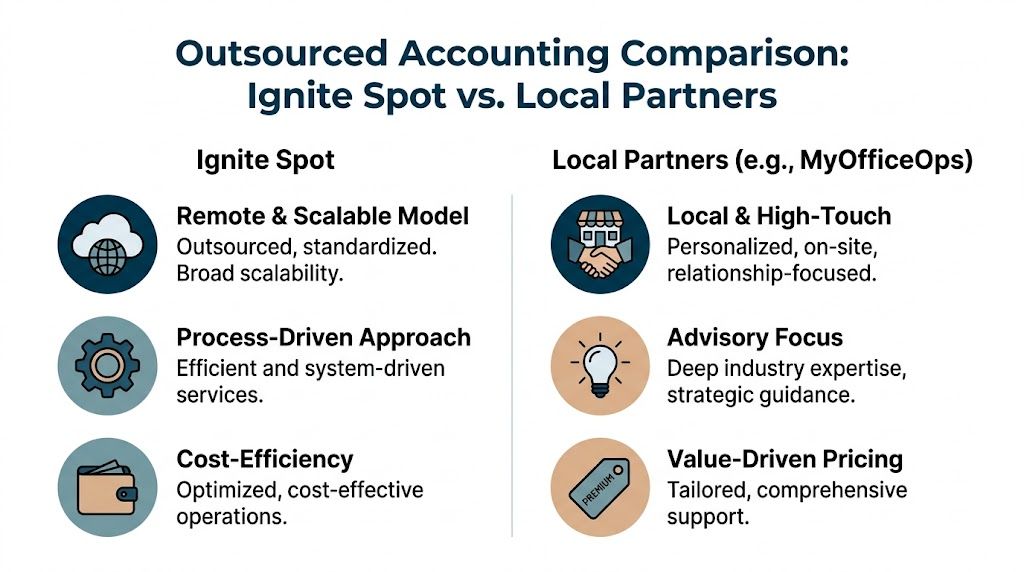
Ignite Spot appears built around a remote delivery model with defined processes, shared systems, and scheduled communication. For some owners, that is a good fit. If you like structure, keep most conversations inside software, and do not need frequent live discussion, that model can work well.
A local partner such as MyOfficeOps usually wins on access and context. You are more likely to get direct contact, quicker back-and-forth, and advice shaped by how businesses in this area operate. For many Philadelphia owners, that matters more than a polished portal.
Here is the practical side-by-side view:
| Decision area | Ignite Spot style | Local partner style |
|---|---|---|
| Day-to-day communication | Scheduled touchpoints and online workflows | Direct calls, faster replies, more relationship-driven contact |
| Service approach | Process-first, standardized delivery | Flexible support shaped around the client |
| Owner involvement | Works best if you are comfortable using systems and waiting for review cycles | Works best if you want discussion in real time |
| Local business context | Broad small business support | Better fit for owners who want a partner who understands the Philadelphia market |
Why local still matters in a remote service
Plenty of accounting work can be done from anywhere. The issue is not location by itself. The issue is responsiveness, judgment, and how much explanation your team has to give every time something unusual happens.
That is where the Philadelphia lens matters. Owners here often want remote convenience, but they still expect quick answers, plain talk, and a partner who understands the pace of East Coast business hours. A remote national firm may still meet that standard. It just should be tested, not assumed.
I have seen this point decide the whole relationship. If your bookkeeper is technically accurate but hard to reach, you still feel unsupported.
Local partnership usually shows up in small moments
A local-style firm often feels different in ways that are easy to miss during a sales call:
- You spend less time explaining the business
- Urgent issues are easier to discuss by phone
- Advice is more likely to connect with hiring, vendor, and cash flow decisions nearby
- Meetings tend to feel like business conversations, not status updates
If you are still comparing providers, this guide on how to find a bookkeeper that fits your business is a useful filter before you commit.
It also helps to separate accounting from adjacent services. If a provider discussion starts blending payroll, HR, and back-office support into one package, read this breakdown of PEO vs Payroll Service so you know what you are buying.
Which option tends to work better
Ignite Spot may be the better fit if your business mainly needs consistency, cleaner month-end work, and a structured remote process.
A local partner often makes more sense if the books are only part of the problem. That is common with growing companies. They need someone who can answer quickly, explain the numbers plainly, and stay close to what is happening in the business week to week.
For Philadelphia-area owners who value a responsive, local-style relationship, that difference is not cosmetic. It changes how supported you feel when the pressure is on.
Asking the Right Questions Before You Sign Up
Most owners ask the wrong first question.
They ask, “How much does it cost?” That matters, but it’s rarely the question that tells you whether the relationship will work. A better question is, “What happens when my business hits a problem on a Tuesday morning?”

Questions that reveal the real fit
Use these when you talk to Ignite Spot or any outsourced accounting firm.
Who will work on my account?
Ask for the day-to-day contact, their role, and how review happens above them. You want to know whether you’re getting one person, a team, or a handoff chain.How do you handle urgent issues?
Don’t accept a soft answer. Ask what happens with payroll problems, bill-pay emergencies, or time-sensitive owner questions.What does onboarding require from my team?
A good process still needs client participation. Find out what documents, access, and decision-making they’ll need from you.How do you measure success for a company like mine?
This is a big one. A BooksTime review points out a critical question many owners miss: how pricing and KPIs scale for specific industries like construction and healthcare, where things like job profitability or billing compliance may not fit a standard package on BooksTime’s Ignite Spot article.
Questions about industry knowledge
If you’re in a specialized field, keep digging.
Ask things like:
- Construction firms: How do you think about job profitability and project-level reporting?
- Healthcare practices: How do you support financial workflows around billing-heavy operations?
- Professional services: What do your reports show me about utilization, margin, or client mix?
- Real estate businesses: How do you handle entity complexity and owner reporting expectations?
If the answers stay generic, pay attention. Generic accounting can still produce clean books. It usually won’t produce sharp management insight.
Questions about training and standards
You also want to understand how the team stays current. Accounting quality isn’t just about software. It’s about people keeping their judgment sharp.
If you want a plain-English primer before that conversation, this short guide to CPE credit explains how continuing education works for accounting professionals.
And if you’re still early in the process, this article on how to find a bookkeeper gives a solid framework for evaluating options before you commit.
A short checklist you can keep
| Ask this | Why it matters |
|---|---|
| Who is my contact? | You need clarity on ownership and communication |
| What happens in an urgent situation? | This exposes service reality, not marketing language |
| How do you handle my industry? | Specialized businesses need more than clean categorization |
| How do your reports help me make decisions? | Reports should lead to action, not just file storage |
“Can you keep my books clean?” is the baseline. “Can you help me run the business better?” is the real question.
That one separates vendors from partners.
Your Next Step to Financial Clarity
It usually comes to a head on a Tuesday afternoon. Payroll is due, your P&L still is not telling you what you need to know, and you are trying to decide whether the problem is the books, the reporting, or the firm behind both.
That is the moment to get honest about the kind of help you want.
Ignite Spot can be a solid fit for owners who prefer a structured, remote accounting model with consistent monthly processes and straightforward reporting. For some businesses, that is enough. They want reliable books, a set review cycle, and fewer accounting fires.
For other owners, especially those who are used to texting a local advisor or picking up the phone when something changes fast, the gap shows up in responsiveness and day-to-day collaboration. I see this often with Philadelphia-area businesses. They are not only buying bookkeeping. They are looking for a partner who can talk through a hiring decision, a cash crunch, or a pricing problem while it is still unfolding.
That difference matters more than a feature list.
The real decision
Choose the model that matches how you run the business.
If you want a firm that handles the monthly work cleanly, uses cloud tools well, and keeps a defined cadence, Ignite Spot may check the box.
If you want quicker back-and-forth, more context around local operations, and a relationship that feels closer to an in-house finance partner, a local-style team may serve you better.
Both approaches can work. Problems start when an owner expects strategic, highly responsive support from a model built for process consistency first.
What to do next
Write down your top three finance problems before you book another call.
Make them specific. Late closes. Weak job-costing. Payroll errors. No visibility into margins. Reports that look fine but do not help you make decisions.
Then use those issues to test fit. Ask how the firm would handle your exact situation, who you would hear from when something is urgent, and what a good first 90 days would look like. Strong firms answer clearly and with examples. Weak ones stay broad.
A good accounting partner should reduce stress, improve decisions, and make you trust the numbers you are using to run the business. If you do not hear a clear path to those outcomes, keep looking.
If you want a more responsive, Philadelphia-area accounting partner that combines bookkeeping, reporting, payroll integration, and practical CFO-level guidance, take a look at MyOfficeOps. Their team works with small and midsize businesses that want clean books, clear reports, and real support on the decisions behind the numbers.