
You know that feeling when money is coming in, bills are going out, payroll is around the corner, and you still can’t answer one basic question.
Are we doing okay?
That’s where a lot of small business owners in Greater Philadelphia get stuck. The work is moving. Clients are calling. Jobs are getting done. But the numbers are messy, late, or spread across a bank feed, a credit card portal, and a few half-finished spreadsheets.
If you run a service business, that problem gets bigger fast. A law firm can look busy and still miss profit targets. A healthcare practice can have solid patient volume and still feel squeezed by payroll and overhead. A contractor can land a great job and still hit a cash crunch because material costs and labor hit before the customer pays.
Good financial advice for small businesses isn’t about fancy reports. It’s about helping you make better decisions with clear information. You need clean books, steady cash flow, a spending plan you’ll use, and a way to know if your pricing, hiring, and long-term strategy make sense.
Your Starting Point Stop Guessing and Start Tracking
Most owners don’t need a lecture on accounting. They need a simple way to stop feeling behind.
Bookkeeping is that starting point. Think of it as a map. If the map is wrong, every decision after that gets harder. You don’t know where your money is going, which jobs make money, or whether your business is healthy or just active.
That confusion is common. Only 54% of small business owners say they had a good grasp of financial management before starting, and 42% say they had limited or no financial literacy at all, according to QuickBooks' financial literacy statistics for small business owners. That doesn’t mean you can’t run a strong business. It means you need a system that makes the numbers easier to use.
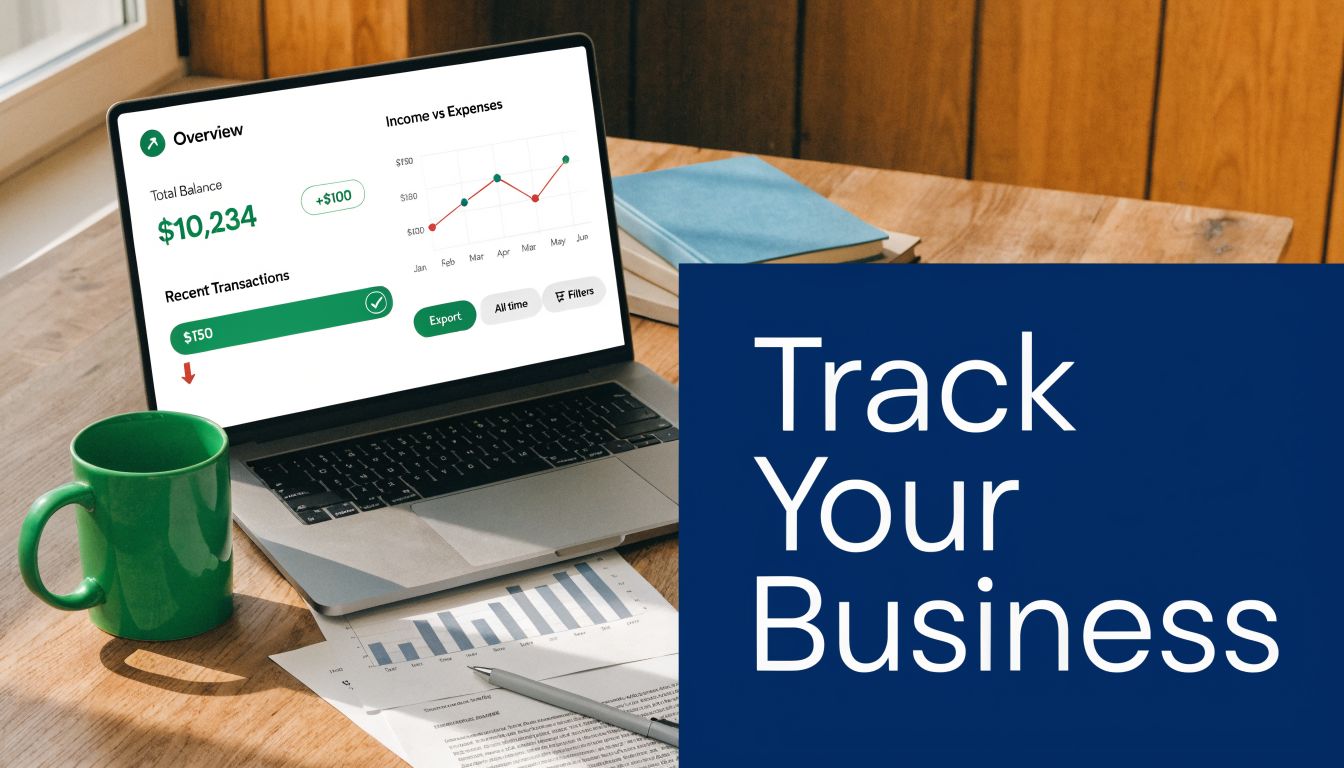
Start with separation
If business and personal spending still mix in one account, fix that first. Open a business checking account if you haven’t already. Use one business credit card for business purchases only.
This sounds basic because it is. It also fixes a lot of problems at once. Categorizing gets easier. Tax prep gets easier. You stop wasting time trying to remember whether that restaurant charge was a client lunch or your family dinner.
Practical rule: If you have to guess what a transaction was for three months later, your system is too loose.
Choose one home for your numbers
For most small service businesses, simple beats clever. Pick one accounting system and commit to it. QuickBooks is a common fit because it connects to banks, lets you organize transactions, and gives you a usable set of reports without a lot of setup.
A lot of owners delay this because they think they need to “get caught up” first. You don’t. Start where you are. Clean up the old months one by one, but get the system running now.
If you need a basic guide on how to track business expenses effectively, that resource is useful because it walks through the habits that keep records clean before tax season turns into a scramble.
Put a weekly date on the calendar
Don’t wait until month-end. Give yourself a short block each week to review and categorize transactions. That one habit keeps the books from turning into a mess again.
A simple weekly routine looks like this:
- Review bank and credit card activity from the past week.
- Categorize each transaction while it’s still fresh.
- Flag anything unclear so you can ask your office manager, partner, or bookkeeper right away.
- Check for missing invoices or receipts before they disappear.
- Look at one number that matters to you, such as cash in the bank or accounts receivable.
Here’s the point. Good bookkeeping is not about becoming a math person. It’s about building a clean record so you can answer plain questions fast.
A Philly-area agency owner might ask, “Which clients make us money?” A medical practice owner might ask, “Why does payroll feel heavier this quarter?” A contractor might ask, “Did that job really earn what we thought it would?” Clean books give you a shot at real answers.
If you want a practical next read, this guide to bookkeeping for small business owners is a good place to tighten up the basics.
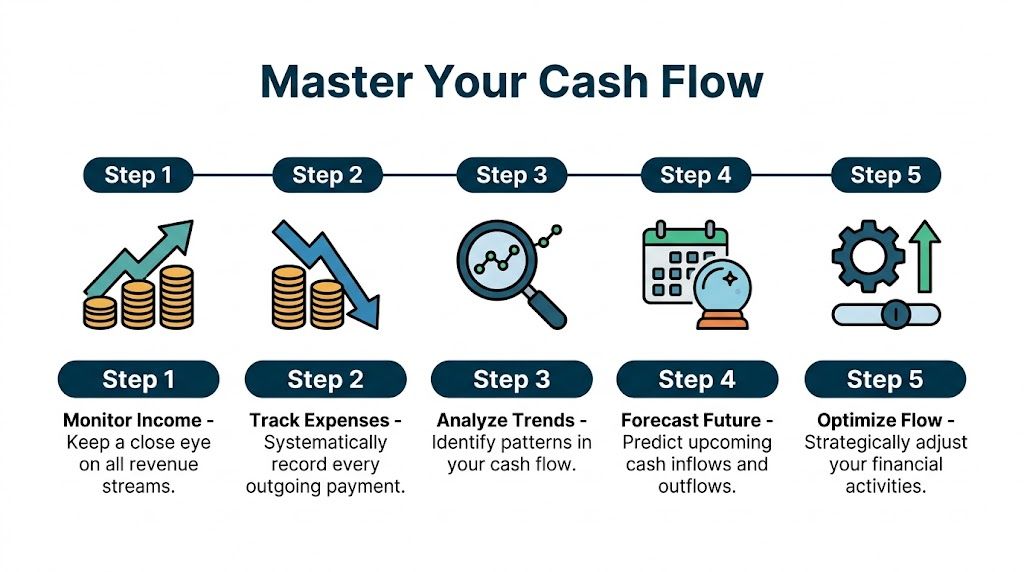
Master Your Cash Flow So You Can Sleep at Night
Profit matters. Cash timing matters more in the short term.
A business can look fine on paper and still run into trouble if cash shows up too late. That’s why cash flow is where many owners lose sleep. Payroll is due Friday. A customer pays next Tuesday. The vendor wants a deposit now. That gap is where stress lives.
One tool fixes a lot of that uncertainty. A rolling 13-week cash flow forecast gives you a week-by-week view of what’s coming in, what’s going out, and when you might get squeezed. When updated weekly, it can improve liquidity management by 30% to 50%, and a key first step is setting a minimum cash reserve often benchmarked at 1 to 2 months of operating expenses, based on Ford Keast’s guidance on managing small business cash flow.
What it looks like in real life
Take a construction company in the Philadelphia area. They order materials in week five for a large job. Payroll continues every week. The customer won’t pay the next draw until week eight.
Without a forecast, the owner feels that problem only when the checking account drops. With a forecast, the owner sees the pinch three weeks earlier and has time to act. They might speed up invoicing, ask for a deposit sooner, delay a non-urgent purchase, or talk with a vendor before terms become a problem.
The same thing happens in professional services. A marketing agency may finish work this month, invoice at month-end, and not get paid until much later. Revenue exists. Cash doesn’t.
If your business feels busy but cash still feels tight, the issue is often timing, not effort.
Build a basic 13-week view
You don’t need a perfect model to start. You need a useful one.
Use a spreadsheet or your accounting software and break the next 13 weeks into columns. Then list the money likely to come in and the money that must go out.
Include these categories:
| Week by week item | What to include |
|---|---|
| Cash in | customer payments, retainers, insurance reimbursements, loan proceeds if applicable |
| Payroll | wages, taxes, benefits |
| Vendors | materials, subcontractors, software, supplies |
| Fixed costs | rent, utilities, insurance, debt payments |
| Owner draws | planned distributions, if any |
Then ask three questions.
- What must be paid no matter what
- What is likely to come in, not just hoped for
- Which week drops below our comfort level
That last one matters most.
What owners usually get wrong
A few patterns show up over and over:
- They use monthly totals only. Monthly reports hide short-term problems. Cash trouble usually happens inside the month.
- They trust invoices instead of payment dates. An invoice sent is not cash received.
- They skip weekly updates. A forecast gets stale quickly if nobody touches it.
- They ignore reserves. If every dollar has a job before it lands, there’s no cushion when timing slips.
A short weekly review changes that. This resource on cash flow management strategies can help if you want a clearer rhythm for keeping the forecast current.
Create a Spending Plan That Actually Works
A lot of owners hate the word “budget.” They hear it and think restriction. Freeze spending. Cut everything. Say no more often.
That’s not how a good budget works in a healthy business. A useful budget is a spending plan. It gives you permission to invest in the right things because you’ve already looked at the numbers.
That difference matters when you run a service business. In healthcare, you may be weighing a new piece of equipment, software, or a front-desk hire. In construction, you may need another truck, a project manager, or updated field technology. In professional services, you may want to bring on an account manager before the team burns out.
The point of budgeting is not to stop those moves. The point is to make them on purpose.

Static budget versus living forecast
A static budget says, “Here’s the year.” Then real life happens.
A forecast says, “Here’s what we expected, here’s what changed, and here’s what we do now.” That approach is more useful for owner-led businesses because demand, staffing, and expenses rarely behave exactly as planned.
Firms that use KPI dashboards to drive financial forecasts can see margin improvements of 15% to 35%, and one key measure is the cash flow coverage ratio, which should ideally stay above 1.5x, based on American Bank’s overview of cash flow forecasting and KPI dashboards.
That doesn’t mean you need a giant reporting package. It means you need a few numbers that help you decide confidently.
The spending plan I’d want in front of me
If you own a healthcare practice and you’re considering new equipment, I’d want these items on one page:
- Current monthly revenue trend
- Expected monthly overhead
- Payroll obligations
- Debt payments
- The cash impact of the new equipment
- The expected operational benefit
Then I’d ask a simple question. If revenue comes in a little light for a stretch, does this purchase still make sense?
That’s where many owners get relief. They stop asking, “Can we afford it today?” and start asking, “Can we afford it without creating pressure next quarter?”
A budget should give you confidence to spend. If it only tells you what to cut, it’s incomplete.
Keep it simple enough to use
A good spending plan usually includes three buckets.
| Bucket | What belongs there |
|---|---|
| Must pay | payroll, rent, insurance, debt, taxes |
| Growth spend | marketing, hiring, equipment, training |
| Nice to have | lower-priority tools, upgrades, discretionary spending |
Once those buckets are visible, decisions get clearer. If a new expense lands, you can ask whether it protects operations, drives growth, or just adds clutter.
For owners who need a starting template, this guide on how to create a business budget lays out a practical approach without making it overly technical.
Use Your Numbers to Price and Hire with Confidence
Two decisions cause more second-guessing than almost anything else. What should we charge, and when should we hire?
Most owners make those calls with a mix of instinct, market pressure, and hope. That’s understandable. It’s also risky, especially now. In 2025, 75% of small businesses said rising costs of goods, services, and wages were their top financial challenge, according to Kaplan’s 2025 small business statistics roundup.
When costs rise, vague pricing and emotional hiring get expensive fast.

Pricing needs job data, not just market talk
Take an IT consulting firm. They may have a standard hourly rate, but that rate alone doesn’t tell the whole story. Some clients create clean work with fast approvals. Others drag projects out, add meetings, and create rework.
If you track time, direct costs, and collection speed by client or project, patterns show up. One client may look great on revenue and weak on profit. Another may be modest in size and strong in margin because the work is efficient and the client pays quickly.
That’s how pricing gets better. Not by copying competitors. By seeing what your own work costs.
Here are useful questions to ask before changing rates:
- Which clients take the most time outside the original scope
- Which services tie up your staff but don’t produce enough margin
- Which customers pay slowly and create cash pressure
- Where are you underpricing because you’ve never measured delivery time well
A lot of service businesses discover they don’t have a sales problem. They have a packaging and pricing problem.
Hiring should pass a simple test
Hiring too late burns out your team. Hiring too early strains cash. The answer usually sits in the middle.
For a law firm, agency, or clinic, I like to tie hiring decisions to workload and cash visibility together. Don’t hire just because everyone feels busy. Busy can be temporary. Hire when your books, forecast, and sales pipeline all point in the same direction.
Look for these signs:
| Hiring signal | What it means |
|---|---|
| Work is consistently delayed | capacity is likely too tight |
| Senior staff are doing basic tasks | your labor mix may be off |
| Sales are healthy but service quality is slipping | growth is starting to outrun delivery |
| Cash flow can support the role over time | the business may be ready |
Then define the role in financial terms. What revenue should this person support, protect, or help collect? If you can’t answer that clearly, you may not be ready yet.
The best hires usually solve a measurable problem. They free up billable time, improve collections, reduce errors, or help you serve more work at the same quality.
What works and what doesn’t
What works is boring. Track profitability by client, service line, or job. Review labor costs. Revisit rates before margin disappears. Tie hiring to capacity and cash, not stress alone.
What doesn’t work is setting prices once and leaving them untouched while wages, software, and vendor costs keep moving. The same goes for adding headcount because a few loud weeks made the office feel overwhelmed.
That’s the practical side of financial advice for small businesses. Your numbers should make hard calls easier, not harder.
Prepare Your Business for Its Next Chapter
A lot of owners hear “exit planning” and think, “That’s for later.”
Usually, later comes faster than expected. Health changes. Partners split. A buyer shows up. A family transition becomes real. Even if none of that happens soon, the habits that make a business sellable also make it easier to run now.
That’s why I tell owners to operate like the business should always be ready for a handoff. Not because you’re leaving tomorrow. Because it forces good discipline today.
A business with clean books, documented processes, stable reporting, and clear profitability is easier to manage. It’s also easier to finance, easier to delegate, and easier to value.
That matters because an estimated 70% of small businesses are undervalued by 15% to 25% during a sale, mainly because of unclean books and poor financial records, according to The American College’s discussion of small business advisory gaps.
Exit readiness helps even if you never sell
Think about what a buyer would want to see.
- Clean financial statements
- Reliable reporting
- Clear customer and revenue patterns
- Dependable operations that do not live only in your head
- A business that produces profit without constant rescue work from the owner
That list is also what a healthy business owner wants to see.
If you run a healthcare practice, that may mean cleaner reporting around provider productivity, payroll, and overhead. If you own a construction company, it may mean stronger job costing and fewer surprises in project margins. If you lead a professional services firm, it may mean showing which clients, teams, and service lines create value.
Build for optionality
You don’t need a buyer in the room to start acting like one might appear.
One practical move is to keep your records and reporting organized enough that someone outside the company could understand them. Another is to reduce the number of financial decisions that only you can make because the process lives in your memory.
That’s the deeper point. Exit planning is really value planning. It gives you more options later because you built a stronger business now.
Your Financial Future is in Your Hands
Most owners don’t need more noise. They need a clear path.
Start with the books. If your records are messy, you’re flying without instruments. Then get control of cash flow so you can see problems before they hit. Build a spending plan that helps you decide, not freeze. Use your numbers to shape pricing and hiring. Keep the business ready for its next chapter, even if that chapter is years away.
None of this requires you to become a CPA. It requires a system you trust and a rhythm you can maintain.
For service businesses in Greater Philadelphia, that matters even more. Your cash cycle, staffing model, and margins often depend on timing, utilization, and follow-through more than raw sales volume. A busy month can still be a weak month if the numbers underneath it aren’t clear.
That’s why practical financial advice for small businesses should feel simple and usable. You should be able to sit down, look at a few clean reports, and know what needs attention. You should know whether you can afford a hire, whether pricing needs to move, and whether cash will stay steady through the next few months.
There are different ways to get there. Some owners build the system themselves. Some use QuickBooks and a trusted CPA. Some work with an outsourced advisory team. In the Philadelphia market, MyOfficeOps is one example of a firm that provides bookkeeping, financial analytics, forecasting, and CFO-level advisory for service businesses that need clearer reporting and decision support.
What matters most is that you stop running the business by feel alone.
If your books are behind, start there. If cash feels tight, build the forecast. If hiring feels risky, run the numbers before you post the job. Small steps done consistently beat big financial cleanups done once a year.
If you own a business in Philadelphia, West Chester, or the surrounding area and want a clearer plan for your numbers, schedule a free Discovery Call with MyOfficeOps. We’ll talk through where you are now, what’s getting in the way, and what a practical next step looks like for your business.