
Let's be real, "bookkeeping" isn't the most exciting word. You probably didn't start a business to spend your days staring at numbers. But think of it this way: bookkeeping is like keeping score in a game. If you don't know the score, you can't tell if you're winning.
The goal isn't to become an accountant overnight. It’s to understand the story your money is telling you, day in and day out.
What Is Bookkeeping And Why It Matters
Bookkeeping is simply the habit of keeping track of every dollar that comes into and goes out of your business. It's the floor of your company's financial house. If that floor is wobbly, everything else—from paying your employees to planning for the future—gets shaky too.
This isn’t just about scrambling to get your numbers together for tax season. Good bookkeeping is how you answer the biggest question in business: are you really making money? Before you can get into the big picture stuff, you have to nail the bookkeeping basics for small business.
From Simple Records To Smart Decisions
I see this happen all the time. A small business feels busy, which is great, but the owner has no idea if all that work is actually making them money.
Imagine you run a small coffee shop. You're selling lots of lattes and the place is always full. But when you look at your bank account, it's not growing as fast as you'd think. Because you’ve been keeping good records, you check your expenses and spot a problem: the cost of your coffee beans has gone up by 20% in the last six months.
Without good books, you might have missed that. Now you can look for a new bean supplier, adjust your prices, and save your business thousands of dollars. That’s the real power of bookkeeping:
- It turns a mess of numbers into a clear story you can understand.
- It helps you find small problems before they turn into big ones.
- It gives you the facts you need to make smart choices with confidence.
This simple habit often separates the businesses that just get by from the ones that grow and succeed. It's how you know for sure when you can afford to hire help, buy new equipment, or finally give yourself a raise.
Bookkeeping isn't about being a math genius. It's about being a smart business owner who can read the story your numbers are telling.
Your Business In Numbers
Keeping track of your money becomes even more important as your business grows. For example, recent data showed that the average small business with one to nine employees brought in $48,270 in a single month.
Some businesses saw their income jump by an average of $1,900 in one month. Good bookkeeping is what lets you see that kind of growth, understand where it's coming from, and make sure it turns into actual profit in your pocket.
The Core Tasks of Good Bookkeeping
So, what does a bookkeeper actually do? Forget the big, scary words. It’s not as complicated as it seems, and it's the foundation of a healthy business.
At its heart, bookkeeping is about keeping a perfect record of every dollar that moves in and out of your company. This involves a few key jobs that turn a pile of receipts into a clear picture of your finances. Let's break them down.
Recording and Categorizing Transactions
The first and most important job is to record every single transaction. This means every sale you make and every penny you spend—from a big new machine down to a pack of pens for the office.
But just writing them down isn’t enough. Each transaction needs a label, or a category, like "Office Supplies," "Marketing," or "Sales." This simple step is what lets you see exactly where your money is going and where it's coming from. Putting things in the right category builds your chart of accounts, which is basically the filing system for all your money stuff. You can learn more about creating a chart of accounts in our guide.
Think of it like being a detective for your own business. You gather clues (the transactions) and sort them into files (the categories) to solve the mystery of whether you're making money.
The goal is to turn a random pile of receipts into an organized story that makes sense. Luckily, this is getting a lot easier. Over half of small businesses now use tools that help automate their bookkeeping, and most pros use accounting software every day. This means less time spent typing and more time understanding your business.
This simple flow chart says it all—you track your money to understand your finances, which then lets you make better decisions.
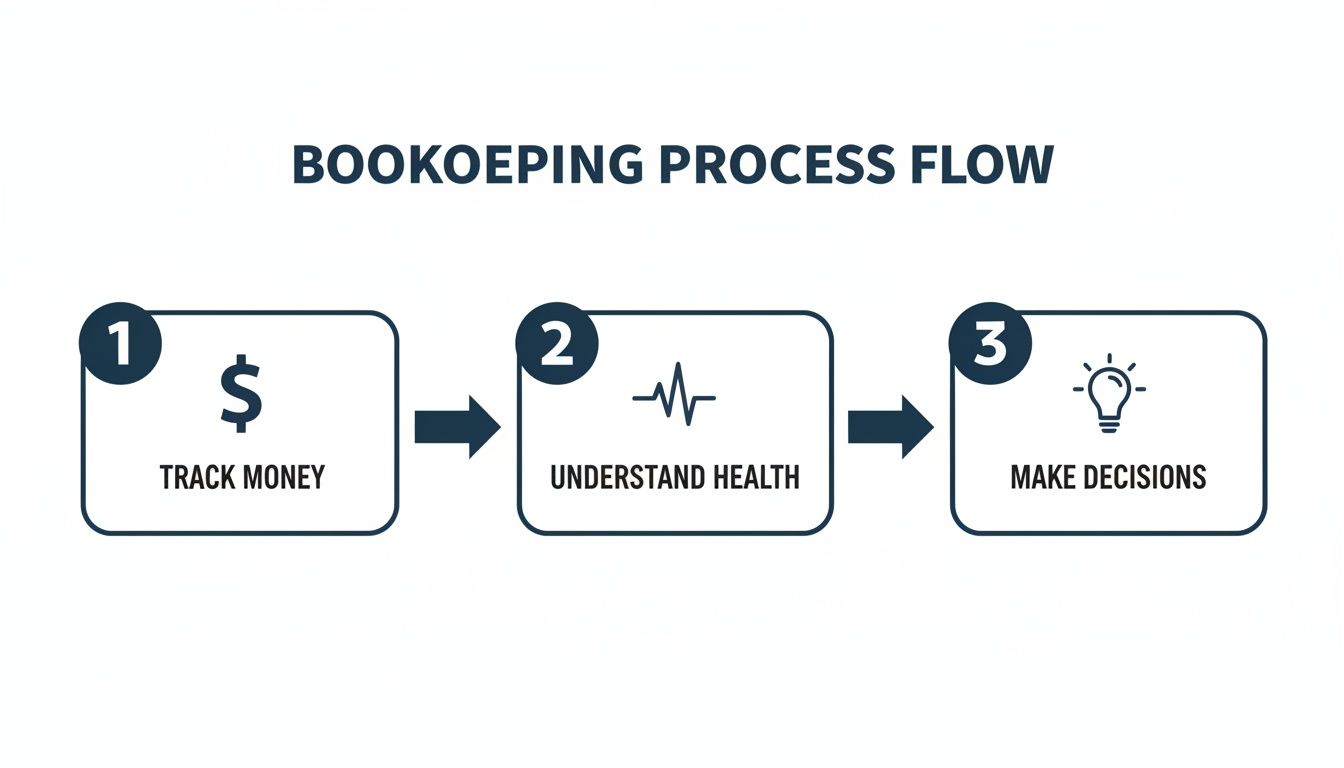
Tracking is just step one. The real magic happens when you use that information to make smart moves for your business.
Cash vs. Accrual Accounting
Another key part of bookkeeping is deciding when to record your money. This isn't a small detail; it changes how you see your company's health. There are two main ways to do it: cash and accrual.
- Cash Method: This one is simple. You record money only when it actually moves. You log a sale when a customer's payment hits your bank account, and you record a bill when you actually pay it.
- Accrual Method: This method records money when the deal is made, not when the cash moves. You log income as soon as you send an invoice and an expense as soon as you get a bill from someone.
Let's say you're a freelance web designer. You finish a website and send an invoice for $2,000. With the accrual method, you'd record that $2,000 as income the day you send the invoice. With the cash method, you'd only record the income on the day the client's payment actually lands in your bank account.
The accrual method gives a better picture of your long-term success, while the cash method is simpler and shows you how much cash you have right now.
Common Bookkeeping Mistakes to Avoid
Making mistakes is a normal part of running a business. But in bookkeeping, little mistakes can grow into big headaches. I've seen it happen too many times. Think of this as a friendly warning from someone who has spent a lot of time cleaning up these kinds of messes.
Learning to avoid these common mistakes early on is one of the best things you can do for your business.

Let's walk through the most common traps I see and, more importantly, how you can sidestep them starting today.
Mixing Business and Personal Finances
This is mistake number one, and it’s a huge one. When you buy a business lunch with your personal card or pay your electric bill from your business account, you're creating a tangled mess that’s hard and expensive to fix.
It makes it almost impossible to see if your business is actually making money. Even worse, it’s a big red flag for the IRS if you ever get audited.
- The Simple Fix: Open a separate business bank account and credit card today. From now on, every single dollar for your business goes through those accounts. No exceptions.
This one change creates a clean line between your personal life and your business, making everything else much, much easier.
Losing Receipts and Putting It Off
"I'll get to it later" is a dangerous phrase for a business owner. You toss receipts in a shoebox or let emails pile up, promising to sort them out at the end of the month. Soon, it's tax time, and you're stuck with a mountain of records to figure out.
Putting it off doesn't just create stress; it means you're running your business blind. You have no idea what your cash flow looks like or where your money is going, which is a risky way to operate.
I once worked with a designer who thought his business was killing it. He was busy and had lots of clients, but his books were a disaster. After we finally cleaned everything up, we found out that his most popular service was actually losing him money on every project.
That's a tough lesson, but an important one. Waiting doesn't just delay the work; it hides the truth about your business's health.
Putting Expenses in the Wrong Category
Putting an expense in the wrong "bucket" is another common mistake. You might accidentally label a software subscription as "Office Supplies" or a client dinner as "Travel." It seems small, but these little errors add up and give you a wrong picture of your business.
When things are in the wrong categories, your financial reports tell you a misleading story. You might think you're spending too much on supplies when that money is actually being used to find new customers.
- The Simple Fix: Make a simple list of categories for your business and stick to it. If you use software, take 30 minutes to set up rules that automatically sort your regular expenses, like rent or software bills. A little setup now saves hours of fixing things later.
Choosing the Right Bookkeeping Tools
You don’t have to be a tech expert to get your books in order. But picking the right tool is like choosing between writing a grocery list on a napkin and using an app on your phone. Both work at first, but one makes life a lot easier when things get busy.
For a new business with only a few sales, a simple spreadsheet might seem fine. The problem is, doing it all by hand gets overwhelming fast. You end up spending hours typing everything in, and one small typo can cause big problems.
This is where bookkeeping software changes the game. Tools like QuickBooks aren’t just for accountants anymore; they’re made for people like you. Their real power is that they do a lot of the work for you.
Software Makes Your Life Simpler
The biggest win with modern software is that it connects right to your business bank account. Instead of you typing in every coffee, supply run, or payment, the software pulls in that information for you automatically. Your only job is to check it and give it a category.
Good software also helps you with other important tasks:
- Professional Invoices: Create and send nice-looking invoices in just a few clicks, which helps you get paid faster.
- Simple Reports: See exactly where your money is going with one-click reports, like a Profit & Loss statement. No need to mess with complicated math.
- Time Savings: Automation gives you back hours every month that you can use to grow your business instead of getting stuck doing data entry.
Choosing software is about more than just tracking numbers; it's about building a system that saves you time, lowers your stress, and gives you the clarity to make good decisions.
There’s a reason so many new business tools are popping up. It's expected that more and more small businesses will start using smart tools to help them run things, and most believe it will help them make more money. This just shows how having the right tools, from bookkeeping to financial advice, is becoming key to success.
Finding the Right Fit for Your Business
Not all software is the same, and what you need depends on your business. A contractor needs to track costs for each job to see if it's making money. An online store owner needs to track how many products they have in stock. As you look at your options, our guide on the best accounting software for small business can help you compare the top choices.
And remember, a good tool grows with you. Look for software that not only helps today but can also handle more work as your business gets bigger. The best tools also connect with other things you use. For example, it's smart to also check out the best payroll software for small business to keep everything running smoothly. The right tools work together to give you a complete, accurate picture of your business.
Should You DIY or Hire a Professional?
Every business owner gets to this point. It’s that moment you realize you’re spending more time fighting with numbers than you are helping customers or leading your team. This is the classic "do it yourself vs. hire a pro" question, and your choice has a big impact on your business and your own sanity.
When you're just starting, doing the books yourself makes total sense. With only a few sales and expenses, you can easily manage things with simple software. It’s a great way to learn the financial pulse of your new business.
But as your business grows, that same DIY attitude that helped you start can begin to hold you back. Time spent on bookkeeping is time you can’t get back—time you should be spending on big-picture ideas, sales, and making your business better.
Signs It's Time to Hire Help
How do you know when it's time to get help? The signs are usually pretty clear. If any of these sound like you, it’s a good signal that you need to think about hiring a professional.
- You're spending more than a few hours a week just on bookkeeping.
- You're always behind, and "catch up on the books" is always on your to-do list.
- Financial reports like the Profit & Loss statement feel like they’re written in another language.
- Your business is growing fast, and the number of transactions is just too much to handle.
Hiring a pro isn’t just about getting rid of a task you don’t like. It’s a smart investment in your most valuable resource: your time. For a deeper look at this, check out our guide on the benefits of outsourced bookkeeping for small business.
Think of it this way: You are the expert at running your business. A professional bookkeeper is an expert at managing the numbers that track its health. Freeing yourself from the numbers lets you focus 100% on what you do best.
This decision is more important than ever. With a huge 94% of owners feeling positive about growth, having reliable financial information is a must-have. You can explore these trends in the latest small business report from Intuit QuickBooks. Investing in professional bookkeeping is how you support that growth, deal with challenges like rising costs, and make smart decisions based on facts.
Ultimately, hiring a pro buys you peace of mind. It’s the confidence you get from knowing your books are right, your taxes are on track, and you have a clear picture of your finances whenever you need it.
DIY Bookkeeping vs. Hiring MyOfficeOps
To help you decide, let's break down what each path really looks like. This isn't just about money; it's about time, skill, and what you get in return.
| Aspect | DIY Approach | MyOfficeOps Partner |
|---|---|---|
| Time Investment | 5-10+ hours/week managing transactions, checking accounts, and making reports. | 1-2 hours/month looking over reports and meeting with your dedicated team. |
| Expertise | Relies on your own knowledge, software help guides, and what you can find online. | Access to a team of skilled bookkeepers, controllers, and CPAs. |
| Accuracy | High risk of mistakes from wrong categories, missed deadlines, or just not knowing. | Guaranteed accuracy with a careful review process by professionals. |
| Cost | "Free" if you don't count your time, but very expensive in terms of your time and potential mistakes. | A set monthly fee that grows with your business, saving you time and preventing costly errors. |
| Strategic Insight | You get numbers but have to figure out what they mean on your own. | We give you clear takeaways and monthly reviews to help you understand what the numbers mean for your business. |
| Scalability | Your system might break as the business grows, forcing you to start all over. | Our systems are built to grow with you, from your first hire to your 50th. |
The DIY route works when your business is simple and you have extra time. But once things get more complicated, the real cost of DIY shows up in stress, mistakes, and missed opportunities. Partnering with MyOfficeOps isn't just handing off a task—it's gaining a financial partner who wants to see you succeed.
Alright, let's turn that idea into action. This isn't about changing everything overnight. It's about taking small, smart steps that build momentum and put you in control of your money.
Honestly, getting your books in order is the single best thing you can do to build a business that doesn't just survive, but grows.
Here’s a simple checklist you can start today.
Your Three-Step Action Plan
Open a separate business bank account. If you’ve been mixing your personal and business money, stop now. This one step creates a clean line between your company and your life and makes all your money tasks much easier.
Pick a simple software tool. Don’t get lost in a bunch of features you don’t need. Start with a user-friendly option like QuickBooks or Wave. The only goal right now is to connect your new bank account and get your transactions flowing in automatically.
Block 30 minutes on your calendar. Every week. No excuses. Use this time to look at what came in, what went out, and put your transactions into categories. Doing this consistently is key—a little bit of work each week stops it from becoming a huge, stressful job later.
These small habits are the foundation of financial control. They turn bookkeeping from a chore you hate into a routine you can actually manage.
Your financial reports tell the story of your business. Taking control of your bookkeeping gives you the power to finally read that story and make smart, confident decisions.
While it's true that statistics show about 20.4% of small businesses don't make it past their first year, there's another side to that story: most owners are feeling very hopeful. A huge 94% are expecting to grow, with many hoping for higher sales and profits.
You can be part of that hopeful group. Building a strong financial base is what turns that hope into a reality, giving you the clarity to handle challenges like cash flow and rising costs. You can see more small business statistics on Wave to get a better feel for the current business world.
Frequently Asked Questions About Bookkeeping
Even after you learn the basics, you'll still have questions. That’s a good sign—it means you’re thinking about how this all works for your own business.
Here are the most common questions I hear from small business owners, with simple answers.
How Often Should I Do My Bookkeeping?
The best habit you can build is to spend a little time on your books every single week. For most small businesses, 30 minutes is all it takes.
This weekly check-in stops small tasks from piling up into a huge project you dread. More importantly, it gives you a live look at your business's financial health, so there are no surprises at the end of the month.
Waiting until the end of the month is the bare minimum, but trust me, a weekly routine is way less stressful and much more effective.
Can I Just Use a Spreadsheet?
A spreadsheet might work for your very first month or two when you only have a few transactions. But the minute your business starts to grow, you'll outgrow it. Fast.
Think of it this way: a spreadsheet is like a paper map, while bookkeeping software is like a GPS. Both can get you to your destination, but the GPS automates the directions, finds you a way around traffic, and makes the trip a lot faster and less stressful.
Modern accounting software automates boring tasks, cuts down on human error, and saves you a ton of time. It's an investment that pays for itself almost right away.
What Is the Most Important Report to Look At?
When you’re just starting, the one report you need to understand is the Profit and Loss (P&L) statement.
It’s a simple summary of your income (money in) and your expenses (money out) over a certain time, like a month or a quarter. In one quick look, it answers the most important question for any business owner: did my business make a profit or a loss?
Make the P&L the first report you learn to read and review.
If these questions feel a bit much, it doesn't mean you're failing—it means your time is better spent growing your business. The team at MyOfficeOps can handle all of this for you, giving you back your time and providing the financial clarity you need. Schedule your free discovery call with us today.