
Your firm is busy. Phones ring. Matters move. Revenue looks fine on paper. But your take-home profit feels stuck, and you’re probably asking the same question I hear all the time from law firm owners: “If we’re this busy, why does it still feel tight?”
That feeling is real. I’ve seen firms add clients, hire people, and push harder, only to find that the extra work creates extra mess instead of extra profit. A partner stays late approving bills, another discounts invoices to avoid awkward calls, and nobody can say with confidence which practice area is making money. The firm grows, but the owner feels poorer.
That’s not a work ethic problem. It’s a systems problem.
The broader market shows the same split. The top 200 U.S. law firms posted 12.6% revenue growth in 2025, but that growth hid a “widening performance gap.” Firms that handled cost control, matter scoping, and collections well kept strong margins, while others watched the gains fade away, according to Global Legal Post’s coverage of the 2025 law firm performance gap. Busy did not automatically mean profitable.
That’s why chasing more work is usually the wrong first move.
You need a clean system for pricing, billing, staffing, and financial visibility. Legal software can help with pieces of that puzzle, and if you’re sorting through options, this roundup of best legal tech tools is a useful starting point. But software alone won’t fix weak financial habits.
Introduction
A lot of law firm owners live the same week on repeat.
Monday starts with a full calendar. Tuesday gets swallowed by client work. Wednesday, someone asks about payroll timing. Thursday, a bill sits in draft because a partner wants to “review it later.” Friday comes, and you look at the bank balance and wonder how a firm that worked this hard still feels squeezed.
That’s the trap. You can have strong revenue and weak profit at the same time.
I’ve seen firms with smart lawyers and solid demand struggle because they confuse production with performance. They assume more cases, more hours, and more people will solve the problem. Most of the time, that just creates more write-downs, more overhead, and more cash flow stress.
Profit is not a reward for being busy. It’s the result of a system that turns work into cash efficiently.
If you want to know how to improve law firm profitability, stop looking for one magic fix. There isn’t one. The firms that keep more of what they earn usually do a few simple things well, over and over. They know where profit leaks out. They price work with intention. They bill fast. They collect firmly. They staff matters at the right level. And they look at live numbers instead of guessing.
That’s the playbook. Not glamorous, but it works.
Find Where Your Firm Is Really Leaking Profit
A partner tells me, “We had a strong month.” Then I ask three questions. Which clients produced the highest margin? How much billed work turned into cash? Where did write-downs spike?
Silence usually follows.
That is the core problem. Many law firms are not short on work. They are short on visibility. They can quote revenue from memory, but they cannot see which matters create profit, which people are buried in non-billable tasks, or which practice areas stay busy while margins stay thin.
If you cannot see where profit slips away, you will keep treating symptoms instead of fixing the system.
Start with four numbers that matter
Do not build a monster spreadsheet. Start with four KPIs and review them every month, without fail.
| KPI | What it tells you | Why it matters |
|---|---|---|
| Profit per partner | How much profit reaches ownership | Shows whether growth improves owner economics |
| Utilization rate | How much time lawyers spend on billable work | Exposes wasted time and poor delegation |
| Realization rate | How much recorded work survives write-downs and gets invoiced | Shows whether pricing and billing discipline are weak |
| Collection rate | How much of what you bill gets paid | Shows whether earned revenue becomes cash |
Revenue alone will fool you. A firm can post a strong top line and still bleed margin through write-offs, delays, bloated staffing, and weak collections.
Read the numbers like an owner
These metrics are not abstract finance terms. They point straight to operational problems.
If utilization is weak, your lawyers are spending too much time on work clients do not pay for. That usually means poor delegation, too much administrative load on high-cost people, or processes that waste hours every week.
If realization is weak, the work is getting done but the firm is not capturing its value. Bad scoping, habitual discounts, weak time-entry habits, and last-minute bill cuts are common causes.
If collections are weak, your firm is funding the client’s business with your cash.
If profit per partner stays flat while everyone feels stretched, you built a busier firm, not a more profitable one.
Practical rule: If you cannot explain a profit decline through utilization, realization, collections, or overhead, your reporting is too weak to run the firm properly.
Sort profit leaks into the right bucket
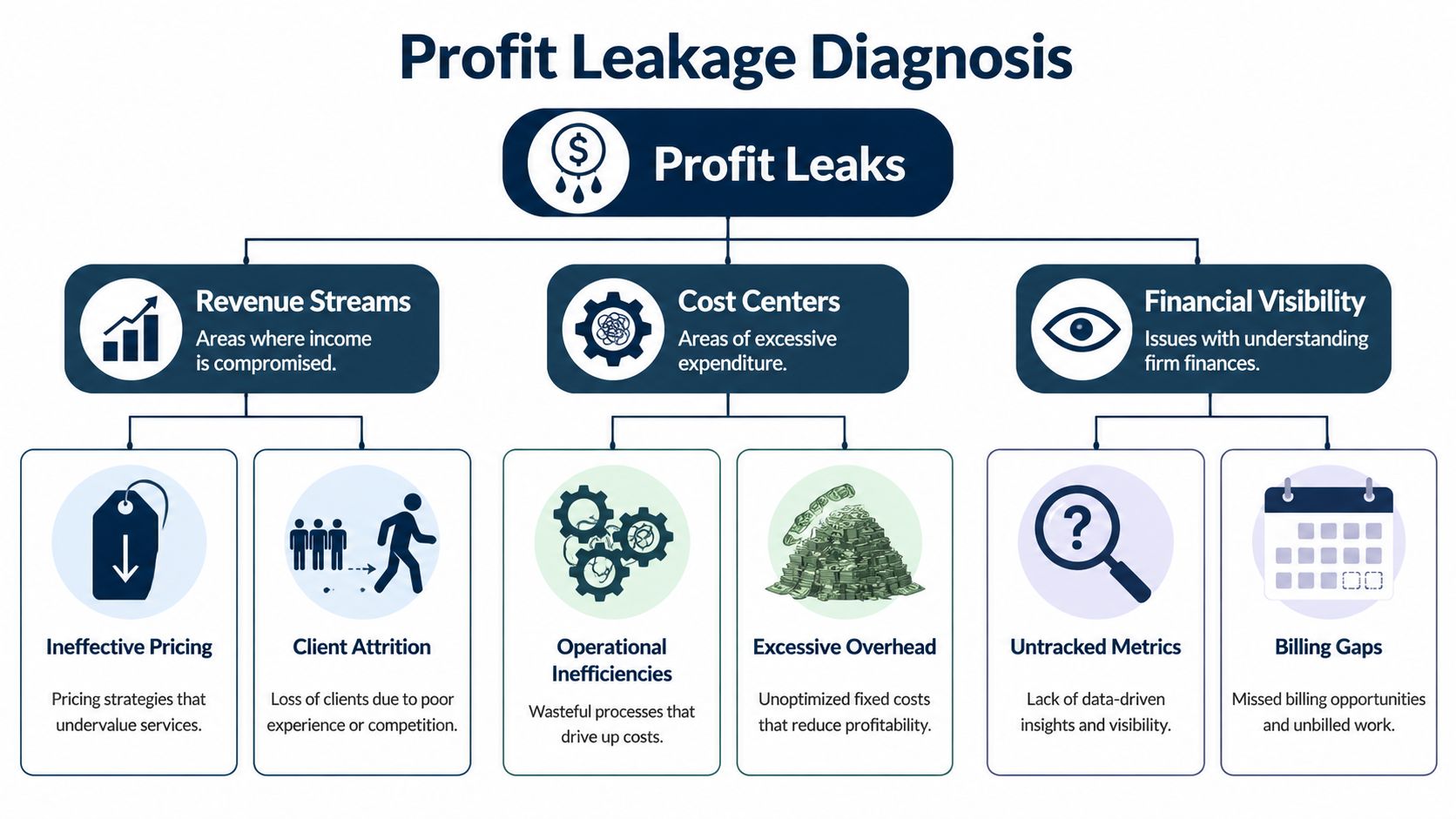
I group leaks into three categories because the fix depends on the type of leak. Too many firms throw random solutions at the problem. New software. Another hire. A rate increase. None of that works if you misread the cause.
Revenue leaks
These leaks show up before cash ever hits the bank.
They include underpriced matters, vague scopes of work, frequent discounts, and clients who consume partner time without producing decent margin. Time can be recorded perfectly and still be worth less than you think if the matter was priced badly from day one.
Watch for:
- Frequent invoice edits right before bills go out
- Clients who challenge fees every month
- Matters that keep expanding without a pricing reset
- Partners who discount to sidestep difficult conversations
Cost leaks
These leaks sit inside your operating model.
They include payroll bloat, poor staffing mix, duplicate tools, unused subscriptions, office costs that no longer make sense, and senior lawyers handling work that should sit with associates or paralegals. The American Bar Association notes in its Law Practice Today guidance on understanding law firm finances that compensation and overhead are two of the biggest drivers of firm financial performance. That is why staffing mistakes hit profit fast.
If a partner is drafting routine documents that a lower-cost team member could handle, margin disappears one hour at a time.
Visibility leaks
This is the bucket firm owners ignore the longest, and it causes the most expensive decisions.
Visibility leaks happen when reports arrive late, books are messy, trust in the numbers is low, or nobody can tie together time worked, bills sent, cash collected, and matter-level profit. At that point, the owner is running the firm on instinct.
Instinct helps. It does not replace a system.
Ask harder questions
Use this audit with your leadership team and insist on same-day answers.
- Which five clients produced the highest profit last quarter?
- Which five clients created the most stress for the least return?
- Which attorneys have the lowest utilization, and what is causing it?
- How many invoices went out late last month?
- How often are discounts applied without approval?
- Which software tools are paid for but barely used?
If your team needs days to pull these answers together, you do not have a reporting habit. You have a reporting problem.
What good diagnosis looks like
A healthy firm can see where money is earned, where it stalls, and where it disappears. That requires connected reporting, not isolated spreadsheets from different departments.
Your numbers should tie together:
- Time worked
- Time billed
- Cash collected
- Direct labor cost
- Overhead by category
- Profit by client, matter, or practice area
Many firms remain stuck. They look inward for one-off fixes and buy more legal tech, but they never build a real profitability system. The better approach is simpler and tougher. Put these KPIs on a dashboard, review them on a set cadence, and get financial advisory support if nobody on your team can translate the numbers into decisions.
That is how you stop guessing. That is how you fix profit leaks for good.
Rethink Your Pricing and Client Selection
Most law firms try to improve profit by pushing for more hours.
That works for a while, then it breaks your people, annoys your clients, and leaves you with the same old margin problem. The stronger move is to get paid properly for the work you already do and stop carrying clients that don’t fit your model.
That requires two things. Better pricing and better client selection.

Raise rates where the market supports it
Law firm owners often act like rate increases are reckless. In the right context, they’re one of the cleanest profit levers you have.
In Q4 2025, every 1% increase in worked rates translated to about 0.9% growth in profitability, a level Thomson Reuters described as “Formula 1-level responsiveness,” according to the Thomson Reuters analysis of law firm rate elasticity.
That doesn’t mean you should blindly raise every rate for every client. It means you should stop treating pricing like a taboo subject.
Raise rates when:
- The work is specialized
- Demand is strong
- Your firm has a strong reputation in that niche
- The client values speed, judgment, or access more than bargain pricing
Keep rates flat, or restructure pricing, when the client is highly price-sensitive and the work can be scoped more tightly another way.
Stop pretending every client is a good client
Some clients are profitable. Some are merely loud.
A bad-fit client usually shows up in familiar ways. They push scope without acknowledging it. They nickel-and-dime every invoice. They create extra meetings, extra emails, and extra stress. Then the partner says, “Well, at least we kept the work.”
You didn’t keep the work. The work kept you.
The easiest client to lose is usually the one you should have priced differently or declined in the first place.
Use a simple client profitability screen
You don’t need a complicated model. Score clients on five plain factors:
| Factor | What to look for |
|---|---|
| Fee strength | Do they accept your pricing without endless negotiation? |
| Scope discipline | Does the matter stay inside the agreed work? |
| Payment behavior | Do they pay on time and without drama? |
| Team burden | Does this client consume unusual partner time or admin time? |
| Referral value | Do they send more of the right work? |
A client can be pleasant and still be unprofitable. A client can also be demanding and still be worth it, if the fee level, matter quality, and payment behavior support the relationship. Look at the full picture.
If you want cleaner data around intake, follow-up, and client history, a strong legal CRM helps. This guide to CRM software for law firms is worth reviewing if your current process lives in scattered inboxes and someone’s memory.
Use pricing models that match the work
Hourly billing has its place. It is not the only model.
For recurring, predictable matters, flat fees can protect margin if your workflow is tight. For ongoing advisory relationships, subscription models can stabilize cash flow and reduce billing friction. For project-based work, phased pricing often works better than a vague estimate that gets revised later.
What matters is not appearing cutting-edge. What matters is matching price structure to how the work is executed.
Here’s a quick way to consider this:
- Hourly billing works when scope changes often and the client understands that.
- Flat fees work when your team has done similar matters enough times to estimate cleanly.
- Subscriptions work when the client needs steady access, routine support, or ongoing compliance help.
- Phased fees work when a matter naturally breaks into stages with clear handoffs.
You also need to know your economics before setting any of these prices. If you want a straightforward explanation of what each client or matter contributes after direct costs, read this guide on contribution margin in accounting. It’s one of the clearest ways to see whether a pricing decision is helping or hurting profit.
Make pricing a leadership discipline
Too many firms let pricing happen in scattered conversations.
One partner gives a discount because the prospect sounds promising. Another keeps old rates for legacy clients. A third quotes a flat fee without knowing how many senior hours usually land in that matter type. None of that is strategy.
A better pricing process looks like this:
- Set standard rate bands by lawyer level and matter type.
- Define when discounts are allowed, and who approves them.
- Review old clients annually instead of letting stale pricing live forever.
- Compare estimated scope to actual time so your next quote gets sharper.
- Track profit by client segment so you know who deserves more attention and who doesn’t.
Smarter pricing does more for profit than squeezing another tired hour out of your team.
Master Your Billing and Collections Process
This is the part many firms avoid because it feels administrative.
That’s a mistake. Billing and collections are where a lot of profit dies after the legal work is already done. You earned the revenue, then your process let it slip.
The leak usually starts before the invoice ever reaches the client.
Fix realization before you chase collections
A lot of lawyers think collections are the main problem. Often, the first damage happens earlier. Time gets entered late. Bills sit in draft. Partners trim invoices without documenting why. The final bill goes out smaller than the work justified, and nobody calls it a loss because it never appeared as an invoice in the first place.
That’s a realization problem.
Firms can recover 10-15% of revenue lost to unnecessary write-downs by tightening billing discipline, including sending invoices by the 5th of the month and requiring approval for discounts, according to Vida’s guidance on improving law firm profitability.
That is low-hanging fruit. You do not need more clients to fix it. You need a stronger process.
Put billing on a non-negotiable schedule
A billing process should not depend on mood, memory, or who had trial that week.
Use a fixed monthly rhythm:
- Time entries complete by the end of the last business day of the month
- Pre-bills reviewed quickly with limited room for casual edits
- Invoices sent by the 5th
- Follow-up starts promptly on aging balances
Late invoices create two problems. First, clients question them more because the work is no longer fresh. Second, your cash gets delayed for no good reason.
If bills are not going out by the 5th, you don’t have a billing system. You have a billing habit, and habits break under pressure.
Tighten discount control
Discounts feel harmless in the moment. They’re often anything but.
If your attorneys can write down bills whenever they want, you’ve handed profit control to whoever feels most uncomfortable with conflict. That is not a serious financial policy.
Use clear approval levels. The benchmark guidance from Vida is simple:
- Discounts under 5% require partner approval
- Discounts from 5-10% require managing partner approval
- Discounts above 10% require firm-wide consensus
That structure forces people to justify the cut. It also exposes patterns. Maybe one client is constantly underquoted. Maybe one attorney consistently overworks matters. Maybe one practice area needs better scoping from the start.
Set payment expectations early
Collections get easier when the client knows the rules before the work begins.
Your engagement letter should spell out:
- Billing frequency
- Payment terms
- Accepted payment methods
- Consequences of late payment
- How out-of-scope work is billed
Then repeat that verbally during intake. Clients rarely get upset by clear expectations. They get upset by surprises.
If your finance process is loose, strong bookkeeping proves more critical than most lawyers realize. Clean trust accounting, clear billing records, and timely reporting reduce confusion before it turns into collection trouble. If your current setup is patchy, this overview of bookkeeping for law firms is a practical place to start.
Audit realization every month
Do not wait until year-end to discover that one practice group writes off too much time.
Run a monthly realization review that compares:
- Hours recorded
- Fees invoiced
- Write-down reasons
- Discount patterns by attorney
- Large variances by client or matter
Keep it simple. You’re looking for repeat behavior, not perfect theory.
A clean billing checklist
Here’s the version I’d hand any law firm owner:
- Make time entry daily. Same day is always more accurate.
- Lock a monthly billing calendar. People follow what’s scheduled.
- Send invoices by the 5th. Not “around then.” By then.
- Require approval for discounts. No silent write-downs.
- Document scope changes fast. Don’t wait until billing day.
- Call on overdue accounts early. Older receivables get harder, not easier.
- Review realization monthly. Weak spots show up quickly if you bother to look.
Billing discipline is not glamorous. It is profitable.
Get Smart About Staffing and Overhead Costs
You see this pattern all the time in law firms. Revenue goes up, everyone feels busy, and profit still looks disappointing at the end of the month.
The problem is usually not effort. It is a weak operating system around people and costs.
Staffing and overhead deserve more than occasional cost cutting. They need a repeatable review process tied to utilization, role design, and profit by matter. If you treat them like one-time cleanup items, the waste comes back.

Use utilization to check whether your team is built right
Utilization shows how much of a person’s time goes to client work that can be billed. It is one of the fastest ways to spot whether your staffing model makes sense.
The Clio Legal Trends Report is a useful benchmark source for tracking how much lawyer time gets consumed by non-billable work across the profession. The exact target for your firm depends on practice area and role mix, but the management lesson is simple. If attorneys are spending too much time on internal admin, status chasing, or work that should sit with support staff, your margin gets squeezed.
Start by looking for predictable causes of low utilization:
- Partners handling admin and project coordination
- Associates stuck in internal tasks that do not train or bill well
- Paralegals carrying too little substantive support work
- Too many meetings
- Unclear matter workflows and handoffs
Do not turn this into a blame exercise. Low utilization usually points to a process problem before it points to a people problem.
Fix role design before you hire again
Too many firms hire because everyone feels overloaded. That is a costly mistake.
First check who is doing work below their pay grade. A partner should not be drafting routine updates, organizing files, or chasing intake paperwork. A senior associate should not be spending prime hours on tasks that a paralegal or admin team can handle with a clear checklist.
A profitable staffing structure usually looks like this:
- Partners handle judgment, strategy, business development, and client trust
- Associates handle legal work that can be trained, reviewed, and billed at the right rate
- Paralegals and support staff own repeatable process work
- Outside specialists cover overflow or back-office tasks when that is cheaper than adding fixed payroll
If your lawyers keep doing support work because “it’s faster,” you do not have a speed advantage. You have a margin problem.
If your team is stretched on document-heavy or deadline-driven work, outside help can make sense. A service like Hire Paralegals can relieve pressure without forcing partners to spend high-value time on work that should move elsewhere.
Run a lean overhead audit
Overhead drifts upward when nobody owns it.
Review expenses every quarter, line by line, with one question in mind. Does this cost help the firm produce work, support lawyers, or keep delivery efficient enough to protect margin?
Use this table in the review:
| Cost area | Question to ask |
|---|---|
| Software | Which tools save time, and which ones are just duplicate subscriptions? |
| Office space | Does your space match how your team works? |
| Marketing | Which spend brings in matters that are profitable, not just busy? |
| Vendors | Are you paying premium rates for fragmented services? |
| Admin processes | Which manual steps are driving hidden labor costs every week? |
Small waste adds up. So does large waste that everybody has learned to ignore.
Office supply cuts will not fix a bloated cost structure. Duplicate software, underused office space, and sloppy workflows will.
Cut costs without hurting production
Some cuts look smart on paper and hurt profit in real life.
If you remove support staff and attorneys pick up the slack, billed hours drop. If you cancel a useful system and replace it with manual workarounds, payroll may stay the same while output slows down. If you reduce admin help and intake response gets weaker, new business suffers before anyone notices why.
Judge every expense by business impact. Does it help the firm produce, delegate, bill, collect, or retain good work at a healthy margin?
That standard keeps you from making cheap decisions that create expensive consequences.
Make staffing review part of your profitability system
Do this review at least quarterly. Monthly is better if the firm is growing fast.
Look at five things:
- Who is doing work below their pay grade?
- Where are partners spending time that should be reassigned?
- Which matters consume too much senior time for the fee collected?
- Which tasks can be standardized, delegated, or outsourced?
- Where is workload uneven across the team?
Many firms stop too early. They make a hire, trim a subscription, or shuffle work around, then move on.
The firms that improve profit and keep it build a system. They track utilization, staffing mix, and overhead on a dashboard. They review the numbers on a schedule. They bring in outside financial advisory help when leadership is too close to the day-to-day to see the pattern clearly. That discipline is what turns staffing and overhead from a recurring frustration into a controlled part of the business.
Build Your Profitability Dashboard and Growth Plan
A one-time cleanup helps. A repeatable management system changes the firm.
Most owners look at financials after the month is over, react to whatever already happened, and then go back to practicing law. That keeps you stuck in hindsight. If you want steady improvement, you need a simple dashboard and a regular habit for using it.
That’s how to improve law firm profitability without turning yourself into a full-time spreadsheet reader.

Keep the dashboard small
A useful dashboard is short enough to review in one sitting and clear enough that partners can act on it.
For most small and midsize law firms, I’d keep these on the dashboard:
- Revenue
- Net profit
- Cash on hand
- Utilization
- Realization
- Collections or accounts receivable aging
- Profit by client, matter type, or practice area
That’s enough to tell you whether the business is healthy. You can add detail under each metric if needed, but don’t bury leadership in clutter.
Turn reporting into a monthly cadence
A dashboard without a meeting is wallpaper.
Set one monthly profitability meeting. Same date range. Same attendees. Same scoreboard. Keep it tight and make decisions.
A good monthly review covers:
- What changed last month
- Which metric moved the wrong way
- Why it moved
- What one or two actions will be taken in the next 30 days
- Who owns each action
If collections slipped, assign a billing follow-up process. If utilization fell, review delegation and workflow. If a practice area looks busy but weak on margin, review pricing and staffing on those matters.
That rhythm matters more than having a “perfect” dashboard.
Firms improve when someone looks at the numbers regularly and does something about them. Not when a report gets saved to a folder.
Use outside financial support when the owner is the bottleneck
Here’s the blunt truth. Many law firm owners should not be the person trying to build the accounting system, clean the books, analyze KPIs, and run the practice all at once.
That doesn’t make you weak. It makes you busy.
Clio’s law firm profitability guidance notes that specialized external financial partners can free up 20-30% more billable time for owners and identify pricing or hiring decisions that improve margins by 10-20%, according to Clio’s discussion of law firm profitability and outsourced financial support.
That’s why I’m a big believer in outsourced bookkeeping plus CFO-level review for firms that have grown past the “we’ll figure it out ourselves” stage. The right partner should keep the books clean, produce readable reports, and turn numbers into decisions on pricing, hiring, and cash flow. In the Philadelphia area, one option is MyOfficeOps, which provides bookkeeping, KPI dashboards, forecasting, and advisory support for professional service firms.
Pair your dashboard with the right tools
Technology should support the dashboard, not replace judgment.
Your accounting stack needs to make reporting easier, not harder. If your numbers live across disconnected systems, your monthly review will always lag. This guide to best accounting software for law firms is helpful if you’re evaluating how your current setup supports trust accounting, billing visibility, and cleaner reporting.
What a strong growth plan looks like
A sustainable growth plan is not “add more clients.”
It looks more like this:
| Focus area | Example action |
|---|---|
| Pricing | Review legacy rates and reset weak-fee matters |
| Billing | Enforce invoice delivery by the 5th |
| Staffing | Move repeatable tasks away from senior lawyers |
| Overhead | Remove underused software and duplicate vendors |
| Financial visibility | Review the dashboard monthly and act on one issue at a time |
That kind of plan is boring in the best way. It creates steady gains instead of drama.
Conclusion
If your law firm feels busy but not profitable, you’re not crazy and you’re not alone. A lot of firms work hard and still struggle because they treat profit like a byproduct instead of something they manage on purpose.
The fix is not more hustle.
It’s better control. Find the leaks. Tighten pricing. Bill faster. Collect firmly. Staff matters at the right level. Cut overhead that doesn’t help the work. Then put the whole thing on a dashboard you review every month.
That’s the difference between a firm that reacts and a firm that runs well.
You do not need to overhaul everything this week. Start with one area that is clearly weak. If your invoices go out late, fix billing cadence. If partners are drowning in low-value tasks, improve delegation. If nobody trusts the numbers, clean up the reporting first. Momentum comes from solving real problems in the right order.
That’s how to improve law firm profitability in a way that lasts.
And if you’d rather spend your time practicing law than building dashboards, chasing reporting issues, and translating financial noise into decisions, get outside help. There’s no prize for doing all of it yourself.
If your law firm needs cleaner books, clearer KPI reporting, and CFO-level guidance on pricing, cash flow, staffing, and profitability, talk to MyOfficeOps. They work with small and midsize businesses on bookkeeping, financial analytics, and advisory support, so owners can stop guessing and start making better decisions with real numbers.