
You open the bank app before breakfast and already feel behind. There’s a credit card payment due, a vendor email marked urgent, payroll coming up, and two clients who still haven’t paid. You know the business brings in money, but somehow there’s never enough left when the bills hit.
That feeling is more common than owners admit. Debt doesn’t just sit on a balance sheet. It follows you home, keeps you awake, and makes every decision feel heavier than it should. A lot of owners carry shame around it, especially in construction, healthcare, and professional services where everyone is trying to look stable on the outside.
I’ve seen this up close with a Philadelphia contractor who was doing solid work, winning jobs, and still panicking every Friday because cash was disappearing into loan payments, cards, and old payables. He wasn’t bad at business. He was running without a clear system. Once we laid everything out, cut what needed cutting, and picked a payoff plan, the fear dropped fast. Not because the debt vanished overnight, but because he finally knew what to do next.
If you want to know how to get out of business debt, start with this truth. Panic is not a strategy. A clear plan is.
You do not need more motivational talk. You need a way to see the whole problem, stop the bleeding, and make smart moves in the right order. That’s what this guide is for.
Introduction
Business debt gets dangerous when it stays vague. If you don’t know exactly who you owe, what each payment costs you, and which bill is doing the most damage, you’ll make emotional decisions. Emotional decisions are expensive.
A lot of owners avoid the numbers because they’re afraid the picture will be worse than expected. Usually, the opposite happens. The mess feels bigger in your head than it does on paper. Once you can see it, you can work it.
Start with one simple rule
Put every debt in one place. Every loan. Every card. Every overdue vendor bill. Every equipment note. Every tax payment plan. No exceptions.
For each one, list:
- Creditor name
- Current balance
- Interest rate or APR
- Minimum monthly payment
- Due date
- Whether it’s secured or unsecured
- Whether you’re current, behind, or in collections risk
That list becomes your control center. You can use Excel, Google Sheets, or even a legal pad for the first draft. The tool doesn’t matter. Seeing the truth does.
Practical rule: If you’re managing debt from memory, you’re already losing.
Don’t judge the numbers. Organize them.
The point is not to feel guilty. The point is to get accurate. A healthcare practice with equipment debt, payroll pressure, and card balances needs a different plan than a contractor carrying supplier payables and a line of credit. You won’t know which path fits until the facts are in front of you.
Also pull your last 90 days of bank and credit card statements. You’re looking for cash leaks, not perfection. Mark each expense in one of three buckets:
- Keep for costs that directly support delivery, compliance, payroll, or revenue
- Cut for waste, duplicate software, convenience spending, or old subscriptions
- Reduce for items you still need but can renegotiate
That sounds basic because it is. Basic wins here. Debt recovery is not about clever finance tricks. It’s about disciplined visibility and fast action.
Create Your Debt Dashboard to See the Full Picture
Before you pay an extra dollar toward anything, build a dashboard. Not a fancy one. A clear one.

A dashboard turns random bills into a ranked list. That matters because scattered debt feels impossible, but organized debt becomes a sequence of decisions.
What to include in the spreadsheet
Use one row per debt. Add these columns:
| Item | What to enter |
|---|---|
| Creditor | Bank, card issuer, vendor, tax agency, lender |
| Balance | What you owe today |
| APR or rate | The actual cost of carrying the debt |
| Minimum payment | The least you must pay to stay current |
| Due date | The date that drives your cash calendar |
| Status | Current, late, or negotiated |
| Notes | Personal guarantee, collateral, promo rate, collections risk |
If you’re not sure how to pull some of this from your financials, a quick refresher on how to read a balance sheet will help you match the dashboard to what your books are already saying.
Do the 90 day cash triage
Once the debt list is built, look backward before you look forward. Review the last 90 days of spending and tag everything as keep, cut, or reduce.
I like this because it forces honesty. Owners often tell me they need more sales when the actual problem is that money is leaking through sloppy operations. Duplicate software. Rush shipping. Unused tools. Materials ordered too early. A service plan nobody remembered to cancel.
Use these categories:
- Keep the essentials like payroll, insurance, rent, core software, materials tied to live jobs, and compliance costs.
- Cut the obvious waste like duplicate subscriptions, convenience spending, and services that no one uses.
- Reduce the negotiable stuff like vendor pricing, phone plans, office supplies, payment processors, and outside contractors.
Compare your two payoff styles
At this stage, you also need to decide how you want to attack the debt. There are two common methods. One is better mathematically. The other can be better emotionally.
| Feature | Debt Avalanche | Debt Snowball |
|---|---|---|
| First target | Highest interest rate | Smallest balance |
| Main benefit | Saves more in interest | Builds momentum fast |
| Best for | Owners who can stay disciplined | Owners who need quick wins |
| Risk | Feels slow at first | Costs more over time |
| Good fit | High APR cards and lines of credit | Many small nuisance balances |
There’s no prize for picking the method that sounds smartest if you won’t stick with it. If your team needs visible progress, snowball can help. If your debt includes ugly credit card rates, avalanche is usually the better move.
When owners finally see every debt in one sheet, the stress changes shape. It stops being a fog and becomes a list.
A quick real world example
Say a small healthcare office has three debts: an equipment note, a business card, and a line of credit. The owner has been making minimum payments on all three and hoping receivables improve. That’s not a plan. Once the debts are listed with rates and minimums, it becomes obvious which one is draining cash fastest.
That’s the whole purpose of the dashboard. You are not trying to impress anyone. You are trying to see what’s actually happening.
Pick Your Attack Plan Avalanche vs Snowball
If you want the blunt answer, I prefer avalanche for most businesses. Businesses need efficiency, not dopamine. When debt is expensive, your first job is to stop feeding the worst interest rate.
According to a debt payoff framework summarized by Citadel, the debt avalanche method means listing debts by APR, keeping minimum payments on all of them, and sending every extra dollar to the highest-rate balance first. For business debt portfolios above $50K, that approach can save 15% to 25% more on interest over 2 to 3 years than the snowball method, and high-interest obligations like cards often run 19% to 27% APR. The same guidance notes that prolonged debt above 20% can erode 10% to 15% annual cash flow and that disciplined firms using this approach see better outcomes than firms without oversight, based on the methodology outlined in Citadel’s business debt payoff guide.
Avalanche is usually the adult choice
Here’s how it works in plain English.
- List every debt by interest rate from highest to lowest.
- Keep making minimum payments on all debts.
- Put every extra dollar toward the debt with the highest rate.
- Roll that payment forward to the next debt after the first one is gone.
This method works because interest is the enemy. If one card is charging a brutal APR, that balance deserves your attention before a lower-cost loan does.
Snowball still has a place
Snowball flips the logic. Instead of targeting the highest rate first, you knock out the smallest balance first.
That can work well for an owner who feels frozen. Quick wins build confidence. When you remove a small debt fast, you simplify your monthly obligations and prove to yourself that the plan is working.
But don’t kid yourself. Snowball is usually more expensive.
| Feature | Debt Avalanche | Debt Snowball |
|---|---|---|
| Focus | Highest APR first | Smallest balance first |
| Goal | Lower total interest cost | Faster emotional wins |
| Good for | Expensive cards, lines, merchant cash pressure | Owners who need visible progress to stay engaged |
| Weak point | Progress can feel slow early on | More interest paid overall |
A healthcare practice example
Let’s say you run a medical practice with an equipment loan, a business credit card, and a line of credit. The equipment loan is annoying, but the card is the one subtly impacting you every month because the rate is much higher. Avalanche says attack the card first.
Snowball might tell you to wipe out the smallest balance, even if it isn’t the most expensive. That can feel good, but if the card keeps charging high interest in the background, the relief is partly fake.
Owners often get tripped up. They chase the most emotionally satisfying target instead of the most damaging one.
If your debt includes high-rate cards, don’t overthink it. Hit the ugliest APR first.
What usually goes wrong
The plan itself is simple. Execution is where businesses fail.
Common mistakes include:
- Underestimating operating cash and throwing too much at debt too early
- Ignoring payroll timing and creating a new crisis while solving the old one
- Using cards again right after paying them down
- Skipping weekly review because things feel busy
I’ve seen construction companies do this in the middle of heavy material purchases. I’ve seen healthcare owners do it when insurance reimbursements are running late. They get excited, make a big debt payment, and then grab the card again two weeks later. That’s not repayment. That’s circular motion.
Use a simple weekly review
Once you pick avalanche or snowball, review the plan every week. Not monthly. Weekly.
Check:
- Cash on hand
- Receivables due this week
- Payroll obligations
- Debt payments due next
- Any expense you can delay, reduce, or renegotiate
If the business is unstable, weekly beats monthly every time. Monthly is too slow when cash is tight.
What to say when you call creditors
A lot of owners avoid the phone call because they think they need the perfect words. You don’t. You need a calm script and current numbers.
Use something like this:
“I’m reviewing our payment obligations and I want to keep this account in good standing. We can pay, but the current terms are too tight for our cash flow. I’d like to discuss a lower rate, reduced minimum payment, or an extended payment term.”
Then ask direct questions:
- Can you reduce the interest rate temporarily?
- Can you extend the repayment term?
- Can you lower the minimum payment for the next few months?
- Can you freeze late fees while we stay on an agreed plan?
That call is not a sign that you’ve failed. It’s what responsible owners do before things get worse.
How to Negotiate Better Terms with Your Creditors
Most creditors do not want your business to collapse. They want to recover money. That gives you room to negotiate if you act early and show up prepared.

According to Patriot Software’s summary of creditor negotiation outcomes, working out terms directly can resolve up to 70% of business debt disputes without litigation, with some businesses reducing rates by 5 to 7 percentage points and extending repayment plans by 12 to 24 months. In the same source, a sample business debt mix shows how lowering minimums from $5,000 to $3,000 per month and capping rates at 12% can free $24,000 annually, and negotiated plans were associated with a 45% lower default rate in some firms dealing with delayed payments. That analysis is discussed in Patriot Software’s business debt relief article.
What to prepare before the call
Do not call with vibes. Call with paperwork.
Have these ready:
- Current balance sheet
- Cash flow view for the next few months
- Accounts receivable list
- A realistic monthly payment amount
- A short explanation of what caused the squeeze
Keep your explanation clean and factual. “Collections slowed, payroll is current, jobs are active, and we want to reset terms before this account gets worse.” That is enough.
If you’re unclear on whether interest expense changes your tax picture, read up on tax deductibility of interest before making decisions that affect how you classify payments.
What to ask for
Don’t make the creditor guess. Ask for specific relief.
A few good options:
- Temporary interest rate reduction
- Lower minimum payment
- Longer repayment term
- Late fee waiver
- Short payment pause
- Settlement option if you can offer a lump sum
If you’re exploring a broader strategy around debt settlement with the bank, that guide gives a useful overview of how settlement discussions are usually framed and what lenders tend to consider.
A script that works
Use plain language. Something like this:
“I’m calling before we miss more payments because I want to solve this the right way. We have the ability to pay under revised terms. I’d like to request a lower rate or extended term so we can keep the account active and avoid default.”
Then stop talking. Let them answer.
If they say no, ask what documentation would support a review. A first no is not the end of the conversation. It often means you reached the wrong department or didn’t give them enough detail.
When consolidation helps and when it hurts
Negotiation and consolidation are not the same thing. Negotiation changes existing terms. Consolidation replaces several debts with one.
Consolidation can help if:
- You have multiple high-rate debts
- You can qualify for a lower rate
- One payment will improve execution
- The term is long enough to stabilize cash flow
Consolidation can hurt if:
- You secure debt that used to be unsecured
- You extend the term so long that you pay more over time
- You fix old debt but keep spending on the cards you paid off
A professional services firm might roll several card balances into one lower-rate loan and gain breathing room. That’s smart if they also stop using the cards like a backup checking account. If they don’t, the loan just creates more room to repeat the same mistake.
The biggest mistake in negotiation
Owners wait too long.
They call after accounts are in collections, after vendors are threatening legal action, or after they’ve already bounced around between partial payments. By then, trust is lower and options are narrower.
Call early. Be honest. Have numbers in front of you. Ask for something specific. That is how adults handle business debt.
Explore Smart Ways to Restructure Your Debt
Sometimes minimum payments and small negotiations aren’t enough. You need to change the structure of the debt itself.
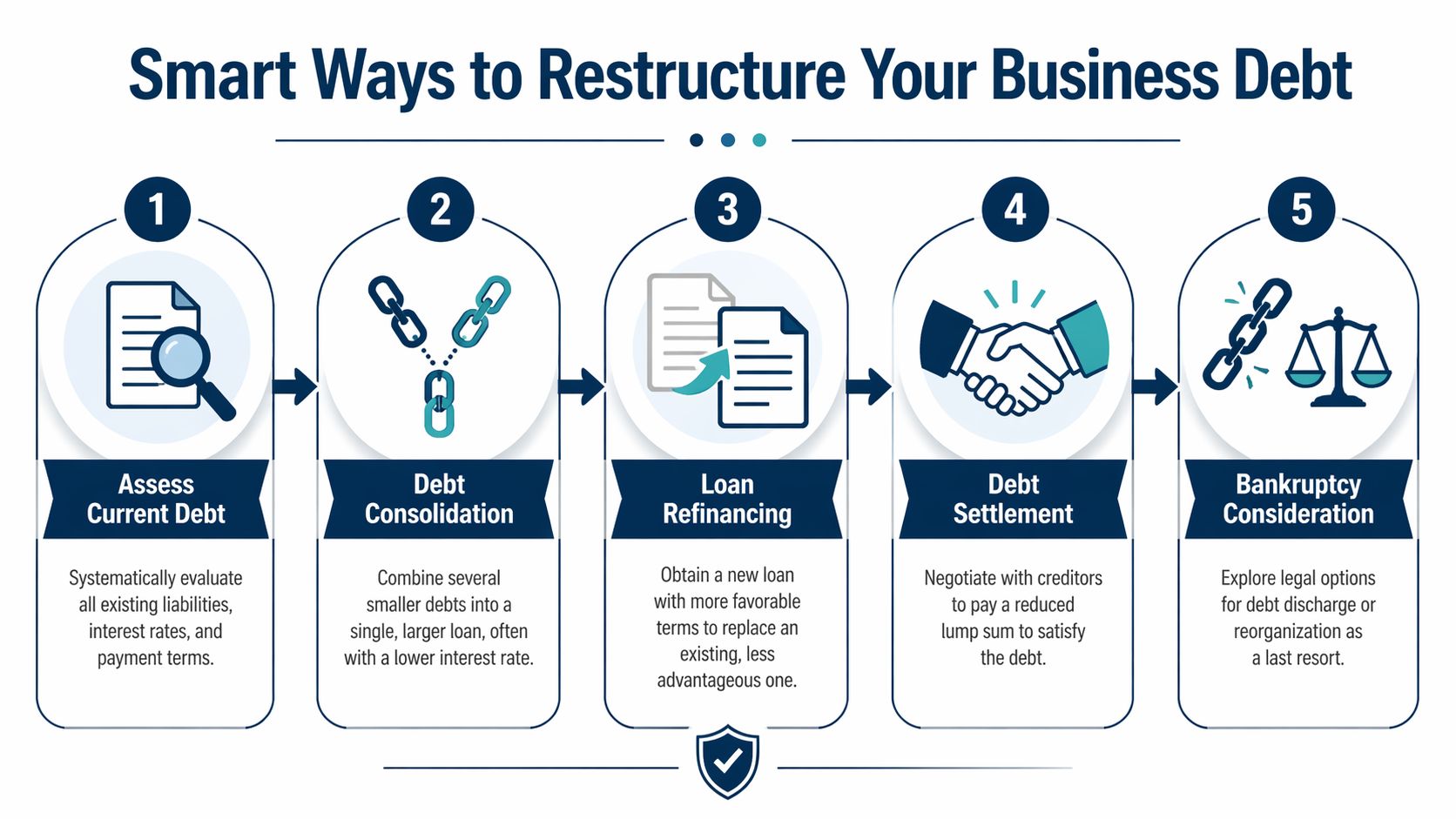
Owners need to stay sharp. Restructuring can save a business, but bad restructuring can trap it for years.
What lenders and creditors want to see
Restructuring works better when you show that the business can survive under new terms. Surfside Capital’s framework notes that businesses seeking concessions should bring audited financials or at least organized balance sheets and cash flow projections, assess a debt-to-income ratio below 40% as a healthier financial position, and present a structured proposal backed by a 6-month revenue forecast. That same guidance says some negotiations target 20% to 50% principal haircuts, while consolidation into loans in the 8% to 12% APR range can lower monthly outflow by 20% to 30% and shorten payoff by 18 to 24 months in certain cases. It also warns that 45% of negotiations fail because documentation is weak or expectations are unrealistic, and 30% of businesses default after consolidation if they keep using credit carelessly, based on the restructuring overview at Surfside Capital Advisors.
The main restructuring options
Here’s how I think about them.
Consolidation loan
This works when you have several ugly debts and can replace them with one cleaner loan. One payment is easier to manage. A lower rate helps. But only do this if the new loan improves the total picture.
Good fit:
- Multiple high-interest cards
- Predictable monthly cash flow
- Clean enough books to qualify
Bad fit:
- You’re still losing money operationally
- You haven’t fixed spending behavior
- The new loan puts critical assets at risk
Refinance an existing loan
If one major loan has rough terms, refinancing may be enough. This is simpler than full consolidation and can improve monthly cash flow without changing everything.
Good fit:
- One expensive loan is causing most of the pain
- Your credit profile or business performance has improved
- Prepayment penalties won’t erase the benefit
Settlement
Settlement means offering less than the full balance, usually in a lump sum or under a strict plan. This can be effective with vendor debt and some unsecured obligations.
Good fit:
- You have access to cash for a realistic offer
- The creditor is motivated
- The account is already distressed
Bad fit:
- You’re guessing instead of documenting repayment capacity
- You can’t fund the offer
- The debt is tied to collateral you can’t risk losing
Clean books are leverage. Sloppy books make every restructuring conversation harder.
Bankruptcy is a last tool, not a moral failure
Some owners hear the word bankruptcy and shut down. That’s a mistake. It’s a legal tool. Not the first one. Not always the right one. But still a tool.
If the business has viable operations but unworkable debt, learning about Chapter 11 bankruptcy for small businesses can help you understand when reorganization is worth considering. The key is to treat it as a decision based on facts, not fear.
Fix the business while you restructure the debt
My strong opinion is this: debt repayment is unsustainable if the operation that created the debt stays broken.
If your margins are weak, your billing is slow, your pricing is wrong, and your subscriptions are bloated, no lender is going to save you for long. A contractor who underbids jobs and waits too long to invoice will borrow again. A healthcare office with weak collections and payroll creep will do the same.
Restructuring should buy time. Use that time to fix the machine.
Fix Your Operations to Fuel the Repayment Plan
A repayment plan without operational changes is just a countdown to the next cash crunch.
According to a 2023 Federal Reserve figure cited in Nav, about 40% of small businesses in the U.S. carry outstanding debt averaging $150,000, with high-interest credit card debt making up 25% of total liabilities and often costing more than 20% APR. The same analysis shows that in one example, moving an extra $500 a month toward the highest-rate debt in a $50,000 debt stack saved over $8,000 in interest over 3 years, and SBA data referenced there says businesses with structured repayment plans reduce debt by 35% within the first year on average. That broader debt reduction context appears in Nav’s small business debt reduction guide.
Start where cash leaks out
Most owners look for one dramatic fix. Usually, the answer is five boring fixes done at the same time.
Check these first:
- Software and subscriptions. Cancel tools your team doesn’t use. Downgrade plans that grew faster than the business.
- Vendor terms. Ask for better pricing, longer payment windows, or volume discounts.
- Pricing. If you’re still charging old rates while your costs climbed, you’re financing your clients.
- Collections. Invoice faster. Follow up sooner. Don’t let receivables age without action.
- Payroll alignment. Make sure staffing matches current demand, not hopeful future demand.
If you want a broader framework for tightening the business itself, this guide on how to improve operational efficiency is a good place to start.
A construction example
A contractor can look busy and still be broke. I see this a lot.
Crews are out working. Materials are moving. Revenue is booked. But billing lags, change orders sit unsigned, and retention slows cash even more. Then the owner uses a card to bridge the gap and calls it normal.
It isn’t normal. It’s expensive.
A better move is to tighten the billing cycle, invoice approved work faster, track change orders in real time, and review job profitability every week. The debt plan improves because operations improve. That’s the point.
Every extra dollar needs a job
Once you free up cash, don’t let it drift. Assign it.
Use freed-up cash in this order:
- Protect payroll and core operations
- Keep minimum debt payments current
- Send the extra amount to your chosen target debt
- Avoid creating new discretionary spending
Discipline is critical. If a price increase, faster collection, or cost cut creates breathing room, don’t reward yourself too early. Use the room to kill the debt.
Debt freedom usually starts with better habits inside the business, not with a miracle loan.
Conclusion Your Path from Debt to Financial Clarity
Debt creates more than financial pressure. It creates noise in your head. Every delayed payment, every short month, every unknown balance takes up mental space you should be using to run the business.
That cost is real. A 2023 American Psychological Association survey cited by Eastern Financial Partners says 72% of small business owners reported heightened anxiety and depression due to financial stress, and 41% considered suicide amid debt pressure. The same source references a 2025 JPMorgan Chase study claiming owners who outsourced bookkeeping and CFO advisory reduced debt-related stress by 35% and recovered 28% faster, while only 12% sought that help. It also mentions projections and later findings around AI dashboards, wellness tools, and higher debt defaults in healthcare settings, all summarized in Eastern Financial Partners’ discussion of business debt stress.
Those numbers are hard to read, but they match what many owners live through. If debt has started affecting your sleep, your health, your marriage, or your ability to make clear decisions, that is your sign to stop treating this like a solo problem.

There are also practical ways to reduce overload while you stabilize cash. For example, some owners lighten admin pressure by delegating routine work through services like Hire LatAm Virtual Assistants, which can free up time for collection follow-up, vendor communication, and operational cleanup.
You should get help when the books are behind, when you can’t explain cash movement clearly, when debt payments are driving daily decisions, or when you’re too stressed to trust your own judgment. That is not weakness. That is leadership.
Getting out of debt matters. Staying out of debt matters more. Financial clarity is the true win.
If you want help turning scattered numbers into a real recovery plan, MyOfficeOps can help you clean up the books, understand cash flow, and build a practical path out of debt. Start with a discovery call and get clear on what to do next.