
You look at the bank account on Friday night, and it makes no sense. The phone rang all week. The crew stayed busy. Patients came in. Clients signed proposals. You worked the whole month and still felt that punch in the gut when you checked the balance.
That feeling is more common than most owners admit.
In Philly, West Chester, the Main Line, and the surrounding suburbs, I’ve seen the same pattern in construction shops, law offices, clinics, agencies, and service businesses. The owner is exhausted, revenue looks decent, and yet there’s not enough left over. They start asking the same question in ten different ways. Why is my business not making money? Why am I busy but broke? Why does my P&L say one thing while my checking account says another?
The hard truth is that “not making money” is not the fundamental problem. It’s the symptom. The underlying problem usually sits underneath the surface in pricing, job costing, billing speed, overhead, or demand.
That’s good news.
It means this can be diagnosed. You don’t need another vague pep talk. You need the financial version of a doctor’s visit. Check the vital signs, find what’s off, and fix the thing that’s causing the pain.
That Sinking Feeling When The Numbers Don't Add Up
A lot of owners hit this point after a stretch of hard work. They don’t come in saying, “I have a margin compression problem.” They say, “We had a strong month. So where did the money go?”
That question usually comes with stress attached to it. Payroll is due. Vendors want payment. You’ve got people depending on you. At home, you’re still carrying the business in your head at dinner. You’re wondering if you’re doing something wrong, even though you haven’t stopped moving.
Here’s what I’d tell you if we were sitting across a desk in West Chester. Busy is not the same as profitable. Profitable is not the same as cash-rich. And a clean-looking income statement can hide a lot.
What this usually looks like in real life
In a service firm, the owner might be delivering work quickly but sending invoices late.
In a healthcare practice, claims and reimbursements may lag while payroll keeps hitting on schedule.
In construction, a contractor may think a job is fine because total revenue is up, but actual job costs are sitting in a spreadsheet, entered too late to help.
The bank account tells you how much oxygen you have today. It does not always tell you whether the business model is healthy.
That’s why guessing is dangerous. Cutting random expenses won’t solve a pricing problem. Pushing sales harder won’t solve sloppy billing. Hiring a bookkeeper won’t fix weak demand if the market doesn’t want the offer.
Start with the right mindset
Ask better questions than “Why am I not making money?”
Try these instead:
- What changed first. Did cash tighten before revenue slowed, or after?
- Where does money get stuck. In receivables, inventory, payroll, job overruns, or overhead?
- Which part of the business feels strong on paper but weak in reality. That gap matters.
If you treat this like a diagnosis instead of a personal failure, the numbers usually start talking.
Is It a Profit Problem or a Cash Problem
If you own a business around Philly, you’ve probably had this moment. The P&L says you made money. The bank account says otherwise. That gap rattles people, especially in service firms, medical practices, and construction companies where the work is done long before the cash shows up.
Start there. Figure out whether the business has an earning problem, a timing problem, or both.

What profit means
Profit answers a period question. After revenue and expenses are recorded for the month, quarter, or year, is anything left over?
That matters because profit shows whether the model works. If pricing is too low, direct costs are too high, or overhead has crept up, profit will expose it. A company can stay busy for months and still have a weak engine underneath.
What cash means
Cash answers a today question. How much money is available to cover payroll, rent, taxes, vendors, and debt payments right now?
In Philadelphia-area healthcare, that often means waiting on claims while staff still need to be paid every Friday. In construction, it can mean fronting labor and materials before a draw comes in. In service businesses, it often comes down to slow invoicing, soft collections, or owners who let too much work sit unbilled at month end.
Profit and cash are connected. They are not the same.
A quick side-by-side view
| Question | Profit | Cash |
|---|---|---|
| What does it measure | Earnings over time | Money available right now |
| Main report | P&L | Cash flow statement and bank balance |
| Common trap | Sales look fine but margins are thin | Bank balance looks weak because cash is tied up |
| What it affects | Long-term viability | Day-to-day survival |
A contractor can finish profitable work on paper and still be strapped for cash because collections lag, retainage is held back, or job costs hit before the customer payment clears. The same basic problem shows up in a therapy practice waiting on reimbursements and in a home services company that invoices a week later than it should.
If you’re in the trades and want a plain-English benchmark for margins, markup, and how remodelers think about profit, this simple guide for remodelers is a useful companion to your own numbers.
Why owners misread the problem
Cash stress makes people react fast. Usually in the wrong direction.
I’ve seen owners push harder on sales when the underlying issue was billing discipline. I’ve seen others slash overhead when their pricing was the actual problem. More revenue does not help if each new job carries weak margins or if every dollar comes in 45 days late. It can put the business under more strain because payroll and vendor bills rise first.
A doctor would not treat chest pain without checking blood pressure, pulse, and oxygen. Business works the same way. Before you change prices, cut staff, or chase more work, separate paper profit from cash movement.
If you want a straightforward way to read that difference in your own reports, this resource on how to know if your business is profitable lays out the basics clearly.
Checking the Five Vital Signs of Your Business
When a doctor checks a patient, they don’t ask one big question and guess. They check several vital signs. A business needs the same treatment.
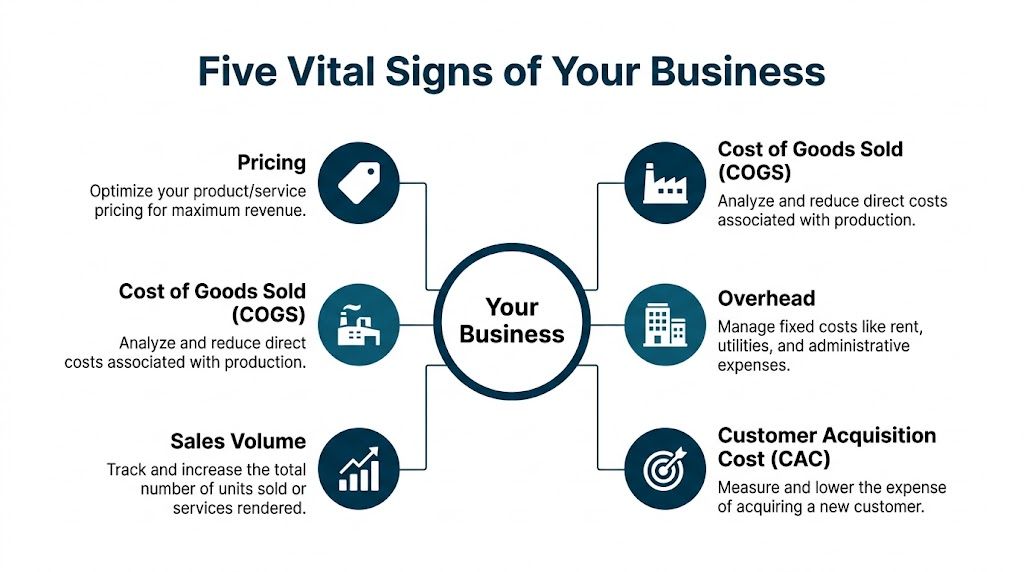
If you’re asking why is my business not making money, start with five areas that usually reveal the answer. Not fifty. Five.
Pricing
Pricing is what you charge for your work. Simple enough. But owners often get emotional here.
Some underprice because they’re afraid to lose jobs. Some never update rates after their own costs rise. Some package too much into a flat fee and slowly train customers to expect extra work for free.
An unhealthy pricing sign looks like this: sales are happening, clients seem happy, but each job leaves too little behind.
Cost of goods sold
Cost of Goods Sold, or COGS, means the direct cost to deliver what you sold. In construction, that can be labor, materials, and subcontractors. In healthcare, it can include direct staffing tied to patient care. In professional services, it often shows up in delivery labor.
This number tells you whether the work itself is worth doing.
If COGS keeps rising and pricing doesn’t, your gross profit gets squeezed. You can be productive all month and still build very little profit.
Overhead
Overhead is everything you need to run the business that isn’t tied to one specific job or sale. Office staff, rent, software, admin payroll, insurance, vehicles, subscriptions, and all the little recurring charges that pile up.
Overhead is sneaky because each item looks reasonable by itself. Together, they can bury a decent business.
Here’s the trade-off. Overhead can support growth, but fixed overhead doesn’t drop just because sales have a weak month.
Sales volume
This is the one some owners try to skip. They’d rather tweak the back office than face the market.
But the market gets the final vote. According to 2024 data from the US Bureau of Labor Statistics analyzed by Commerce Institute, 42% of businesses fail due to no market need for their services or products. That makes demand the biggest problem by a wide margin.
If people don’t want what you sell, clean bookkeeping won’t save you.
Healthy and unhealthy signs
- Healthy sales volume means enough demand comes in at a price that works.
- Unhealthy sales volume means your team is chasing every lead, discounting too often, or selling work people don’t value enough to buy consistently.
Cash flow
Cash flow is the last vital sign because it tells you how the other four are behaving in real life.
A business can survive a temporary issue in one area. It usually can’t survive cash stress for long. Cash flow problems often come from a mix of slow collections, underbilling, poor forecasting, and overhead that outgrew the revenue base.
Strong businesses don’t just earn profit. They turn that profit into cash fast enough to stay in control.
Quick diagnostic table
| Vital sign | What it asks | Red flag |
|---|---|---|
| Pricing | Are we charging enough | Busy team, weak margins |
| COGS | Does the work cost too much to deliver | Revenue up, gross profit thin |
| Overhead | Did fixed costs drift too high | Strong months still feel tight |
| Sales volume | Is there enough real demand | Constant discounting or weak pipeline |
| Cash flow | Does cash arrive in time | Profitable months, empty bank |
When one of these looks off, don’t panic. But don’t lump them all together either. A pricing problem needs one fix. A demand problem needs another.
How to Run Your Own Financial Health Check
If you run a business in Philly and the bank account feels tighter than the P&L says it should, that messes with your head. You finish jobs, see revenue on the reports, and still wonder why payroll week feels like a street fight.
Treat the business like a doctor checking a patient. Start with the core readings, then find out where the strain starts. Pull these three reports from QuickBooks, Xero, or whatever system you use:
- Profit & Loss statement
- Balance Sheet
- Cash Flow statement
Get the books in order before you draw conclusions. If personal spending is mixed in, job costs are late, or insurance reimbursements are posted inconsistently, the numbers will point you in the wrong direction.
Step one, check gross profit first
Start with the P&L and look at what the work leaves behind before office costs hit.
Gross Profit = Revenue – Cost of Goods Sold
Then calculate:
Gross Margin = Gross Profit / Revenue
The first pass is simple. Compare one month to the next and compare one service line to another if you can. In a Main Line clinic, one provider schedule can look full while reimbursement on those visits comes in too low. In a contractor shop, revenue can rise while material overruns and sloppy labor tracking eat the job alive. In a service business, fixed-fee work often hides extra hours that never got priced.
Gross margin usually slips for a handful of reasons. Pricing is off. Labor takes longer than estimated. Materials ran hot. Scope changed and nobody billed for it.
Step two, test your overhead load
After gross profit, check what it costs to keep the doors open.
Use this formula:
Overhead Ratio = Overhead Expenses / Revenue
Many Philadelphia-area owners often miscalculate. They add a project manager, another admin, a software stack, a truck, maybe a bigger space, all based on expected growth. Then revenue comes in unevenly and those fixed costs keep drafting the account every month.
A useful review sorts overhead into three buckets:
- Locked costs like rent, insurance, and lease payments
- Useful but reviewable costs like software, outside support, and subscriptions
- Optional costs that may feel productive but are not producing enough return
Marketing belongs in that review too. If you cannot tell whether campaigns are creating profitable work, use Jackson Digital's ROI guide and run the numbers.
If a cost does not help you sell the work, deliver the work, or collect the money, question it.
Step three, review demand honestly
Now check whether the market is responding to what you sell.
Look at closed deals, repeat customers, referral sources, win rate, and the mix of work coming in. A healthy pipeline has steady movement and enough margin in the work you win. A weak pipeline shows up as long quoting cycles, too many proposals that go nowhere, and price resistance on the jobs you need most.
This matters in Philly service businesses because busyness can hide weak demand. The phone rings. The team stays active. But if the work is low-margin, heavily customized, or full of small client concessions, volume will not fix the economics.
Step four, measure how fast money comes in
Go to the Balance Sheet and review accounts receivable like someone who expects to get paid.
Use this formula:
DSO = Accounts Receivable / Credit Sales x Number of Days
If you do not track credit sales separately, use total sales as a rough internal measure and stay consistent month to month.
For construction firms, healthcare practices, and B2B service companies, this step exposes a lot. You may be profitable on paper and still short on cash because invoices sit too long, claims are delayed, retainage hangs out there, or completed work has not been billed yet. Bills move on their own schedule. Collections rarely do unless someone owns the process.
What to look for in receivables
- Current invoices that are recent and likely to pay on time
- Aging invoices that need follow-up now
- Disputed invoices where confusion is slowing payment
- Unbilled work that has already been delivered but has not been invoiced
Unbilled work is a silent killer. You already spent the labor and bought the materials. In healthcare, it can be unsigned notes or claim lag. In construction, it is often change orders or progress billing that did not go out cleanly. In service firms, it is work finished last week that nobody invoiced because everyone was busy.
Step five, read the cash flow statement like an owner
A lot of owners skip the cash flow statement because it feels more technical than the P&L. That is a mistake.
The cash flow statement shows where money came from and where it went. Operations, debt, owner contributions, equipment purchases, and timing swings all show up there. If the business keeps looking stable only because you are covering gaps with a credit line or personal cash, that should be obvious on this report.
This guide on how to read a cash flow statement gives a clear breakdown of what to check so you can see whether the business is funding itself or getting propped up.
Put your findings on one page
Keep this part simple. Write down the answers in plain English, not accountant language.
| Question | Your answer |
|---|---|
| Are we charging enough | |
| Are direct costs under control | |
| Is overhead too heavy | |
| Is demand strong enough | |
| How quickly do we collect cash |
That one-page checkup gives you a cleaner read than staring at the bank balance and hoping next month feels better.
Spotting Common Profit Leaks in Philly Businesses
Once you start looking closely, profit leaks are usually easy to recognize. They just don’t always show up in the place owners expect.
In the Philly area, I see the same kinds of leaks over and over. Different industries, same pain. Revenue looks decent. The owner stays busy. The cash keeps slipping out.
The West Chester contractor with the healthy-looking P&L
A contractor can have a decent top-line month and still lose money job by job.
The classic problem is broad or delayed job costing. Costs get dumped into general buckets. Receipts get entered after the fact. Labor isn’t tied cleanly to specific jobs. The monthly P&L looks acceptable, but one or two jobs are bleeding margin.
That blind spot is common in construction and service businesses. As noted in this analysis of financial clarity problems in construction, job cost data is often too broad or entered too late to be actionable. The main P&L can look healthy while individual projects lose money and drain cash.
What this leak looks like
- Underbilling on work already completed
- Late entry of labor and materials
- No real-time WIP view
- Project managers guessing instead of seeing current numbers
The Center City professional services firm that bills too slowly
This one happens all the time with law firms, agencies, consultants, and IT shops.
The team does the work. The owner is hands-on. Everyone tells themselves they’ll send invoices after one more task is wrapped up. Then billing drifts. Work sits in draft. Collections don’t start because the invoice never got out.
The result is simple. The firm acts like a bank for its clients.
If you wait too long to invoice, you’re financing your client’s business with your labor.
In these firms, the profit leak usually isn’t dramatic. It’s death by delay. A week here. Two weeks there. A stack of unbilled time. A partner who hates following up. Nothing looks broken until payroll lands.
The suburban clinic dealing with reimbursement lag
Healthcare has its own flavor of this problem.
A practice can be full, providers can stay booked, and the owner can still feel squeezed because reimbursements move slowly, denials take time to fix, and payroll doesn’t care that a claim is pending. Add growing admin load and the business starts feeling heavier every month.
Three leaks that show up often
| Business type | Common leak | What the owner feels |
|---|---|---|
| Construction | Weak job costing and underbilling | “We’re working hard but cash is tight” |
| Professional services | Slow invoicing and weak follow-up | “Clients owe us a lot, but we’re still squeezed” |
| Healthcare | Reimbursement delays and admin drag | “Volume is up, but the bank account says otherwise” |
If you want a more practical view of common small business money mistakes, this financial advice for small businesses is a good next read.
Practical Fixes to Stop the Bleeding and Boost Profit
Once you know where the leak is, the fix gets more straightforward. Not easy, always. But straightforward.
Most businesses need a mix of quick cash fixes and slower operational fixes. You need both. Quick fixes give you breathing room. Operational fixes keep the same problem from coming back next quarter.

Short-term moves that improve cash now
Start with actions that put cash back under your control.
- Invoice faster. Set a rule that work gets billed on a fixed schedule, not when someone “gets to it.”
- Follow up on receivables weekly. Not monthly. Weekly.
- Bill for completed work. If the work is done, get it out the door.
- Pause low-value spending. Review software, subscriptions, and recurring costs that no one has challenged in months.
- Review scope creep. If clients are getting free extras, stop pretending that’s customer service. It’s margin leakage.
These steps won’t cure a weak business model. They will stop avoidable cash drain.
Medium-term fixes that build a stronger business
At this point, owners have to make decisions, not just clean up paperwork.
Raise prices with a reason
A lot of businesses don’t need more customers first. They need better pricing discipline.
That doesn’t mean random price hikes. It means reviewing which services, jobs, or client types produce healthy gross profit. Then price based on cost to deliver.
Cut or redesign weak offers
Some services create activity but not profit. If an offer consistently eats time, causes rework, or attracts price shoppers, redesign it or stop selling it.
That can feel scary. It’s often the right move.
Narrow your niche
Broad targeting makes a lot of businesses blend into the noise. A tighter niche can improve pricing power and help buyers understand why they should choose you.
The idea is simple. Instead of trying to serve everybody, focus on a smaller market with a more specific need. As discussed in this report on profitable micro-niches, a general contractor might specialize in sustainable building retrofits rather than staying broad. That kind of focus can reduce competition and support stronger pricing.
Match the fix to the diagnosis
| If your issue is | Try this first |
|---|---|
| Weak pricing | Reprice top services and remove underquoted work |
| High direct costs | Review labor use, suppliers, and project scoping |
| Heavy overhead | Zero out nonessential spending and rebuild from necessity |
| Weak demand | Tighten the offer and narrow the target market |
| Slow cash | Speed up billing and collections |
For contractors and trades owners who want a practical outside read on the operating side, this practical guide to construction business does a good job connecting field work to business discipline.
A business usually doesn’t become more profitable by working harder. It becomes more profitable by charging right, selling the right work, and collecting cash without delay.
In practice, systems matter. Job costing software, better invoice workflows, regular review meetings, and KPI dashboards all help. Owners often bring in outside support for this as well. Tools and advisory services, including options like MyOfficeOps for bookkeeping, KPI reporting, and profitability consulting, can help turn the diagnosis into a repeatable process.
When DIY Is Not Enough You Need an Expert Partner
Some business problems are fixable with a cleaner invoicing process and a hard look at expenses. Others need deeper help.
You may need an expert when the numbers keep changing but the pattern stays the same. Revenue rises, cash stays tight. You cut costs, but margins still drift. You’re trying to grow, hire, or borrow, and you can’t tell a clear financial story from your own reports.
That’s where a solid bookkeeping and advisory partner earns their keep.
Signs you’ve outgrown DIY
- Your books are technically done, but not useful. You get reports, but they don’t help you decide.
- You can’t forecast cash with confidence. You know what happened last month, not what’s coming next.
- You need lender-ready financials. Sloppy statements hurt credibility fast.
- Your business has moving parts. Payroll, job costing, reimbursements, bill pay, and owner draws all interact.
This matters even more for owners who already face extra barriers when trying to access capital. According to the Milken Institute report on lending disparities and financial clarity, minority-owned businesses face significantly higher financing denial rates. One practical way to improve the odds is to present clean financial statements and KPI dashboards that clearly show how the business performs and where it’s headed.
What a good advisor actually does
A good advisor doesn’t just hand you reports after month-end.
They help you answer questions like:
- Can we afford this hire
- Which service lines make money
- Why does cash drop during growth
- What should we fix before talking to a bank
- Are we building a business that can eventually be sold
That work is especially useful in Philadelphia-area businesses with industry-specific friction. Construction needs job-level visibility. Professional services need cleaner billing discipline. Healthcare needs reporting that makes reimbursement delays visible before they become emergencies.
The right advisor gives you clarity, not more jargon.
If you’re at the point where the business is too important to run on guesses, bringing in help is not a sign that you failed. It means you finally stopped trying to do surgery on yourself.
If you want clearer books, better cash visibility, and practical advice on pricing, hiring, forecasting, and profitability, MyOfficeOps works with Philadelphia-area businesses in professional services, healthcare, construction, and real estate to turn messy numbers into usable decisions. Start with a conversation, get a clear picture of what’s happening, and fix the parts of the business that are holding profit back.