
You've probably done this before. A busy craft fair ends, Etsy payouts hit your account, you buy more supplies on the way home, and a week later you're staring at your bank app thinking, “I sold a lot… so why does this feel like chaos?”
That's where most makers get stuck.
The problem usually isn't that you're bad with money. It's that your bookkeeping still looks like a hobby while your business is acting like a real business. Receipts are in your bag. Materials are mixed in with groceries on the same card. You know revenue, but you don't know profit. And if someone asked which product makes you money, you'd be guessing.
Good bookkeeping for small craft business owners fixes that. It gives you a clean way to track what you sell, what you spend, what your products cost to make, and whether your hard work is paying off. Once your books are set up the right way, pricing gets easier, tax time gets less painful, and your decisions stop being based on vibes.
Why Your Craft Business Needs a Bookkeeping Plan
A lot of makers start with a spreadsheet and good intentions. That works for a little while. Then the business gets messier.
You add another sales channel. You start doing markets. You order materials in bigger batches. You forget to log a few cash sales. Then tax season shows up, and now you're trying to rebuild months of activity from emails, payment apps, and half-faded receipts.
That's when people start telling themselves a story that isn't true. “I'm selling a lot, so I must be doing fine.” Maybe. Maybe not.
The real problem is hidden profit confusion
Say you make candles. You spend money on wax, fragrance oil, jars, labels, shipping supplies, market booth fees, and platform fees. Money is going out all the time. Money is also coming in from different places.
If you only look at your bank balance, you can't tell what's happening. A good sales month can still be a weak profit month. A bestselling item can still be underpriced. A handmade business can look busy and still leak money.
Good bookkeeping gives you an honest answer to one simple question. Did this product, this market, or this month actually make money?
That's why a bookkeeping plan matters. Not because you want to become an accountant. Because you need a system that tells the truth.
A clean system changes how you run the business
Once your records are organized, you can answer useful questions fast:
- Which products pull their weight: Not just what sells most, but what leaves enough margin after materials and fees.
- Which sales channel is worth your time: Etsy, your website, in-person markets, or wholesale.
- Whether your pricing makes sense: If your costs rise and your prices don't, your margin gets squeezed.
- What you can safely take out of the business: Without draining cash you need for supplies and shipping.
Bookkeeping isn't paperwork for the sake of paperwork. It's the system that helps you stop guessing.
Building Your Bookkeeping Foundation
If your finances are messy, don't start by trying to fix everything at once. Start with the base layer. For bookkeeping for small craft business owners, two steps matter most at the beginning. Separate the money, then give it categories.
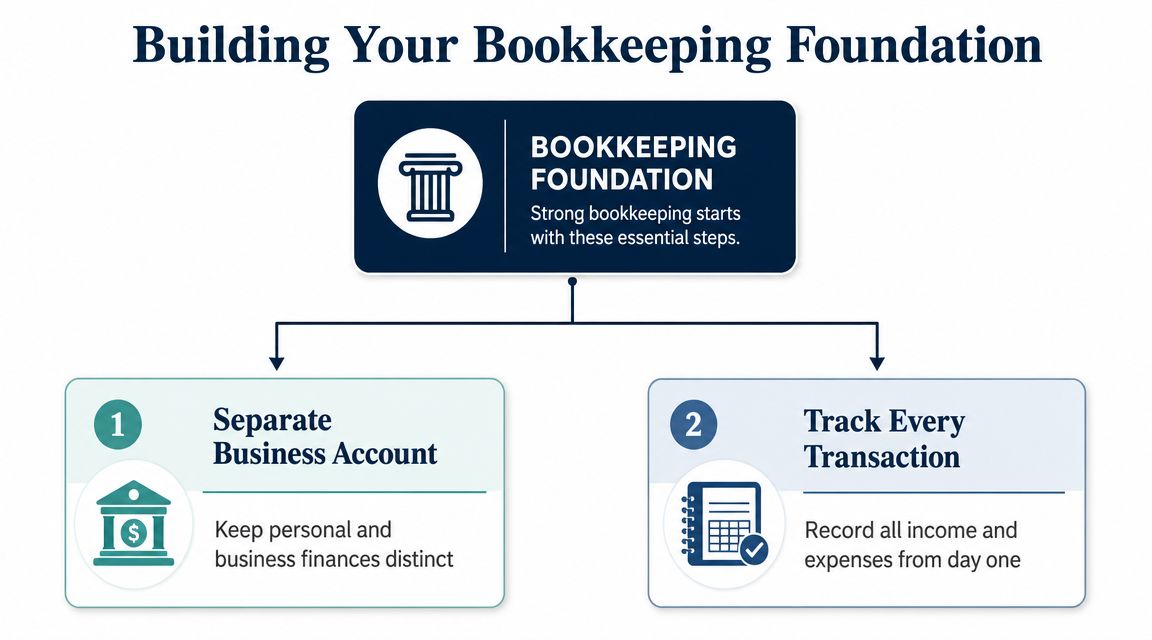
A solid workflow for makers is straightforward. Open a dedicated business bank account or card, build a chart of accounts, record every transaction with date, amount, and purpose, reconcile monthly, and store receipts digitally by month for traceability, as outlined in this bookkeeping workflow for craft businesses.
Open a separate business account first
This is not optional.
If business money and personal money run through the same account, every bookkeeping task gets harder. You have to sort out what was business, what was personal, and what was half and half. That wastes time and creates mistakes.
Go to the bank and keep it simple. Ask for a business checking account and, if possible, a business debit card or credit card that you'll use only for the business. If you're small and just starting, you don't need anything fancy. You need clean separation.
Use a basic script if that helps:
“I need an account I'll use only for my craft business. I want all sales deposits and business expenses going through one place.”
That one move gives you a clean record of income and spending from day one.
Your chart of accounts is just a folder system
“Chart of accounts” sounds bigger than it is. It's just a list of categories for your money.
Much like labeled drawers in your studio, where throwing every bead, label, and tool into one giant bin makes finding anything impossible, your bookkeeping operates similarly. Categories help you see what each dollar was for.
Here's a simple version you can copy and use.
| Account type | Suggested category |
|---|---|
| Income | Product sales |
| Income | Shipping income |
| Income | Wholesale sales |
| Cost-related | Raw materials |
| Cost-related | Packaging and shipping supplies |
| Expense | Etsy fees |
| Expense | Shopify fees |
| Expense | Payment processing fees |
| Expense | Craft fair fees |
| Expense | Marketing |
| Expense | Postage and shipping expense |
| Expense | Software |
| Expense | Studio or workspace expense |
| Expense | Utilities related to the business |
| Equity | Owner's draw |
| Asset | Inventory |
Keep the categories useful, not perfect
You don't need a giant list. You need categories that help you make decisions.
If you sell on Etsy and at in-person events, separate those costs. If shipping is a real part of your business, separate shipping charged to customers from what shipping costs you. If materials are a major part of what you make, keep them visible.
A simple setup works better than an impressive one nobody updates.
- Revenue buckets: Separate product sales from shipping income if both show up in your records.
- Fee buckets: Keep platform and payment fees visible so they don't disappear into generic expenses.
- Production buckets: Materials, packaging, labor if you pay helpers, and overhead should not all live in one line.
Practical rule: If a category helps you price better, spot waste, or explain profit, keep it. If it doesn't, remove it.
Tracking Your Materials and True Product Costs
This is the part that trips up almost every maker.
When you buy a box of wax, a roll of fabric, or a bulk pack of earring hooks, it feels like you “spent” that money right away. In bookkeeping, that's not the full story. You bought inventory. The cost becomes part of your product cost as materials are used and products are sold.
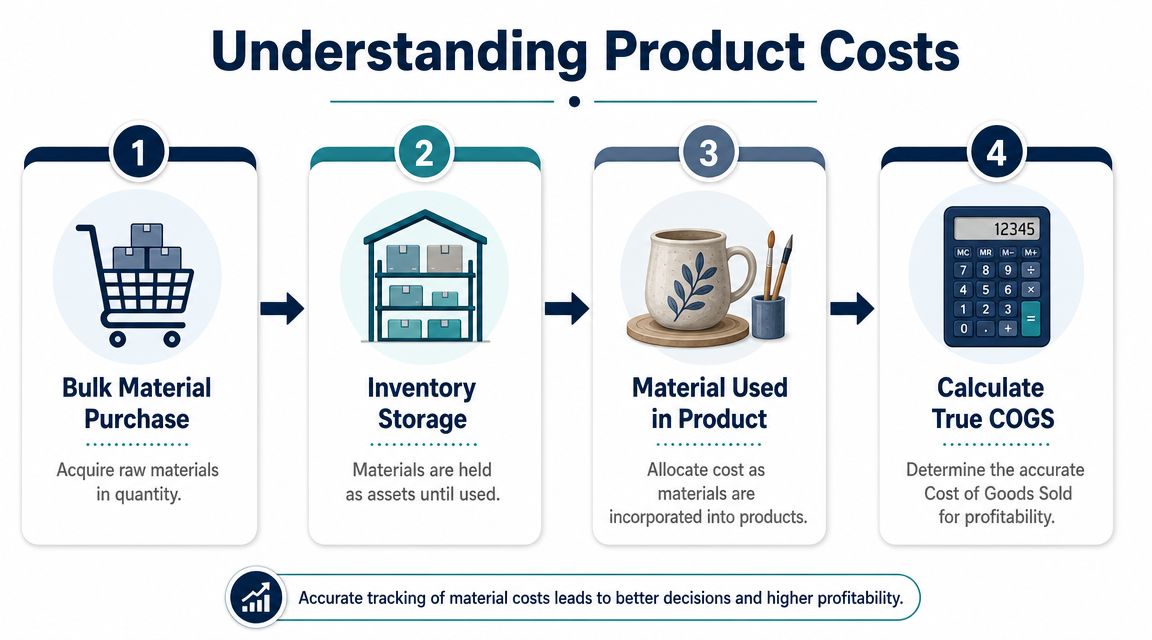
For makers, records need more than simple income and expense totals. Each transaction should capture details like date, sales channel, products, discounts, and sales tax. You also need opening and closing inventory to calculate COGS using Opening Inventory + Purchases − Closing Inventory, and the IRS requires businesses producing goods from raw materials to track inventory, as explained in this recordkeeping guide for craft businesses.
What COGS really means for a maker
COGS stands for Cost of Goods Sold. It's the cost of the materials tied to the products you sold.
That matters because many makers make the same mistake. They buy a big supply order in one month, dump it all into expenses, and think profit disappeared. Then the next month looks strangely profitable because they didn't buy much. The numbers swing around, but the business hasn't really changed. The bookkeeping is just telling the story badly.
Here's a plain example.
You buy a bulk pack of jewelry findings. You don't use all of them right away. Only the portion used in sold products belongs in your product cost for that period. The rest is still inventory sitting on your shelf.
The wrong way and the right way
Let's compare them.
| Approach | What happens |
|---|---|
| Expense all materials as soon as you buy them | Profit looks lower in purchase months and distorted later |
| Track materials as inventory until used | Product costs line up better with actual sales |
That second method is what gives you a real margin.
If you want a plain-English breakdown, this cost of goods sold guide is a useful place to start.
What you need to track for each product
This doesn't have to be fancy, but it does have to be consistent. For each material purchase, keep a record of:
- What you bought: Wax, yarn, clay, clasps, labels, boxes, whatever goes into your products.
- How much you bought: Quantity matters because you'll use it over time.
- Unit cost: The cost per item, ounce, yard, or pack.
- Supplier: Helpful when prices change or you need to reorder.
- Arrival date: Useful for inventory control and clean records.
Then build a simple bill-of-materials style list for each product. That just means writing down what materials go into one finished item or one batch.
For example, if you make soap, one batch might use base, color, fragrance, mold liners, and packaging. If you make tote bags, one bag might use fabric, thread, label, and tag.
If you don't track which materials go into which products, you can't trust your margins.
Why makers get pricing wrong
Most underpricing comes from one of two problems. Either you're guessing on material cost, or you're ignoring related costs like packaging, shipping differences, and selling fees.
A product can look profitable when you only count the obvious raw material. Then you add packaging, marketplace fees, refund risk, and shipping overages, and the picture changes fast.
That's why bookkeeping for small craft business owners has to go deeper than cash in and cash out. You need product-level thinking. Not just “Did the business make money?” but “Did this item make enough money to deserve shelf space, studio time, and reorder cash?”
Keep inventory simple, but keep it real
You do not need warehouse software on day one. You do need a repeatable habit.
Try this:
- Count your starting inventory at the beginning of your tracking period.
- Record all material purchases as they come in.
- Track what goes into each product or batch using your bill of materials.
- Count what's left at the end of the period.
- Use the COGS formula to keep your records grounded in reality.
The biggest technical pitfall for makers is incomplete inventory and COGS detail. Guidance for craft businesses also recommends recording each sale with channel, quantities, discounts, sales tax, and shipping charged versus actual shipping cost, then matching that with product-level records, according to these bookkeeping basics for product businesses.
Recording Sales and Untangling Fees
Sales look simple until you sell in more than one place.
An Etsy sale, a Shopify order, and a cash sale at a weekend market do not land in your books the same way. If you lump them together and ignore the fees, your revenue looks better than reality. That's how makers end up feeling busy but underpaid.
Don't record only the payout
This is the mistake I see all the time. You get a deposit from a platform and record that deposit as sales. That's incomplete.
You need the full sale record, then the fees, then the shipping pieces, then the tax collected. For makers, each sale should include channel, quantities, discounts, sales tax, and shipping charged versus actual shipping cost. That level of detail is what helps you understand product and channel profitability.
Here's a clean approach:
- Gross sale: What the customer paid for the product.
- Discounts: Any promo or coupon applied.
- Sales tax collected: Money collected from the buyer that isn't your income.
- Shipping charged: What the buyer paid for shipping.
- Fees: Platform or payment charges.
- Actual shipping cost: What you paid to ship it.
A simple channel-by-channel method
If you sell in multiple places, track sales by channel. That one move makes your books much more useful.
| Sales channel | What to record |
|---|---|
| Etsy | Sale amount, discounts, fees, tax collected, shipping charged, actual shipping cost |
| Shopify | Sale amount, payment fees, tax collected, shipping charged, actual shipping cost |
| Craft fairs | Cash and card sales, booth fees, tax collected, packaging or event-specific costs |
| Wholesale | Invoice amount, payment received, discounts, shipping and related fees |
For craft fairs, write down cash sales the same day or the next day at the latest. Waiting a week is how numbers disappear.
Keep platform fees visible
Platform fees deserve their own categories. If Etsy fees, payment processing, and website costs all get dumped into one generic expense account, you lose useful information.
You don't need perfection. You need visibility.
If one channel creates lots of sales but eats up margin with fees and shipping issues, that matters. If another channel brings fewer orders but cleaner profit, that matters too.
A good rule is to review any selling channel that feels busy but leaves you frustrated. The bookkeeping usually explains why.
Revenue without fee tracking is inflated revenue.
If you invoice custom orders or wholesale clients, basic receivables habits also help. This accounts receivable best practices guide can help you stay organized when money doesn't come in at the moment of sale.
A quick note on sales tax
I'm not giving tax advice here, but I am giving you a bookkeeping warning. Don't treat sales tax collected as income. It isn't.
Also, if your online shop grows across state lines, you need to pay attention to when sales tax obligations get more complex. That's the point where a tax professional is worth asking, because cleaning up sales tax after the fact is a pain.
Your Monthly Bookkeeping Checklist
Messy books usually come from delay, not difficulty.
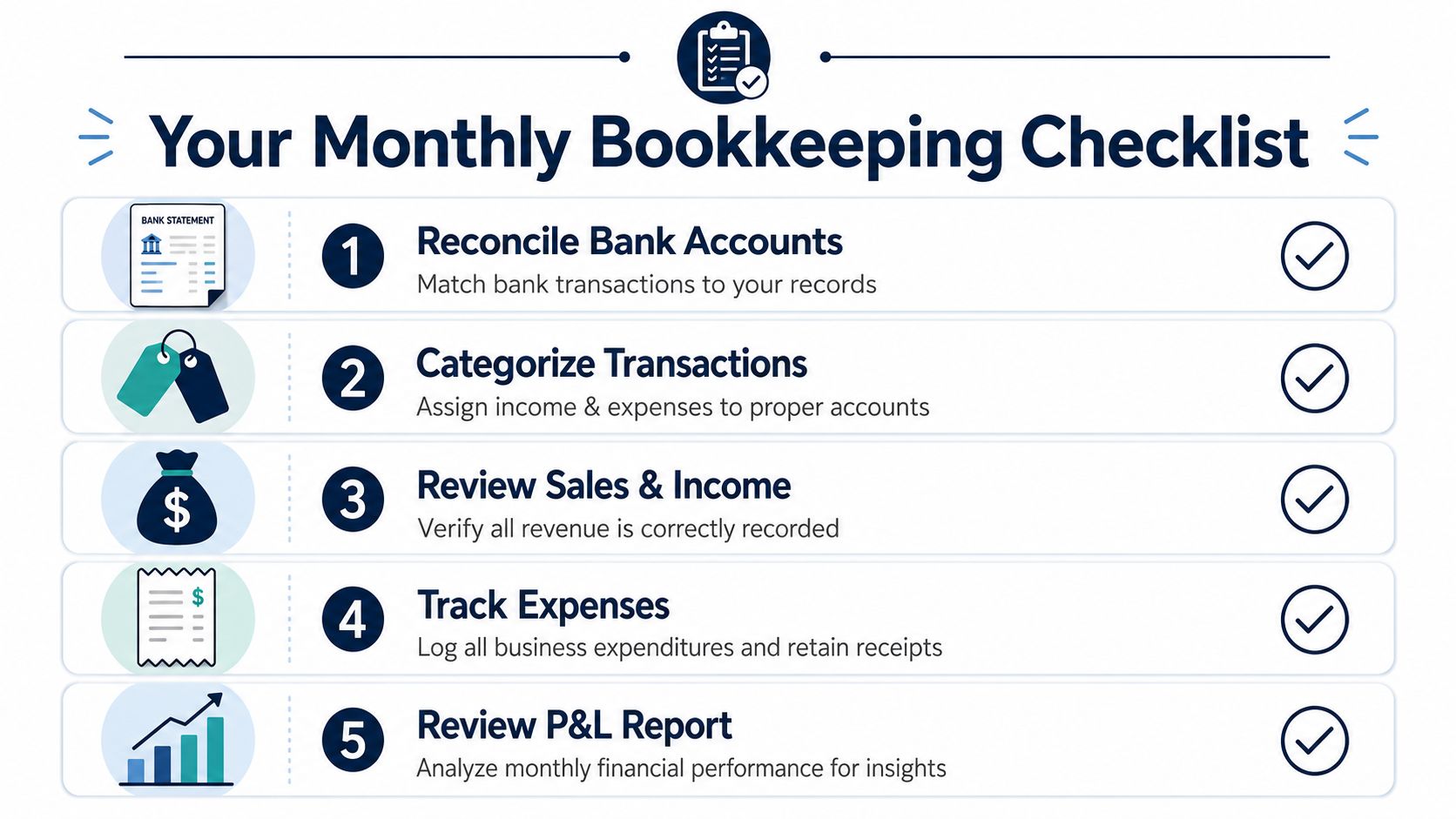
If you let bookkeeping pile up for months, it turns into a weekend-killing project. If you handle it every month, it's manageable. For most makers, a short, repeatable routine beats a big cleanup every time.
Your core monthly routine
Use this as your baseline checklist.
Categorize every transaction
Go through your business bank account and card. Make sure each transaction lands in the right category. Don't leave mystery charges uncategorized.Reconcile your accounts
Match your bookkeeping records to your bank and credit card statements. If the books and the bank don't agree, find out why now, not at tax time.Record missing sales
Add any cash sales from markets, local pickup orders, or direct payments that didn't flow neatly through your software.Review your Profit and Loss report
Look at income, cost-related accounts, and expenses. You're not trying to become a financial analyst. You're checking whether the month makes sense.File your receipts
Save digital receipts by month. Scan paper ones and store them in the same monthly folder.
A weekly habit makes month-end easier
Monthly is the minimum. Weekly is smarter.
The practical benchmark I recommend is simple. Review and categorize transactions weekly, then do your full month-end reconciliation on schedule. That reduces errors and keeps small problems from growing teeth.
Try a basic folder setup like this:
- Bank and card statements: One folder per month
- Receipts: One folder per month
- Marketplace reports: Separate subfolder for Etsy, Shopify, fairs, or wholesale
- Inventory notes: Product counts, purchase logs, or batch records
Your receipt system is working if you can pull up any business receipt quickly without digging through email for half an hour.
Don't forget how you pay yourself
A lot of owners accidentally make their books messy by treating personal transfers like business expenses. Don't do that.
If you take money from the business for personal use, record it as an owner's draw in equity, not as an expense on your Profit and Loss report. That keeps your business expenses honest and your profit report useful.
Here's a short monthly review table you can keep near your desk.
| Task | What you're checking |
|---|---|
| Transactions | Everything is categorized clearly |
| Reconciliation | Books match bank and card statements |
| Sales | All channels and cash sales are recorded |
| Receipts | Backup exists for expenses |
| P&L review | Income and spending look reasonable |
| Owner's draw | Personal transfers are not buried in expenses |
Consistency beats intensity
You do not need a marathon bookkeeping day.
You need a routine you'll stick with. A simple monthly process, supported by quick weekly reviews, is enough to keep most small craft businesses under control and far away from shoebox accounting.
Choosing Your Tools and Knowing When to Call for Help
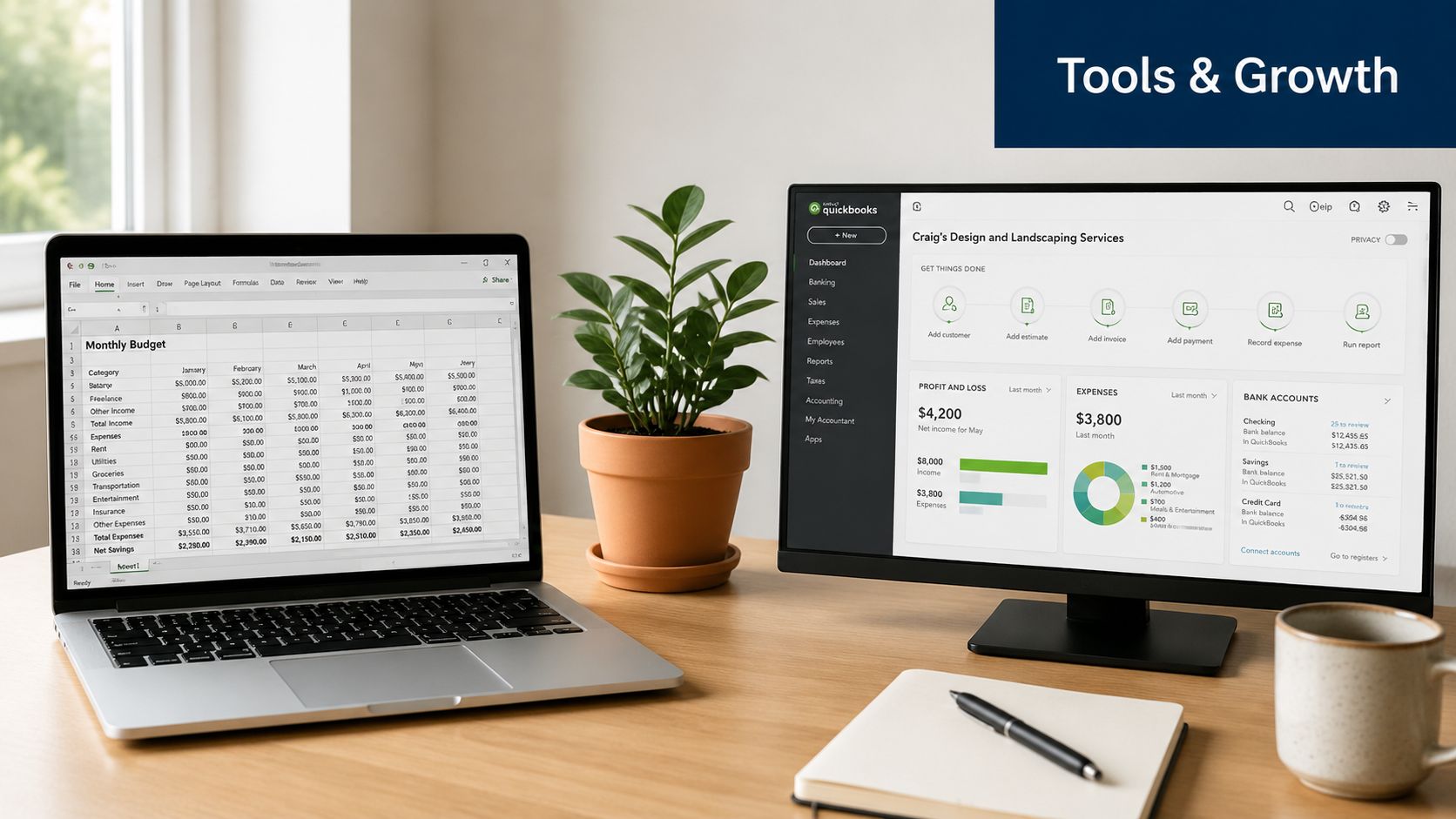
You can absolutely start with a spreadsheet. For a very small operation, that's fine.
But spreadsheets have a shelf life. Once you're selling in multiple channels, tracking inventory, dealing with platform fees, and trying to understand product-level profit, manual systems start to fight back.
Pick tools that match your stage
A spreadsheet works when you have few products and low complexity. Once the business grows, accounting software makes life easier. A QuickBooks survey found that 71% of small business owners use accounting software or apps, and 71% still use some manual method too, which tells you hybrid systems are common, not unusual, according to these small business financial literacy statistics.
That means you don't have to go all-in on software overnight. Many makers use a mix of tools for a while.
Here's the practical version:
- Spreadsheet: Fine for early tracking if you're disciplined.
- QuickBooks: Good when you need stronger bookkeeping, reporting, and bank feeds.
- Craftybase: Useful if inventory and maker-specific product costing are becoming the pain point.
- Receipt tools or cloud storage: Helpful for keeping support documents easy to find.
If you're comparing options, this guide to accounting software for microbusinesses gives a useful overview without assuming you're a larger company.
The point where DIY stops making sense
You should seriously consider professional help when any of these are true:
- You don't trust your numbers anymore: You're making pricing or purchasing decisions with crossed fingers.
- Your books are always behind: If you're months late, you're managing blind.
- Inventory is getting harder to track: More SKUs, more materials, more room for error.
- You're making bigger business moves: Hiring, studio rent, loans, wholesale growth, or a major platform expansion.
- Bookkeeping is stealing creative time: If admin keeps pushing out production, the system is costing you more than it's saving.
That's where outsourced help becomes a smart investment, not a luxury. A service like outsourced bookkeeping for small business can take over the day-to-day cleanup, reporting, and organization so you can focus on making and selling. If you need hands-on support, MyOfficeOps is one option for bookkeeping, reporting, and financial visibility as your business gets more complex.
You do not have to wait until things are a mess to get help. In fact, the smartest time is usually just before the mess gets expensive.
If your craft business is growing and your bookkeeping hasn't caught up, MyOfficeOps can help you build clean books, understand your numbers, and get a clearer view of profit without turning your studio time into admin time.