
You close the month, open the balance sheet, and one number just feels off. Maybe cash is fine, but accounts receivable looks crowded, a payroll clearing account won't zero out, and a payment platform dumped a summary entry that doesn't match the detail you expected. That's the point where general ledger reconciliation stops being a back-office chore and turns into a reality check for the whole business.
Why Your Books Need a Reality Check Every Month
At month-end, a lot of owners get that stomach-drop moment. The bank feed looks clean, the invoices were sent, payroll ran, and still one account doesn't tie out the way it should. That's usually when the real work starts, because the books don't care how busy the month was. They only care whether the balances can be proved.
General ledger reconciliation is the process of proving that the balance in the ledger matches an independent record outside the ledger. For cash, that's the bank statement. For receivables, it's the aging report or open invoice detail. For fixed assets, it's the depreciation schedule. A good overview of the month-end rhythm sits in this month-end close guide, and reconciliation is one of the parts that keeps the close honest.
A missed deposit, duplicate vendor bill, or expense coded to the wrong account can sit there for weeks. Then it shows up later as a tax headache, a bad margin decision, or a lender asking why the numbers changed. That's why this isn't just “bookkeeping cleanup.” It's how you keep small errors from becoming expensive ones.
Practical rule: if an account balance can't be tied to something independent, it isn't ready to trust.
The scale problem is bigger than many owners expect. Resourceful Finance Pro's benchmarking found that 63% of companies have 100 to 500 active accounts in the general ledger, and another 30% manage 501 to 3,000 active accounts. The same benchmark found that 83% reconcile 100 to 500 accounts at least quarterly. It also showed that 54% use no tools for reconciliation, while 23% use third-party software and 22% use internally built tools. That's a lot of recurring work still happening by hand, even when the account count is already large enough to cause trouble. The benchmark is at Resourceful Finance Pro.
The main lesson is simple. If the ledger is a memory of what happened, reconciliation is the proof that the memory is accurate.
The Core Reconciliation Workflow That Actually Works
The cleanest workflow starts before anyone begins matching numbers. Freeze the period first. If new entries keep sliding in while someone is reconciling, the workpaper turns into a moving target and the ending balance loses meaning.
After that, pull the trial balance straight from the GL and gather independent support for each account. Cash should be tied to the bank statement, receivables to the aging report, payables to vendor support, and fixed assets to the depreciation schedule. If you want a solid bank-rec framework as a companion, ReceiptsAI bank reconciliation tips are useful because they focus on matching records before you start adjusting anything. A broader account-by-account approach is laid out in this reconciliation-of-bank-accounts guide.
Match the detail, not just the totals
Total-only tie-outs are where people get fooled. Two wrong entries can cancel each other out and still produce a matching total, which makes the account look fine when it really isn't. Comparing at the transaction level is slower, but it catches offsetting mistakes before they spread into other accounts.
When a difference shows up, sort it into one of two buckets. A timing item is real but temporary, like a check that hasn't cleared or a deposit still in transit. An actual error needs a fix, like a duplicate bill, a missed posting, or a misclassified transaction.
Practical rule: don't post an adjustment until you can explain why the difference exists.
Once the cause is clear, post only evidence-backed correcting journal entries. Then keep the support, the explanation, and the reviewer's sign-off together. That's what makes the file audit-ready later, not just “done” for the month.
A lot of accountants describe this as freeze, gather, match, classify, correct, and sign off. That sequence works because each part protects the next one. Skip the freeze, and new activity muddies the waters. Skip the review, and a simple mistake can get approved twice.
Reconciling the Accounts That Matter Most
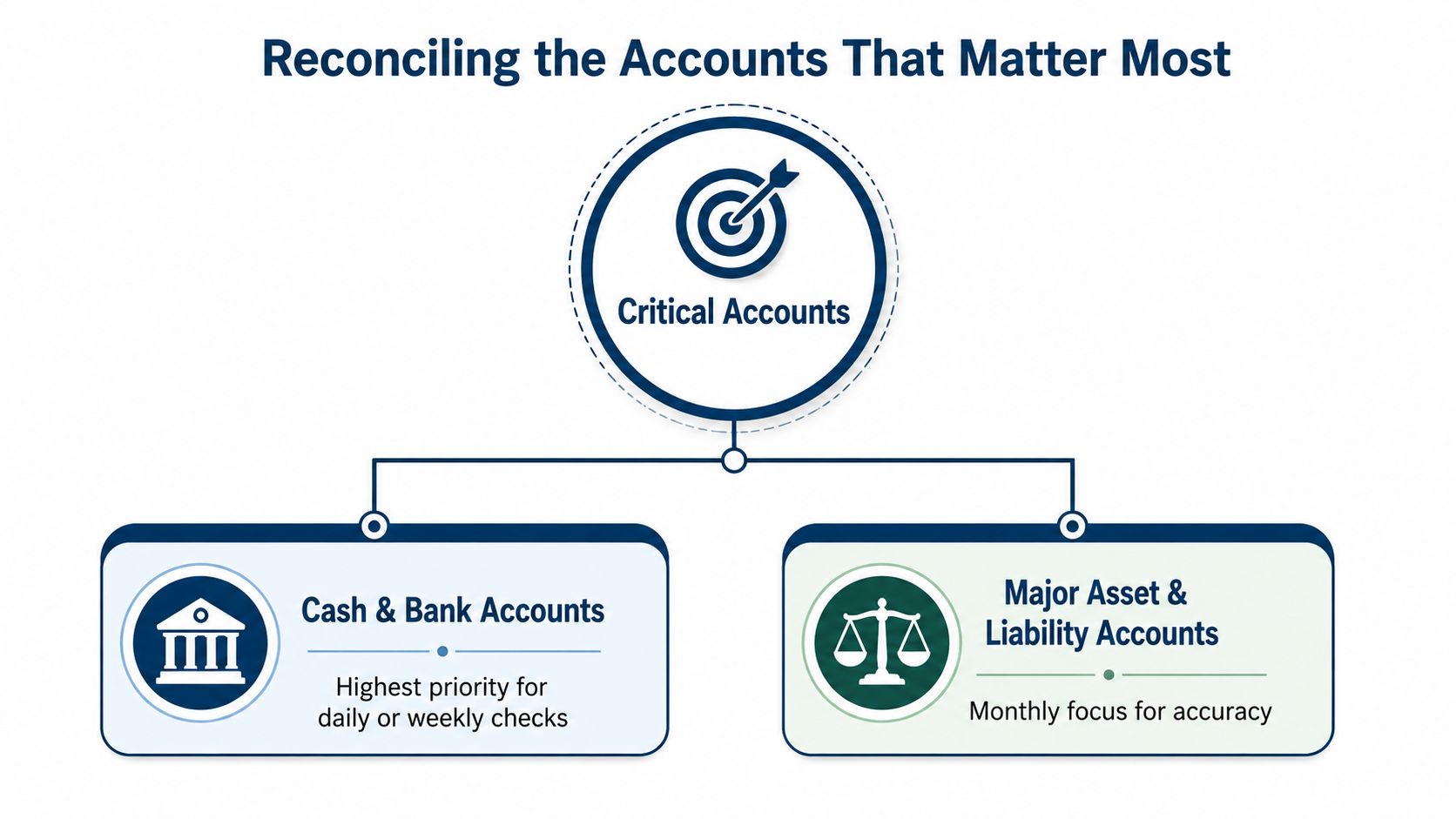
Not every account deserves the same attention. A small prepaid expense with no movement doesn't need the same energy as cash, payroll, or receivables. That's why experienced bookkeepers risk-rank accounts by volume, business impact, and how ugly the fallout would be if something stayed wrong for a month.
Start with the accounts that move money
Cash and bank accounts come first because they touch everything else. Match them to the bank statement, watch for outstanding checks, deposits in transit, and bank fees that haven't been booked yet. A one-line mismatch here can throw off the rest of the close, so clean support matters most at this stage.
Accounts receivable should be tied to the aging report and open invoices. If the GL says a customer balance is low but the aging report still shows an old invoice, the usual problem is not math, it's process. Someone may have received payment without closing the invoice, or the payment may have been applied to the wrong account.
Accounts payable can hide duplicate bills, missed credits, and unapplied vendor adjustments. Vendor statements help, but so do the original invoices and payment runs. If a bill appears twice, the issue isn't fixed by forcing the total to match. The extra posting has to be found and backed out.
Payroll deserves special care because it has several moving parts at once, gross wages, tax withholdings, benefits, net pay, and any payroll liability accounts. For that reason, PEO Metrics reconciliation advice is useful when you're trying to keep the payroll side tied to provider reports instead of guessing from the GL alone. Their focus on payroll reconciliation lines up well with what SMBs deal with every cycle.
Don't ignore the oddball accounts
Clearing and suspense accounts should be temporary, but in real life they often become junk drawers. That's where orphaned transactions, misapplied payments, and half-finished entries end up. If an account is supposed to zero out and it doesn't, the balance is telling you something got parked and forgotten.
Construction firms often need an eye on job cost clearing. Professional services teams may need to watch revenue deferrals and project-related receivables. Healthcare businesses often have patient billing or collections layers that don't behave like a simple retail ledger. The common thread is the same. The account itself isn't the problem. The coding behind it is.
For a deeper look at how subledgers sit underneath the GL, this subsidiary ledger resource helps explain why the detail matters before the summary does.
Common Reconciliation Mistakes and How to Catch Them
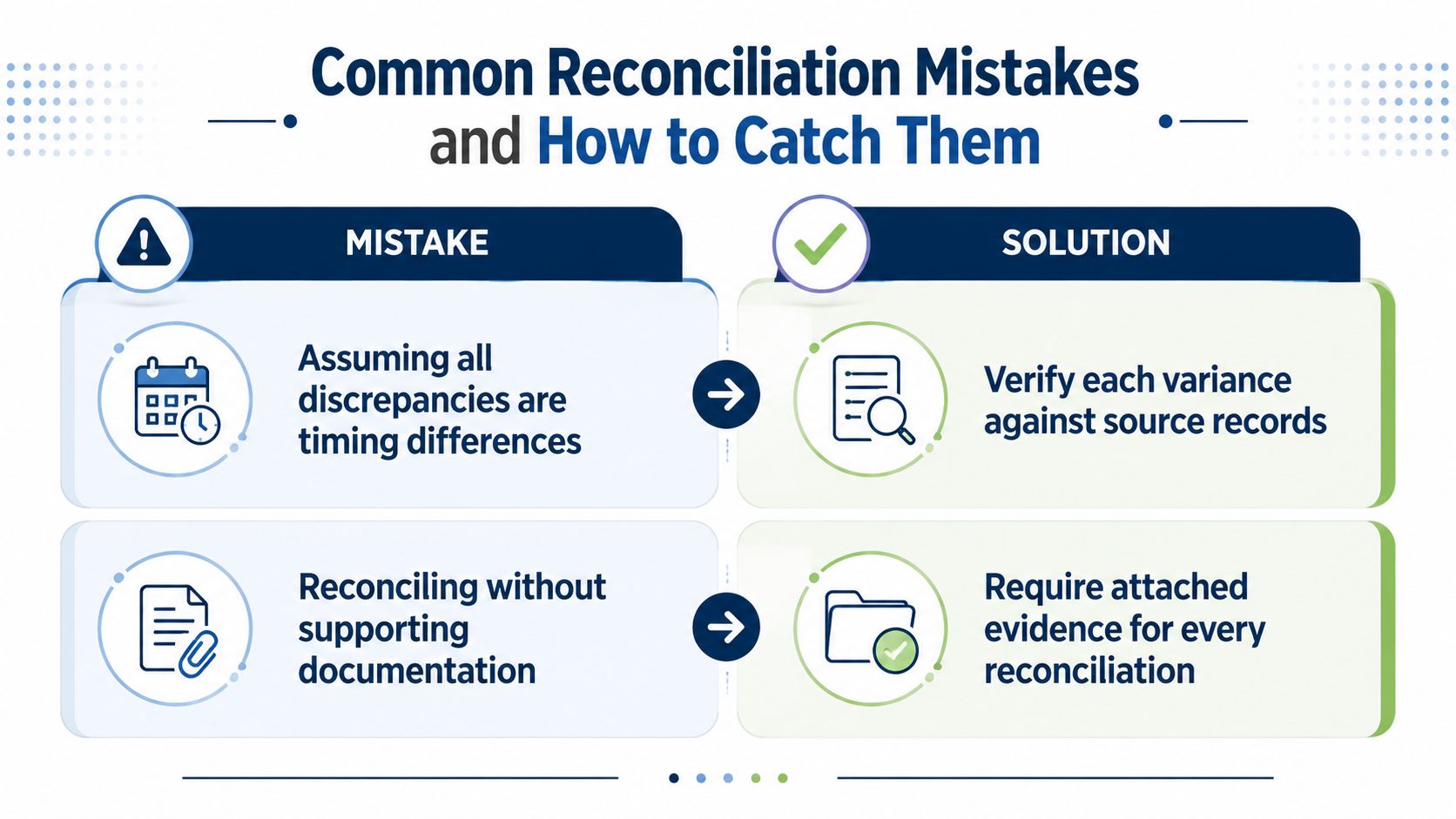
The biggest mistake I see is assuming every mismatch will sort itself out next month. Sometimes it does. A lot of the time, it doesn't. A duplicate payment, a miscoded transfer, or a bill applied to the wrong invoice will happily sit there forever unless someone digs in and fixes the source.
The usual trouble spots
One common problem is misuse of Undeposited Funds. Money sits there longer than it should, then the clearing account stops acting like a clearing account and starts acting like a parking lot. The symptom is a balance that never seems to empty out, even though the payments should have already hit the bank.
Another issue is ad hoc journal entries with no support. They may solve a short-term close problem, but they create a long-term one because nobody can tell where the number came from. If the only explanation is “we needed it to tie,” that isn't a real reconciliation. It's a patch.
Bad chart-of-accounts design creates another layer of pain. If everything gets shoved into a vague catch-all bucket, the recon becomes a guessing game. The cleaner the account structure, the faster the mismatches show you where they came from.
Modern platforms create new mismatch types
Payment tools like Stripe and Square can feed summary entries into the GL, while the subledger holds the transaction detail. That's where people get trapped. The summary may look right on its own, but the detail can still be off because of timing cuts, duplicate feeds, or a transfer that got classified wrong on the way in.
The balance is not the proof. The proof is the support behind the balance.
The fix is boring, but it works. Verify each variance against source records, require attached evidence, and write down the reason before the adjustment goes through. That keeps the recurring issue visible instead of hiding it inside a neat-looking total.
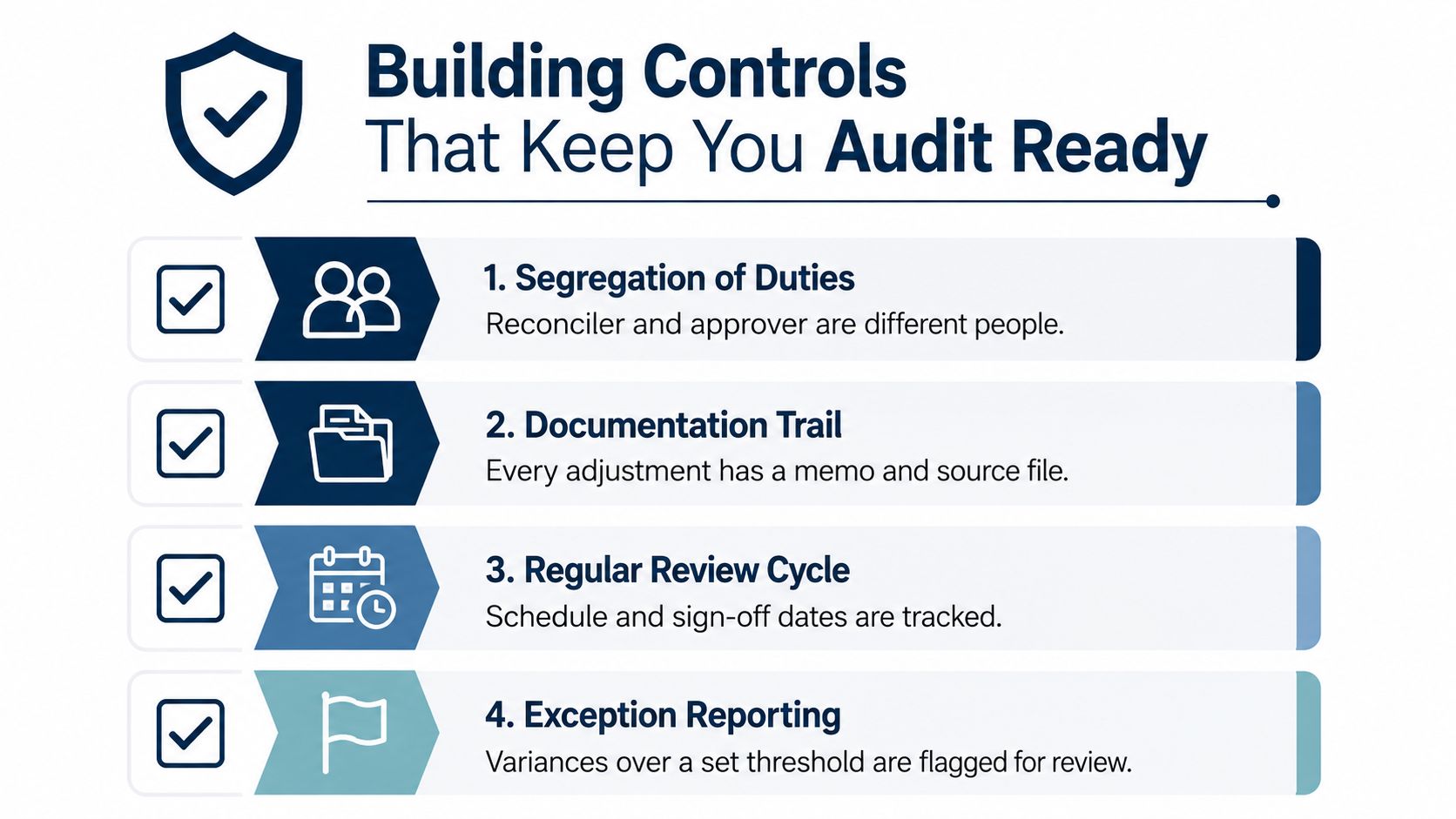
A stronger workflow also needs control points. Separation of duties helps because the person who prepares the recon shouldn't be the same person who rubber-stamps it. Review dates, sign-off, and a documented trail matter because they show who checked what, and when. For a practical compliance lens, building proactive compliance posture is a useful way to think about the broader control environment around reconciliation.
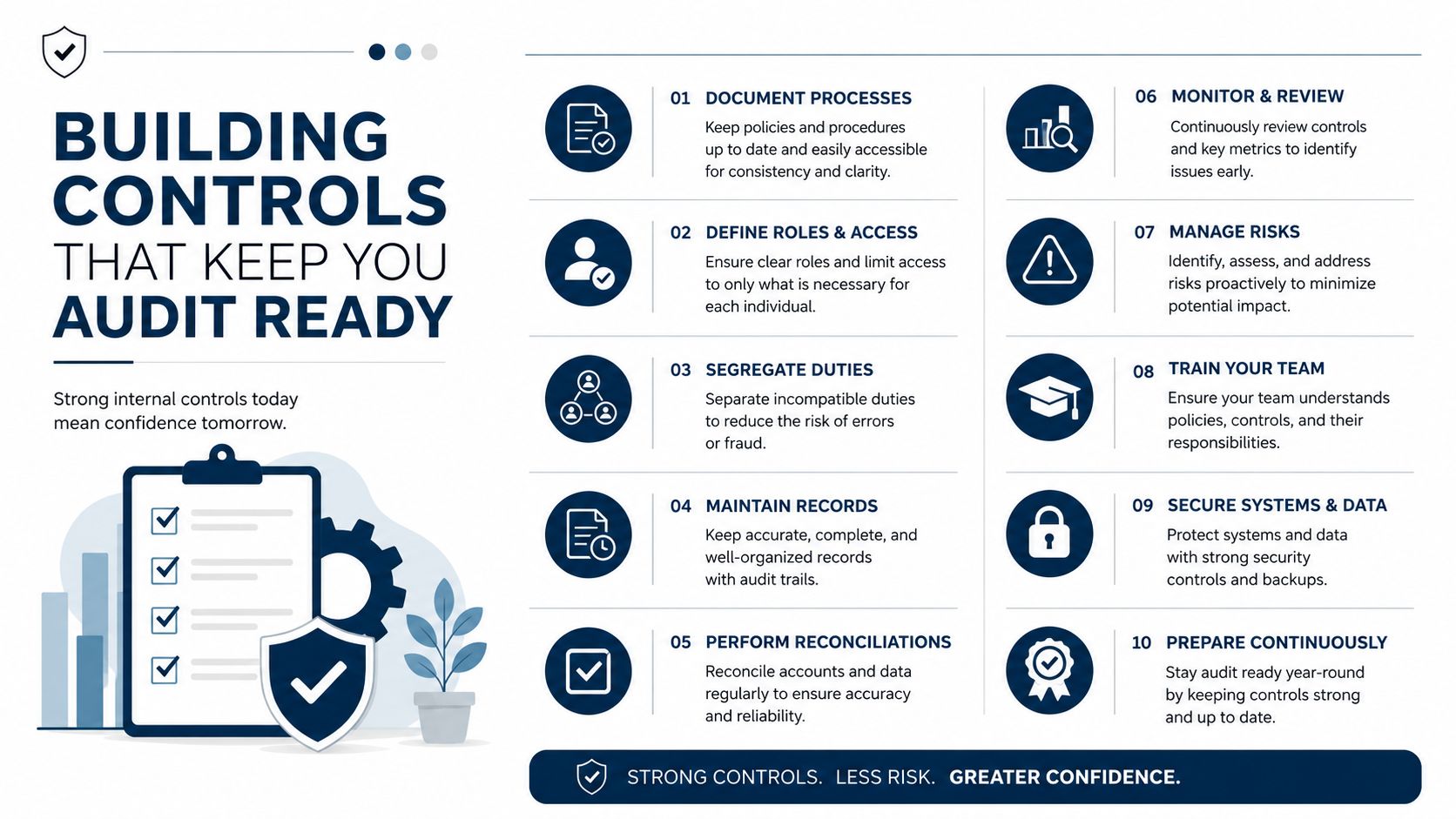
Building Controls That Keep You Audit Ready
A reconciliation file should tell a clean story months later, not just pass today's close. That story needs an opening balance, the transactions reviewed, unmatched items with explanations, any adjustments posted, and the closing balance. If a reviewer can't follow that chain, the workpaper isn't finished yet.
Timing matters too. One practical rule is to reconcile all balance sheet accounts each month, and one source says to finish the work three days before the books are closed so mistakes don't roll into the next period. The same source also says to start from the prior period's ending balance by using a trial balance report, which is common sense once you think about it. The new month should prove it carried forward the old month correctly before anything else gets layered on top. That workflow is described in Study.com's general ledger reconciliation policy and process guide.
Build the control, not just the cleanup
A reviewer's sign-off matters even in a small team. It forces a second set of eyes on the logic, not just the math. If the accountant who prepared the recon also approves it without question, there's no control, just a completed form.
Risk-ranking the accounts helps a lot when time is tight. High-volume, high-exposure accounts need tighter attention than quiet, low-movement accounts. That doesn't mean the quiet accounts get ignored. It means the work gets matched to the risk instead of spread evenly like peanut butter.
The win is that this habit supports more than the books. It helps during tax prep, lender requests, and buyer due diligence because the support is already organized. It also makes it easier to see which accounts are repeatedly messy and which ones are safe to leave on a lighter review cycle.
If the process feels too fragmented to manage well, that's usually the point where a tool or outside bookkeeping partner earns its keep. A lot of teams use a mix of workflow software, spreadsheet controls, and review checklists before they ever bring in outside help. MyOfficeOps is one option in that space, since it handles bookkeeping, bank reconciliations, payroll integration, and CFO-level reporting for SMBs that need cleaner month-end close files.
When to Handle It In-House and When to Bring in Help
If reconciliation is still getting done by one exhausted person after everyone else has moved on, that's a warning sign. If the same mismatches keep showing up, if nobody feels confident in the reports, or if you're adding new entities and payment platforms faster than the process can absorb them, the work has outgrown the current setup.
The APQC benchmark cited by CFO.com shows a median GL reconciliation time of 6 hours, with the 25th percentile at 5 hours and the 75th percentile at 10 hours. If your team is far beyond that and still mostly working by hand, the process may be too manual or too scattered to stay healthy. That benchmark is covered in CFO.com's metric of the month on reconciling the general ledger.
A good outside partner does more than enter transactions. They tighten the chart of accounts, standardize the reconciliation workflow, set review sign-offs, and make sure the reports are usable for hiring, pricing, and cash decisions. If you're choosing help, look for someone who answers quickly, explains things without jargon, knows your industry, and can scale from core accounting into profit work when the business needs it.
If you want clean books without living inside spreadsheets every month, MyOfficeOps helps SMBs with bookkeeping, bank reconciliations, payroll integration, and CFO-level advisory. Visit MyOfficeOps if you want a practical partner that can take the close off your plate and keep the numbers ready for the next decision.