
You're staring at a bank feed late at night, trying to decide whether a payment belongs under software, supplies, or something else entirely. Your company is growing, customers need attention, and tax deadlines keep getting closer. Yet the books still depend on you remembering what every transaction means.
That situation is common for small businesses in Philadelphia, West Chester, and the surrounding suburbs. Bookkeeping starts as one more task the owner can handle, then becomes a weekly burden that competes with sales, hiring, client work, and family time. One industry summary estimates that owners who manage accounting themselves spend about 8 to 10 hours each week on bookkeeping and financial management, while another reports 10 to 15 hours per week on financial administration tasks. (Industry summary on owner bookkeeping time)
Outsourcing can give those hours back, but time is only part of the answer to why outsource bookkeeping services. The larger benefit is clarity. Clean books help you see cash, understand profit, close each month with less confusion, and make decisions with actual information instead of a guess.
Introduction Why Bookkeeping Feels Harder Than It Should
Many owners don't struggle because they're careless. They struggle because bookkeeping sits between several jobs. You have to collect receipts, match bank transactions, track unpaid invoices, check bills, review payroll, and remember which expenses belong to which part of the business. Each task seems small until they pile up.
A Philadelphia contractor might finish several jobs before reviewing job costs. A healthcare practice may have payroll, insurance payments, and vendor bills moving at different speeds. An agency or law firm may earn strong revenue while waiting on clients to pay. In each case, the owner needs more than a list of transactions. They need a reliable picture of what the business can afford today and what it can support next month.
The practical shift: Outsourcing bookkeeping isn't giving away control. It's replacing scattered financial chores with a repeatable process and clear review points.
That process matters because accounting software alone doesn't guarantee dependable records. Bank feeds can import transactions, but someone still needs to classify them, investigate unusual items, reconcile accounts, and explain what the reports mean. Owners reviewing software connections may also benefit from this resource on compliance in accounting integration, especially when several systems share financial data.
You should also know what your own role includes before deciding what to hand off. A plain-language guide to bookkeeping duties for small businesses can help you separate daily recordkeeping from approvals, planning, and owner-level decisions.
This guide focuses on the core operating question. Should you keep the work inside, outsource part of it, or use an outside team for the full process? The answer depends on your workload, risk, reporting needs, and plans for growth. For many Greater Philadelphia businesses, the right partner can turn bookkeeping from a late-night obligation into a useful management tool.
What Outsourced Bookkeeping Really Means
Think of bookkeeping as keeping the score in a game. Your bank account shows movement, but it doesn't explain the score. A bookkeeper records what happened, puts each transaction in the right place, and prepares reports that show whether the business is making money and where cash is going.
An outsourced bookkeeper performs that work from outside your company. You provide secure access to the accounting system, bank feeds, payroll information, invoices, bills, and receipts. The provider handles agreed tasks, sends questions when something doesn't make sense, and gives you reports to review.
What the service usually includes
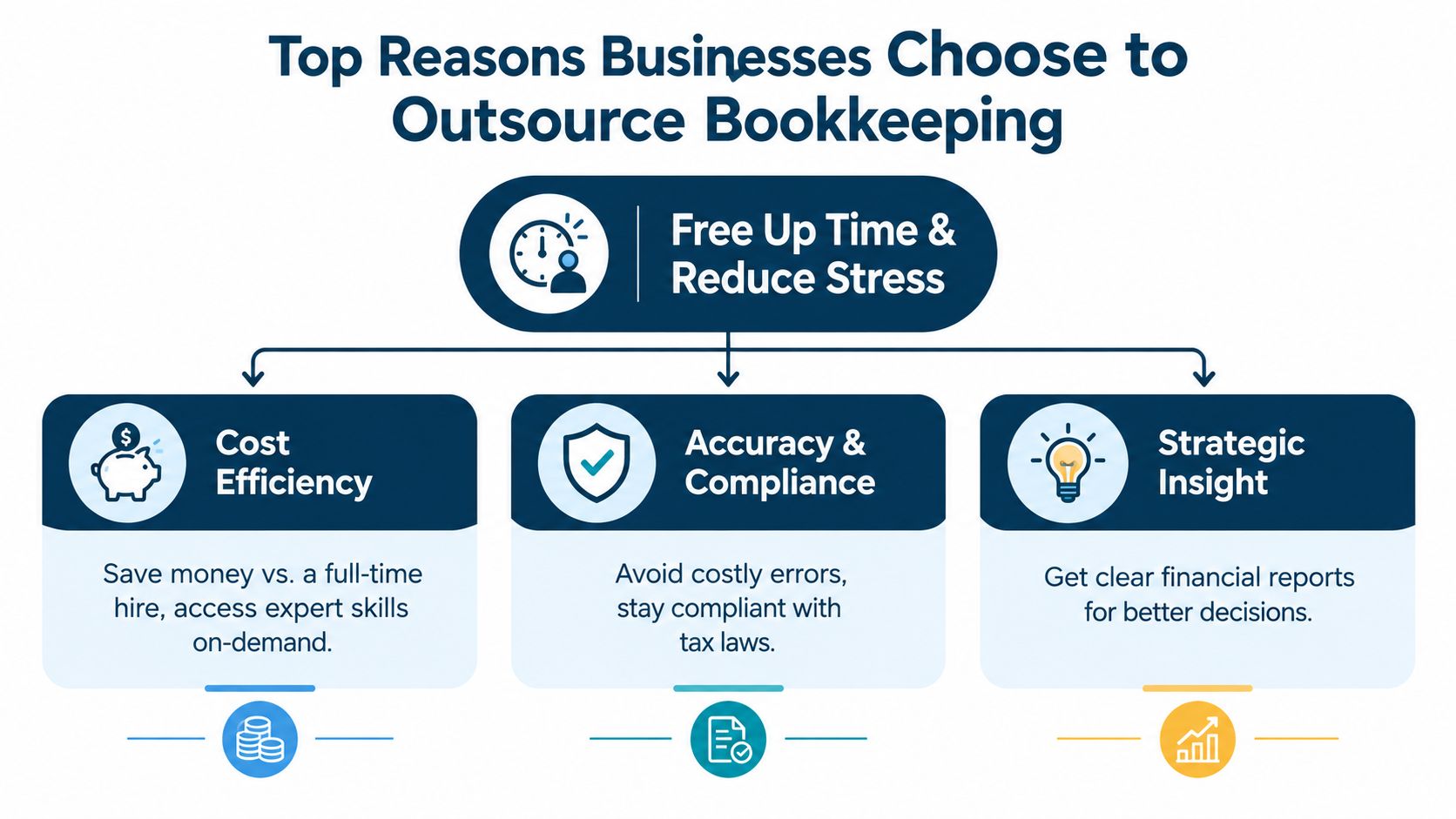
The exact package varies, but common work includes:
- Transaction recording: Categorizing income, expenses, transfers, and payments.
- Account reconciliation: Matching accounting records to bank and credit card statements.
- Accounts payable and receivable: Tracking bills owed by the business and invoices owed to it.
- Receipt management: Organizing support for purchases and business expenses.
- Monthly reporting: Preparing income statements, balance sheets, cash reports, and custom management reports.
- Payroll coordination: Connecting payroll activity to the books and checking that entries land correctly.
Bookkeeping isn't the same as a CPA's entire role. A CPA may handle tax returns, audits, attest work, or specialized tax advice. A bookkeeper maintains the records those professionals rely on. Some outsourced accounting providers add forecasting, budgeting, and CFO-level guidance, but you should confirm that scope before signing.
It also isn't the same as hiring one employee. An outside team may bring more than one reviewer, established procedures, and support that can change as your needs change. That makes the arrangement useful for a small business that needs dependable work but isn't ready for a full internal finance department.
For a more detailed look at the service model, review this guide to outsourced bookkeeping for small businesses. The key idea is simple: you're not buying a black box. You're assigning specific financial jobs to a partner, then keeping approval and review rights inside the business.
Top Reasons Businesses Choose to Outsource Bookkeeping
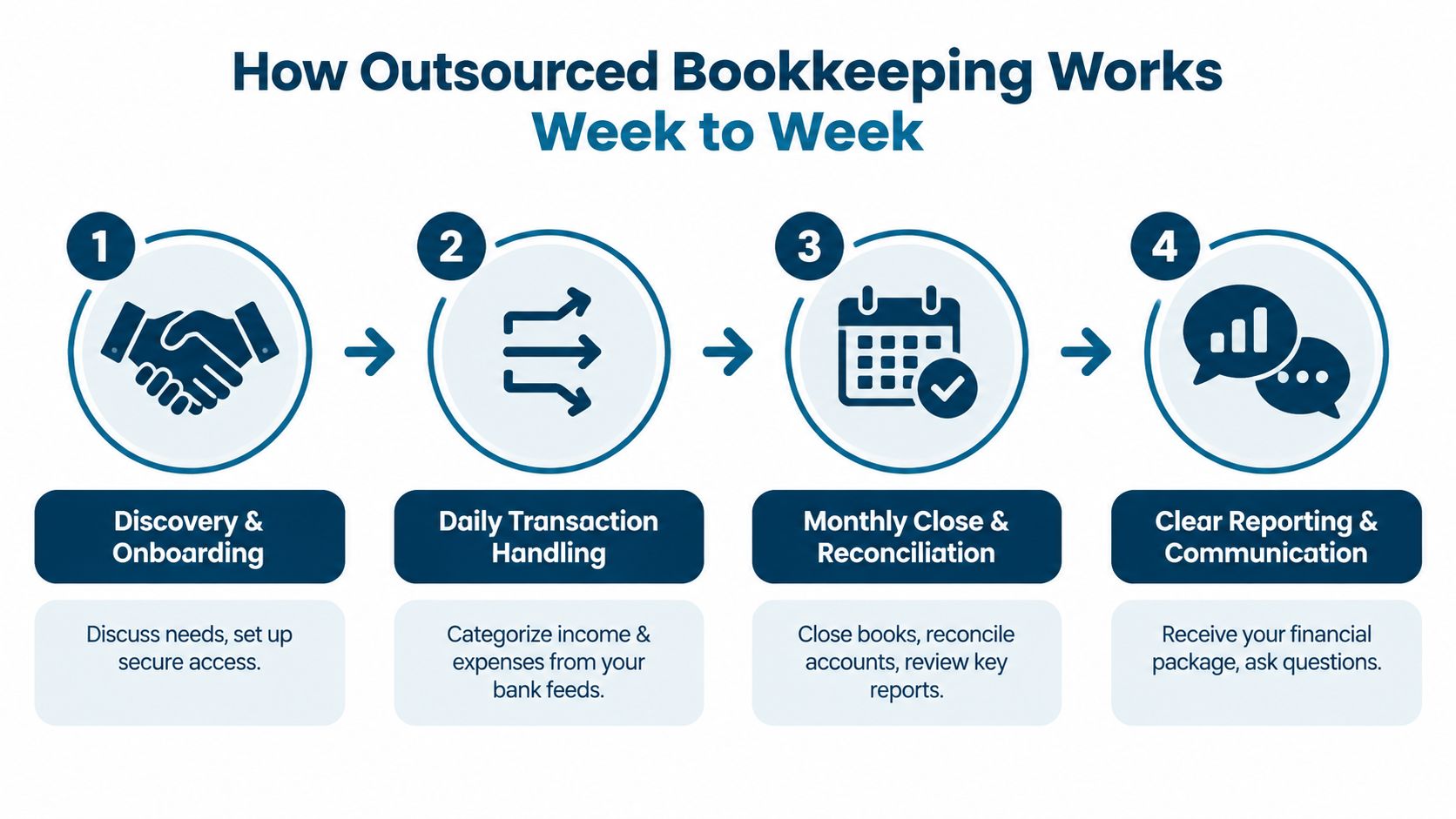
Businesses usually outsource bookkeeping for several connected reasons. Cost may start the conversation, but owners often stay because the books become easier to use.
Lower operating cost without a full-time hire
A full-time employee costs more than wages. The business also carries benefits, training, software, equipment, management time, and the problem of covering the work when that person is unavailable. One survey summary reported that small businesses experienced a 40% to 60% reduction in accounting costs when outsourcing instead of hiring in-house. (Clutch survey summary via PR Newswire)
Other 2026 industry summaries describe roughly 40% to 60% labor-cost reductions for outsourced bookkeeping and finance work, while small-business outsourcing research cites 20% to 30% average operational savings on non-core functions. (Accounting outsourcing industry summary)
The right comparison isn't an hourly rate. It's the total cost of getting accurate work completed.
Return the owner's working hours
When an owner spends every Sunday reviewing transactions, the business pays twice. First, it pays for the bookkeeping work. Second, it loses time that could go toward clients, estimates, hiring, collections, or planning.
A professional services firm may use that recovered time to follow up with overdue invoices. A construction company may review job profitability instead of sorting receipts. A clinic owner may focus on staffing and patient operations rather than trying to reconstruct last month's expenses.
Add checks that a small team can't maintain alone
Outsourcing can strengthen internal controls by separating transaction processing, approvals, and review among different people or systems. Standardized workflows, approval routing, and audit trails make it harder for one person to enter and approve the same transaction without review. (SVA guidance on outsourced internal controls)
That structure doesn't remove every risk. You still need owner approvals, secure access, and periodic review. It does, however, give a small business a practical control framework without requiring several full-time finance employees.
Turn records into decisions
Bookkeeping becomes more valuable when reports answer real questions. Can you hire? Which service line earns the strongest margin? Are customers paying slowly? Is a project consuming more cash than expected?
The finance and accounting outsourcing market's expansion suggests that buyers increasingly want more than transaction entry. A market summary places the global market at USD 54.79 billion in 2025 and USD 59.05 billion in 2026, with North America holding 40.88% share and the small and midsize business segment growing at an 8.93% CAGR through 2031. (Finance and accounting outsourcing market analysis)
Those figures don't prove that every business should outsource. They do show a broader move toward bookkeeping connected to reporting, forecasting, and advisory work.
In House vs Outsourced Bookkeeping Cost and Risk Compared
The cheapest-looking option can become expensive when you include the work around the work. An internal bookkeeper may need supervision, backup coverage, training, software support, and help during busy periods. An outsourced partner may charge a recurring fee, but the business receives a defined service and a team built around that process.
Use the comparison below as a discussion tool, not a universal price sheet.
| Cost Factor | In House Team | Outsourced Partner |
|---|---|---|
| Labor | Salary or hourly wages for an employee | Recurring service fee based on agreed scope |
| Benefits | Benefits and employer costs remain with the business | Usually included in the provider's operating model rather than added as an employee cost |
| Training | The owner or manager handles onboarding and process training | The provider trains its team on its workflows and your account |
| Software | The business may purchase and manage tools directly | The provider may use and manage the accounting workflow, with tool costs clarified in the agreement |
| Coverage | One person may be unavailable during leave or turnover | A team structure can provide continuity, depending on the contract |
| Controls | A small internal team may concentrate access and approval power | Processing, approvals, and review can be separated across people and systems |
| Management time | Internal leaders coordinate the work and resolve process gaps | The owner manages the relationship, approvals, and questions |
| Scalability | More workload may require another hire or role change | Scope can often expand or contract with business needs |
Cost isn't the only risk. If one person receives payments, enters transactions, approves bills, and reconciles the bank, the business has limited separation between duties. Outsourcing can create additional review points, but only if the provider explains who does what and how approvals work.
Questions that reveal the real value
Ask how the provider handles unusual transactions, missing documents, owner draws, credit card activity, payroll entries, and month-end adjustments. Ask who reviews reconciliations and how you'll approve payments. You should also ask what happens when the main contact leaves.
A useful ROI estimate includes:
- The hours you or your staff spend on bookkeeping.
- The full employment cost of an internal hire.
- The cost of errors, late invoices, weak collections, and delayed decisions.
- The value of timely reports during hiring, expansion, financing, or a sale.
This small-business bookkeeping cost guide can help you organize that conversation. Don't choose a provider only because the quote is lower. Choose the model that gives you dependable records, clear accountability, and enough insight to run the company.
How Outsourced Bookkeeping Works Week to Week
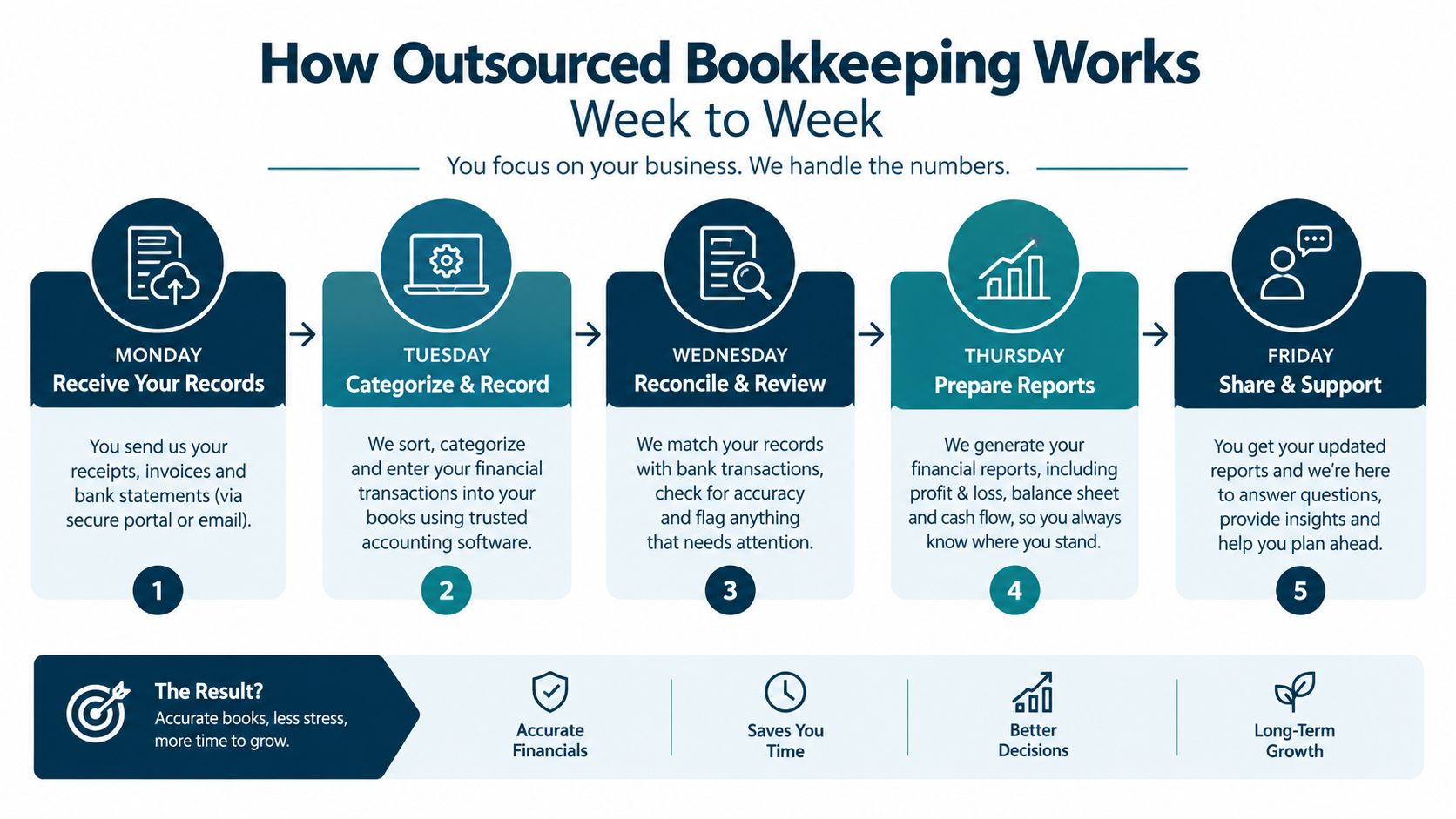
A good handoff feels less dramatic than most owners expect. The provider first learns how money moves through the business, then builds a routine around the accounts, documents, approvals, and reports that matter.
The first stage sets the rules
During discovery and onboarding, you explain your business model, accounting history, software, bank accounts, payroll process, sales cycle, and reporting needs. The partner reviews the existing books, identifies unreconciled items, confirms the chart of accounts, and defines who can approve transactions.
Secure access matters. Use individual logins, limit permissions, and agree on how documents will move between the business and the provider. Your provider should explain its security practices in plain language instead of asking you to accept vague assurances.
The weekly routine keeps work moving
A typical week may include:
- Transaction review: The bookkeeper categorizes new bank and credit card activity.
- Question queue: The team sends a short list of items that need your explanation.
- Invoice and bill tracking: Receivables and payables are updated so you can see what is due.
- Payroll coordination: Payroll reports are checked and posted to the accounting system.
- Owner approvals: You approve payments, unusual entries, or account changes that require your decision.
Cloud accounting makes remote collaboration practical, but the technology doesn't replace communication. You should know where to answer questions, when reports arrive, and who handles urgent issues.
Month-end produces the useful picture
At close, the team reconciles accounts, checks outstanding items, records needed adjustments, and prepares the financial package. The review should connect reports to decisions. A cash report can show pressure before the income statement does. A profit report can reveal that busy work isn't always profitable.
In the first phase, expect questions and cleanup. After the workflow settles, the reports should arrive with fewer surprises and clearer explanations. Over time, the service can connect bookkeeping with budgeting, forecasting, bill pay, payroll integration, and KPI reporting.
How to Choose the Right Bookkeeping Partner in Philadelphia
A Philadelphia-area owner needs more than a provider that knows accounting software. You need a partner that understands how local businesses operate and can communicate in a way your team will use.
Start with industry fit. Professional services firms care about utilization, collections, and margins by service line. Healthcare practices need dependable payroll coordination, expense tracking, and reports that support staffing decisions. Construction and trades businesses need job-cost visibility and cash planning. Real estate businesses may need property-level tracking and careful handling of recurring expenses.
A local partner checklist
Use these questions during a discovery call:
- Local understanding: Does the team understand Greater Philadelphia and West Chester businesses, or does it serve every client with the same script?
- Industry experience: Can it explain the reports your industry needs without hiding behind accounting terms?
- Clear scope: Does the proposal say who handles reconciliation, accounts payable, accounts receivable, payroll integration, reporting, and cleanup?
- Communication: Will you have a named contact, a regular review rhythm, and a clear way to ask urgent questions?
- Technology: Does the provider work comfortably with your accounting platform, payroll system, receipt tools, and bank feeds?
- Security: Can the team describe access controls, document handling, backups, and employee permissions?
- Review process: Who checks the work, approves adjustments, and investigates unusual transactions?
- Advisory depth: Can the partner help with cash flow, budgeting, profitability, or forecasting when your needs expand?
Price still matters, but it shouldn't be your first filter. A low quote may exclude cleanup, reporting, payroll coordination, or owner meetings. A higher quote may include work your business doesn't need.
Ask for a sample report: If you can't understand the sample without a dictionary, the reporting relationship may frustrate you.
Also ask what happens during growth. Can the partner support a new location, additional entities, a larger payroll, financing preparation, or a future sale? The right choice should fit your company now without forcing you to rebuild the whole process later.
Why MyOfficeOps Makes Outsourcing Simple for Growing Businesses
MyOfficeOps offers a Philadelphia-area bookkeeping and advisory model for small and midsize businesses, including companies in West Chester. Its work covers day-to-day bookkeeping, account management, bill pay, forecasting, budgeting, KPI dashboards, profitability consulting, business valuation, and merger and acquisition readiness.
The service is organized into three tiers:
- Core Accounting: Keeps transactions categorized, accounts reconciled, payables and receivables organized, and monthly books closed.
- Profit Optimization: Turns financial records into useful management information through cash-flow review, forecasting, budgeting, KPI dashboards, and profitability analysis.
- Exit Strategy: Helps owners prepare for valuation, transition planning, and M&A readiness by improving the quality and usefulness of the financial records.
That structure fits the way many businesses grow. A professional services firm may begin with clean monthly reporting, then need pricing and margin analysis. A construction company may add job-profitability tracking and cash forecasting. A healthcare practice may need better payroll integration and staffing visibility before considering expansion.
The engagement path is straightforward. You start with a Discovery Call, move to a Custom Plan, complete Smooth Onboarding, and continue through a Growth Partnership as the business changes. The team works remotely while keeping communication accessible, with reports designed to be clear and free of unnecessary jargon.
Outsourcing bookkeeping makes the most sense when it improves how you run the business, not just how quickly someone enters transactions. For an owner in the Philadelphia region, that means finding a partner that can keep the books clean today and help turn them into better decisions tomorrow.
MyOfficeOps provides bookkeeping, accounting, payroll integration, financial reporting, forecasting, and advisory support for growing Philadelphia-area businesses. Visit MyOfficeOps to schedule a Discovery Call and discuss a bookkeeping plan built around your accounts, reporting needs, and next stage of growth.