

You close a strong month, watch a large commission check hit the bank, and feel successful for about five minutes. Then tax season arrives. Your books show a few deposits, scattered card charges, and no clear answer to the basic questions: What did you earn, what did the brokerage keep, and how much profit did the business make?
That mess is common, but it isn't harmless. Accounting for real estate agents has to follow the commission agreement, brokerage split, trust rules, and tax classification, not just the money moving through a checking account. The system below gives you a practical way to make your reports match reality.
Why Real Estate Agent Accounting Feels So Different
A salaried employee can usually compare a paycheck with a payroll report and move on. A real estate agent can't use that shortcut. Commission income arrives in uneven bursts tied to closings, not on a predictable schedule, and the amount deposited often represents only the agent's share after brokerage deductions.
Take an agent who closes several transactions in one month. The bank statement may show one net deposit, while the closing statement, commission agreement, brokerage report, and tax records tell a much fuller story. If the books record only the deposit, the agent loses sight of gross commission income and can't see whether brokerage splits, transaction fees, marketing costs, and other expenses are producing a healthy margin.
The uneven nature of the work also makes cash flow harder to read. The National Association of REALTORS® member profile reports median gross income of $58,100 in 2024 and $59,200 in 2025, while the U.S. Bureau of Labor Statistics reported a $56,320 median annual wage for real estate sales agents in May 2024. Those figures aren't a personal forecast, but they show why an agent's books need to distinguish gross commissions from the money that finally reaches the bank.
Three reasons ordinary bookkeeping fails
First, income is lumpy. A quiet month can be followed by several closings, so a bank balance doesn't tell you whether the business is profitable or merely holding cash from an unusual month.
Second, the brokerage takes its share before you receive the remainder. Treating the net deposit as revenue hides the cost of the relationship and makes commission margins impossible to review.
Third, client money is different from operating money. Earnest money, escrow funds, and other trust balances belong to clients or transactions. They aren't revenue and can't be used to cover advertising, payroll, or personal bills.
Practical rule: Your bank feed is evidence of cash movement, not a complete income statement.
If your books feel confusing, use a focused resource such as INTELLI real estate accounting resources to compare your setup with common real estate accounting workflows. The fix still comes down to disciplined records: gross income, brokerage deductions, operating expenses, trust liabilities, and cash flow each need their own place.
Setting Up a Chart of Accounts That Actually Fits an Agent
A chart of accounts is the filing cabinet inside your accounting software. If the folders are wrong, every report will be wrong no matter how neatly you reconcile the bank.
Start with a short list of income accounts. Use Gross Commission Income as a clearing account for the full commission earned under the agreement. Add Brokerage Split as a separate contra-income or expense account, then create Referral Fee Income and Other Income for items such as signs or photography fees when those are part of your business activity.
Build the accounts around decisions
Your cost-of-sales accounts should show what it takes to produce a closed transaction. Useful accounts include:
- Desk Fees: Recurring amounts paid to the brokerage for office or platform access.
- Franchise Fees: Brand or franchise charges withheld or billed by the brokerage.
- E&O Insurance: Professional liability coverage connected with your real estate work.
- Transaction Fees: Per-file processing, compliance, or closing charges.
Operating expenses belong in a separate group. Include MLS dues, board dues, marketing, lead generation, vehicle costs, mileage, cell phone, education, subscriptions, home office, and professional fees. Don't combine everything into “miscellaneous.” That account tells you nothing when you need to decide whether a lead source, vehicle, or membership is worth the cost.
On the balance sheet, keep the structure equally practical:
- Operating Bank holds business cash available for expenses.
- Trust Bank holds funds that belong to clients or transactions.
- Commission Receivable tracks earned money not yet deposited.
- Accounts Payable records bills the business owes.
- Owner Equity captures the owner's investment.
- Draws tracks money taken out for personal use.
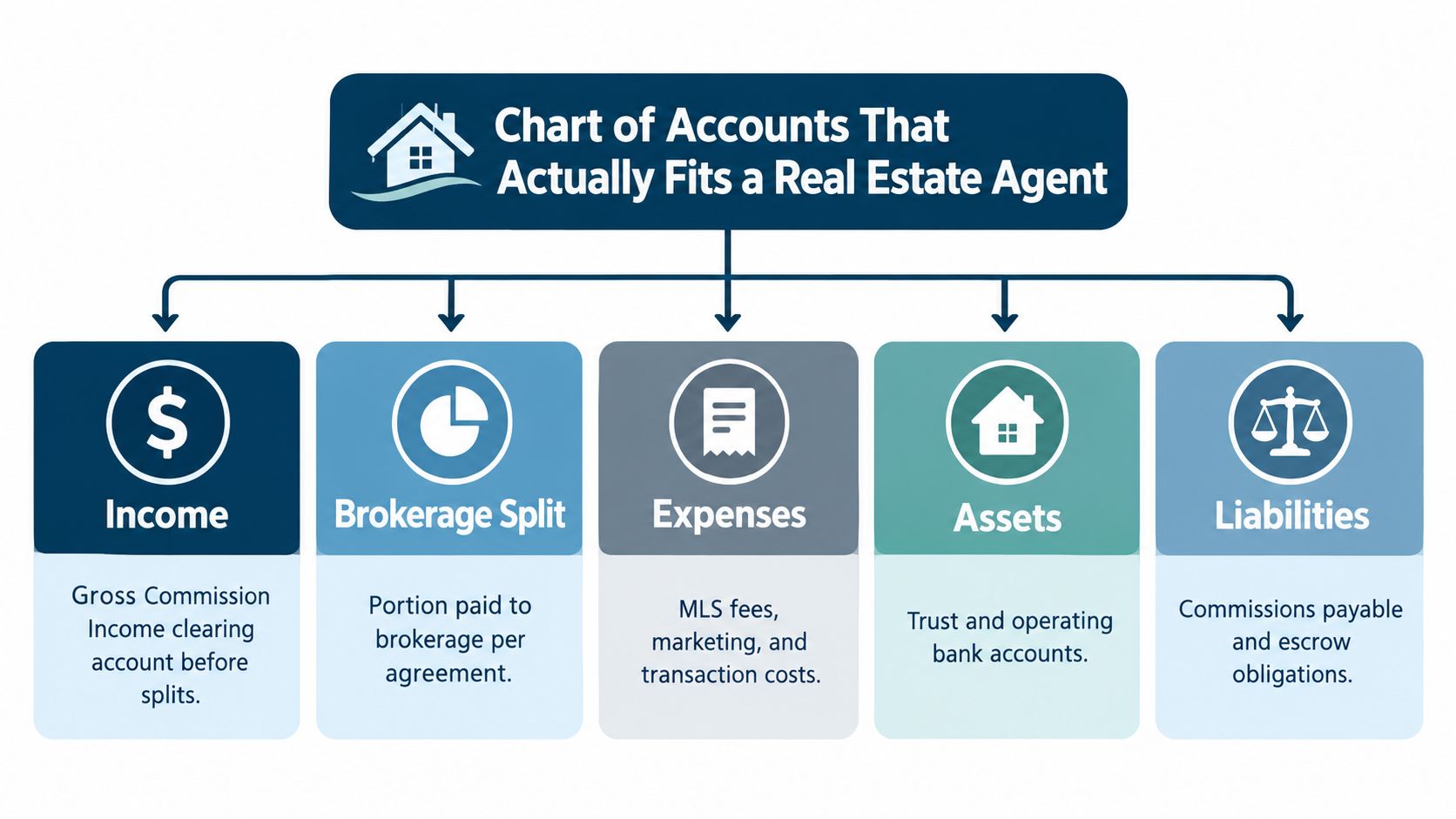
The most important design choice is separating gross commission income from the brokerage split. That one decision makes revenue, cost of sales, profitability, tax planning, and transaction reporting far more useful. A short chart that you reconcile every week is better than a huge list of accounts nobody maintains. For a plain-language reference, review what a chart of accounts does.
Recording Commissions, Splits, and Desk Fees the Right Way
The common shortcut is to open the bank feed, see a net commission deposit, and categorize it as income. That feels efficient, but it destroys the information you need.
Suppose the gross commission is $10,000, the agent has a 70/30 split, and the transaction carries a $395 fee. The agent receives $6,605 after the brokerage keeps $3,000 and the transaction fee takes $395. The books should show all three pieces, not just the final deposit.
The journal entry
| Account | Debit | Credit |
|---|---|---|
| Commission Receivable | $10,000 | |
| Gross Commission Income | $10,000 | |
| Brokerage Split Expense | $3,000 | |
| Commission Receivable | $3,000 | |
| Transaction Fees Expense | $395 | |
| Commission Receivable | $395 | |
| Operating Bank | $6,605 | |
| Commission Receivable | $6,605 |
This entry makes the revenue visible and records the brokerage's retained share as its own expense. It also leaves a clean trail from the gross commission to the net deposit.
If you book only $6,605 as income, your revenue looks smaller than the agreement says. That can understate business activity, hide the actual brokerage cost, distort profit comparisons, and make tax records harder to support. It also makes it impossible to answer whether a lower net check came from a smaller commission, a changed split, a desk fee, or a transaction charge.
The report should explain the deposit, not replace the commission statement.
Record the commission when it is earned under the agreement and supported by the closing documentation. For an agent using cash-basis accounting, actual receipt remains the key tax timing point, and the record should include the date received, amount, property or transaction reference, and payer, as described in cash-basis bookkeeping guidance for real estate agents. In practice, use the closing and brokerage reports to track the receivable, then clear it when the money arrives.
Commission history also explains why this discipline matters. A historical account traces standardized brokerage commissions to 1913, when the National Association of Real Estate Exchanges created a standardized commission structure. It records an average home price of $6,296 in 1920, a typical seller-paid commission of 2.5% then, 5% by 1940, and 6% by the 1980s. A Federal Reserve analysis published in 2025 describes commissions and omissions as downward trending over time, with spikes between 2005 and 2010 and again from 2022. Rates and timing change, so your accounting can't depend on a permanent split arrangement.
Trust and Escrow Accounting Without the Headaches
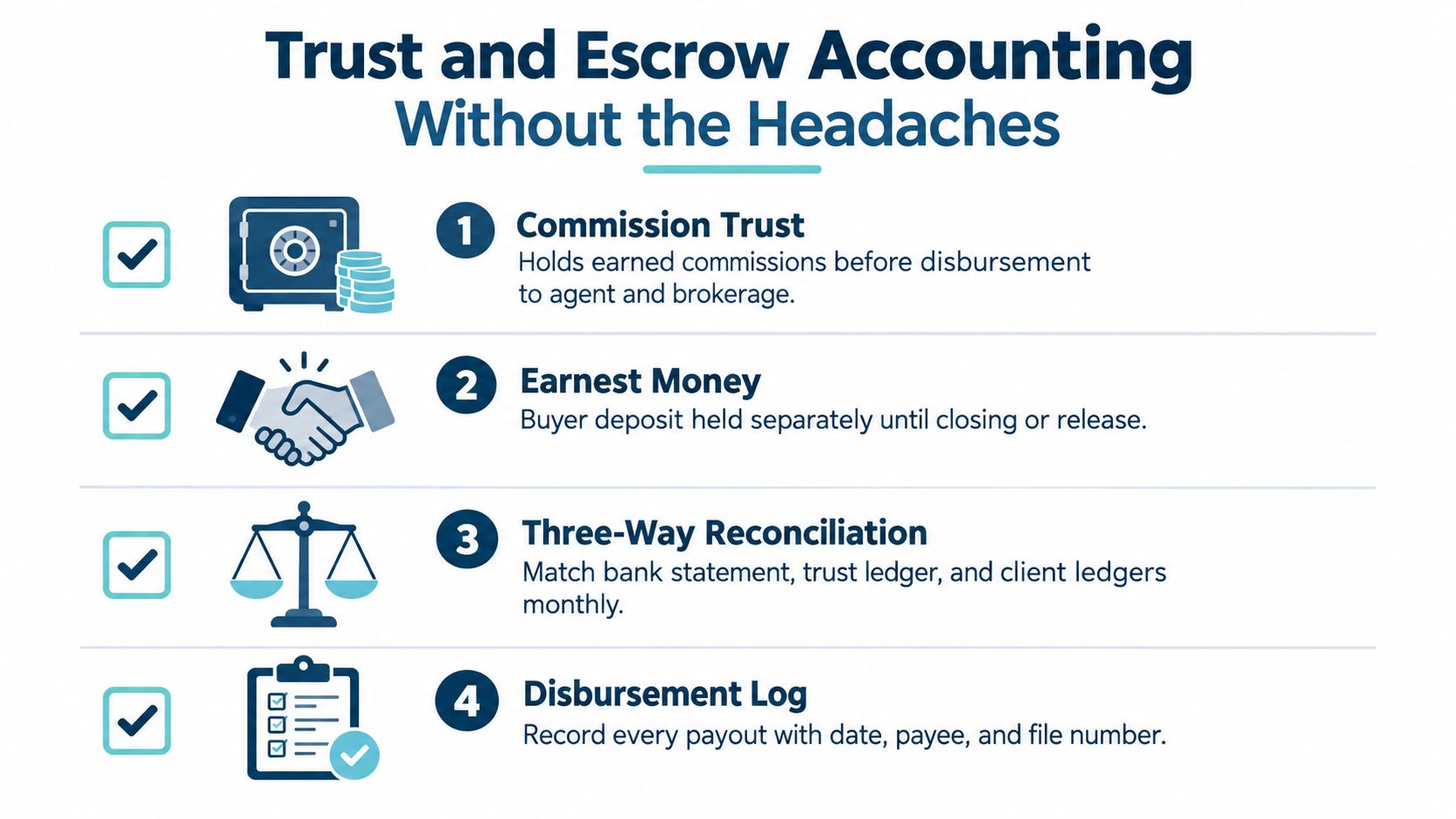
Trust accounting isn't ordinary bookkeeping with a different bank account. It protects money that belongs to someone else. Operating cash pays business bills. Commission trust holds earned funds awaiting distribution. Earnest money escrow holds a buyer's deposit until the transaction closes or the funds are properly released. Keep those purposes separate.
The monthly control is a three-way reconciliation. The following three balances must agree exactly:
- The bank balance of the trust account.
- The total of every individual client-ledger balance.
- The brokerage's general-ledger trust-liability balance.
A broker-cleanup benchmark treats 5% or more of closing statements failing to reconcile as evidence that the bookkeeping process needs redesign, not just a few corrected entries. That same benchmark targets completion of the monthly P&L within 15 days of month-end. See reconciliation of bank accounts for the broader bank-control principle.
A monthly trust checklist
Open the trust bank statement and identify uncleared checks, pending wires, deposits in transit, and bank fees. Pull the trust ledger by client or transaction file. Then compare the total of those individual ledgers with the bank and general-ledger liability balance.
When the numbers disagree, don't plug the difference to miscellaneous expense. Search for an unposted receipt first. Then check whether a payment was applied to the wrong client or file. Review duplicate disbursements, stale checks, and transfers between accounts. If the balance still doesn't agree, escalate the issue to the broker and document the correction.
Keep the written agreement, deposit slip, wire confirmation, disbursement authorization, closing statement, and reconciliation report with the transaction file. California DRE audit data cited in industry summaries reported 683 audits in one fiscal year, with trust-fund shortages totaling $10,736,771.13. The same summary reported shortages in 42% of property-management audits, with half of large shortages tied to commingling or conversion and nearly 40% of cases involving inadequate supervision, as detailed in real estate trust-fund compliance guidance.
For a plain explanation of the broader escrow concept, review understanding escrow in mortgage. In your own books, test every trust balance to the penny. A missing cent is still a control failure.
Tax Planning, Estimated Payments, and Key Deductions
The first tax mistake is often putting every real estate dollar into the same bucket. Commission income from your agent business generally belongs with business activity, while rental income usually follows different reporting rules. IRS Publication 334 explains that real estate dealers and certain lodging operators report rental income and expenses on Schedule C, while most other rental activity belongs on Schedule E. Real estate professional rules can also affect how losses are treated, so don't let your bookkeeping software make that decision by default.
| Item | Schedule C (Agent Business) | Schedule E (Rental or Passive) |
|---|---|---|
| Main activity | Commissions and agent operating activity | Rental property activity in most cases |
| Typical records | Brokerage reports, splits, marketing, mileage, education | Rent, repairs, insurance, interest, property-level costs |
| Key question | Was the income earned from your services? | Was the income produced by owning or renting property? |
| Special issue | Business deductions and self-employment tax planning | Passive activity and real estate professional treatment |
Keep separate property records if you own rentals, manage property, or flip homes. Don't bury property repairs, loan principal, or rent inside the agent operating accounts. Track basis carefully for rentals and flips, because the purchase and improvement history affects later reporting.
Home office and estimated payments
The IRS requires a home office to be used exclusively and regularly for business, and it must be your principal place of business or a place where you meet clients. The rules can also apply to a separate structure used for business, as explained in the IRS home office FAQ.
You can use the simplified method at $5 per square foot up to 300 square feet, making the maximum deduction $1,500, or use the regular method to allocate rent, mortgage interest, utilities, insurance, and repairs by business-use percentage, according to realtor tax deduction guidance. The simplified method is easier. The regular method may fit better when the business-use share of actual home costs is higher.
Self-employed agents generally need estimated payments if they expect to owe $1,000 or more for the year. The usual federal dates are April 15, June 15, September 15, and January 15 of the following year, as summarized in quarterly estimated tax guidance. Review the prior year's tax, divide the expected obligation across the payment dates, and revise the estimate after a large closing. Set aside 25% to 30% of each commission check in a separate tax savings account so tax money doesn't get spent on lifestyle costs. Use estimated tax payment planning to keep the dates visible.
A Practical Bookkeeping Cadence for Busy Agents
Agents don't need to spend all day in accounting software. They need short, repeatable control points. The work becomes painful when receipts, commission reports, and trust entries sit untouched until tax season.
Daily and weekly work
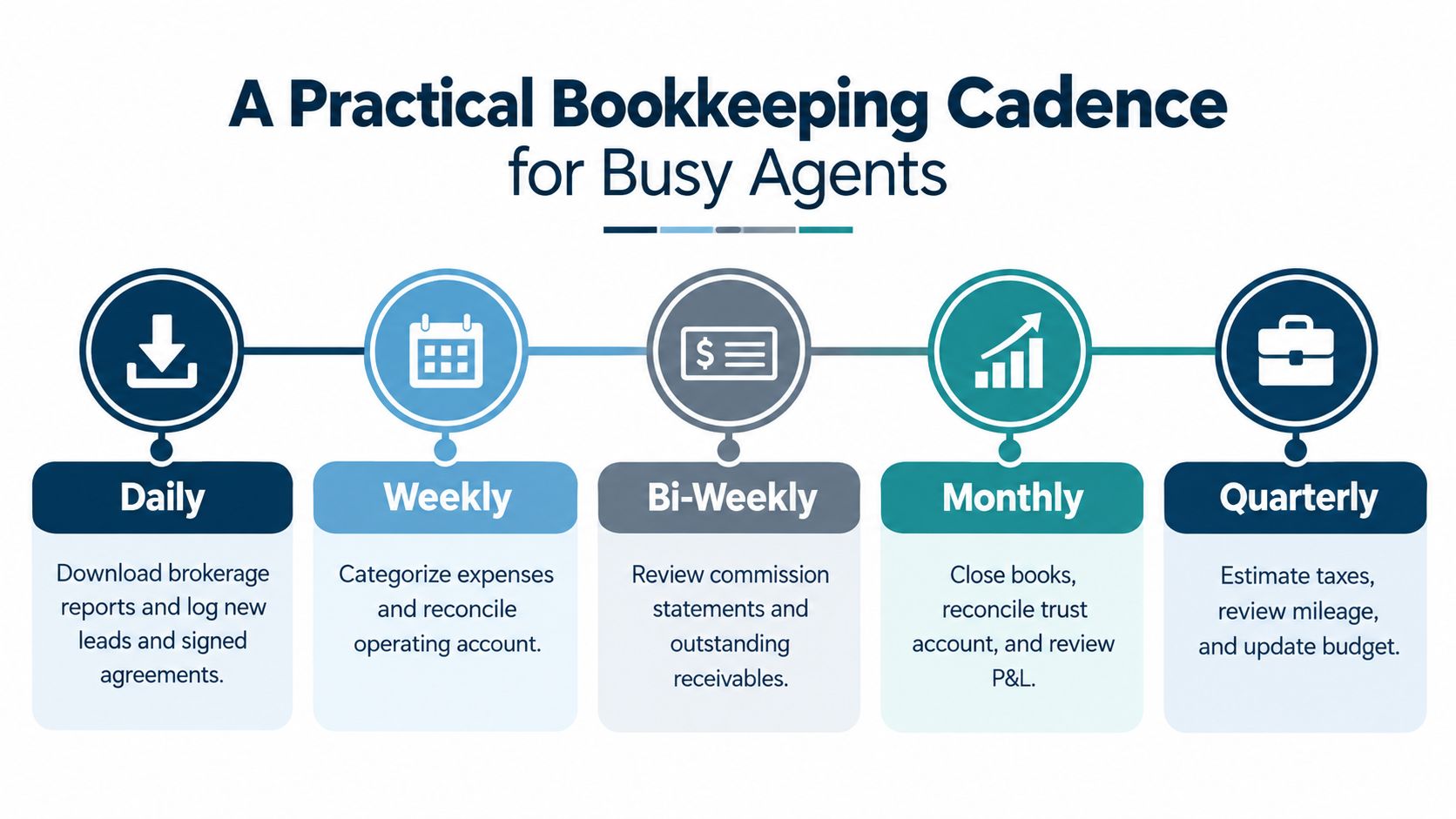
Daily, download brokerage reports, log new leads and signed agreements, and photograph receipts before they disappear into a car console. Add the property or transaction reference while you still remember why the expense happened.
Weekly, reconcile the business checking account, categorize card transactions, and follow up on commission checks the brokerage owes you. Review uncategorized transactions instead of allowing them to accumulate. A short weekly appointment is easier to keep than a large cleanup project.
Monthly and quarterly work
Monthly, complete the trust reconciliation, close the operating books, and compare the P&L with your goals. Review gross commissions, brokerage splits, lead-generation costs, vehicle spending, and owner draws. If vendor payments require reporting, collect the tax details before year-end rather than chasing them later.
Quarterly, update the tax estimate, adjust transfers into the tax savings account, and review the mileage log. A commission-heavy business can change quickly, so a stale estimate is not a plan.
Yearly, close the books, send 1099-NECs to anyone paid $600 or more, review entity structure, and confirm year-end trust balances match the bank records. The IRS Form 1099-S instructions also reinforce the importance of identifying the correct reporting person in real estate transactions.
A workable Monday routine takes about 30 minutes: download the latest brokerage report, match open commission receivables, reconcile the operating account, categorize the prior week's card charges, and flag anything needing broker or tax-advisor review. Put that appointment on the calendar like a showing.
Common Mistakes to Avoid and a Simple Action Plan
Most agent-book cleanup starts with the same errors. The cost isn't only an ugly report. A bad setup can hide expenses, weaken tax support, distort the profitability of a lead source, or leave trust liabilities unexplained.
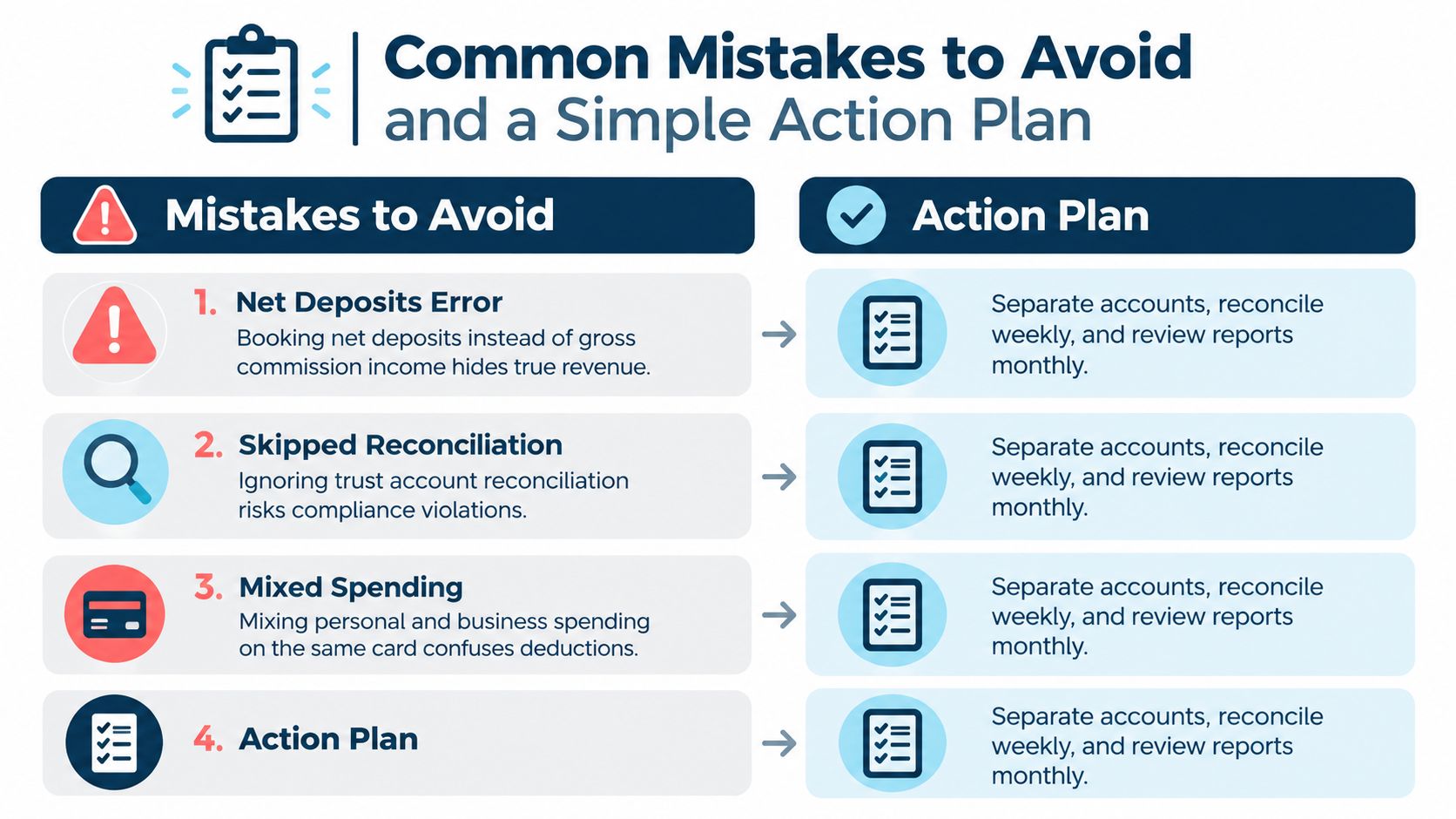
- Booking net deposits: The bank feed shows what arrived, but it hides gross revenue, brokerage splits, and transaction charges. Record the full commission and the deductions separately.
- Skipping trust reconciliation: An unreconciled trust account can leave client balances wrong and create regulatory exposure. Match the bank, client ledgers, and trust liability every month.
- Mixing personal and business spending: One card used for groceries, fuel, advertising, and subscriptions forces you to reconstruct the business later. Use separate accounts and record owner draws clearly.
- Treating marketing as an occasional cost: Lead-generation bills often recur. Review them monthly by source so you know which expenses support the business.
- Missing home office and mileage records: A deduction without usage records is hard to defend. Capture the business purpose when the expense occurs.
- Leaving 1099 forms and transaction reports untouched: An annual form isn't a bookkeeping entry by itself. Match it to your ledger and investigate differences.
- Skipping estimated payments: A strong closing can create a tax bill that your checking account isn't ready to handle. Reserve cash as commissions arrive.
Start this week
- Open a dedicated business account: Stop mixing personal purchases with commission activity.
- Build the chart of accounts: Add gross commissions, brokerage splits, transaction costs, operating expenses, assets, liabilities, and draws.
- Rebuild the last 90 days: Match each commission report to the gross amount, brokerage deduction, fees, and deposit.
- Reserve a weekly 30-minute slot: Reconcile the operating account and clear uncategorized transactions.
- Schedule the next estimated payment: Put the date on your calendar and move tax savings into a separate account.
Clean books don't require complicated software. They require records that follow the deal from closing to commission receivable, brokerage split, expense, deposit, and tax reserve. If you want help maintaining that system, MyOfficeOps provides bookkeeping, financial reporting, and advisory support for real estate businesses, including cleaner transaction categorization and property-level reporting. Visit the team to discuss your current books, choose a cleanup plan, and set a recurring cadence before the next closing creates another mess.