

You finish a full day of patient visits, approve payroll, answer a staffing question, and open the monthly financial report. Revenue looks healthy, yet the bank balance feels tight. Claims are still pending, insurance adjustments are hard to follow, and the report doesn't tell you whether hiring another clinician is sensible. The problem isn't a lack of data. It's that nobody has translated the data into decisions.
Healthcare accounting services should do more than close the books or prepare tax returns. They should connect patient visits, claims, payments, payroll, expenses, and reporting into one financial operating system. When that connection works, you can see where cash is stuck, which services earn a useful margin, and what your clinic can afford next.
Why Clinic Owners Struggle With Financial Clarity
A clinic owner can have plenty of reports and still feel financially blind. The income statement may show revenue, expenses, and profit, but it often doesn't explain why cash arrived late or why a busy month produced a weak deposit. A balance sheet may be accurate, yet it won't tell you that a payer is taking longer to process claims or that patient balances are aging without follow-up.
Consider a small specialty clinic preparing to buy equipment. The owner sees strong appointment volume and assumes the purchase is affordable. Then the accountant points out that several large balances are tied to unpaid claims, payroll is rising, and the clinic's most popular service has weaker reimbursement after contractual adjustments. The purchase may still make sense, but now the decision is based on usable facts instead of optimism.
Reports record the past
Traditional bookkeeping answers questions such as:
- What was paid: Which bills, payroll items, and operating expenses cleared.
- What was billed: What the practice recorded as revenue.
- What remains open: Which receivables, liabilities, and bank items still need attention.
Those answers matter, but they don't explain the operating story. A healthcare-focused advisor should connect the general ledger to the practice management system, payer reports, deposit records, and payroll data. That lets the owner ask better questions about hiring, scheduling, pricing, collections, and expansion.
Practical rule: If your financial report can't help you decide what to fix this week, it isn't doing enough work.
Specialized interpretation changes the decision
Healthcare accounting services turn historical records into an action plan. They can show whether a cash problem comes from slow claims, missing charges, weak patient collections, excessive overtime, or a service line that consumes more resources than it produces. They can also separate a temporary timing issue from a structural margin problem.
The history of this work matters. The first attempts at formal health accounts were made in 1926 by the American Medical Association, which published a health spending report for that year in 1932, as documented in this history of health accounting and national health accounts. Modern clinic finance still depends on the same basic idea, measure how healthcare work creates, moves, and consumes money.
Your accounting data already contains clues about whether you can add staff, open a location, replace equipment, or distribute more owner income. You need someone who understands both the numbers and the way a clinic earns them.
Standard Bookkeeping Versus Healthcare Accounting
Generic bookkeeping is like looking in the rearview mirror. It tells you what happened in the bank account, but it doesn't show whether a visit was coded correctly, whether a payer reduced payment, or whether a claim is likely to become a denial.
Healthcare accounting starts with the same basic discipline, bank reconciliation, expense coding, payroll records, and financial statements. The difference is the interpretation. A healthcare accountant asks how those entries connect to patient access, documentation, claims, payer contracts, and collections.
The same transaction can tell different stories
Suppose your clinic records a large insurance payment. A general bookkeeper may match the deposit to the bank and post it to revenue. That is necessary, but incomplete. A healthcare-focused team also checks whether the payment matches the remittance advice, whether contractual adjustments were posted correctly, and whether the payer left any underpayment or denial behind.
The distinction becomes clearer with these common issues:
| Generic bookkeeping view | Healthcare accounting view |
|---|---|
| Deposit arrived | Deposit matches claims and remittance detail |
| Revenue increased | Revenue is separated from contractual adjustments and unpaid balances |
| Payroll cleared | Staffing cost is compared with service-line activity and cash capacity |
| Receivable remains open | A/R is grouped by payer, age, denial reason, and responsible owner |
| Expense was recorded | Expense is connected to the service line or operating function it supports |
A clinic needs more than clean ledgers
Payer mix affects cash flow. Insurance adjustments affect net revenue. Delayed reimbursements affect hiring and purchasing decisions. Patient collections require a careful process that respects both financial controls and the patient relationship.
That is why a generic accountant may miss a problem even when the books are technically correct. The missing piece is often the bridge between clinical activity and collected cash. A visit can appear in a report without becoming a clean claim, and a claim can be paid without producing the expected net revenue.
For a practical explanation of the accounting issues unique to medical practices, review this medical practice accounting resource. The right service keeps bookkeeping, reporting, and revenue-cycle facts in the same conversation.
Core Services That Keep Your Practice Profitable
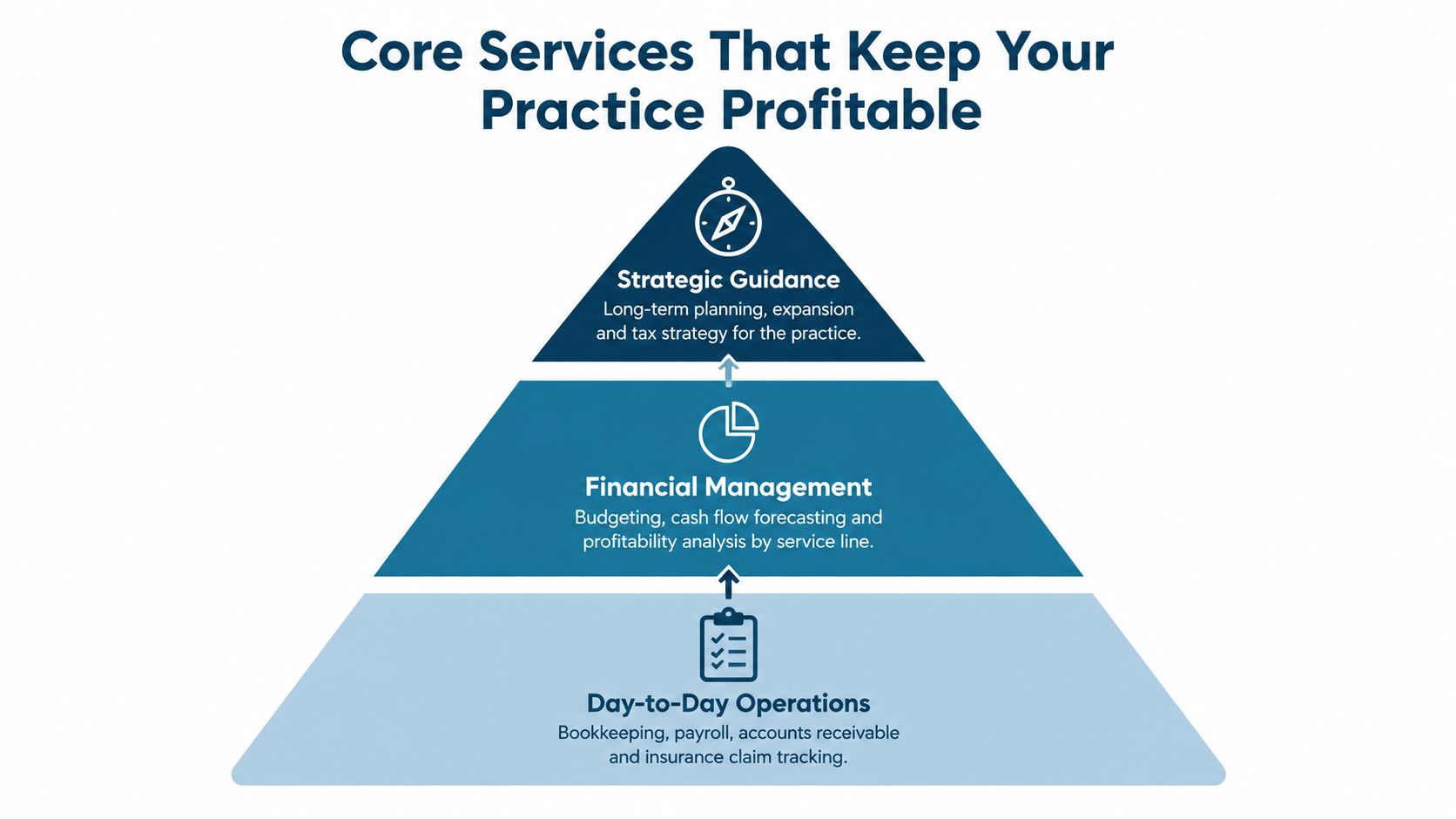
A useful accounting partner works at three levels. First, the team keeps daily records accurate. Next, it turns those records into management information. Finally, it helps you decide what to change.
Daily controls protect earned revenue
Revenue-cycle integration means checking that the work clinicians perform reaches the financial statements and, ultimately, the bank. The process should connect scheduling, charge capture, coding, claim submission, remittance posting, denial work, patient balances, and deposits.
A strong service typically includes:
- Billing reconciliation: Compare charges, claims, remittances, adjustments, and deposits so missing or misapplied payments don't disappear inside a monthly total.
- Accounts receivable review: Sort open balances by payer, service line, aging, and denial reason. Assign each problem to a person who can act.
- Payroll integration: Match payroll and benefits to the cash forecast, staffing plan, and service activity. Payroll shouldn't be a surprise that arrives after an optimistic revenue report.
- Expense and bill management: Code vendor bills consistently and identify recurring costs that no longer support the clinic.
- Month-end close: Set a repeatable deadline for reconciliations, accruals, adjustments, and management reporting.
HFMA's MAP Keys framework defines 29 industry-standard KPIs across Patient Access, Pre-Billing, Claims, Account Resolution, and Financial Management, including a target of keeping days in accounts receivable at 30 days or less. See the HFMA MAP Keys framework for the framework and its measures.
Weekly visibility beats month-end surprises
Don't wait for the income statement to reveal a problem. Review a small dashboard each week, then use the monthly close for deeper analysis.
Track:
- Charge capture and charge lag, to see whether completed work is entering the billing process.
- Clean claim performance, to identify avoidable submission errors.
- Denial volume and causes, to separate documentation, coding, authorization, and payer problems.
- A/R age by payer, to find balances that need escalation.
- Net collections, to compare expected reimbursement with actual cash.
- Payroll and operating cash, to see what the clinic can safely commit to.
The point isn't to collect more metrics. The point is to connect each variance to an owner and a next action. If claims are delayed, the billing lead needs a correction. If one payer underpays, someone needs to review the contract and remittance detail. If payroll consumes more cash, the clinical schedule and staffing model need attention.
For clinics that also need help with clearer marketing and practice growth systems, see how Leaping Lemur Media helps practices. Marketing won't repair a broken revenue cycle, but it can support growth once your financial controls can show which new demand the clinic can serve profitably.
Navigating Healthcare Compliance and Payer Rules
Compliance isn't a separate folder that your accountant opens once a year. It affects how you document revenue, handle patient balances, submit government reports, and protect sensitive information.
Medicare cost reports need a calendar
For Medicare Part A providers, the standard cost-report due date is the last day of the fifth month after the provider's fiscal year ends, according to CMS guidance on Medicare cost-report deadlines. CMS also allows providers to file the full Medicare cost-report package electronically through MCReF, including supporting documents, for eligible fiscal year ends.
Build the process backward from the deadline:
- Map the accounts: Keep chart-of-accounts categories aligned with cost-report requirements.
- Reconcile the source records: Tie financial statements, payroll, statistics, and supporting schedules together.
- Review allocations: Test whether overhead and indirect costs are assigned using a consistent method.
- Prepare evidence: Keep invoices, payroll records, contracts, and schedules organized for review.
- File and retain confirmation: Submit through the required channel and preserve the filing record.
Larger provider organizations need this discipline because a simple cash report can hide the effect of payer mix, contractual adjustments, charity care, bad debt, and indirect-cost allocation. A service line may look profitable before those items are assigned and weak afterward.
Patient privacy and billing rules still matter
HIPAA gives patients a right to request an accounting of certain disclosures of protected health information. A provider generally must respond within 60 days, with only one possible 30-day extension when it gives written notice and explains the delay. The accounting can cover disclosures from the previous six years, but treatment, payment, and healthcare operations disclosures are excluded under the rule described in 45 CFR §164.528.
The No Surprises Act also limits balance billing in certain situations. A provider or facility can't bill a patient for the gap between its charge and the plan's payment plus the patient's required cost sharing. Where no applicable state law or agreement controls, the provider and plan can use a 30-business-day open negotiation period before independent dispute resolution, as outlined in CMS training on balance billing protections.
Your accounting partner should help make these rules operational. That means clean documentation, clear patient-balance workflows, controlled access to data, and escalation when a bill or payer issue needs legal or compliance review. For the financial side of claims, payments, and follow-up, use this healthcare revenue cycle management guide.
Deciding Between In-House Teams and Outsourced Partners
An in-house accountant gives you proximity. An outsourced healthcare accounting team gives you broader coverage without requiring one employee to handle every specialty. Neither model fixes weak processes automatically, so choose based on the work your clinic needs and the level of oversight you can provide.
| Feature | In-House Hire | Outsourced Partner |
|---|---|---|
| Daily access | Direct contact during working hours | Scheduled and remote access, often across a team |
| Coverage | Depends on one person's skills and availability | Can combine bookkeeping, payroll, reporting, and advisory skills |
| Cost structure | Salary, benefits, training, software, and backup coverage | Contracted service cost based on scope |
| Healthcare expertise | Must be recruited and developed | Can be selected for medical-practice experience |
| Continuity | Vulnerable when the employee leaves or takes leave | Processes and responsibilities can be shared |
| Scaling | Requires another hire as needs expand | Scope can often grow with the practice |
| AI oversight | Clinic must select, test, and supervise tools | Partner may bring tools, controls, and review processes |
The hidden cost of an in-house role is management time. Someone must define the workflow, train the employee on the practice system, review work, cover absences, maintain software access, and explain unusual payer activity. That can work well for a larger organization with enough volume and a strong finance leader. It can become expensive and fragile for a small clinic that needs several kinds of expertise but doesn't have full-time work for each role.
AI needs a human owner
Automation can flag unusual payments, group denial reasons, and reduce manual entry. It can also create confident-looking errors if nobody checks the data, rules, and output.
Recent survey data found that only 27% of healthcare finance professionals were actively deploying AI at scale, while 53% were still in pilots, according to HFMA's Revenue Cycle of the Future report. Those figures support a simple recommendation: use automation as an assistant, not as an unsupervised accountant.
Ask who reviews automated suggestions, who can explain a changed posting, and who owns the correction when a claim or payment is misclassified. If you're comparing models, this in-house billing versus outsourcing guide can help frame the staffing decision. For a broader look at delegation, reporting, and financial support, review outsourced accounting for small business.
Choose in-house when you need a daily finance presence and can support specialized oversight. Choose an outsourced partner when you need healthcare knowledge, reliable processes, and flexible access without building an entire finance department.
How to Choose a Partner and Start the Onboarding Process
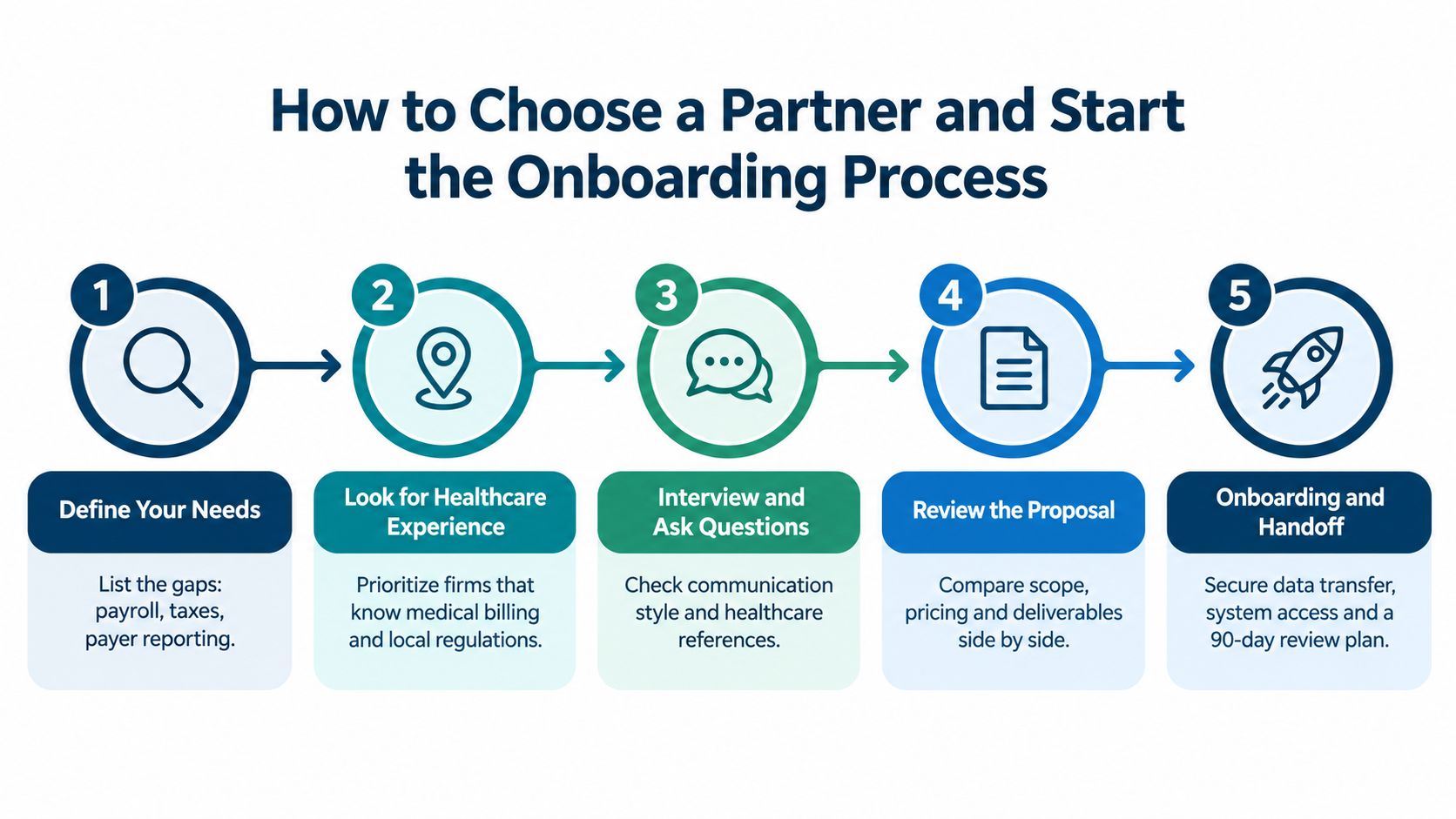
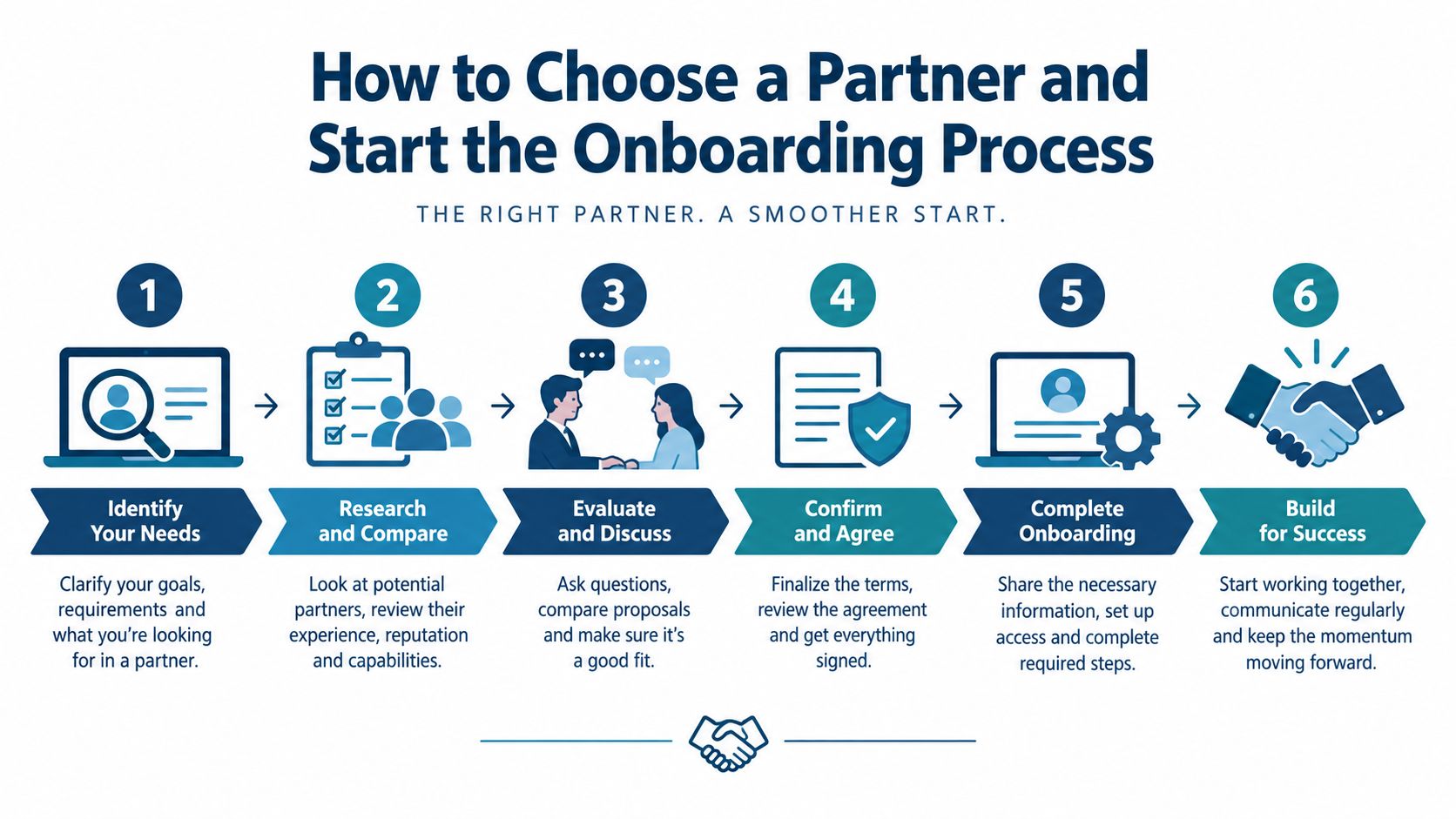
Start with the clinic's problems, not a vendor's service list. Write down where money or time is being lost: delayed claims, unclear reports, payroll strain, weak cash forecasts, inconsistent coding, or limited owner visibility.
Use a simple selection process
- Define the gaps. List the work you need covered, such as bookkeeping, payroll integration, tax coordination, reporting, payer analysis, and forecasting.
- Check healthcare experience. Ask whether the firm understands medical billing, remittance advice, contractual adjustments, patient balances, and the systems your clinic uses.
- Test communication. Request a sample report. Ask who answers questions, how often reviews occur, and how urgent issues are escalated.
- Compare proposals. Put scope, deliverables, responsibilities, technology, and pricing beside each other. A cheap proposal with unclear exclusions is not a cheap service.
- Protect the handoff. Confirm user access, data transfer, approval limits, reconciliation procedures, and the first reporting deadline.
- Set a review point. Agree on what will be checked after the initial operating period, including open items, reporting quality, and unresolved process gaps.
Match the service to the clinic's stage
A three-tier model gives owners a useful way to avoid buying too much or too little.
- Core Accounting: Clean books, reconciliations, bill management, payroll coordination, and dependable monthly reports.
- Profit Optimization: Cash forecasting, KPI dashboards, service-line analysis, pricing review, and help identifying leakage.
- Exit Strategy: Valuation preparation, normalized financials, process documentation, and readiness for a sale, merger, or ownership transition.
A solo provider may start with the first tier and add forecasting as staffing or equipment decisions become more complex. A multi-provider clinic may need the first two tiers immediately because clean books alone won't explain which clinicians, payers, or services drive the result. A future transition should shape the records long before a buyer asks for them.
Ask these questions before signing
- Who will reconcile the practice management system to the general ledger?
- How will you handle contractual adjustments and denied claims?
- Which reports will I receive, and when?
- Can you explain results in plain English?
- Who reviews automated entries and unusual transactions?
- What does onboarding require from my staff?
- Which work is included, and which work costs extra?
- How will you protect financial and patient information?
A partner serving clinics in Greater Philadelphia should understand local business conditions and still have systems that work remotely. Location helps with trust and access, but healthcare experience, clear ownership, and consistent reporting matter more than an office address.
Taking Control of Your Clinic's Financial Future
A financially healthy clinic doesn't rely on a single year-end report. It uses clean daily records, connected revenue-cycle controls, timely reconciliations, and simple management dashboards. The owner can see whether cash is improving, whether a payer is creating friction, and whether growth will strengthen the practice or stretch it too far.
The central shift is from bookkeeping as a record of the past to accounting as an operating system. Claims, deposits, payroll, expenses, and clinical activity should explain one another. When they don't, the clinic may be working hard while losing money in places nobody owns.
You don't need to become a finance expert. You do need a partner who can explain the numbers, challenge weak assumptions, and turn a report into a decision. Start by requesting a review of your chart of accounts, A/R aging, payer adjustments, payroll trend, and cash forecast. Those five areas usually reveal whether the problem is visibility, process, or economics.
Don't wait for tax season or a cash crisis to ask for help. Choose healthcare accounting services that connect the ledger to the work your team performs every day, then use that information to make deliberate decisions about hiring, equipment, pricing, and growth.
MyOfficeOps provides bookkeeping, accounting, payroll integration, financial analytics, and CFO-level advisory for healthcare practices that need more than year-end cleanup. Visit MyOfficeOps to start a conversation about cleaner financial records, connected revenue-cycle reporting, and practical guidance for your clinic's next decision.