

On a Tuesday morning, the owner of a 14-person marketing agency opens the bank dashboard before her first call. She expected to see about 14 weeks of payroll runway. The number is 9. Two clients slowed their payments at the same time, and the change exposed a problem her annual budget had hidden.
She has revenue on the books, work in progress, and a healthy-looking profit forecast. None of that tells her what to do this week. Should she pause advertising, delay a hire, call clients, cut contractor hours, or protect the team and use a credit line? She spends the weekend rewriting offers and trimming ads because she never decided in advance who would act when cash moved below a safe level.
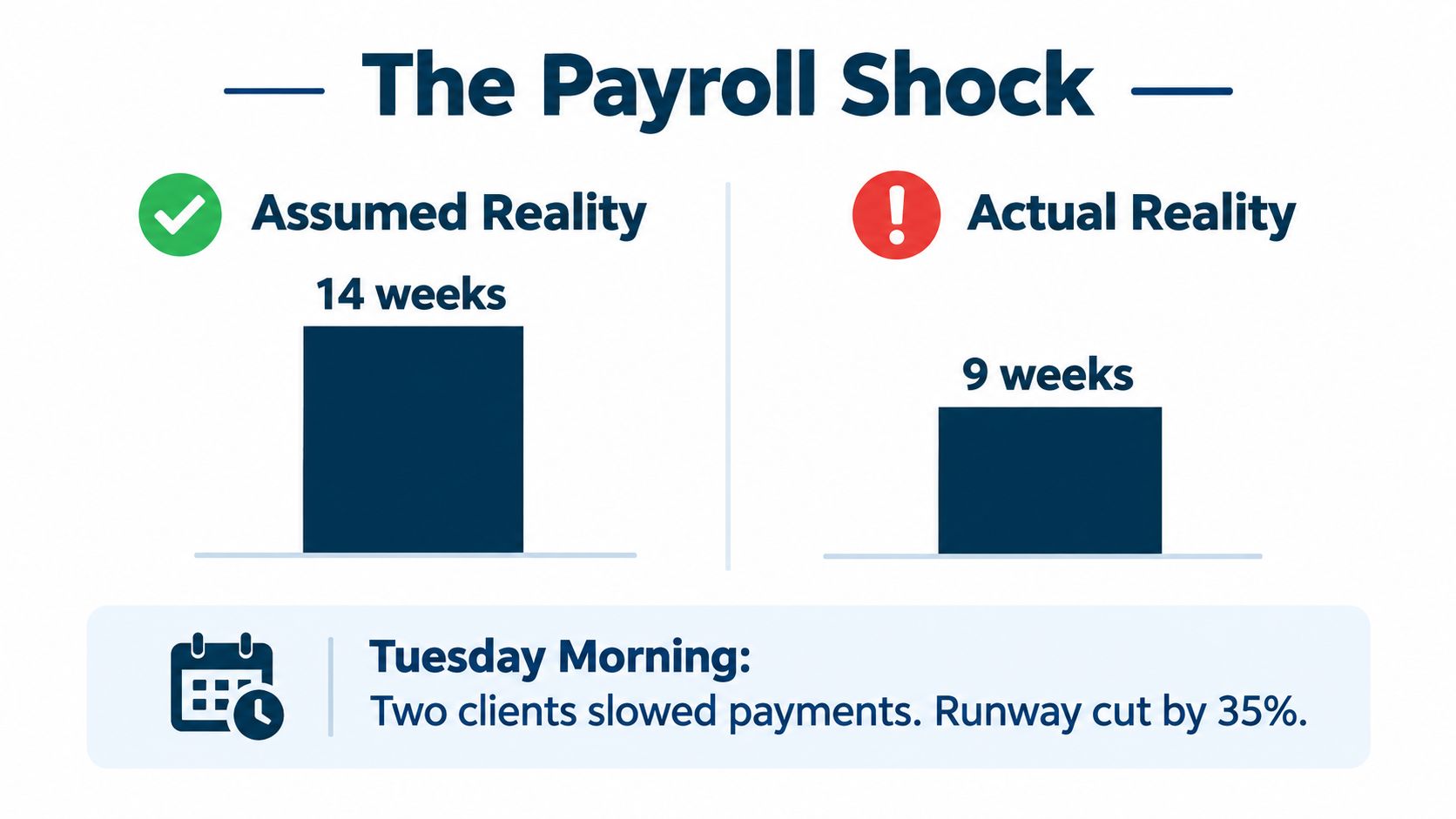
That's the practical case for scenario planning for business. It isn't a prediction machine or a collection of impressive spreadsheet tabs. It's a way to decide what you'll do when revenue drops, costs rise, a key customer leaves, or financing terms tighten. The strongest plans connect a small number of possible futures to cash thresholds, named owners, and specific actions.
Why Most Small Businesses Get Caught Off Guard
Most small businesses have a budget. Far fewer have a response plan.
The typical budget describes one expected year. Sales grow at a reasonable pace, customers pay near their usual terms, hiring follows the plan, and expenses stay within their categories. When reality differs, the owner often treats the change as a one-time exception. A late payment is annoying. A lost client is unfortunate. A cost increase is absorbed. Several exceptions arriving together can remove weeks of payroll cover before the owner has made a decision.
A bank statement then becomes the business's check-engine light. It tells the owner that something is wrong, but it doesn't explain which lever to pull or who has permission to pull it. A useful overview of cash flow problems in small business shows why cash timing deserves its own management process rather than being left inside a year-end budget.
Forecasting and scenario planning do different jobs
A forecast asks, “What do we expect to happen?” Scenario planning asks, “If conditions change, what will we do?”
That distinction matters for an agency, a clinic, a contractor, or a brokerage. The plan might contain a slower-sales scenario, a margin squeeze scenario, and a customer-loss scenario. Each one should answer practical questions:
- What changes first? A payment delay, lower bookings, a supplier increase, or a staffing gap.
- What number tells us it's happening? A cash balance, collection period, pipeline level, or gross margin.
- Who acts? The owner, bookkeeper, sales lead, practice manager, or project manager.
- What action is already approved? A hiring pause, client call, price change, purchase delay, or expense review.
Three well-built scenarios usually beat twelve spreadsheet variations because each scenario can have a clear owner and a short action list. A large scenario library often creates the appearance of control while leaving the central question unanswered: who acts on Friday afternoon when the numbers cross the line?
Practical rule: If a scenario doesn't change a real decision, remove it.
The method has a long corporate history, but small businesses don't need a corporate planning department to use it. Modern scenario planning traces back to work at RAND in the 1950s, then entered corporate strategy through Royal Dutch Shell in the early 1970s. The history is useful for one reason: the method was built to challenge single forecasts, not to decorate them. This account of scenario planning's development provides the background.
Pick the One Question Your Scenarios Need to Answer
Start with one question, written in plain English. Don't open a spreadsheet until the question is specific enough to force a choice.
A 14-person creative agency might ask:
Can we hold payroll and keep two senior producers if our largest client cuts spend by 30 percent in Q3?
A two-location dental practice might ask:
Can we absorb a 15 percent drop in insured reimbursements for one quarter without touching the equipment loan covenant?
Both questions work because they contain a decision, a business pressure, and a time window. They also point toward measurable outputs. The agency cares about payroll coverage, senior headcount, and cash. The dental practice cares about reimbursement revenue, operating cash, and covenant headroom.
Use a short question filter
Test your draft against four conditions:
- One focal issue: Is the question about one business choice rather than the whole company?
- A realistic horizon: Can you examine the next 6 to 18 months without pretending to know distant details?
- An owner-controlled decision: Can someone decide whether to hire, pause spending, change prices, or protect cash?
- A number that matters: Will the answer affect cash balance, covenant headroom, headcount, or another operating limit?
If the question says, “How will the economy affect us?”, it's too broad. The owner can't act on the economy. If it says, “What happens to payroll coverage if two major customers pay late and new sales slow?”, the team can model it and assign responses.
The horizon should match the commitment you're testing. A staffing decision may need a year because contracts and recruitment take time. A cash decision may need a shorter view because payroll, taxes, and collections happen quickly. Don't force every scenario exercise into an annual planning cycle.
Write the line before the drivers
Put the question at the top of the document. Under it, write the decision the answer must support, such as:
- Keep both producers and freeze new hiring.
- Add hygiene hours and renegotiate selected supplies.
- Delay equipment purchases until cash recovers.
- Require stronger contract protections on new work.
This prevents the exercise from drifting into a list of interesting risks. A practical guide to scenario planning follows the same basic logic, beginning with a defined focus and horizon before teams develop scenarios and triggers.
Write your focal question on a single line. If it doesn't fit on one line, narrow it before you touch any drivers or models.
Choose the Few Drivers That Actually Move Your Numbers
A driver belongs in the model when it can bend profit or cash flow enough to change the decision. It doesn't belong there just because it's uncertain.
Start with the line items that move noticeably from month to month. For a small company, that may include sales volume, average selling price, collection speed, labor utilization, project margin, supplier cost, or staffing timing. Then ask three questions:
- Can we influence it? You may not control a customer's budget, but you can control follow-up, contract terms, pricing, and capacity.
- Can we measure it weekly? If the number appears only after the month closes, it may be a lagging result rather than a useful trigger.
- Does it show up before the damage? A falling proposal pipeline can warn you before revenue falls. A cash shortage usually arrives later.
For the agency example, average days to payment, billable staff utilization, and average project margin belong in the first model. Office snacks and a small software subscription don't. Those costs may deserve normal expense control, but they won't answer whether the agency can protect two senior producers after a major client cut.
For the dental practice, insured reimbursement rate, hygienist hours, and supply cost per visit are more useful. The office Wi-Fi provider isn't. The practice can watch reimbursement terms, appointment capacity, and supplies closely enough to connect them to a decision.
A simple driver selector
| Driver | Typical Swing | Lead Time | Controllable? |
|---|---|---|---|
| Average days to payment | 5 to 10 days in a stress test | Weekly | Partly |
| Billable staff utilization | 5 to 10 percentage points in a stress test | Weekly | Yes |
| Average project margin | 5 to 10 percent in a stress test | Per project | Yes |
| Office snack budget | Small operating variance | Monthly | Yes, but low impact |
| Insured reimbursement rate | 15 percent in a stress test | By payer cycle | Limited |
| Hygienist hours | Practice-defined change | Weekly | Yes |
| Supply cost per visit | Practice-defined change | Weekly or monthly | Partly |
| Office Wi-Fi provider | Contract or service change | Monthly | Yes, but low impact |
The swings in this worksheet are planning assumptions for the examples, not claims about what every business experiences. Replace them with your own actual history.
Keep the first scenario set to 3 or 4 distinct futures, a range that operational planning guidance repeatedly recommends for keeping the work useful rather than overwhelming. This scenario-planning workflow also emphasizes leading indicators, trigger points, owners, and regular updates.
A long list of risks can make a leadership team feel thorough. A short list of measurable drivers gives the team something better, a decision it can execute.
Turn Scenarios Into a Profit and Cash Flow Model
A non-accountant can build a useful first model in a spreadsheet in an afternoon. The model won't replace proper financial statements, but it can show whether an operating choice protects the business under pressure.
Begin with a one-page monthly profit and loss statement based on the last 12 months of actual results. Keep the categories plain:
- Revenue by service or product stream
- Cost of goods sold or direct delivery costs
- Gross profit and gross margin
- Payroll
- Subcontractors
- Software
- Marketing
- Rent and other fixed operating costs
Then add a 13-week cash flow view to keep profit and cash from being confused. Map expected collections, payroll dates, tax payments, debt payments, and other large outflows by week. A business can show a profit for a month and still miss payroll if customers pay after the bills are due.
Flex only the lines that change
Don't rewrite the entire model for every scenario. Change the inputs tied to the focal question:
- Revenue volume
- Average price
- Variable cost per job or visit
- Payment terms and collection timing
- Headcount start dates
- Contractor capacity
- Material or supply costs
Hold steady what isn't relevant. This makes the result easier to explain and reduces false precision.
| Line Item | Flex in Scenarios? | How to Adjust | Why It Matters |
|---|---|---|---|
| Revenue volume | Yes | Reduce jobs, visits, or client spend | Changes gross profit and cash inflow |
| Average price | Yes | Apply a planned discount or price change | Tests margin protection |
| Variable cost | Yes | Change labor, material, or supply cost per sale | Shows contribution pressure |
| Payment timing | Yes | Move collections later in the cash view | Exposes payroll and bill-payment risk |
| Payroll | Usually partly | Keep current staff, delay a hire, or model a role change | Tests the main fixed-cost commitment |
| Rent | Usually hold steady | Leave unchanged unless a lease action is realistic | Prevents irrelevant model noise |
| Software | Usually hold steady | Adjust only if a specific cancellation is planned | Keeps attention on material choices |
A worked agency example
Suppose the agency models losing one anchor client. For the exercise, assume that client currently produces $40,000 in monthly revenue, with $24,000 of direct delivery cost and $16,000 of gross profit. Those figures are illustrative inputs for the model, not a benchmark for agencies.
The first effect is a $40,000 monthly revenue reduction. If the direct delivery cost disappears with the work, gross profit falls by $16,000 rather than by the full revenue amount. The owner then tests whether the remaining contribution covers payroll and other fixed costs.
Next, the cash view assumes collections from other clients arrive 10 days later than usual. That delay doesn't necessarily change accounting profit, but it pushes expected cash receipts beyond a payroll date. The model should show the minimum bank balance during the 13-week period, not just the month-end balance.
The output should answer a direct question: can the agency keep both senior producers, and what cash action must happen first? If the minimum bank balance falls below the owner's payroll buffer, the response might be a hiring freeze, earlier client invoicing, a collection call plan, or a pre-approved credit draw. The spreadsheet's value comes from connecting the result to that decision.
Sales assumptions deserve the same discipline. Teams that need a clearer view of how pipeline assumptions affect revenue can review methods to close more deals with forecasting, then bring only the useful sales inputs into the financial model.
For a practical template and guidance on building projections, use this resource on creating financial projections. The finished file should fit on a few readable pages. If an owner can't explain which input changed and what action follows, the model is too complicated.
How Real SMBs Use Scenarios Across Industries
The method stays consistent across industries. The drivers, triggers, and decisions change with the business model.
A professional services firm
The focal question is, “Can we replace a major client without hiring ahead of confirmed demand?” The firm models client concentration, sales pipeline, billable utilization, and delivery margin.
The trigger is a confirmed loss of 30 percent of client revenue in the planning example. The pre-decided response is to hold overhead flat, assign the sales lead a backfill target, and delay hiring until signed work supports the role. If qualified pipeline reaches the agreed threshold, the owner can reopen the hiring decision. If it doesn't, the firm accepts a smaller year rather than carrying unused capacity.
A dental practice
The practice asks, “Can we protect cash if a payer reduces reimbursement?” Its drivers are the insured reimbursement rate, hygienist productivity, appointment volume, and supply cost per visit.
The example tests a 15 percent fee schedule reduction against the available hygiene capacity. The action may be to add hygiene days if demand supports them, review supply purchasing, and protect the equipment loan covenant by delaying nonessential capital spending. The practice doesn't need the same response as an agency because its capacity is tied to chairs, clinical staff, and appointment slots.
A construction contractor
The contractor asks, “Which jobs remain profitable if material prices rise while completion is delayed?” The model uses material cost, labor hours, payment milestones, and schedule slippage.
The trigger is a material cost increase combined with a project delay. Before signing new work, the owner decides which job types require escalation clauses, deposits, or a price-validity period. That decision belongs with the estimator or owner, not only with the bookkeeper, because the contract is where the protection begins.
A real estate brokerage
The brokerage asks, “Can we keep overhead flat if listing inventory falls and commission rates compress?” Its drivers are active listings, agent count, commission per closing, and office overhead.
If inventory drops below the agreed pipeline threshold, the broker holds fixed costs steady and focuses on retention and referral activity. Recruiting new agents becomes an option only when listing volume and projected closings support additional capacity. The same scenario method produces a different operating answer because the revenue engine is different.
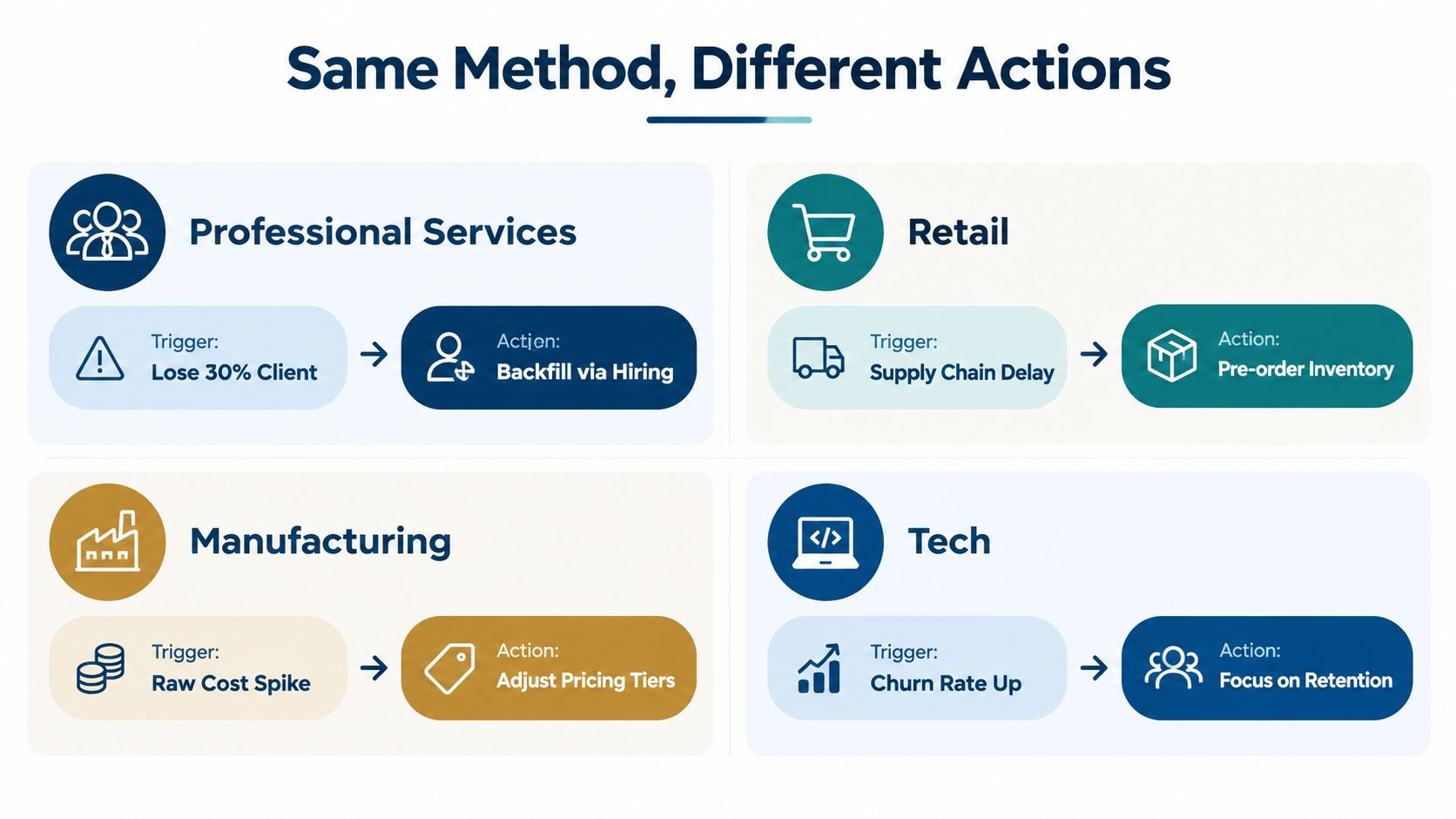
The common thread is not the spreadsheet. It's the pre-decision. Each owner identifies the trigger, names the person who watches it, and decides what happens before the event creates panic. Scenario planning is also useful for testing shocks such as economic volatility, supply disruption, regulation, and new product launches, as outlined in this overview of scenario planning's role in business strategy.
Triggers, Owners, and the Monthly Review Rhythm
A scenario without an owner is a document, not a management tool.
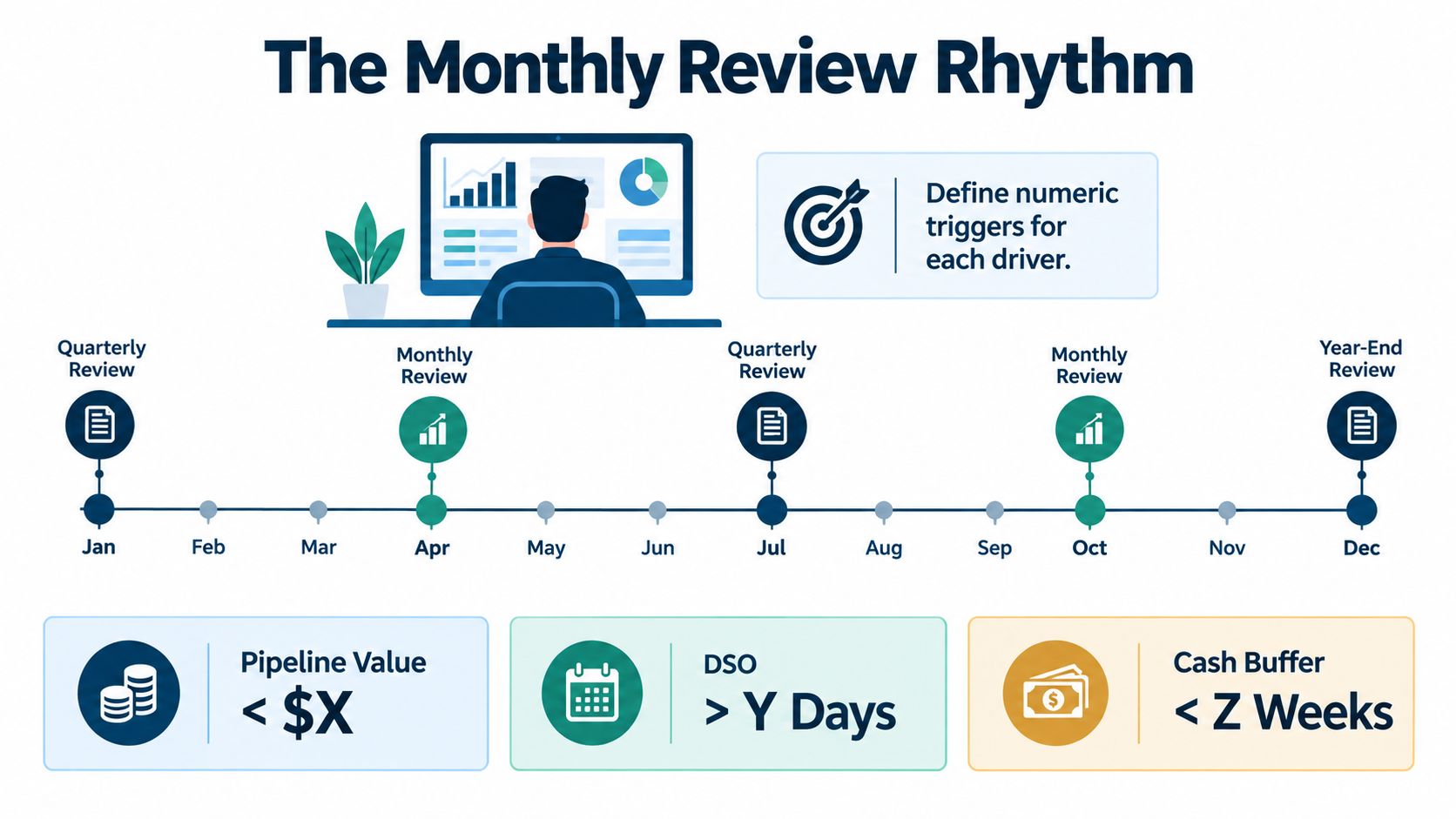
Give each important driver a numeric trigger. The exact number should come from the business's cash needs, contracts, history, and risk tolerance. Examples include pipeline value below X, days sales outstanding above Y days, or cash buffer below Z weeks of payroll. The letters belong in the first draft until the owner chooses real thresholds.
Assign one person to each trigger. The bookkeeper might own collection timing. The sales lead might own pipeline. The practice manager might own appointment capacity. The owner or CFO may approve the response, but one person should watch the signal and raise it quickly. Committees are useful for discussion, but they rarely create clear responsibility when a decision is needed immediately.
Put the signals inside weekly cash management
The weekly cash review should include more than the bank balance. It should show expected receipts, committed payments, payroll coverage, overdue invoices, and the scenario indicators most likely to change cash.
A simple review rhythm looks like this:
- Daily: Check available cash and payments due soon.
- Weekly: Review collections, pipeline, utilization, margin, and the 13-week cash view.
- Monthly: Compare actual results with the selected scenario path and decide whether any branch is becoming more likely.
- Quarterly: Refresh drivers and assumptions, or refresh sooner after a material change.
The monthly meeting can take 30 minutes if the weekly process is clean. Use the time to answer four questions:
- Which triggers moved?
- Are actual results following the base case, or another scenario?
- Has any threshold been crossed?
- Which pre-decided action starts now, and who records it?
Use clear monthly financial statements as the starting point for that discussion. This resource on monthly financial statements can help owners keep the review grounded in actual results rather than memory.
The review shouldn't become a debate about whether the forecast was “right.” It should identify the next decision while there's still time to act. That's why the bookkeeper or controller needs to see the warning before the owner discovers it in the bank account.
Your First 90 Days and What to Watch For
A small business can put the system in place without turning planning into a large project.
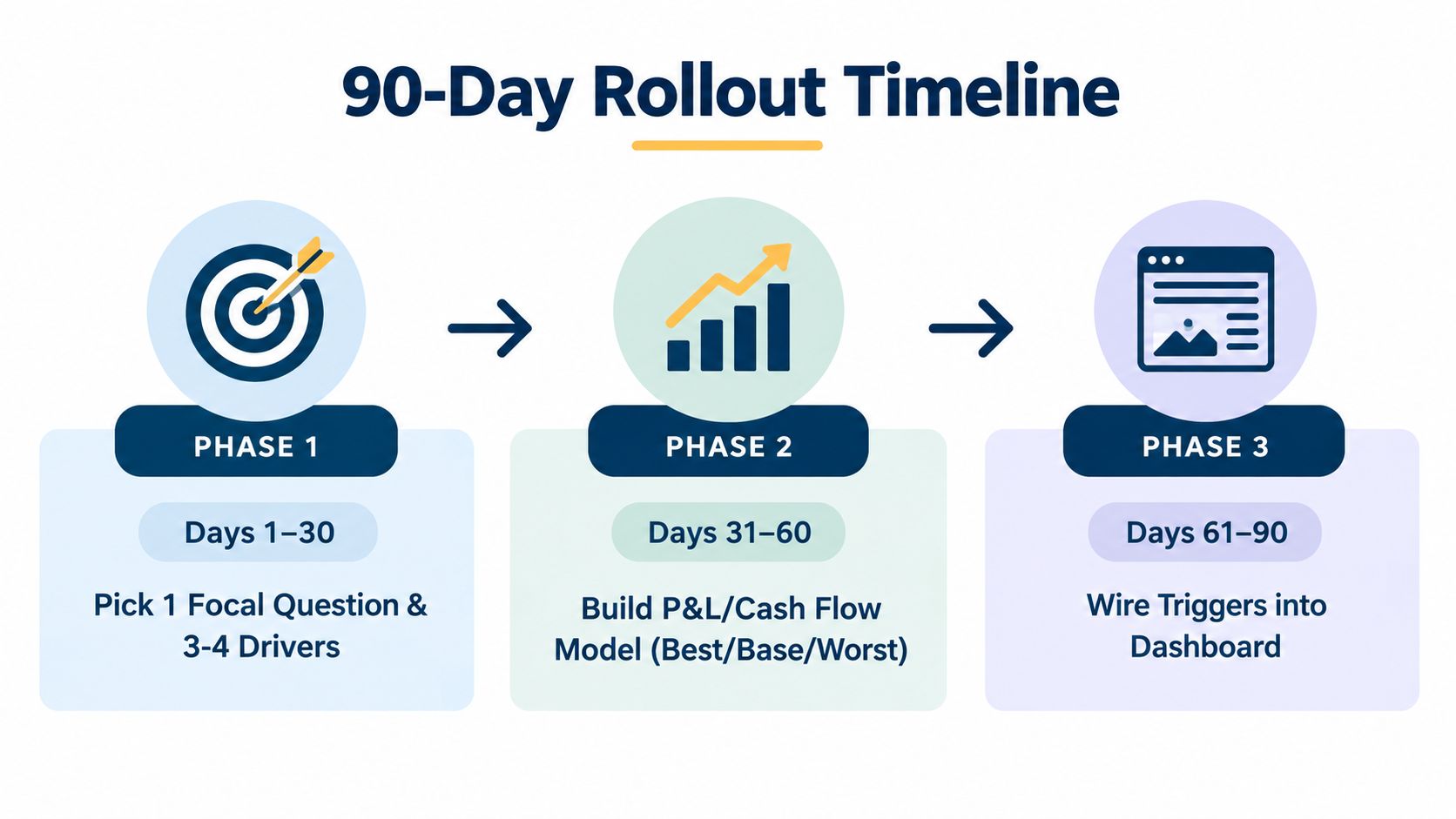
Days 1 to 30
Choose one focal question and write it at the top of the file. List the 3 to 4 drivers that can change the answer, then decide how each one will be measured and who will watch it.
Keep the first meeting focused. Don't try to model every risk in the company. A narrow question about payroll, a loan covenant, job margin, or hiring capacity will produce a more useful result than a broad discussion about uncertainty.
Days 31 to 60
Build the monthly P&L and 13-week cash flow view. Add best, base, and worst cases, but make sure each case has a different operating story rather than a cosmetic change to every cell.
Wire the triggers into the dashboard or weekly review file. For example, an overdue receivables flag should sit beside the expected collection week, not in a separate document that nobody opens during cash review.
Days 61 to 90
Run the monthly review as a rehearsal. Compare actual results with the scenario path, test whether owners can find the signals, and record the action that would start if a threshold were crossed. Fix unclear authority immediately.
A 2026 AFP FP&A Benchmarking Survey found that 38% of organizations reported using structured scenario planning. It also reported average budgeting cycle times of 8.1 weeks for users and 9.2 weeks for non-users, an 11% difference, showing how the practice can connect to an operating process rather than remain strategic theory. The AFP benchmarking report contains those findings.
Troubleshoot the common breakdowns
- Too many scenarios: More than three or four can blur the signals. Combine cases that lead to the same action.
- No trigger owner: The scenario dies in the spreadsheet because nobody has responsibility for watching it.
- Profit confused with cash: A profitable month can still miss payroll when collections arrive late.
- A stale plan: Refresh the drivers quarterly and after any material change in customers, costs, staffing, or financing.
- Finance-only ownership: The leadership team must own the operating decisions. Finance can model the result, but sales, operations, and the owner control many of the inputs.
McKinsey reported that 40% of surveyed organizations in 2013 described scenario planning as having little effectiveness. The cited causes included focusing on the most likely case, limiting analysis to familiar areas, and pushing the work too far down the organization. The benchmarking reference supports the broader lesson, challenge the base case and involve the people who can act.
Print this checklist and keep it beside the cash forecast:
- Focal question: One decision, one horizon, one meaningful number.
- Drivers: Three or four inputs that move profit or cash.
- Scenarios: Distinct cases with different actions, not duplicated spreadsheets.
- Cash view: Weekly collections, payroll, taxes, debt, and minimum balance.
- Triggers: Numeric thresholds that someone can monitor.
- Owners: One named person per trigger.
- Cadence: Daily cash check, weekly KPI pulse, monthly review, quarterly refresh.
- Rehearsal: A written response for each trigger before it is crossed.
Research on continuous planning shows why this operating link matters. Recent findings report that 42% of surveyed finance leaders are doing high-frequency proactive scenario planning, while 51% can run scenarios within a week and 19% still can't run them at all. The same research identifies lack of tools, cross-functional alignment, and data issues as leading barriers. This finance-leader survey makes the practical point clear: the advantage doesn't come from creating more scenarios. It comes from connecting a few useful scenarios to current data and fast decisions.
MyOfficeOps provides bookkeeping, payroll integration, financial reporting, rolling 13-week cash flow forecasting, and CFO-level advisory for small and midsize businesses that need to turn scenarios into weekly decisions. Visit MyOfficeOps to discuss a cash forecast, dashboard, or planning process built around the surprises your business is most likely to face.