
You're sitting at your desk, looking at a monthly profit and loss report that says the business made money. Then you check the bank account and wonder where that money went. Bills are waiting, payroll is coming up, and the spreadsheet in front of you feels more like a puzzle than a useful answer.
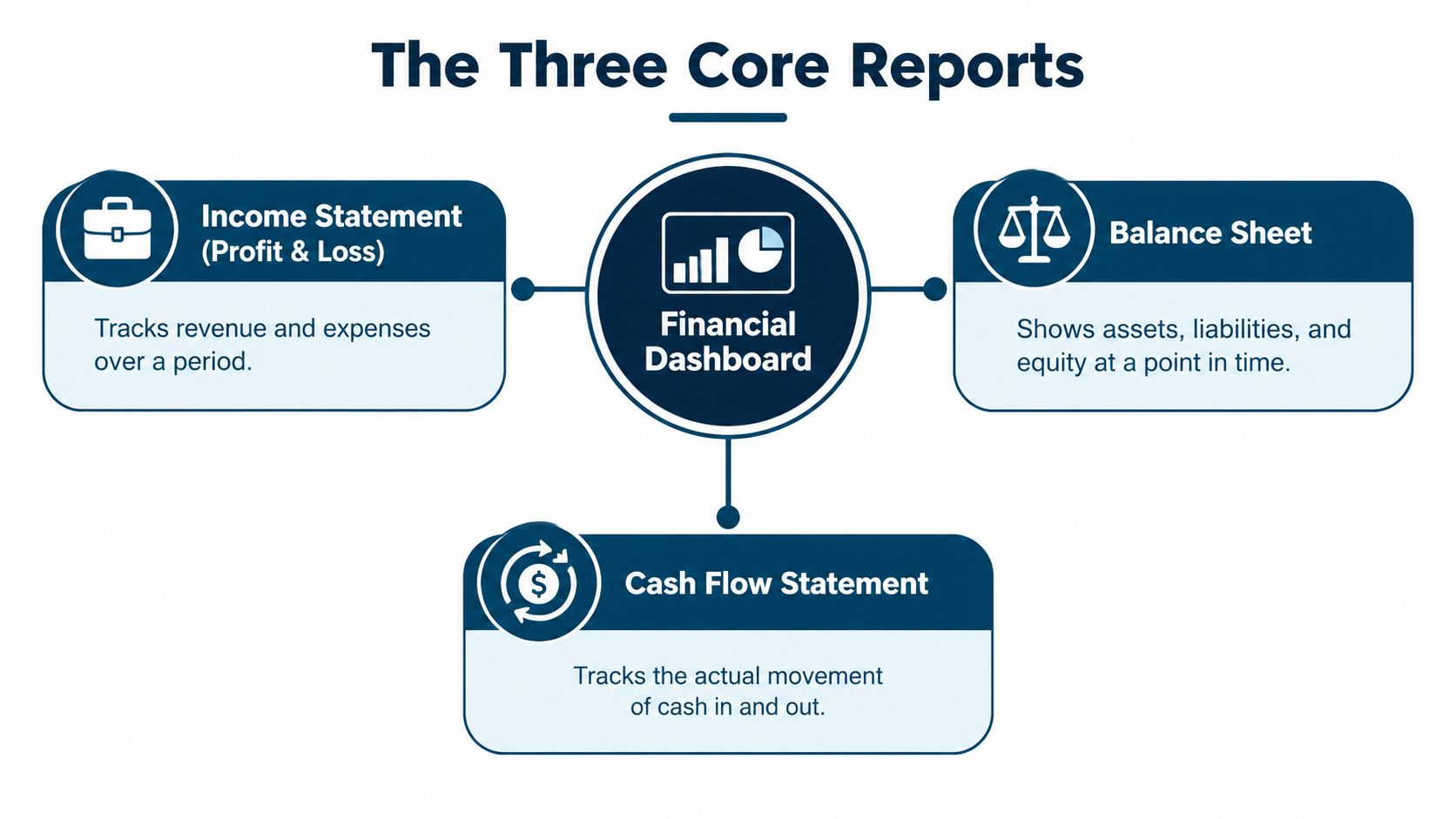
Monthly financial statements can make that situation clearer. Think of them as a business health dashboard. One report acts like a scoreboard, another gives you a snapshot of what the business owns and owes, and the third keeps a diary of actual cash movement. Together, they help you decide whether to change prices, delay spending, hire, collect overdue invoices, or protect cash.
The Three Core Reports Every Business Owner Needs
A business owner named Maya runs a small design studio. At the end of the month, she sees strong sales and feels relieved. Then she notices that several clients haven't paid, software costs increased, and a tax payment is due soon. Her income statement, balance sheet, and cash flow statement each tell part of that story.
The income statement is your scoreboard
The income statement, also called the profit and loss statement, shows revenue and expenses over a period. It answers a simple question: did the business earn a profit or create a loss during the month?
Maya sees project revenue at the top, followed by contractor costs, software, rent, payroll, and other expenses. The result shows how much profit remains after those costs. This report helps her ask practical questions:
- Are prices high enough to cover the work?
- Which services bring in revenue?
- Did a cost rise without a matching reason?
- Did actual spending differ from the budget?
A profit on this report doesn't automatically mean Maya has that amount in the bank. A client may owe her money, or the business may have used cash to pay down a loan. That's why the scoreboard can't stand alone.
The balance sheet is a health snapshot
The balance sheet shows the business at a specific point in time. It lists assets, liabilities, and equity.
Assets include resources the business owns or controls, such as cash, equipment, and amounts customers owe. Liabilities include obligations such as unpaid bills, loans, and taxes owed. Equity represents the owner's remaining interest after liabilities are considered.
A simple way to remember it is:
| Report | Everyday comparison | Main question |
|---|---|---|
| Income statement | Scoreboard | Did we make or lose money? |
| Balance sheet | Snapshot | What do we own and owe right now? |
| Cash flow statement | Cash diary | Where did money actually move? |
If your business involves property, a sample balance sheet for rental property can make the layout easier to recognize. For a broader walkthrough, learn how to read financial reports and connect each line to a real business question.
The cash flow statement is your cash diary
The cash flow statement tracks money coming into and leaving the business. It helps explain why a profitable month can still feel tight.
Maya may have recorded a large sale, but if the customer hasn't paid, that sale appears as revenue without adding cash yet. Meanwhile, payroll, rent, and vendor payments may have already left the bank account. The cash flow statement shows that timing difference.
IAS 34 describes interim reporting as reporting for a period shorter than a full financial year, with either a full or condensed set of statements. Its minimum structure includes financial position, profit or loss, changes in equity, cash flows, and selected notes, along with comparative information so readers can assess figures side by side. IAS 34 provides the formal framework behind that broader view.
Practical rule: Never make a major decision from the profit and loss statement alone. Check profit, financial position, and cash movement together.
How to Close Your Books Without the Stress
You can't print a report on the last day of the month and assume it's finished. The books need a cleanup first, much like a kitchen after a large dinner. Until the dishes are washed, counters are cleared, and leftovers are stored, you don't know what food you have left.
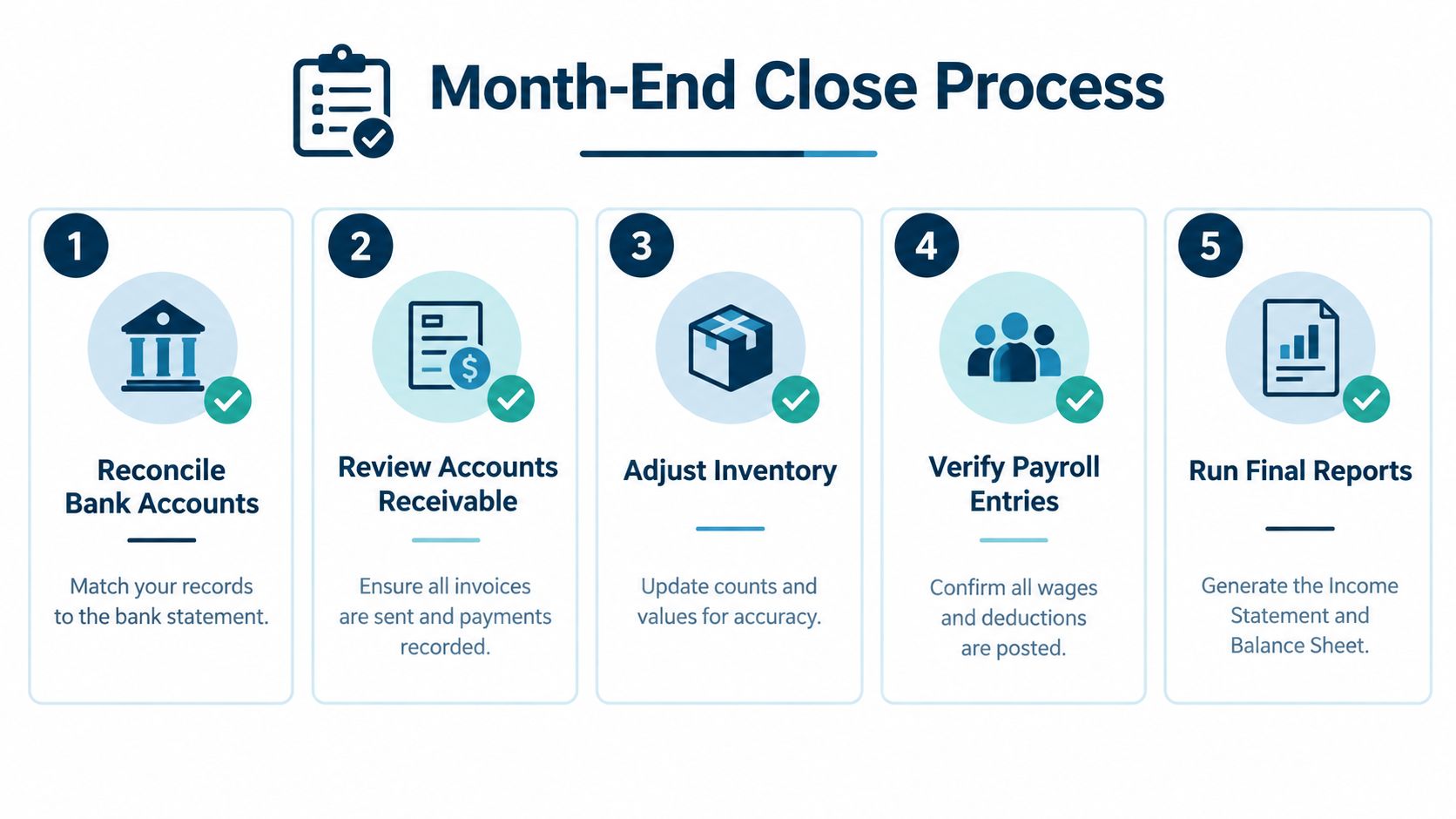
The month-end close gathers, checks, and reconciles transactions before the reports are prepared. That work covers bank accounts, accounts receivable, accounts payable, and the general ledger, as described in this month-end close process guide.
Start before the calendar flips
The close works better when preparation begins before the month ends. A CPA checklist recommends using the three to five days before month-end to review unposted accounts payable, accounts receivable, payroll, and journal entries, communicate deadlines, and run a pre-close trial balance. You're checking whether every “dish” has reached the kitchen before cleanup starts.
Use a simple pre-close list:
- Review unpaid bills: Find vendor invoices that belong to the month but haven't been entered.
- Check customer invoices: Confirm completed work has been billed and payments are recorded correctly.
- Review payroll: Make sure wages, taxes, and deductions are posted to the right period.
- Check unusual entries: Look for duplicate transactions, missing expenses, or entries without support.
- Tell people the deadline: Ask staff and vendors to submit missing information before the close begins.
Work through the first days
During workdays one through five, complete the main close tasks. Reconcile each bank account, match customer and vendor records, verify payroll, update inventory where relevant, and post necessary adjustments. The aim is not speed at any cost. The aim is a report that reflects what happened.
If customers owe money, an aging trial balance explained by Lucentive can help you understand how receivables are grouped by age and which balances need attention. That information connects bookkeeping to collection decisions.
During workdays six through ten, review the balance sheet, investigate differences, document lessons learned, and make post-closing adjustments where needed. The Keiter CPA checklist describes this timing pattern and also recommends consistent variance thresholds, tying subledgers to the general ledger, supporting material journal entries, and locking periods with clear rules for reopening them. You can find a plain-language overview of what month-end close means if you're building the process from scratch.
Let the reports wait when they need to
A finance research benchmark places the median monthly close at 6.4 calendar days, with top-quartile organizations closing in 4.8 days or less and bottom-quartile organizations taking 10 or more days. The figures come from APQC close-time research summarized by Scribe. These numbers aren't a command that every small business must copy, but they show why rushing incomplete books can create bigger problems.
Reading the Story Behind Your Numbers
Clean reports are only the beginning. The useful question isn't “What's the total?” It's “What decision does this number support?”
Start with revenue, but don't stop there. Compare revenue with the direct costs needed to deliver your product or service, then examine operating expenses, receivables, payables, debt, and cash. A rising sales line can look encouraging while the business becomes less profitable because materials, contractors, wages, or supplier charges rise faster.

Read changes as clues
Suppose a contractor reports more revenue this month. The income statement looks stronger, but the cash flow statement shows less cash because several customers haven't paid. The balance sheet shows accounts receivable growing, while accounts payable is also building. The story isn't “sales are up.” It's “work is growing, but cash collection and vendor timing need attention.”
Recent small-business earnings data makes this warning concrete. The NFIB report says average monthly revenue rose while expenses also moved up sharply, and earnings changed dramatically from month to month. It also reports that January 2025 earnings fell nearly 58% year over year while revenue increased 29%, showing why revenue alone can mislead owners. See the NFIB small-business earnings report for that comparison.
Use each report to ask a different question:
- Income statement: Which revenue streams cover their costs?
- Balance sheet: Are receivables, debt, inventory, or unpaid bills changing?
- Cash flow statement: Can the bank balance support upcoming obligations?
- Budget comparison: Which result surprised us, and what caused it?
- Forecast: Should next month's plan change because of what happened?
Turn numbers into decisions
A hiring decision needs more than a profitable month. Look for repeatable revenue, enough cash for payroll, manageable receivables, and a forecast that includes the new cost. A pricing decision also needs more than sales volume. If customers buy more but each job leaves less money after direct costs, higher volume may increase pressure rather than solve it.
The same logic applies to spending. If a marketing expense rises, connect it to leads, sales, and collection timing. If software costs increase, check whether the tools support enough productive work to justify keeping them.
Financial statement analysis guidance can help you build a repeatable habit of comparing trends instead of staring at isolated totals. For small businesses, that interpretation matters because recent central-bank analysis described conditions as improved but still subdued, with median operating profit margins improving only a little. The practical lesson is simple: owners need context and action, not a P&L dump.
Common Financial Mistakes and How to Avoid Them
The most dangerous mistake is treating profit as cash. Profit measures performance under accounting rules. Cash measures what has reached or left the bank account.
A customer can receive an invoice today and pay later. Your income statement may record the sale, but your bank balance won't increase until payment arrives. At the same time, payroll, rent, loan payments, and vendor bills may leave immediately.
Profit tells you whether the business worked. Cash tells you whether the business can pay its next obligation.
Mistake one is trusting a single report
Looking only at the income statement is like driving while watching the speedometer and ignoring the fuel gauge. You may know how fast the business is moving, but not whether it has enough fuel to keep going.
Check the balance sheet for unpaid customer invoices, debt, inventory, and obligations. Then check cash flow to understand timing. If the three reports disagree, don't pick the most flattering one. Find the reason.
Mistake two is accepting unreconciled numbers
A report can look polished and still contain a duplicate payment, missing bank fee, incorrectly posted payroll entry, or invoice assigned to the wrong period. The month-end close exists to find those problems before you use the statements for decisions.
Use a monthly review routine:
- Match bank records: Reconcile every account to the statement.
- Check receivables: Review overdue invoices and customer balances.
- Review payables: Confirm bills belong in the correct month.
- Inspect the balance sheet: Ask for support behind unusual balances.
- Explain variances: Write a short reason for material changes.
- Record decisions: Note who will act, what they'll do, and when it should happen.
Mistake three is ignoring context
A weak month may reflect seasonality, delayed billing, a one-time repair, or a temporary cost shock. A strong month may reflect one large project that won't repeat. Write a short comment beside unusual movements so next month's review doesn't begin from guesswork.
The report becomes useful when each important number has an explanation and a next step.
When to Hand Over the Financial Reins
Doing your own bookkeeping can make sense when the business is small and transactions are easy to follow. The problem starts when bookkeeping takes time away from serving customers, managing staff, selling work, or planning the next move.
A warning sign isn't only a messy ledger. It's a decision process built on delay. If your statements arrive long after the month ends, you may be managing yesterday's business. If you spend weekends fixing spreadsheets, you're also paying for bookkeeping with owner time, even if no invoice arrives.
Look for the decision signals
You may be ready for an outsourced bookkeeping and advisory partner if:
- You avoid the reports: You open them only when a lender, tax professional, or crisis forces you to.
- You rely on bank balance alone: You know what's in the account but not what the business earned or owes.
- You keep changing spreadsheets: Different versions make it hard to identify the trusted number.
- You delay invoices and bill payments: Administrative work sits behind customer work.
- You make large decisions by instinct: Hiring, pricing, and spending happen without a clear forecast.
- You can't explain changes: Revenue, margins, receivables, or expenses move, but nobody can say why.
- You're preparing for growth or a sale: Buyers and lenders need organized records, consistent reporting, and support for the numbers.
The right partner doesn't only enter transactions after the fact. A capable team can help organize the close, prepare monthly financial statements, build cash-flow analysis, maintain KPI dashboards, and turn results into choices about pricing, hiring, and spending.
Choose support that matches the business
Ask how the provider handles reconciliations, review questions, payroll integration, bill pay, forecasting, and communication. You should know who owns the work, when reports arrive, and how unusual items get explained.
MyOfficeOps offers bookkeeping, accounting, payroll integration, financial analytics, and CFO-level advisory for small and midsize businesses. Its service model covers core accounting, profit optimization, and exit strategy, so an owner can use the same financial foundation for clean books, operating decisions, and future transition planning.
Keep ownership of the decisions
Outsourcing doesn't mean handing away control. It means separating recordkeeping from leadership. Your accountant or bookkeeper prepares and explains the information. You still decide whether to raise prices, change vendors, hire, invest, or preserve cash.
The best handoff gives you fewer administrative tasks and better questions to answer.
Your Next Steps for Better Financial Clarity
You don't need a complicated finance department to start. You need a repeatable monthly rhythm and a short list of questions that connect reports to action.
On the next business day, choose one recent month and gather the income statement, balance sheet, cash flow statement, bank statements, accounts receivable list, accounts payable list, and budget comparison. If those records aren't ready, write down what's missing. That list is your first improvement plan.
Build a simple review habit
Use the same order each month:
- Confirm the close: Check that bank accounts and major ledger accounts were reconciled.
- Read the scoreboard: Review revenue, expenses, profit, and significant budget differences.
- Check the snapshot: Look at cash, receivables, debt, inventory, unpaid bills, and equity.
- Follow the cash diary: Identify what came in, what went out, and what must be paid next.
- Write the story: Explain unusual movements in plain language.
- Choose actions: Assign a small number of clear tasks with an owner and deadline.
The important shift is from collecting reports to using them. A monthly package should help you answer whether prices work, whether customers pay on time, whether expenses are controlled, and whether the business can support its next decision.
Make the package easy to understand
A useful management package usually includes the three core statements, KPI dashboards, budget comparisons, forecast updates, and commentary. Independent finance guidance describes concise packages of 5 to 10 pages, with enough information to show material variances and projected year-end outcomes without burying leadership in transaction detail. See this financial reporting guide for finance managers for that management-focused approach.
Organizations with outside funding or formal oversight may also need clear monthly reporting processes. Alignmint's fiscal sponsor reporting guide offers useful context for understanding how regular financial reporting can support accountability and communication.
Start small, but don't skip the habit. A clean monthly review gives you a clearer view of what happened, what needs attention, and which move deserves your energy next.
MyOfficeOps helps small and midsize businesses prepare monthly financial statements, review profit and loss results, analyze cash flow, and connect the numbers to decisions about pricing, hiring, and growth. Visit MyOfficeOps to discuss a bookkeeping or advisory plan that gives your business a clearer financial dashboard.