

A framing contractor is five weeks into a custom build. The materials are on site, two subcontractors have finished their first phase, and the client has approved two progress checks. At dinner, his wife asks the question he should be able to answer quickly: “Are we making money on this job?”
He checks the bank account. It looks healthy. The accounts receivable report shows one customer still owes him money. QuickBooks shows profit somewhere on the income statement. None of those numbers match what he sees at the jobsite.
That gap is why construction accounting methods matter. A contractor needs books that answer practical questions, not just tax questions: Should we bid another project like this? Is this job still profitable? How much cash is trapped in work in progress? The right method gives you a useful answer before the project is finished, when you can still act.
Why Construction Accounting Feels So Hard Mid-Job
Construction accounting feels difficult because the work happens in one period while the money often appears in another. You buy materials before installation, pay labor before billing the owner, and wait for retainage after the customer accepts the work. A job can look profitable on paper while your operating account feels empty.
A framing contractor might have a contract worth $180,000, but that number says little about the job's current health. He needs to know how much labor has been used, whether lumber costs are above budget, whether the subcontractor's invoice matches completed work, and whether approved changes have reached the billing schedule. A deposit in the bank doesn't answer those questions.
The jobsite and the ledger tell different stories
Suppose the contractor has spent heavily during the first month. Under a simple cash view, the P&L may show a loss because materials and labor were paid before the next draw arrived. After the customer pays, the same job may suddenly look very profitable, even though no new work was completed that week.
That timing problem gets worse when projects cross reporting periods. Residential work can run from a few weeks to several months, while commercial work may continue across fiscal years. Progress billing, retainage, pending changes, and subcontractor commitments all affect the result before the final invoice is issued.
A useful review should connect four records:
- The budget, which shows what the estimator expected.
- Actual job costs, which show what the field has consumed.
- The billing schedule, which shows what the contractor has invoiced.
- The forecast, which shows what the job is likely to cost before closeout.
Controller's rule: If the project manager can see a problem in the field but accounting can't see it in the report, the report is late or incomplete.
The contractor in this example doesn't need a prettier income statement. He needs a job report that flags a labor overrun, an unbilled change, or a cost-to-complete estimate that has moved. A practical guide to cost overruns in construction projects can help owners connect those field problems to their financial controls.
The rest of the accounting decision follows from that need. Cash and accrual determine when transactions enter the books. Percentage-of-completion and completed-contract determine how long-term project revenue and profit appear over time. Job costing and WIP schedules make either approach useful.
Cash vs Accrual for Contractors
Cash accounting records income when the customer pays and expenses when the contractor pays. Accrual accounting records revenue when it is earned and expenses when they are incurred. For a contractor, that difference can change the answer to “How profitable was the job this month?” without changing anything at the jobsite.
Take a $220,000 kitchen remodel with three progress draws. The contractor buys most materials in the first month, performs substantial work by day 60, and expects the final payment 30 days after completion. At the 60-day month-end, the two methods can show very different results.
| Line Item | Cash Method | Accrual Method |
|---|---|---|
| Revenue | Records only customer payments that cleared the bank | Records revenue earned from work completed |
| Materials | Shows costs when supplier checks or card payments clear | Shows materials consumed or incurred for the project |
| Subcontractors | May omit unpaid subcontractor work | Records incurred subcontractor costs |
| Profit at day 60 | Can look unusually high or low based on payment timing | Better reflects the work performed and costs used |
| Final payment | Appears when received | Appears as a receivable when earned |
Why the bank balance isn't the P&L
Cash accounting is easy to understand, and it can be acceptable for a small contractor with short jobs and simple reporting needs. The problem starts when the owner uses the cash P&L to decide whether a fixed-price job is working.
If the customer pays a draw before the contractor pays every supplier, cash accounting can overstate current profitability. If a large materials invoice clears before a draw arrives, it can make a healthy job look like a loss. Neither result tells the owner what the completed work earned.
Accrual accounting fixes the timing issue, but it doesn't eliminate cash pressure. A contractor can show earned revenue and profit while waiting for the customer to pay. That's why an accrual P&L should sit beside an aged receivables report, a cash forecast, and a WIP schedule. For a plain-language explanation of why the timing difference matters at year-end, see this guide to why accrual accounting matters for EOFY.
When cash stops being enough
The IRS still allows the cash method for many small contractors that meet the applicable gross-receipts test. Tax eligibility and management reporting are separate decisions, though. A contractor may use one method for a tax return and maintain accrual-based internal reports to understand job performance.
A switch usually becomes necessary when the business needs stronger financial statements for GAAP reporting, percentage-of-completion work, bonding capacity reviews, surety underwriting, lender covenants, or a working-capital line over $500,000. A contractor carrying more than $5 million in WIP also needs reporting that shows earned revenue, billings, committed costs, and expected margin rather than just bank activity.
My recommendation is simple. Use cash accounting only when the business and its jobs are simple. If the owner is bidding larger fixed-price work or seeking outside capital, build accrual reporting before a lender or surety demands it.
Percentage-of-Completion vs Completed-Contract
For a qualifying long-term contract, percentage-of-completion accounting recognizes revenue and cost as work advances. Completed-contract accounting generally defers contract income and costs until the project is considered complete. The choice affects taxable income, cash timing, year-end statements, and the speed at which a contractor sees a bad job.
Return to the $220,000 remodel. Assume the project has incurred $88,000 of allocated costs against estimated total costs of $220,000. Under a cost-to-cost calculation, the job is 40% complete because $88,000 is 40% of the estimated cost. Under PCM, the contractor generally recognizes the related share of contract revenue, subject to required adjustments and reliable estimates. Under CCM, the project's income and costs generally remain deferred until completion.
| Milestone | Percentage-of-Completion | Completed-Contract |
|---|---|---|
| Early project | Recognizes revenue and cost as measured work progresses | Defers project income and costs |
| Cost forecast changes | Updates completion and expected profit as estimates change | May hide the effect until completion |
| Year-end statement | Shows activity and emerging margin | May show little project profit before closeout |
| Tax timing | Can accelerate taxable income | Can defer eligible taxable income |
| Management visibility | Shows margin erosion while the team can respond | Can delay the warning |
PCM shows the damage while you can still fix it
The standard cost-to-cost formula is straightforward:
Costs incurred to date ÷ estimated total contract costs = completion percentage
The IRS describes PCM as the general rule for long-term contracts under Internal Revenue Code Section 460, enacted through the Tax Reform Act of 1986. A long-term contract generally means a construction, installation, or building contract that isn't completed in the same taxable year in which it begins. The IRS guidance on long-term contract accounting explains the general rule and the limited exceptions.
Assume the same remodel is 40% complete when the contractor discovers a $50,000 cost overrun. Under PCM, the revised estimate changes the project's completion calculation and expected gross profit in the current reporting period. The contractor sees the margin problem now, which gives him time to renegotiate scope, control labor, or stop bidding similar work.
Under CCM, that project-level loss may not flow through taxable income or the external income statement until the contract is complete. The method can preserve cash by postponing taxable income on an eligible contract, but it can also leave management with a weak interim picture.
CCM is a tax tool, not a management dashboard
The IRS permits CCM for qualifying home-construction contracts and certain small-contractor work. For tax years beginning on or after January 1, 2018, the small-contractor exception generally uses a $25 million average annual gross-receipts threshold measured over the prior three tax years, along with a requirement that the project is expected to finish within two years. The earlier threshold was $10 million. Eligibility must be checked contract by contract, not assumed from company size alone. The IRS examination guidance on the completed-contract method outlines these distinctions.
A contractor using CCM should still maintain internal WIP and forecast reports. Keep the tax method separate from management reporting so the owner can see current job performance without giving up a permitted tax-timing option. For most commercial contractors with reliable estimates, PCM is the more useful operating method. For eligible smaller residential work, CCM may be sensible for tax, but it shouldn't be the only view of the business.
Job Costing That Tells You the Truth
Job costing isn't a month-end cleanup task. It's a weekly operating habit that tells the owner whether the estimate is holding up while the crew can still change the outcome.
Use cost codes that match how the work is performed. A workable structure might include 01 labor by crew, 02 materials by phase, 03 subcontractors by trade, and 05 equipment with operator hours separated from idle hours. The exact numbering matters less than consistent use. A lumber invoice coded only to “materials” doesn't tell you whether framing, cabinets, or finish work caused the variance.
Consider a $400,000 kitchen renovation with an estimated gross profit target of 32%. The planned cost structure is:
| Cost Code | Category | Budget | % of Contract | Variance Trigger |
|---|---|---|---|---|
| 01 | Labor | $92,000 | 23% | Crew hours exceed phase budget |
| 02 | Materials | $148,000 | 37% | Purchases exceed approved takeoff |
| 03 | Subcontractors | $112,000 | 28% | Billing exceeds Schedule of Values |
| 05 | Equipment | $18,000 | 4.5% | Idle hours or rental extension |
| 06 | Permits and dumpsters | $14,000 | 3.5% | Unplanned fees or extra haul-offs |
| Total listed costs | $384,000 | 96% | Forecast must preserve target margin |
The target gross profit implies an estimated cost ceiling of $272,000, so the sample allocation above should be treated as a deliberate warning. It doesn't support a 32% gross profit target without a correction to the budget, contract price, scope, or forecast. That's exactly why cost-code review matters. A clean table can expose an estimate that was never internally consistent.
Review the job before Friday ends
The process should be boring and repeatable:
- Code invoices before approval: Assign every invoice to a job and phase before someone approves payment.
- Match timecards weekly: Tie each crew member's labor hours to the correct cost code, not a general overhead bucket.
- Check subcontractor billings: Compare each billing to the Schedule of Values before posting it.
- Review commitments: Include approved purchase orders and subcontractor commitments in the cost-to-complete view.
- Read one page every Friday: The project manager and bookkeeper should review budget, actual cost, billed amount, remaining cost, and forecast margin together.
Practical rule: If a cost isn't assigned to a job and phase before approval, the report will be late even if the bookkeeping is technically accurate.
Smaller teams can use a properly structured workbook, and a construction job costing Excel template can provide a starting layout. Contractors with recurring billing needs can also borrow ideas from landscaping billing tactics and templates, especially around clear descriptions, job references, and documentation that helps accounting match billing to production.
The point isn't to create more codes. It's to make each weekly review answer one question: What changed since the estimate, and who is responsible for the next decision?
Retainage, Change Orders, and WIP Schedules
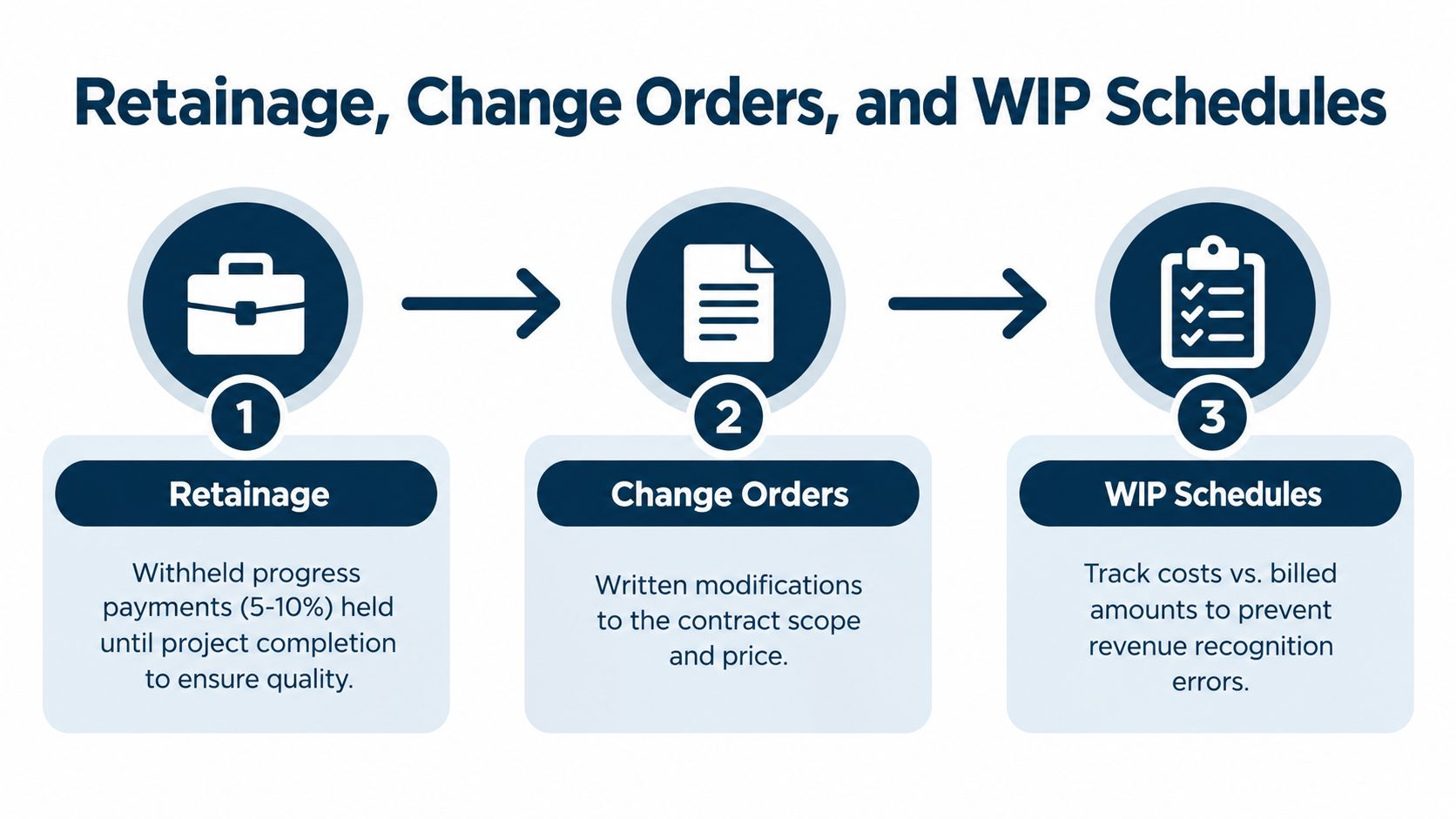
Retainage, change orders, and WIP schedules are connected. Treating them as separate bookkeeping chores is how a contractor ends up with a job that looks profitable, has cash problems, and is missing revenue.
Retainage is the portion of a progress payment held back until contractual conditions are met. It may sit as a receivable after the owner approves the pay application, so the contractor shouldn't treat the withheld amount as a vanished cost or ignore it in cash planning.
A change order creates the opposite risk. The field performs extra work, but the office never records the scope, price, or billing. On a $1.2 million office buildout, three completed change orders worth $25,000 each leave the schedule short by roughly $75,000 in revenue if nobody logs them. The job can appear 92% complete while the financial report has no unbilled exposure to explain the gap.
Use one chain of control
Every field change should move through the same chain:
- Assign a change-order number the same day. Record the request, job, affected phase, estimated cost, and status.
- Price the work before production when possible. Separate pending changes from approved changes so the forecast doesn't treat uncertain revenue as earned.
- Obtain written approval. The contract file should show the scope and price that support the billing.
- Update the budget and forecast. Add the expected cost and revenue to the job record.
- Tie the change to billing. The pay application should make it clear which approved changes are being invoiced.
At month-end, reconcile billings to date plus contract-to-bill against the cost-to-cost progress calculation. The underbilling or overbilling line should come from a documented reconciliation, not a guess.
A WIP schedule gives management that reconciliation. It compares earned revenue, costs incurred, billings, estimated costs to complete, and forecast gross profit. The IRS guidance on the 95% completion threshold and completed-contract treatment also makes clear why completion status needs careful documentation. A contractor should maintain a separate tax-method reconciliation when tax and management reporting use different methods.
For practical guidance on maintaining a construction work-in-progress accounting process, start with ownership. The project manager owns field progress and scope changes. Accounting owns the reconciliation. The controller owns the challenge when the two records don't agree.
The Software Trap and What to Do Instead
A contractor can spend $50,000 on an ERP and still miss a change order, code labor late, or carry stale job costs. The system will process those errors quickly. Better reporting starts with consistent entries, clear ownership, and weekly review.
A $40,000-a-year platform cannot compensate for a project manager who waits until month-end to report a field change. Set the process first, then choose software that supports it.
Build the control layer before buying features
Use three operating habits:
- Code every invoice within 48 hours: Assign the job, phase, and cost code while the transaction is still easy to identify.
- Review WIP every Friday: The project manager explains changes in percent complete, remaining cost, billing status, and forecast margin.
- Close within 10 business days of month-end: A timely close gives the team a chance to correct a weak job before the warning becomes a cash problem.
QuickBooks Online Contractor or a well-set-up Excel workbook can support these controls for many smaller contractors. Larger operations may need Procore Foundation, Foundation Software, or another integrated platform. Choose the system according to the reports and decisions the business must produce, including what to bid next and where cash is trapped in work-in-progress.
Industry surveys show rising investment in accounting, estimating, and project-management software. That spending pays off only when the control layer is ready: consistent cost codes, timely subcontractor commitments, approved changes, labor-hour capture, retainage tracking, and a documented estimate-at-completion process. For tax-method questions, verify the applicable rule in this IRS practice unit.
Software only records the discipline a team already has.
Evaluate a platform by asking whether it shortens the delay between field activity and financial reporting, flags underbilling or worsening cost-to-complete estimates early, and preserves an audit trail. It should make job-level decisions easier to support with current evidence.
For contractors formalizing repeatable controls, the Safety Space practical ISO guide reinforces the value of documented processes, named owners, evidence, and regular review. Accounting controls need the same structure.
Recommended Workflows and Final Recommendations
A contractor doesn't need a complicated ritual. He needs a fixed cadence that makes missing information uncomfortable.
Start next Monday with a weekly operating rhythm:
- Every Friday: The bookkeeper and project manager review job cost, committed cost, billed-to-date, percent complete, remaining cost, change-order status, and forecast gross profit.
- On the 1st and 15th: Update WIP, review retainage receivables, and compare earned revenue with billings.
- By the 5th business day after month-end: Post late invoices, accrue known subcontractor and labor costs, reconcile bank and receivables, and prepare the management P&L.
- Before a new bid: Review completed jobs by cost code. Use actual labor productivity, material usage, and subcontractor performance instead of relying only on the original estimate.
Match the method to the contractor
| Contractor Type / Size | Tax Method | Revenue Recognition | Required Reports |
|---|---|---|---|
| Solo remodeler under $1 million with no lender covenants | Cash can be appropriate if eligible | Simple job-level tracking, with accrual visibility as jobs grow | Cash forecast, open invoices, job budget versus actual |
| Small general contractor doing fixed-price work over $1 million | Select a permitted tax method with CPA review | Accrual with job costing and PCM-style progress reporting | Monthly WIP, cost-to-complete, change-order log, margin report |
| Commercial or multi-trade contractor over $5 million | Formal tax-method review and documented reconciliations | PCM with reliable cost-to-cost estimates | Formal WIP, earned-margin reporting, committed costs, retainage, separate change-order revenue |
| Contractor using CCM for eligible work | CCM for qualifying tax contracts | Internal management reporting should still show project progress | Tax-to-book reconciliation, WIP, completion-threshold monitoring |
The IRS identifies PCM as the general tax rule for most long-term construction contracts, while qualifying home-construction and small-contractor work may use exceptions. Under PCM, the cost-to-cost calculation divides allocated costs incurred to date by estimated total allocated costs. That makes monthly estimate updates and accurate coding essential. The IRS practice unit on construction contract accounting also supports the practical control of separately tracking labor, materials, subcontractors, equipment, and approved changes.
Close the year without surprises
At year-end, perform a final percentage-of-completion true-up, issue 1099s, and review retained receivables. Confirm that every active job has a current estimate to complete, that approved change orders are in both the contract value and billing schedule, and that tax reporting agrees with the books or has a documented reconciliation.
My direct recommendations are these:
- A solo remodeler with short jobs and no financing pressure can use cash basis if eligible, but should still track job profitability.
- A small fixed-price GC should run accrual reporting, maintain job costing, and use progressive revenue reporting.
- A commercial or multi-trade contractor over $5 million needs formal WIP, monthly earned-margin reporting, and separate change-order revenue.
- Any contractor seeking bonding or lending should stop relying on a cash-only P&L before the review process forces a change.
Pick one tax method, one revenue-recognition method, and one weekly review habit. Document the choices, reconcile them, and enforce them. Construction accounting works when the records reflect what crews are doing now, not what the office remembers several weeks later.
MyOfficeOps helps contractors organize bookkeeping, job-cost reporting, payroll integration, forecasting, and CFO-level financial analysis so project data supports better decisions. Visit MyOfficeOps to discuss a practical accounting workflow for cleaner WIP, clearer margins, and stronger cash-flow control.