
You finish a job. The customer is happy. Subs got paid. The bank balance doesn't look terrible.
Then you sit down and ask the only question that matters. Did this job make money?
That's where a lot of contractors get stuck. The receipts are in one place, payroll is in another, material bills came in late, and half the equipment cost never got tied back to the project. You know work was done. You just don't know your real profit.
That's why accounting services for contractors matter. Not because tax season is coming. Not because your CPA asked for cleaner books. Because if you can't tell which jobs make money, which crews are productive, and which labor setup puts you at risk, you're running the business on instinct. Instinct helps you win jobs. It does not protect margin.
The Real Reason You Need Contractor Accounting
A lot of owners treat accounting like cleanup work. Build first, sort the paperwork out later.
That works right up until one “good” job turns out to be a weak one.
A contractor might finish a remodel, look at the contract total, subtract the obvious material and labor costs, and think the job went well. Then the missing pieces show up. Dumpster charges. Extra trips to the supply house. Payroll taxes. Small tools. Equipment use. Change order work that got done but wasn't billed cleanly. Suddenly the profit is a lot thinner than expected.
That's the core job of contractor accounting. It tells you the score while the game is still being played.
Practical rule: If you only know your numbers after the job is over, you're not managing profit. You're doing an autopsy.
Specialized contractor accounting gives each project its own financial trail. Instead of one pile of income and expenses, you get job-level visibility. You can see where labor drifted, where materials ran hot, and whether your pricing held up.
That matters even more when costs move around fast. One bid can look solid on paper and get squeezed later by labor overruns, supplier changes, or scope creep. Gut feel won't catch that early enough.
Here's the simple version. If your family takes a road trip, knowing the total spent at the end is helpful. But if you want to stay on budget, you track gas, food, hotels, and tickets as you go. Contracting works the same way. The total company profit matters. But each job needs its own receipts, its own mileage, and its own scorecard.
Good accounting services for contractors turn accounting into a decision tool. You stop asking, “Where did the money go?” and start asking better questions like, “Should we price this kind of work higher?” or “Why does Crew A beat Crew B on the same type of job?”
Why Contractor Accounting Is a Different Beast
A restaurant sells the same product over and over from one location. A contractor doesn't. You're managing different jobs, different crews, different schedules, and different cost patterns across multiple sites.
That's why regular bookkeeping often falls short in construction.
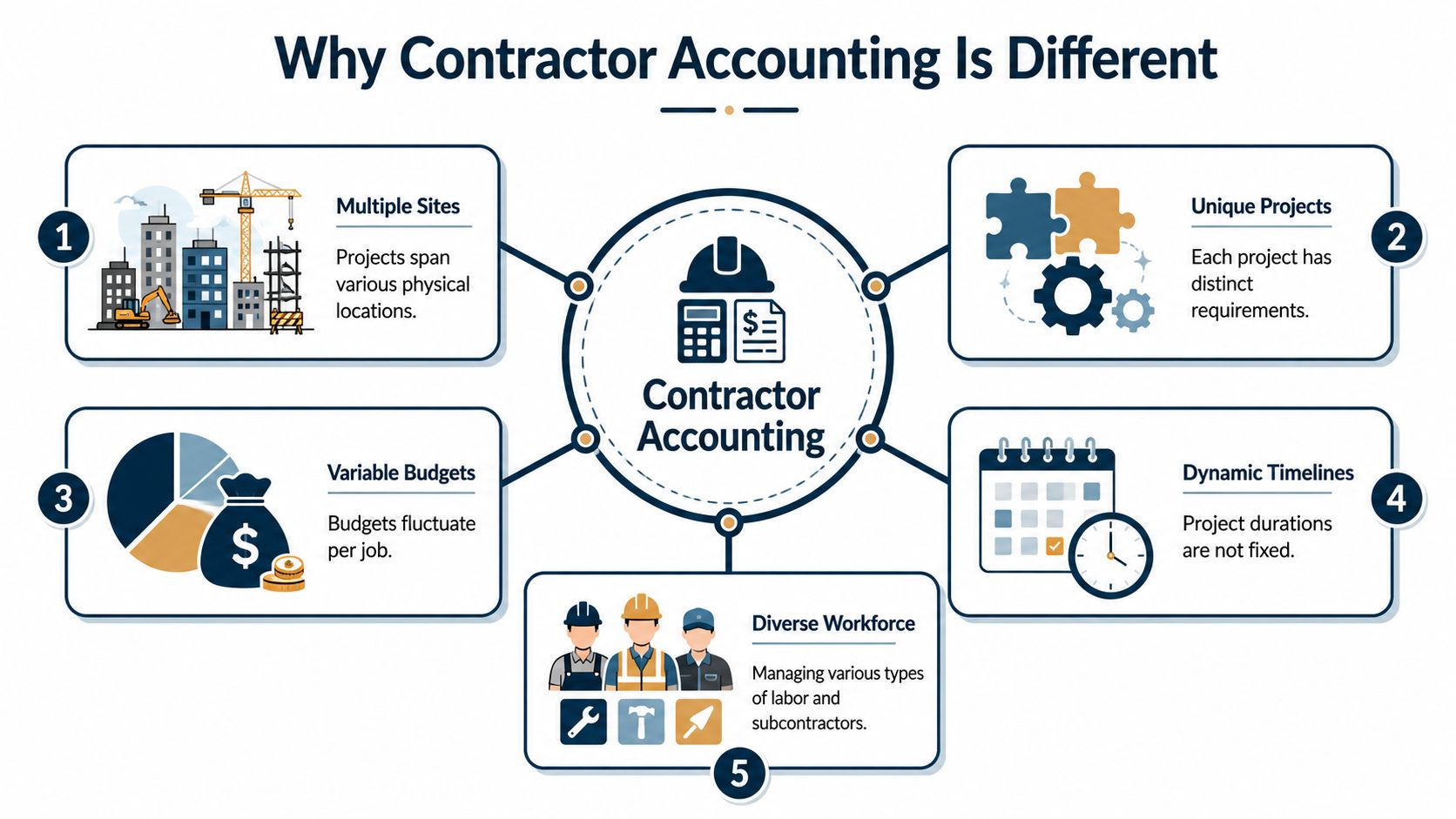
Every job is its own little business
Each project has a separate budget, timeline, and risk profile. One job may run smoothly with repeatable labor. Another may have weather delays, client changes, permit issues, or expensive rework.
If your books only show total monthly revenue and total monthly expenses, you miss the point. You need to know which job created the profit and which one drained it.
That's why contractor accounting organizes the numbers around jobs, phases, and cost codes. Not just around broad categories like “materials” or “payroll.”
A simple comparison makes this clearer:
| Business type | How money is tracked |
|---|---|
| Restaurant | By daily sales and regular overhead |
| Retail store | By inventory, sales volume, and location |
| Contractor | By project, labor, material, equipment, timeline, and billing status |
Revenue timing matters more than most owners expect
Construction also has a special problem. Work and billing don't always happen at the same pace.
Construction contractors typically use one of two accounting methods: the completed contract method or the percentage of completion method, with the latter preferred for jobs that take longer than one accounting period, as explained in Whittmarsh's construction bookkeeping guide.
That sounds technical, but the idea is simple.
- Completed contract method: You record profit when the whole job is done.
- Percentage of completion method: You record profit as the job progresses.
If you run long projects, this changes how you read your numbers. A month can look strong on cash because you billed well, while the actual job margin is slipping. Or the opposite can happen. You may have done solid work, but collections lag and the bank account feels tight.
The books for a contractor have to answer two questions at once. “How is the company doing?” and “How is each job doing?”
Standard bookkeeping misses the field reality
Generic bookkeeping is often built for businesses with steady, repeatable transactions. Contracting is not that.
You have:
- Multiple sites: Expenses happen away from the office.
- Mixed labor: Employees and subcontractors may work on the same project.
- Shifting schedules: Delays change cost patterns fast.
- Job-based purchasing: Materials often hit one project, not the whole company.
- Billing complexity: Progress billing, deposits, and change work need tighter tracking.
That's why contractor accounting feels like a different beast. Because it is. Trying to run construction on generic books is like trying to frame a house with only a hammer. You can hit things, but you can't build cleanly.
The Core Accounting Services Your Business Needs
Most service lists are too vague. “Bookkeeping, payroll, tax, reporting” doesn't help much if you're trying to solve actual field problems.
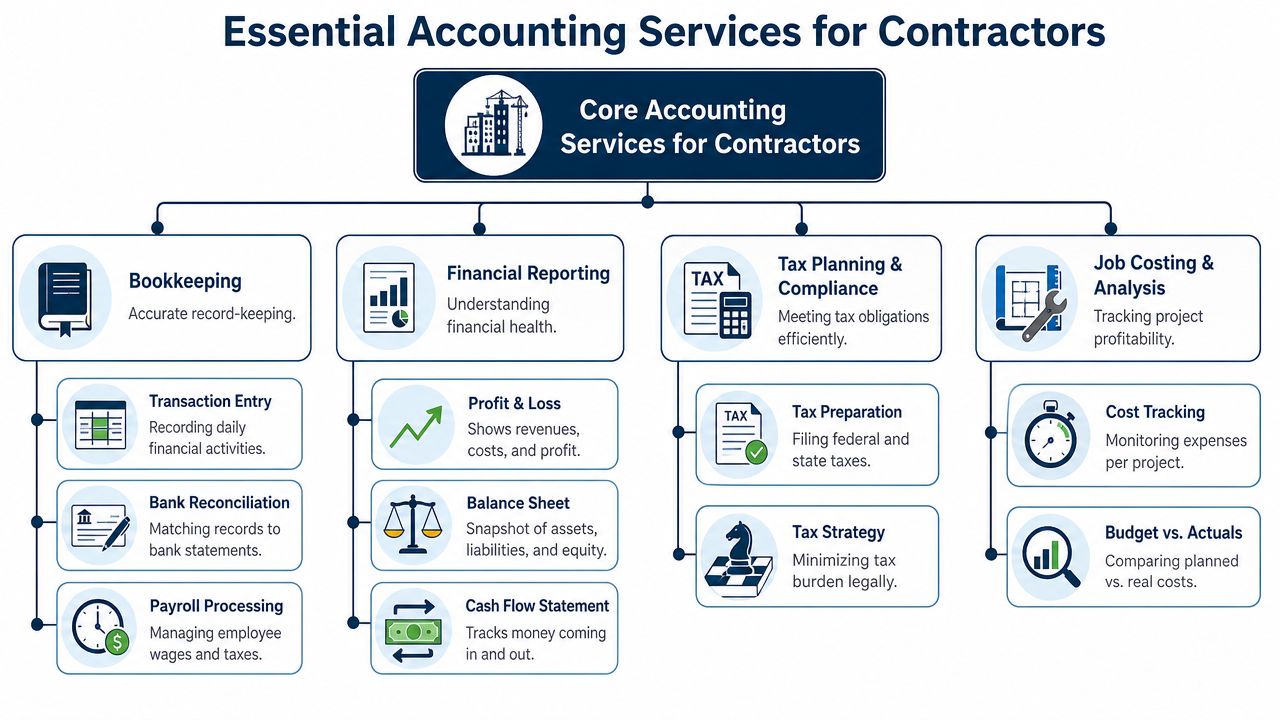
The right accounting services for contractors should fix four day-to-day headaches: knowing job profit, paying people the right way, staying compliant, and keeping cash from drying up between vendor payments and customer collections.
Job costing
This is the engine.
Job costing means every meaningful cost gets tied to the right project. Labor. Materials. Subs. Equipment. Smaller owned assets. Tool use. The hidden stuff that owners often absorb without noticing.
Deltek puts it plainly in its discussion of construction accounting best practices. Job costing is the foundational technical requirement for contractor accounting, and it requires daily allocation of equipment, tool, and asset ownership or operating costs to specific jobs.
If that sounds fussy, think of it this way. If two jobs both use the same skid steer and only one job gets charged for it, one job looks worse than reality and the other looks better than reality. Bad inputs lead to bad pricing later.
For a practical breakdown of how the pieces fit together, this guide to bookkeeping for contractors is useful because it ties routine bookkeeping back to project decisions.
Payroll and worker classification
Here, a lot of contractors get burned.
Construction businesses often use both employees and independent contractors. On paper, that sounds simple. In practice, it isn't. Employees go through payroll with taxes and wage rules attached. Independent contractors need vendor tracking and forms like 1099-NEC.
The danger is misclassification. If your accounting team treats everyone like “labor” without a clean process behind it, you can create tax and labor problems fast.
A good setup separates these workflows clearly:
- Employees: Time tracking, payroll taxes, overtime rules, benefits, and job costing.
- Independent contractors: Vendor onboarding, payment tracking, agreement records, and 1099 reporting.
If you're also reviewing business risk on the insurance side, this overview of New Jersey contractors insurance options is worth a look because labor setup, subcontractor use, and documentation often affect coverage issues too.
Compliance and tax planning
Tax planning for contractors isn't just “file the return on time.” It includes how jobs are tracked, how costs are classified, and whether your records hold up if someone asks questions later.
This gets even more serious with public work. Government contractors need cleaner cost separation, tighter labor records, and stronger documentation than many private jobs require.
A weak chart of accounts creates mess later. So does mixing personal spending with business transactions, or coding job purchases too broadly to learn anything from them.
Cash flow forecasting
Profit and cash are not the same thing. Every contractor learns that sooner or later.
You can be busy, profitable on paper, and still feel squeezed because payroll hits every week, suppliers want payment, and customer money takes longer to arrive. Good accounting support doesn't just report what happened last month. It helps you see the gaps coming.
That usually means watching a few things closely:
| Problem | What forecasting helps you see |
|---|---|
| Big material purchases | Whether cash gets tight before billing catches up |
| Slow-paying clients | Which jobs are stressing working capital |
| Crew growth | Whether revenue timing supports new hires |
| Several active jobs at once | Which billing schedule creates the pinch point |
Good accounting should help you make tomorrow's decision, not just explain yesterday's mess.
Key Numbers Every Contractor Should Know by Heart
You don't need to become a CPA. You do need a short list of numbers that tell you whether the business is healthy.
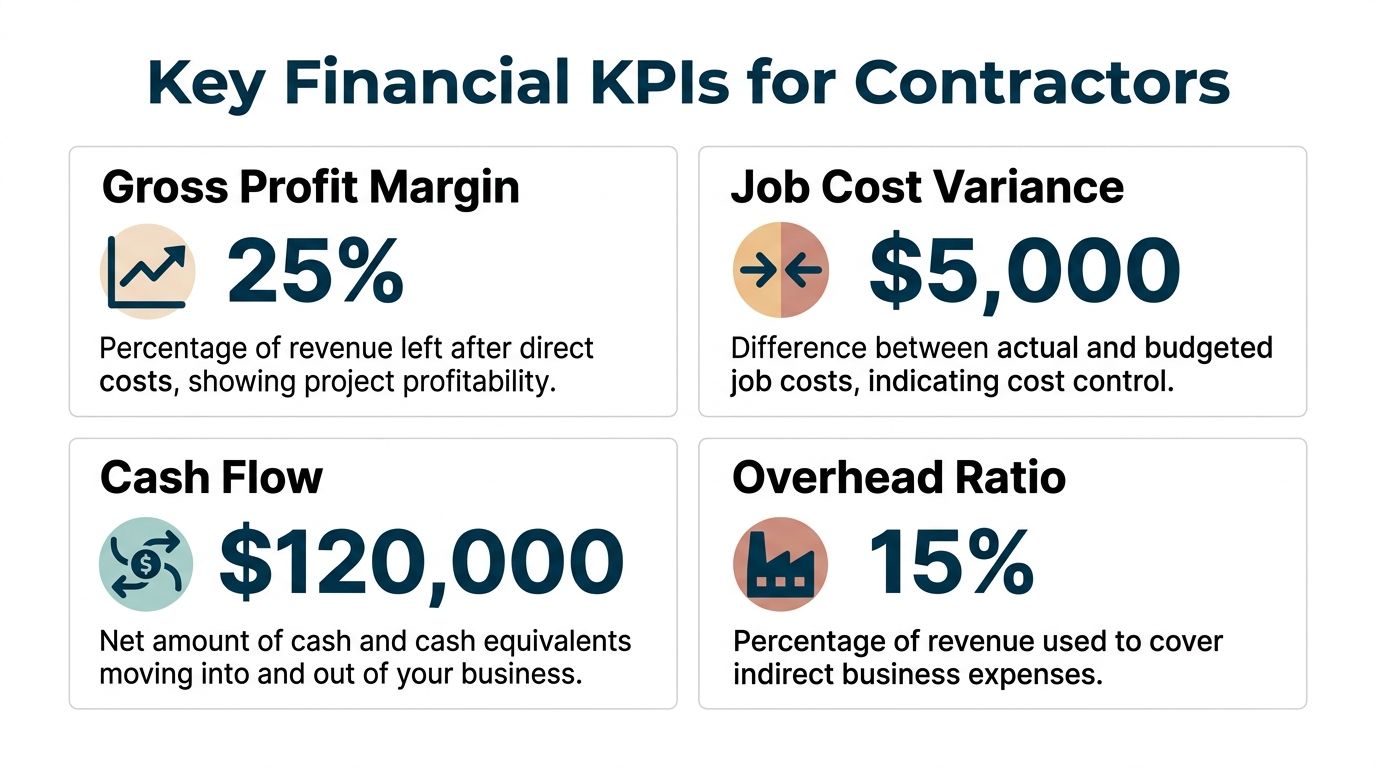
The best KPIs for contractors aren't abstract. Each one answers a job site question.
Are we making money on this job
That's gross profit per job.
This is the number most owners care about first, and for good reason. It tells you what's left after direct job costs. If a project looked busy but gross profit came in weak, pricing, labor efficiency, purchasing, or scope control probably slipped.
The reason job-level tracking matters is backed by real industry data. According to the CFMA 2023 Financial Survey, 76% of construction companies that implemented job costing reported improved financial performance on a per-job basis, as summarized by Foundation Software's review of construction accounting basics.
If you want the basics in plain language, this short explanation of what job costing is is a solid place to start.
Are my guys taking too long
That question points to labor burden and labor performance.
Hourly wage is only part of labor cost. Payroll taxes, benefits, paid time off, and other employer costs sit on top of it. If you price jobs using wage rate alone, your estimate is too optimistic.
Watch labor by job, by phase, and by crew. If the same type of work keeps running long, your estimate may be wrong. Or the field process may need work.
Are we drifting off budget
That's job cost variance.
This compares what you thought a phase would cost against what it's costing. It catches trouble while there's still time to respond. Material overage on one phase might be manageable. Labor overage across several phases usually means the margin is sliding.
A simple weekly review works better than a big monthly surprise.
- Budgeted cost: What you expected before work started
- Actual cost: What has hit the books so far
- Variance: The gap between the two
- Action: Raise an issue, adjust labor, reprice future bids, or clean up change orders
Are we billing ahead or behind the work
That's where Work in Progress, often called WIP, earns its keep.
WIP helps you compare what's been spent, what's been earned, and what's been billed. In plain English, it tells you whether billings line up with actual progress. That matters because overbilling and underbilling can both hide problems if you're not paying attention.
When owners learn to read these few numbers well, better decisions follow. You bid smarter. You staff smarter. You stop confusing activity with profit.
How to Choose the Right Accounting Partner
A cheap bookkeeper who doesn't understand construction can cost more than a specialized firm that does.
That sounds harsh, but it's true. In this industry, bad financial setup doesn't stay in the office. It shows up in underpriced estimates, payroll mistakes, tax headaches, and jobs that looked profitable until they closed.
Look for someone who can connect the layers
Many firms talk about bookkeeping, accounting, and CFO advice as separate service tiers. The problem is that contractors don't need a list of tiers. They need to know how daily field data turns into better pricing and cleaner decisions.
That gap is real. As noted in James Moore's article on outsourced accounting for construction companies, most content explains the tiers but doesn't show how unit-level job cost data flows into monthly reporting or affects pricing decisions in real time.
That's the first thing I'd test in a sales call.
Ask them this: when a foreman submits hours, a project manager approves a material bill, and a credit card charge hits for a tool pickup, how does that become a report I can use to adjust pricing next week?
If the answer stays fluffy, move on.
Know the roles before you buy
Here's the simple version:
| Role | What they should own |
|---|---|
| Bookkeeper | Transactions, reconciliations, clean records |
| Accountant | Financial statements, close process, tax-ready books |
| CFO-level advisor | Cash forecasting, pricing insight, hiring and growth decisions |
The best partner doesn't just offer all three. They know how each handoff works.
Questions worth asking
Don't ask whether they “work with contractors.” Everyone says yes. Ask sharper questions.
- How do you handle job costs daily: Listen for specifics on labor, materials, equipment, and coding discipline.
- What does your monthly close include: You want more than a P&L dump.
- How do you separate employee payroll from subcontractor payments: If they blur that line, that's a red flag.
- How do you help with pricing decisions: They should tie reporting back to bids and margin protection.
- What software do you support: QuickBooks Online, payroll tools, expense capture apps, and project systems should all come up naturally.
- Who answers when something breaks: Responsiveness matters more than polished proposals.
If an accounting partner can't explain your numbers in plain English, they won't help you make better field decisions.
Price matters, but fit matters more
Hourly billing can work for cleanup or one-time projects. Flat-fee arrangements often fit ongoing support better because the scope is clearer and the surprises are lower.
Still, the core issue isn't hourly versus flat. It's whether the service matches your complexity. A small trade contractor with a handful of active jobs needs something different from a growing GC juggling payroll, subs, and multi-month billing cycles.
The right accounting partner should feel like someone who understands how construction runs. Not just someone who knows debits and credits.
What a Modern Accounting Workflow Looks Like
The old way was a glove box full of receipts, timecards on paper, and a monthly scramble.
A modern setup is a lot cleaner.
A crew member clocks time in a payroll app. A PM approves it. That labor gets pushed into the accounting system and tagged to the right job. On the same day, someone buys material at the supply house, snaps a receipt photo, and uploads it from a phone. The office reviews it, codes it, and attaches it to the same project.
Now that one expense starts telling a story.
By the time the bank feed clears in QuickBooks Online, the transaction is already tied to the job. Payroll data from a system like Gusto can line up with labor reporting. Project management platforms can hold the operational detail. The accounting system becomes the place where those pieces meet.
What this looks like in real life
Morning. A field lead logs hours for two workers on Job A and one helper on Job B.
Lunch. The office gets an alert that a supplier charge came through on a company card.
Afternoon. The PM reviews whether that material belongs in framing, finish work, or punch list. The bookkeeper codes it correctly. By evening, that cost is visible inside the job record instead of floating in “miscellaneous expense.”
That's the difference. Good systems reduce guesswork.
If you're comparing tools, this roundup of the best bookkeeping software for contractors gives a useful overview of what to look for in job tracking, reporting, and workflow fit.
The main goal is speed with accuracy
You don't need fancy dashboards for the sake of it. You need cleaner inputs and faster visibility.
When the workflow is set up right:
- Receipts get captured quickly
- Labor lands in the right job
- Bills don't sit uncoded for weeks
- Owners can review job status without chasing paper
That's what modern accounting should feel like. Less admin drag. Better numbers. Fewer surprises at month-end.
Frequently Asked Questions About Contractor Accounting
Can I use QuickBooks for a contracting business
Yes, if it is set up for construction work instead of basic bookkeeping.
I've seen plenty of contractors use QuickBooks well. I've also seen the same software produce useless reports because every cost went into broad buckets and nothing tied back to the job. The software matters less than the setup. You need jobs, phases, labor, materials, and overhead mapped in a way that helps you price the next bid with real numbers instead of gut feel.
What's the difference between a bookkeeper and an accountant
A bookkeeper handles the daily recording and organization. An accountant reviews the bigger picture, cleans up errors, produces financial statements, and helps interpret what the numbers mean.
For contractors, that handoff matters. If expenses are coded loosely all month, the accountant can still give you a profit and loss statement, but job profitability will be blurry. That creates one of the biggest headaches in construction accounting. You finish the job, but you still cannot tell whether the estimate was solid or the margin got eaten up by labor and material swings.
What's the first step if my books are a mess
Start with separation. Business spending needs to be separate from personal spending.
Then clean up the structure. Fix the chart of accounts, remove duplicate customers and vendors, and make sure each active project has a clear job record. After that, work through uncategorized transactions and assign each one to the right account and, where needed, the right job.
Do not try to rebuild everything in a weekend. A clean foundation beats a rushed cleanup every time.
How should outsourced accounting handle employees versus independent contractors
This question deserves more attention than it usually gets because it affects cash flow, taxes, job costing, and compliance at the same time.
Many generic accounting providers may say they “do payroll and 1099s,” but that answer is often too broad for a contractor's needs. You need to know how they classify workers, what documents they collect, how they track labor by job, and how they handle payments to subs before year-end problems show up.
The employee versus independent contractor line causes real trouble in construction, and the IRS regularly reviews worker classification issues in the industry, as noted in ASNANI CPA's write-up on accounting firms for remodelers and contractors.
A solid provider should be able to explain, in plain English:
- How they onboard workers
- How they document classification decisions
- How employee payroll flows into job costing
- How subcontractor payments flow into 1099 reporting
- How they catch classification risk before year-end
That matters for more than compliance. If payroll is handled poorly, labor costs land in the wrong place, job reports get distorted, and your next estimate starts from bad information. If your business overlaps with design teams, office process matters there too. For example, BIM Heroes helps architecture firms tighten production workflows, which is a good reminder that production systems and financial systems affect each other.
What do accounting services for contractors usually cost
Cost depends more on complexity than headcount or annual revenue. A contractor running ten active jobs, weekly payroll, subcontractor payments, and change orders needs a different level of support than a small operator with two jobs and no employees.
Focus on long-term value over the lowest initial price, because poor job data gets expensive fast. If the books cannot show where labor drifted, where material overruns hit, or whether a crew was profitable, you end up paying for that bad information in underpriced work, missed tax issues, and messy cleanup later.
If you're tired of guessing which jobs make money, cleaning up payroll issues after the fact, or waiting until tax season to understand your business, MyOfficeOps can help. They provide bookkeeping, payroll integration, financial reporting, and advisory support built for owners who want clear numbers and practical guidance, not accounting jargon.