
You finish a job. The customer is happy. The crew is paid. Suppliers got their checks. Then you look at the bank account and ask the question most contractors hate asking.
Where did the money go?
That problem usually isn't about working too little. It's about tracking too little. A lot of owners have bookkeeping that tells them what they spent this month, but not what they made on Job A versus Job B, what's still tied up in retainage, or whether next month's payroll will land before the next draw.
That's why bookkeeping for contractors can't look like bookkeeping for a retail shop or a basic service business. Contractors work by project. Costs hit at odd times. Bills go out in stages. Cash shows up late. If your books don't match that reality, your reports will lie to you.
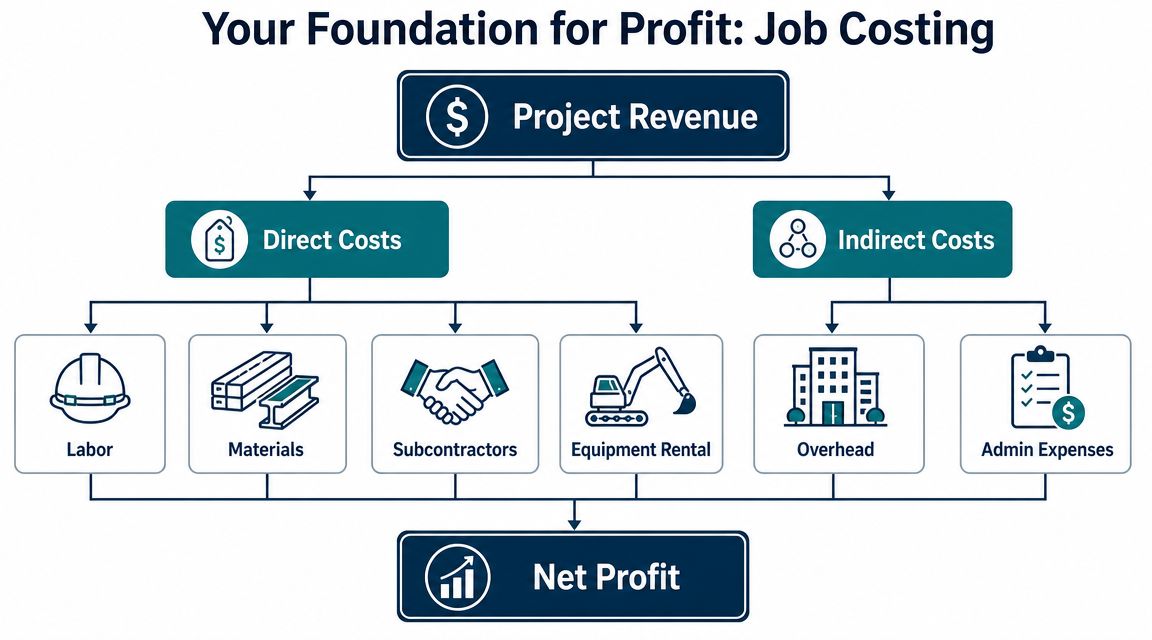
Your Foundation for Profit Job Costing
A lot of contractors hit the same wall. Revenue looks fine. Work is moving. Then one job finishes and the margin is nowhere near what they expected.
The usual problem is not effort. It is visibility.
If the books only show broad buckets like materials, payroll, and subcontractors, you can see what the company spent this month. You still cannot see which job carried the overhead, which crew burned extra labor, or which project is tying up cash before the next billing cycle. That is why job costing matters. It is the base layer for protecting cash flow, not just measuring profit after the fact.
What job costing means
Job costing means assigning every direct cost to the job that caused it, in enough detail to compare what you estimated against what is happening in the field.
That usually includes:
- Labor by job: Crew hours posted to the right project and phase
- Materials by job: Purchases tied to the site that used them
- Subcontractors by job: Trade invoices coded to the correct project
- Equipment by job: Rentals, fuel, and usage assigned where they belong
Hubstaff's construction bookkeeping overview points to the same core setup: track costs by project and cost code, not just by vendor, so you can measure gross profit accurately.
Here is the trade-off. More detail takes more discipline from the office and the field. Less detail gives you faster bookkeeping and weaker decisions. I have never seen a contractor regret having clean job-level numbers once a project starts slipping.
Practical rule: If a cost cannot be tied to a job or true overhead, your margins will get blurred.
Start with a chart of accounts that fits construction
A generic chart of accounts gives generic answers. Contractors need one that separates direct job costs from overhead so each project can stand on its own.
A simple version might look like this:
| Account group | What belongs there |
|---|---|
| Income | Contract revenue, change order revenue |
| Direct labor | Field payroll tied to jobs |
| Materials | Job-specific material purchases |
| Subcontractors | Trade partner invoices by project |
| Equipment | Rentals, fuel, small equipment use |
| Overhead | Office rent, admin payroll, software, insurance |
Keep it simple, but keep it consistent.
Inside the accounting system, set up each job and use cost codes that match the way you estimate. If your estimate separates site work, framing, electrical, and finish labor, your books should follow that same structure. That is how you spot overruns early enough to do something about them. If you want a plain-English walkthrough, this guide on what job costing is covers the basics clearly.
Use job costing to manage timing, not just totals
This is the part many guides skip.
A job can be profitable on paper and still put pressure on cash if labor and materials hit weeks before you can bill or collect. Clean job costing helps you see that timing gap. You can tell which jobs are front-loaded, which phases are burning labor faster than planned, and where to push change orders or billing updates before the bank account gets tight.
For example, if framing labor is already over estimate at 60% completion, that is not just a margin issue. It is a warning that payroll will keep landing before enough cash comes in. The right response might be tighter crew tracking, a billing adjustment, or a conversation with the customer about approved extras. Waiting until month-end is how small leaks turn into cash shortages.
What works and what fails
What works is coding costs as they happen. Supply house receipts get assigned the same day. Payroll hours go to the right job each pay period. Sub bills are matched to the project and cost code before payment is approved.
What fails is rebuilding job costs from memory at the end of the month.
I see that mistake all the time. A project looks profitable until someone notices equipment charges were buried in overhead and labor hours were posted to the wrong site. The job did not outperform. The books just hid the problem.
Getting Paid Correctly Invoicing and Retainage
A lot of contractors don't have a sales problem. They have a billing problem.
You can do solid work and still run short on cash if invoices go out late, draw requests are sloppy, or retainage disappears into the background. Construction billing has more moving parts than a normal invoice-and-get-paid setup. If your books don't track those parts cleanly, collections get messy fast.
Bill the full amount you've earned
Retainage trips up a lot of people. The clean way to handle it is not to invoice less. The clean way is to invoice the full authorized amount for the milestone and show retainage as a separate credit.
That matters because it keeps contract revenue and accounts receivable accurate. CMiC notes this as a best practice in construction accounting, and reports that 67% of firms saw about 14% higher profitability after adopting construction-focused software in its guide to construction accounting concepts.
A profitable job can still starve your bank account if a big piece of the bill is sitting in retainage and nobody is watching the release date.
A simple progress billing example
Let's say you hit a project milestone and you're approved to bill for that phase.
Your invoice should show:
- Work completed to date: the full approved billing amount
- Less retainage: listed as a credit or holdback
- Net amount due now: what the customer should pay this round
That layout does two important things. First, it shows the customer exactly how the amount due was calculated. Second, it keeps the retainage visible inside your receivables instead of letting it vanish into a lower invoice total.
Keep a separate retainage watch list
Retainage is easy to forget because it's usually collected later, after punch list work, final waivers, or closeout documents. That's why I like a short retainage report outside the normal AR aging.
Track these items for each job:
- Project name: No shortcuts or nicknames.
- Amount held: The current unpaid retainage balance.
- Release condition: Final completion, closeout package, owner approval, or another contract trigger.
- Next action: Send documents, follow up with project manager, or request release.
If you don't do this, retainage becomes "money we know is out there somewhere." That's not a system.
Why timing matters more than most owners think
Most owners focus on whether the job is profitable. That's fair. But cash flow timing is the primary pressure point.
Labor and materials usually get paid before the customer pays the full amount earned. Add retainage on top, and you can end up funding a good job with your own cash for longer than expected. That's why tight invoicing habits matter just as much as estimating.
Managing Your Biggest Expenses Payroll and Subs
Your largest cash outflows are usually your field payroll and your subcontractors. If either one is messy, your job costs won't be right.
That's where a lot of margin disappears. Not because the work was bad, but because costs were assigned late, assigned wrong, or not assigned at all.

Payroll needs job tracking, not just paychecks
A paycheck isn't the full labor cost. You also have payroll taxes, insurance, and other burden tied to that employee. If you only job-cost the hourly wage, your labor numbers will look better than reality.
The fix is straightforward:
- Track time by job. Crews should code hours to the project they worked on.
- Map payroll to jobs each pay period. Don't leave field labor in one lump account.
- Include burden in your thinking. The wage is only part of the labor cost.
- Review labor against estimate. If framing labor is running hot, you need to know before the job ends.
For owners setting up or cleaning up this process, this guide on how to set up payroll for small business covers the basics in plain language.
Subcontractors need clean paperwork from day one
Subs can create two kinds of problems. Compliance problems and costing problems.
Before a subcontractor sends the first invoice, collect the paperwork you need and make sure they're set up correctly in your system. Then post each invoice to the right job and cost code. If a plumbing bill lands in a general subcontractor account with no project attached, you've lost useful data.
A simple sub workflow looks like this:
- Collect W-9s early: Get the form before payment starts, not when year-end is already a mess.
- Match bills to jobs: Every invoice should tie to a project and scope.
- Review change work: Extra work should be tied to approved changes, not buried in the next bill.
- Watch unpaid balances: Large open payables can distort your view of job progress if they aren't entered on time.
Good job costing depends on good field habits. Someone has to capture hours, receipts, and sub bills while the job is moving.
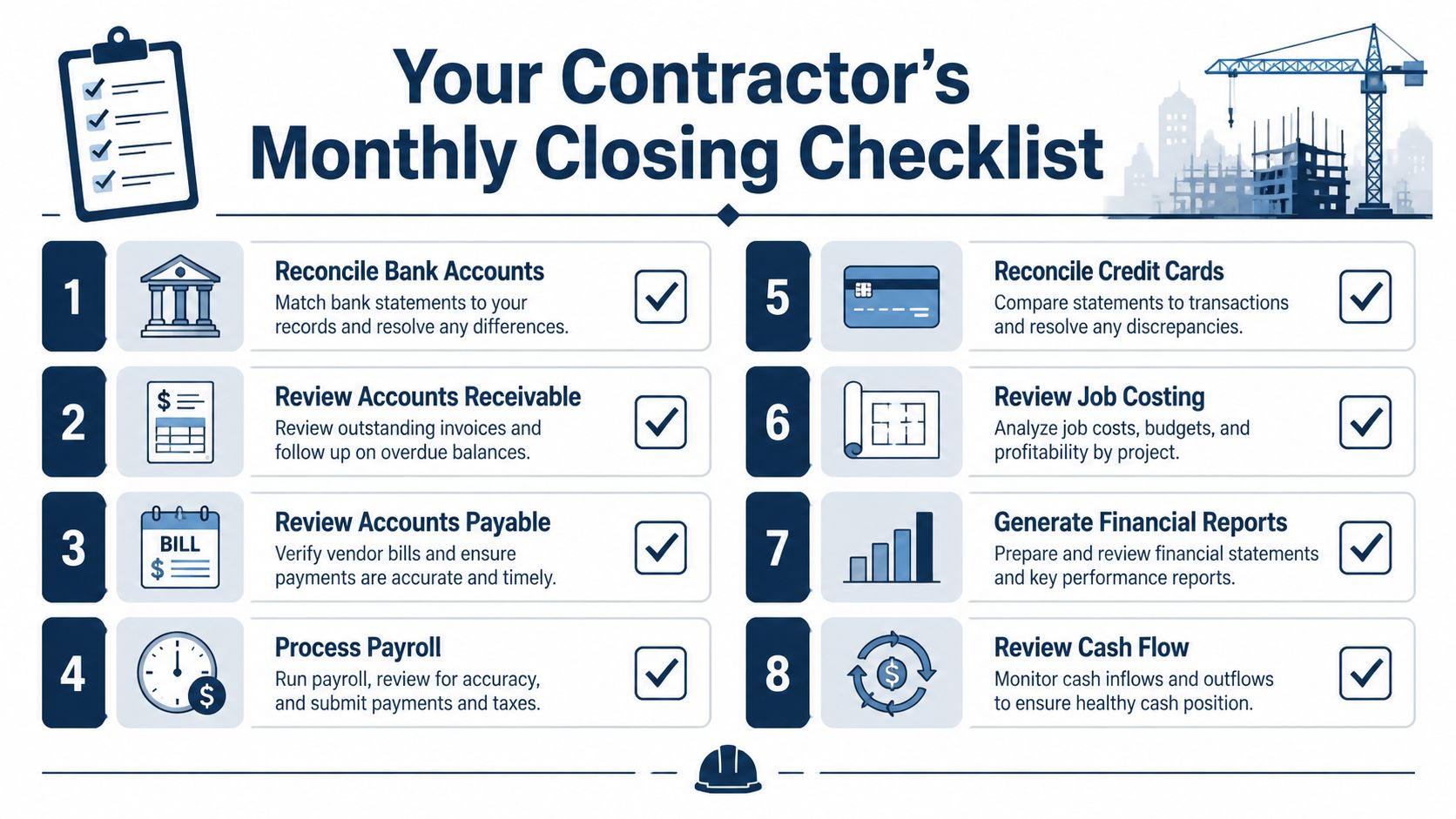
Your Contractor's Monthly Closing Checklist
On the last day of the month, a lot of contractors are asking the same question. "Can I trust these numbers enough to make payroll, pay vendors, and start the next job without getting squeezed?"
If the answer is "maybe," the close is the problem.
Month-end is not an accounting formality for contractors. It is the point where you confirm what happened, catch timing gaps, and decide whether the next 30 to 60 days look stable or tight. Clean books matter because construction cash flow rarely lines up neatly. Labor gets paid before draws clear. Materials hit before change orders are approved. Retainage sits on the balance sheet while the job keeps consuming cash.
The monthly close that keeps bad surprises from piling up
A good close gives you a clean cutoff. It tells you which costs belong in the month, which invoices are still outstanding, and whether reported profit is turning into usable cash.
Use a checklist and run it the same way every month:
- Reconcile bank accounts: Match book activity to the bank so cash is real, not assumed.
- Reconcile credit cards: Code charges while details are still fresh. Small miscoded purchases add up fast.
- Review accounts receivable: Chase old invoices, unpaid draws, and billing items that were approved but never sent.
- Review accounts payable: Enter bills before payment goes out so costs land in the correct period and job reports stay honest.
- Review payroll postings: Confirm labor hit the right jobs and departments before you rely on job margins.
- Update work in progress: Compare costs incurred, billings sent, and revenue recognized so overbilling or underbilling is visible.
- Check job cost reports: Look for jobs that are burning cash faster than they are billing.
- Generate financial statements: Review the profit and loss, balance sheet, and job reports together, not in isolation.
- Review short-term cash needs: Map expected inflows against payroll, vendor payments, tax payments, and debt draws.
What to look for in the reports
Closing the month is less about producing reports and more about spotting problems early.
Use this table as a working review:
| Report | Question to ask |
|---|---|
| Job cost report | Which jobs are over budget, and is the issue labor, materials, subs, or billing delays? |
| AR aging | Which invoices are collectible now, and which ones are stuck because paperwork or approvals are missing? |
| AP aging | Are there bills missing from the month, or are you looking better on paper than you are in reality? |
| Balance sheet | Do cash, retainage, loan balances, and payables reflect what is actually owed and collectible? |
| Profit and loss | Did margin improve because the job performed well, or because costs have not been entered yet? |
One report by itself can mislead you. I have seen contractors feel good about a profitable month on the profit and loss, then realize cash is still under pressure because retainage is tied up, customer payments are late, and two large vendor bills were never entered. That is why the close has to tie profit to timing.
If reports arrive three weeks late, you are not managing the month you just finished. You are explaining a problem after the cash pressure has already started.
Keep the work weekly so month-end stays useful
The contractors with the cleanest books usually do less at month-end, not more. They clear transactions weekly, enter bills as they come in, and review billing status before details go stale.
That rhythm matters if you want to forecast jobs and bid the next phase with confidence. Owners trying to tighten planning around backlog, hiring, and cash reserves should also build a winning roofing business plan with the same discipline. The bookkeeping and the plan need to agree.
A monthly close should confirm the story your weekly process has already captured. If your team is rebuilding the month from receipts, texts, and memory, the books are too late to protect cash.
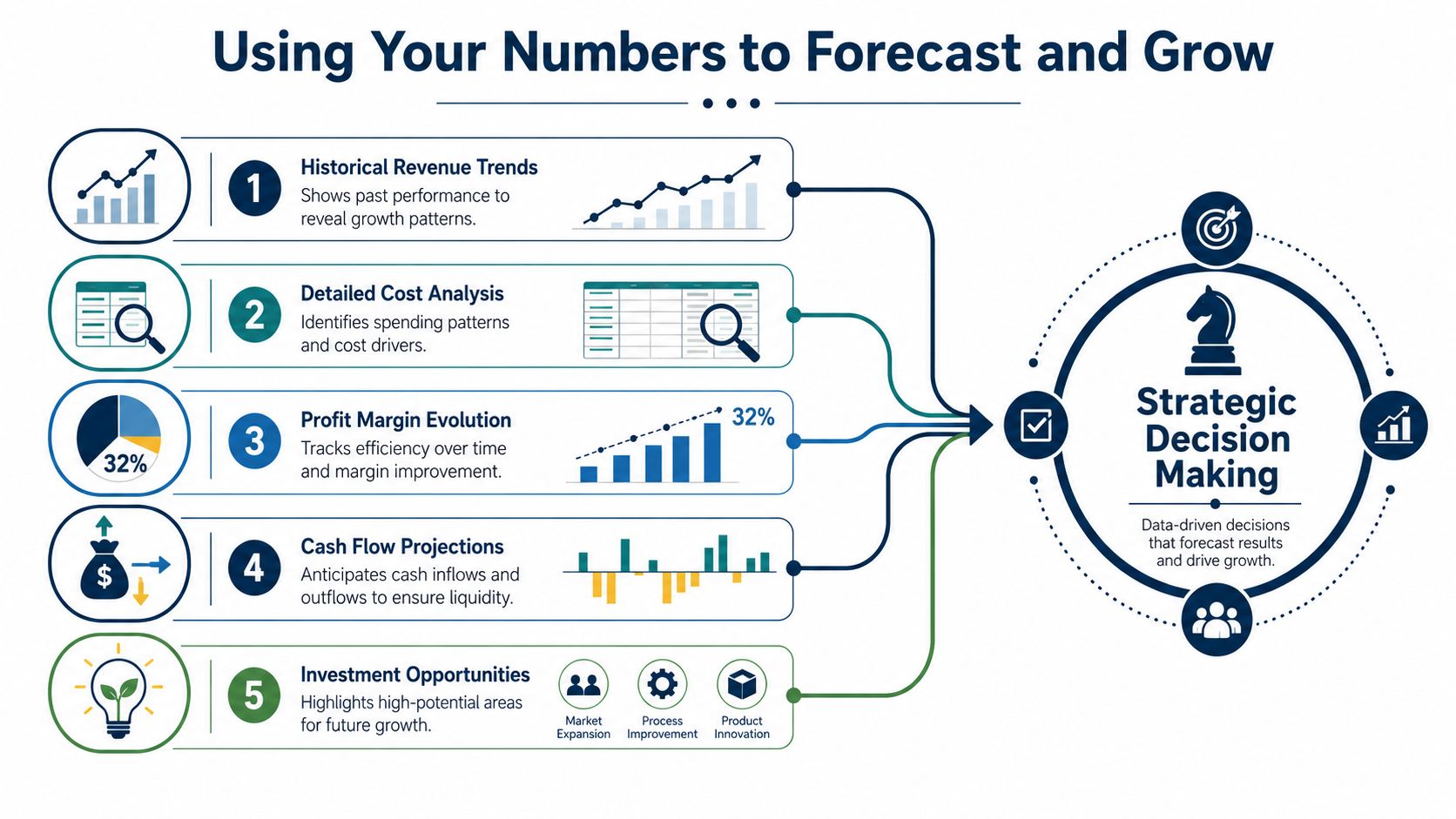
Using Your Numbers to Forecast and Grow
Clean books are valuable, but only if you use them to make decisions before cash gets tight.
Bookkeeping for contractors becomes a management tool instead of a record of old problems. The question isn't just "Did we make money last month?" It's "What does the next six to eight weeks look like if payroll hits before the next draw clears?"
A major underserved topic in contractor bookkeeping guidance is cash-flow timing. Many resources explain how to categorize transactions but don't show contractors how to model the gap between when labor and materials are paid and when milestone or retainage cash is collected, according to Truss Payments' discussion of construction bookkeeping best practices.
Build a simple cash view first
You don't need a complicated model to get useful answers. Start with a rolling forecast.
List expected cash in by week. Then list expected cash out by week. Keep it grounded in real things you already know:
- Incoming cash: approved draws, open invoices likely to pay, retainage releases you reasonably expect
- Outgoing cash: payroll, rent, loan payments, supplier terms, subcontractor bills, tax payments
The point isn't perfection. The point is timing.
A contractor can be profitable on paper and still hit a cash squeeze because labor gets paid every week while customer payments arrive on a slower schedule. Once you see that gap, you can act earlier. Push an invoice out faster. Delay a discretionary purchase. Tighten collections. Stage hiring more carefully.
Watch a few numbers, not fifty
Most owners don't need a giant dashboard. They need a short list they trust.
I usually tell contractors to watch:
- Gross profit by job: Which work is worth repeating?
- Cash due in versus cash due out: Will near-term obligations outrun collections?
- Aging on receivables: Which customers are slow, and which project manager needs to follow up?
- Change-order exposure: How much work is done but not fully approved or billed yet?
Those numbers shape decisions about hiring, equipment, and bidding. If you're planning for growth, a document like this guide to build a winning roofing business plan can help connect your financial reality to staffing, pricing, and market strategy.
Use the books to answer real owner questions
Outside support can be valuable. Some contractors use internal staff. Some use their CPA for year-end cleanup. Some work with firms that combine bookkeeping, analytics, and forecasting. For example, MyOfficeOps provides bookkeeping, reporting, and advisory support for small and midsize businesses that need cleaner financial data and forward-looking analysis.
The key is simple. Your system should help you answer practical questions with confidence:
- Can we cover payroll if this draw is late?
- Are we growing too fast for our working capital?
- Which job types create the healthiest cash cycle?
- Can we afford another truck, or should we wait?
If your books can't answer those questions, they're unfinished.
When to Call for Backup and Outsource Your Books
There comes a point where doing the books yourself stops being scrappy and starts being expensive.
You usually know you've hit that point when you're spending evenings inside QuickBooks instead of reviewing estimates, talking to customers, or checking jobs. Another sign is when every financial question turns into a scavenger hunt across spreadsheets, texts, and unopened mail.
The signs are usually obvious
You likely need help if any of this sounds familiar:
- You're behind all the time: Books are never current, so reports always feel old.
- You can't see profit by job: Revenue may look fine, but margin by project is fuzzy.
- Cash flow feels unpredictable: Payroll and vendor payments keep you guessing.
- Change orders and retainage aren't under control: Money earned is hard to track and harder to collect.
- Your CPA cleans up too much: Year-end becomes a repair project instead of a review.
A key challenge for contractors is managing profitability risk from change orders and delayed retainage. Basic bookkeeping may record those items, but it often doesn't give early warning on overruns or collections risk, which is one reason the industry is moving toward more integrated project accounting and analytics, as noted in Uplinq's review of construction bookkeeping practices.
Outsourcing should reduce noise, not add it
Good outsourced support doesn't just enter transactions. It creates a cleaner operating rhythm. Bills get coded correctly. Reports arrive on time. Questions get answered before they become fires.
If you're comparing options, this overview of outsourced bookkeeping for small business is a practical place to start.
The right partner should help you spend less time reconstructing the past and more time managing the next job, the next hire, and the next cash decision.
If your books don't tell you which jobs make money, when cash is getting tight, or what you're still owed, it's time to tighten the system. MyOfficeOps helps contractors clean up bookkeeping, improve reporting, and turn financial data into clearer decisions about cash flow, pricing, and growth.