

Your phone's not ringing the way it should. Invoices are out, work got done, and yet the cash still sits in someone else's inbox while payroll, rent, and vendor bills keep moving toward you. That's usually the point where owners start making awkward follow-up calls and calling it a collections process, even though the problem started long before the account went late.
A strong collection strategy doesn't begin with chasing overdue invoices. It begins with clear rules, early reminders, customer segmentation, and a system that tells each account what happens next. That's the difference between hoping people pay and building a receivables process that consistently feeds cash back into the business.
Why Your Current Approach to Collections Isn't Working
Most SMBs don't have a collection strategy. They have a reaction pattern. The month goes sideways, someone opens the aging report, and now the team is scrambling to send a few emails, make a few calls, and hope no one gets annoyed.
I've seen this turn into a painful loop. The owner waits too long, the bookkeeper sends a couple of reminders, a salesperson jumps in with a “just checking on this” message, and everyone feels busy while the balance stays open. That kind of follow-up usually misses the core issue, which is that no one decided in advance who gets contacted, when they get contacted, and what happens if they still don't pay.
Ad hoc follow-up burns time and trust
A loose process creates two problems at once. First, your team wastes time on accounts that would've paid anyway. Second, your best customers get treated like stragglers because nobody separated reliable payers from problem accounts.
That's why a system beats a scramble. MyOfficeOps has a useful overview of how a clean receivables process keeps the work organized in accounts receivable best practices, and the core idea is simple, keep the process visible before balances age out of control.
Practical rule: if your team can't say what happens on day one, day seven, and day thirty, you don't have a collection strategy yet.
The hidden cost isn't just late money. It's staff time, awkward customer conversations, and delayed decisions on hiring or inventory because the cash picture keeps shifting. Once you start seeing collections as a process instead of a panic response, you can fix the parts that cause the delay.
Building Your Collection Strategy Foundation
Before automation makes sense, the rules have to be plain enough that everyone can follow them without guessing. If your billing terms, invoice timing, and payment options are fuzzy, reminders won't save you. They'll only deliver a clearer version of a messy process.
Set terms that match how small businesses actually get paid
Some companies can live with net 30. Others can't. If your work is quick, your materials are already paid for, or your cash reserves are tight, it can make sense to move toward payment upon receipt and stop pretending every customer needs the same terms.
One practical article on collections recommends communicating upfront payment expectations, providing the invoice when the work is complete, and even making invoices due upon receipt instead of defaulting to net 30 CRI Advantage's collections process guidance. It also points to early payment discounts as a cleaner motivator than late-fee pressure. That lines up with what works in real life, people respond better to a clear benefit than to a threat that arrives after the fact.
A few basics belong in every SMB policy:
- Invoice timing: send the bill the same day the job is done, not next week.
- Payment terms: use the shortest term your market will tolerate.
- Payment methods: accept the methods your customers already use, so paying doesn't feel like a project.
- Late-fee policy: keep it visible, but don't make it the main tool.
Make the rules easy to see
If customers have to dig for payment terms, they'll ignore them. Put the terms on quotes, contracts, and invoices. Tell clients what happens next before you start the work.
For teams looking for a broader checklist, CallZent's accounts receivable management tips are a solid reference point because they fit the same basic idea, keep payment expectations plain, then back them up with a consistent process.
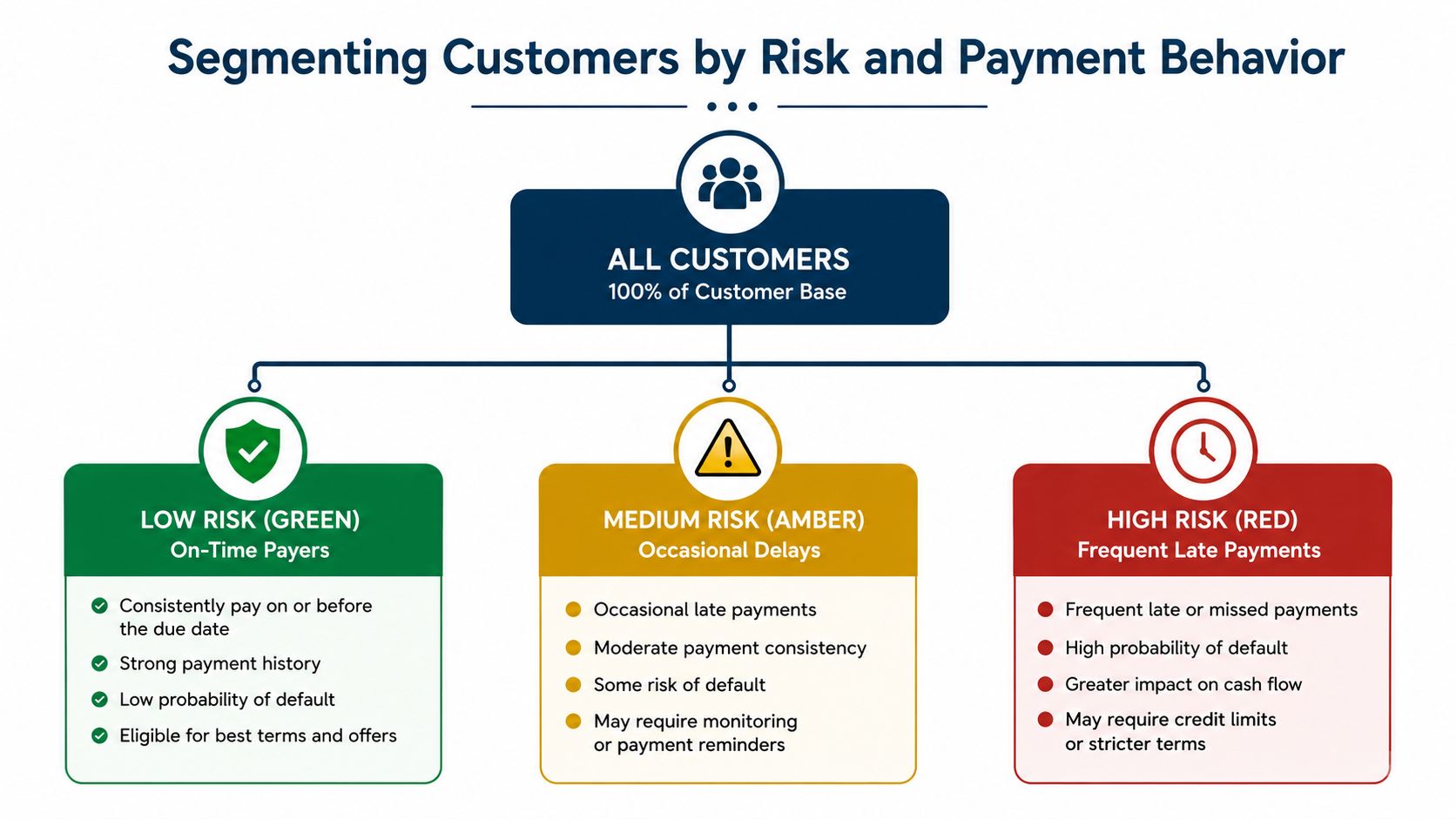
Segmenting Customers by Risk and Payment Behavior
Treating every customer the same is a fast way to waste effort. A reliable customer who pays on time doesn't need the same nudges as a customer who drifts past due every month. The more precise your groups are, the less noise your team creates.
Start with aging buckets, then add risk signals
HighRadius recommends aging buckets of 0–30, 30–60, and 60+ days, and that's a sensible starting point because it matches how delinquency usually develops in real accounts HighRadius segmentation guidance. From there, look at average days delinquent (ADD) and compare it with an industry benchmark to separate faster payers from slower ones. You can then layer in credit-limit data, payment history, debt level, and reference checks to split accounts into low, medium, and high risk groups.
That's where most businesses get more useful. A customer who pays late but always pays eventually should be handled differently from a customer whose behavior keeps slipping. Same overdue balance, different treatment.
Build different actions for different groups
A clean segmentation model usually looks like this:
| Segment | What you see | What to do |
|---|---|---|
| Low risk | On-time or close to on-time payment behavior | Send polite reminders, keep it automated |
| Medium risk | Occasional delays or changing habits | Increase reminder frequency and watch for disputes |
| High risk | Frequent late payments or rising delinquency age | Escalate faster, assign human review sooner |
The important part is not the label, it's the response. Low-risk accounts shouldn't be over-contacted just because the system makes it easy. High-risk accounts shouldn't sit untouched until the balance is old enough to hurt.
You can see this same logic in Sendvo's direct mail audience setup guide, which is useful because the core issue is audience routing. Good collections work is really about matching the right message to the right account at the right time.
Automating Invoicing and Payment Reminders
The biggest gains usually come before an invoice turns overdue. If the bill goes out late, or the reminder sequence is random, you're creating delinquency instead of preventing it. Automation fixes that by making the first touch happen on time, every time.
Send the invoice the moment the work is done
A clean workflow starts when the job ends. The invoice should go out that same day, not whenever someone remembers to do it. Then the reminders should follow a predictable path, so customers know what to expect and your team doesn't have to rebuild the process each week.
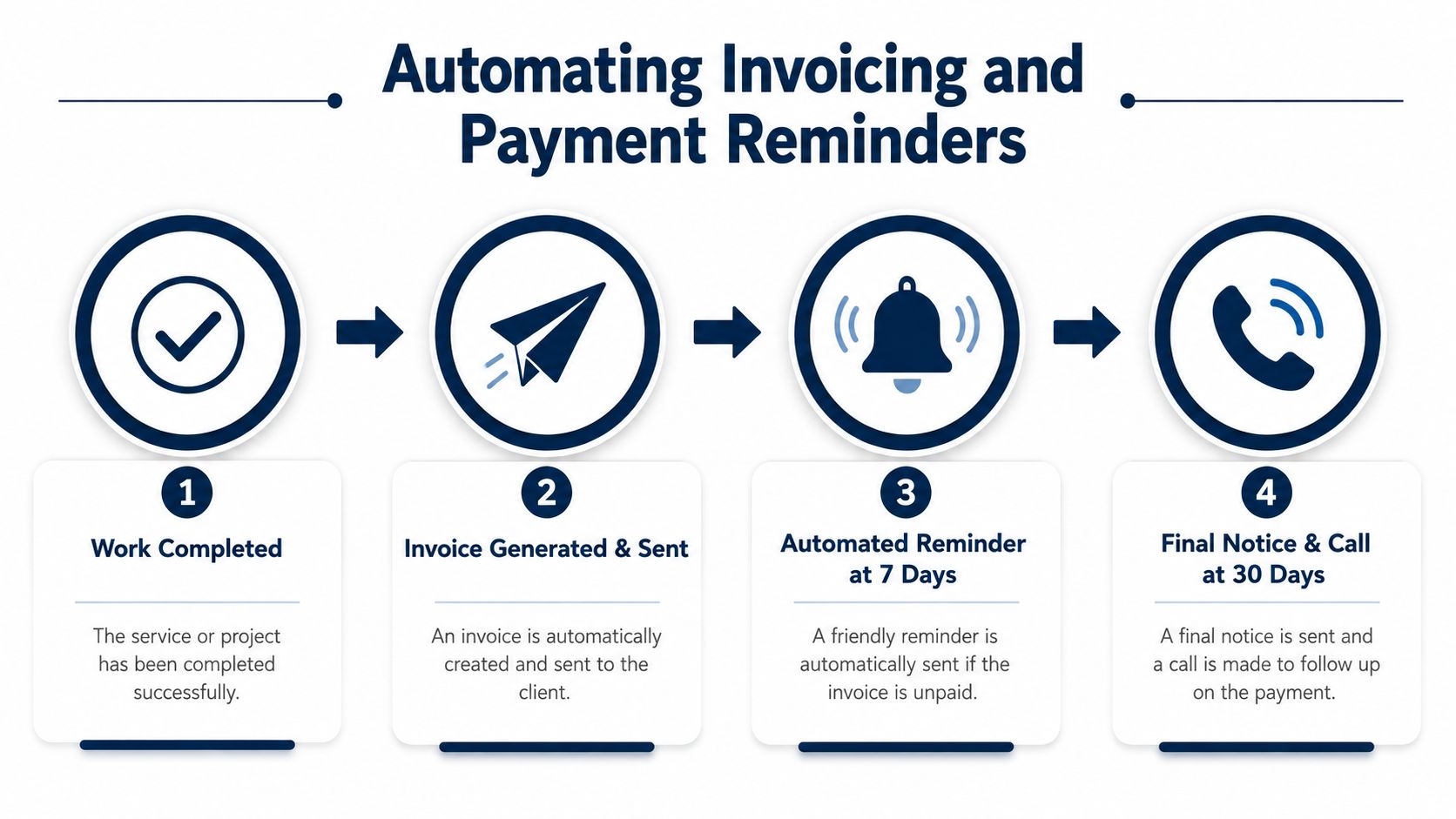
A practical setup looks like this:
- Work completed. The job is signed off.
- Invoice generated and sent. No delay, no “I'll do it Monday.”
- Automated reminder before the due date. A gentle nudge while the bill is still fresh.
- Reminder at the due date. Clear, direct, and professional.
- Follow-up after a short delay. Enough time to allow normal processing, not enough to let the invoice disappear.
- Escalation by segment. Higher-risk accounts move into human review sooner.
That structure keeps the business from waiting too long to act. It also reduces the number of accounts that ever reach serious delinquency, which is the whole point.
Match the channel to the customer
A modern collection strategy doesn't rely on one channel. Some customers answer email. Others respond faster to a text or portal notice. FICO notes that an automated, risk-aligned model achieved a 99% digital auto-resolution rate for early-stage collections in a cited example, which shows how much early orchestration can matter FICO on early-stage digital auto-resolution.
That doesn't mean every business needs fancy software on day one. It does mean your reminders should follow the customer's actual behavior, not the collector's preference. If a client always pays through a portal, push them there. If a customer ignores email but responds to direct outreach, reserve a person for that step.
Reserve live time for the accounts that need judgment, not for every invoice with a balance.
A source on collections prioritization makes the same point in plain terms, measure the team's real workload, then save human effort for medium- and high-value accounts while routing self-cure candidates toward automation collections prioritization guidance. That's where many SMBs get relief fast, because the team stops treating every invoice like it deserves the same attention.
For a deeper look at workflow setup, MyOfficeOps' explanation of accounts receivable automation fits well with this step, especially if you're trying to clean up a manual billing process without adding more admin work.
A manufacturing-focused example of that same approach is covered in DigiParser's guide to automating receivables in manufacturing, which is useful because the principle is identical, remove delay, keep reminders consistent, and stop depending on memory.
Handling Disputes and Escalating Problem Accounts
Automation handles most routine follow-up, but it will not resolve every account. Some customers dispute the invoice. Some need a payment plan. Some stay quiet until a real person steps in. A collection strategy has to make careful choices here, not just louder ones.
Decide what deserves a call and what doesn't
A live call makes sense when the balance is meaningful, the account is old enough to require attention, or the issue cannot be cleared up with a standard reminder. It makes less sense when the customer usually pays on time and only needs a prompt. Segmentation matters because it shows where human time creates value and where it only adds noise.
A practical rule is to reserve manual work for accounts that show signs of real risk or real complexity. Routine balances can stay in the automated flow. If the customer has a short-term cash problem but still intends to pay, a structured payment plan often works better than pressure. If the account has already gone through reminders and still shows no response, escalation should be deliberate, not emotional.
Keep disputes separate from delinquency
A disputed invoice is not the same as a customer who is avoiding payment. If the work was wrong, the document was unclear, or the delivery details were off, the right move is to fix the issue quickly. Mixing disputes into the same queue as true delinquency wastes time and frustrates customers who may pay once the problem is resolved.
A small business also needs a clear line for when to stop working the account internally. If a customer has gone past the normal reminder sequence and still will not respond, the choice is usually between a third-party collections agency and small-claims court. For many SMBs, a handoff to a collections agency makes sense first, especially when the balance is modest and the goal is to recover cash without spending more staff time on repeated follow-up. Small-claims court fits better when there is solid documentation, the amount justifies the effort, and the business is prepared for the time involved.
That trade-off matters. Move too slowly, and the balance gets harder to recover. Move too fast, and you can damage a relationship that still has value. Good judgment means using clear rules for escalation, then applying them consistently so the team knows when to keep working the file and when to stop.
Measuring What Matters and Continuously Improving
If you don't measure collections, you'll end up arguing about impressions. One person will say the team is doing fine because they sent a lot of emails. Another will say cash is still tight. The only way to settle that is to track the right numbers and look at them often.
Use the metrics that tell you whether cash is moving
HighRadius identifies Days Sales Outstanding (DSO), Collection Effectiveness Index (CEI), Average Days Delinquent (ADD), and Promise-to-Pay fulfillment rates as widely used collections metrics HighRadius KPI framework. Those are useful because they connect behavior to cash flow instead of just counting activity.
A basic dashboard doesn't need to be fancy. It just needs to answer a few questions:
- Are invoices getting paid faster or slower?
- Are promises being kept?
- Which segment is aging the most?
- Which reminder or escalation step works?
Once you have that, you can compare what worked last month against what worked this month. FICO recommends controlled testing frameworks that compare alternative treatment strategies against a baseline, and McKinsey's advice in the research brief points to test-mode rollout and paydown-focused measurement before full deployment FICO analytics for collection decision strategies. That's the right mindset. Don't assume a new sequence is better just because it feels cleaner.
Tie performance back to the business
The point isn't to produce a pretty report. It's to keep cash visible. If collections improve, you should see it in fewer old balances, fewer surprise gaps, and less time spent cleaning up after the fact.
If you need a simple starting point, MyOfficeOps' accounts receivable aging report template is a practical place to begin. Pair that with your reminder logs and payment status, and you'll know which accounts need action before they go stale.
If your current process is mostly reminders, guesswork, and end-of-month panic, MyOfficeOps can help you turn receivables into a system you can manage. We handle bookkeeping, financial reporting, and CFO-level cash flow guidance for SMBs, so you can set clear payment terms, track aging, and keep follow-up consistent. Visit MyOfficeOps if you want cleaner books and a collections process that doesn't depend on memory.