
You've got payroll coming up, a promising candidate waiting for an offer, and a stack of financial reports on your desk. Sales look good. The bank balance feels low. You're trying to answer a simple question: can the business afford another employee?
Good financial analysis and reporting should help you make that decision, not give you more paperwork. Start with reports you can trust, then look at when cash will arrive and leave. A polished dashboard can wait.
The Three Reports That Tell Your Business Story
Say you run a consulting firm and want to hire another project manager. Your profit and loss statement shows a profitable month, but that alone doesn't tell you whether the next payroll will clear. You need different views of the same business.
The profit and loss statement, also called the income statement, is like a movie of the month. It shows revenue earned, the cost of delivering that work, and the expenses of running the business. Read revenue, gross profit, and net income together. Higher sales aren't much help if delivering them costs more than expected.
The balance sheet is a photo taken on a particular day. It lists what the business owns, what it owes, and owner equity, the amount left after subtracting liabilities from assets. Receivables are customer payments you're still waiting for. They're assets, but you can't spend them yet.
The three core reports at a glance
| Report | Question It Answers | Key Lines to Read | How Often to Review |
|---|---|---|---|
| Profit and loss statement | Did we make money over the period? | Revenue, cost of sales, gross profit, operating expenses, net income | Monthly |
| Balance sheet | What do we own and owe on a given day? | Cash, receivables, equipment, loans, owner equity | Monthly |
| Cash flow statement | Where did cash come from and where did it go? | Operating, investing and financing cash flows | Monthly, and weekly for tight cash |
The cash flow statement is the bank account diary. It separates cash from regular operations, spending on assets such as equipment, and financing such as loans or owner contributions.
The SBA's financial statements guide starts its cash-flow process with the cash balance from the balance sheet, then tracks money coming in and going out. That helps explain why a company can report profit from invoices and still struggle to cover payroll before customers pay.
Read for the decision you're making
For the proposed hire, check whether existing work produces enough profit, whether customers owe overdue balances, and whether operating cash supports the added payroll. Don't count a new loan as evidence that operations are improving.
Property owners also need to distinguish property performance from the wider business picture. The Axis Meter Solutions guide to property NOI is a useful companion when reviewing net operating income, rather than treating every profit measure as interchangeable.
No single report tells the whole story. Each answers a different part of the hiring question.
Why Profit and Cash Tell Different Stories
A consulting firm completes a $10,000 project in December and receives payment in January. Under accrual accounting, it may recognize the revenue in December; under cash accounting, it reports the income in January, following the timing principles described in IRS Publication 334.
The work hasn't changed. The reporting method has. Under accrual accounting, income is generally recorded when earned and expenses when incurred. Under cash accounting, income generally follows receipt of payment and expenses follow payment.

Check the movement, not just the balance
An ending bank balance tells you what's available. It doesn't explain why that amount changed. Use this simple check:
- Start with opening cash. Take the beginning balance from the balance sheet and confirm which accounts it includes.
- List receipts and payments. Include customer collections, borrowing, payroll, vendors, taxes, equipment, and owner withdrawals.
- Calculate ending cash. Subtract outgoing cash from incoming cash, then add that net movement to opening cash.
The last step matters. Receipts minus payments gives you the change in cash, not the ending balance.
A profitable invoice won't pay wages until the customer's money arrives.
Find what's creating the gap
Common explanations include:
- Slow-paying customers. You've earned revenue, but collections haven't caught up.
- Deposits spent early. Cash has arrived, but you still owe the customer future work.
- Owner withdrawals. Money leaves the business without being a normal operating expense.
- Equipment purchases. Cash leaves immediately, while the accounting expense may be spread over time.
For a closer explanation of these differences, use this guide to cash flow versus profit.
Healthy performance generally means earnings and operating cash improve together over several months. Don't judge that relationship from a single strong month, especially if a loan or unusually large advance payment increased the bank balance.
Choosing KPIs You Can Act On
Pair profit measures with cash measures. Gross margin can improve while customer payments slow. EBITDA can rise while the business borrows to meet ordinary bills.
A key performance indicator, or KPI, is a number you check on a schedule and use to make a decision. I'd start with five to eight measures, each with a written definition. A longer dashboard often makes it harder to see what needs attention.
PwC's cash and liquidity guidance connects cash balances, financing movements, and liquidity risk. For management reporting, apply that principle by reconciling net income to operating cash and separating borrowing, debt repayments, owner distributions, and asset purchases.
Core KPIs, how to calculate them and what to watch
The warning signs below are illustrative management triggers, not universal standards. Set your own targets around payment terms, seasonality, and operating commitments.
| KPI | How to Calculate It | Why It Matters | Warning Sign |
|---|---|---|---|
| Gross margin | (Revenue minus cost of sales) divided by revenue | Shows pricing and direct job cost health | Falling for two months in a row |
| EBITDA | Earnings before interest, taxes, depreciation and amortization | Shows earnings before these expenses, but isn't cash flow | Rising while cash conversion falls |
| Cash conversion | Operating cash flow divided by net income | Shows whether profit is turning into cash | Falling despite positive net income |
| Days sales outstanding | Receivables divided by average daily revenue | Shows how fast customers pay | Rising for three months in a row |
| Utilization | Billable hours divided by available hours | Shows how much paid capacity is in use | Below target for a full quarter |
| Cash runway | Cash on hand divided by average monthly net cash outflow | Shows how long existing cash covers a continuing cash shortfall | Under three months |
Use matching periods when calculating ratios. Cash conversion becomes hard to interpret when net income is near zero or negative. Cash runway is useful when the business is consuming cash, not when it consistently generates it.
Choose measures that fit the work
Service firms should watch utilization and backlog, meaning paid capacity used and work already booked. Contractors need job margins and retainage, money withheld until agreed project conditions are met. Clinics need receivables and payer mix, the balance of payments expected from different insurers and patients.
For healthcare-specific measures, Happy Billing's key accounts receivable benchmarks provide a useful starting point. Property owners may instead prioritize occupancy and cash runway.
Say an agency reports healthy margins while receivables keep growing. Hiring based only on margin could add payroll before collections can support it. Assign a named owner to each measure and review results at the same monthly meeting; this guide to understanding key performance indicators can help organize that discussion.
How to Build a Monthly Reporting Routine
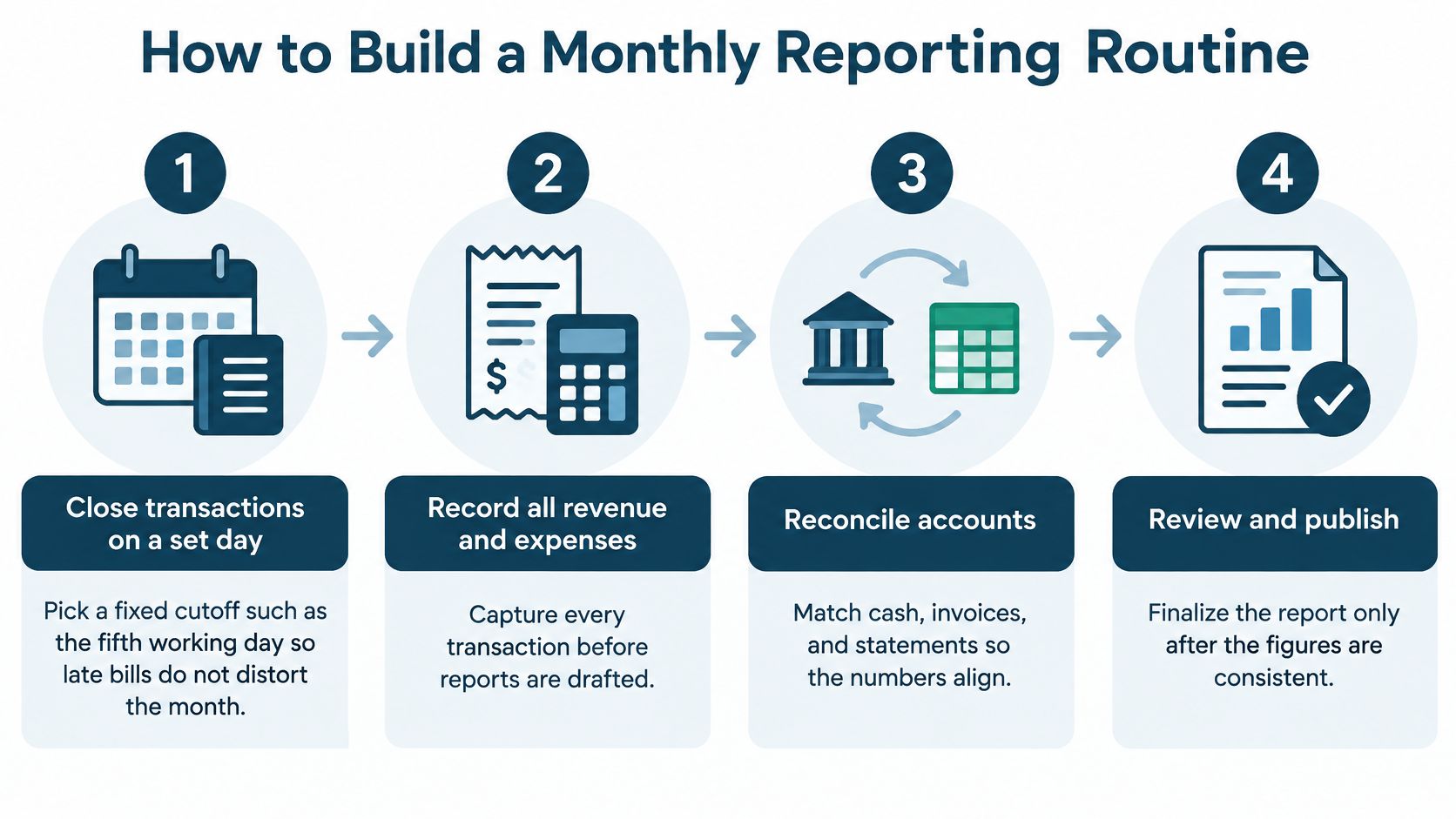
A reliable monthly close gives everyone a clear finish line. Without one, someone enters a late bill, last month's profit changes, and the owner keeps making decisions from different versions of the same report.
Use a written checklist, with a named person responsible for each task. Here's a practical sequence.
Close the books before publishing
Set a cutoff day. For example, choose the fifth working day as your target for completing the close, with a clear process for late information. The common slip is treating the deadline as permission to leave expenses out rather than record an estimate or flag an exception.
Reconcile every cash-related account. Match bank, credit card, and payment-platform records to the books, explaining outstanding items. Reconciling only the main checking account leaves card charges and platform fees unchecked.
Record earned revenue and incurred costs. Capture work completed but not yet billed, unpaid expenses, and customer advances that haven't been earned. Don't assume an invoice date or bank deposit always determines the correct reporting period.
Review receivables and payables aging. These reports group unpaid customer invoices and vendor bills by age, helping you prioritize collection and payment decisions. Start with old items, but also flag disputed invoices and essential vendors before they become urgent.
Turn the close into a decision
Produce reports from the same closed books. Run the profit and loss statement, balance sheet, and cash flow statement using consistent dates and accounting settings. Mixing cash-basis and accrual-basis reports without labeling them creates avoidable confusion.
Explain meaningful differences. Compare results with budget and the previous month, using a written review threshold. For example, investigate a gap above ten percent, but also review smaller changes that could threaten payroll or a loan commitment.
Write plain commentary. Use three sentences to explain what changed, why it changed, and what action follows. Repeating the report's totals doesn't help an owner understand whether pricing, staffing, or collections need attention.
Hold a decision meeting. A hypothetical thirty-minute review is enough to assign actions and update the rolling cash forecast if the reports are ready beforehand. The usual mistake is spending the meeting correcting bookkeeping instead of deciding what to do.
Don't hide unresolved items to meet a deadline. Publish the package with clear exceptions, owners, and expected resolution dates, rather than presenting incomplete figures as final.
Checking Your Numbers Before You Trust Them
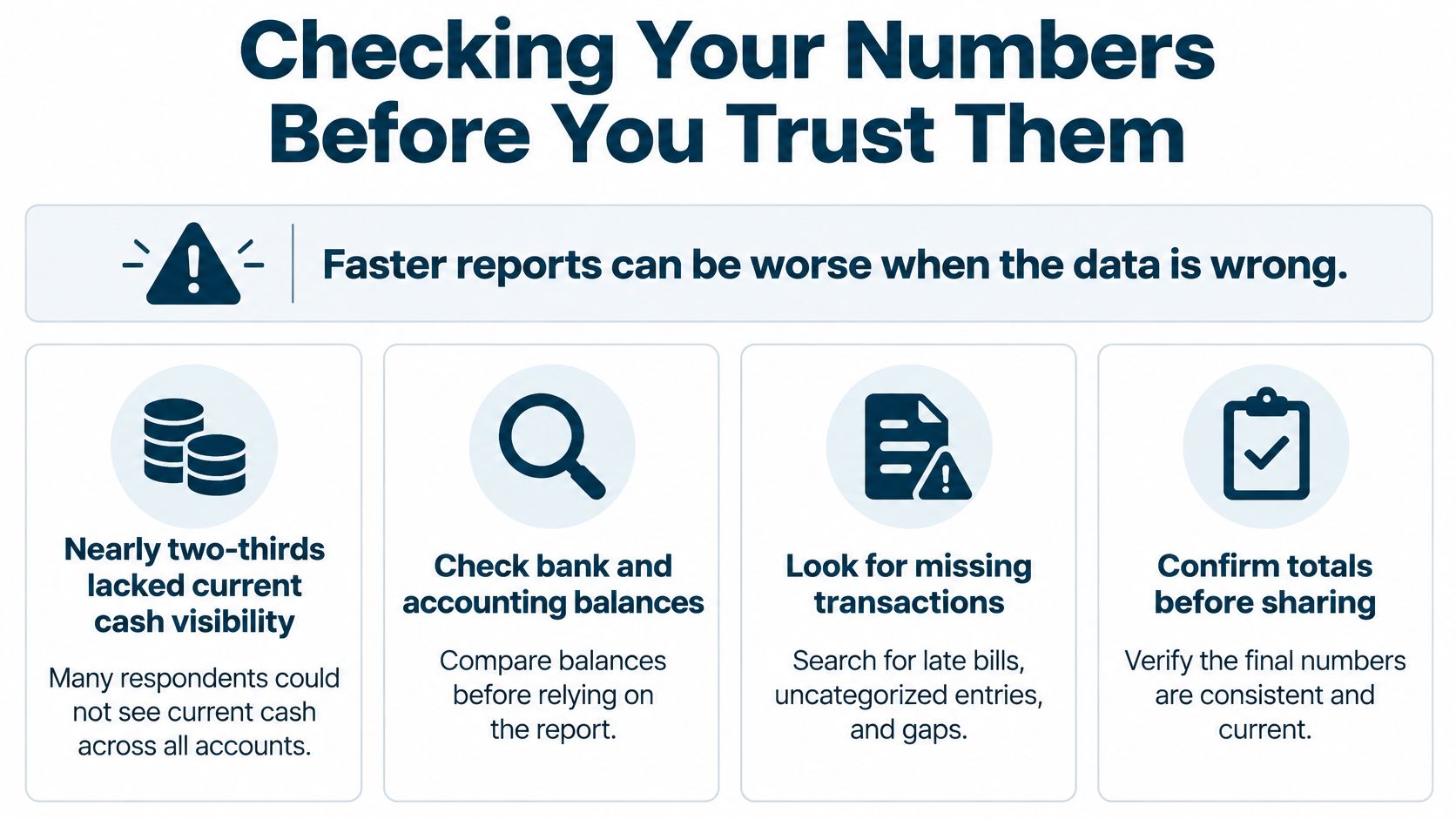
A dashboard can look clean while the bank feed is still catching up. In SMB research covered by CFO.com, nearly two-thirds of respondents couldn't access current cash positions across their accounts, and 20% experienced delays of days or weeks in obtaining real-time cash data. Faster delivery helps only after the underlying entries are complete, coded, and reconciled.
Run the trust tests
Treat each number as decision-ready only when it passes the same checks every month:
- Balances agree. Bank and payment-platform balances reconcile to the books, with differences explained rather than parked in suspense.
- Transactions have owners. Missing receipts, uncategorized entries, and open questions each have a named person and a due date.
- Cutoff rules are written. Staff know which period gets late bills, deposits, and completed work.
- Project coding is consistent. Revenue, subcontractors, materials, and payroll land against the right jobs.
- Definitions are shared. Gross margin, utilization, and similar metrics have one written formula and one owner.
Say a contractor's job report misses two weeks of subcontractor bills. The margin looks strong because the costs are absent. Pricing did not improve; the record is incomplete.
Give each KPI a high, medium, or low confidence rating in the report itself. High means the checks passed. Medium means a known estimate remains, so use a range and name the assumption. Low means missing information could change the decision, so fix the gap before approving spend.
Check customer advances separately
Reconcile beginning and ending unearned revenue and refund obligations against receipts, recognized revenue, refunds, and adjustments. The point is simple: cash collected before work is delivered is not the same as revenue earned.
Keep a contract-to-ledger schedule, a simple spreadsheet connecting customer agreements to accounting entries. Each deposit should trace to an invoice, retainer, or contract, with evidence of what has been earned.
Online sellers need the same discipline with platform totals. HiveHQ's explanation of why GMV differs from bank deposits helps separate gross sales activity from the cash that reaches the bank.
Decision rule: Use a KPI to approve hiring, pricing, borrowing, or investment only when its confidence is high.
Forecasting Cash Week by Week
Can you afford the hire? What happens if customers pay later? Which clients provide cash soon enough to fund the work you do for them?
A 13-week rolling cash forecast turns those questions into a weekly plan. Give each week a row, start with available cash, and show expected receipts, payments, and ending cash. Replace estimates with actual results every week and add another week at the end.
You do not need an advanced AI model to begin. In a 2025 PwC survey of 678 executives and board members, 58% said they were investing in AI and analytics, while the same percentage focused on core finance capabilities such as cash and liquidity forecasting. Technology investment and basic cash discipline belong together.
What-if scenarios for a 13-week cash forecast
Treat these as assumptions to test. Slower collections do not automatically translate into a fixed delay, so choose receipt dates using your own customer history.
| Scenario | What Changes in the Forecast | Question to Answer |
|---|---|---|
| Collections slow by 15 percent | Model receipts arriving about two weeks later | Does payroll still clear in every week? |
| New hire starts in week 4 | Payroll outflow added from week 4 onward | Does the lowest weekly balance stay above your minimum? |
| Largest client pays 30 days late | Move a large receipt about four weeks later, from week 3 to week 7 | Can rent and payroll still be covered in the gap? |
| Loan payment due in week 8 | Debt service line added in week 8 | Does the balance stay positive after the payment? |
| Equipment purchase in week 10 | Capital spending outflow in week 10 | Is the purchase still affordable at the forecast low point? |
For an actual late-payment scenario, move the receipt by the full assumed delay using calendar dates. A 30-day delay lands about four weeks later, and weekly buckets can hide a shortfall inside the week.
Build around drivers you can explain
Start with customer collection dates, payroll dates, debt payments, and expected sales. Include hiring costs beyond wages, such as payroll taxes, benefits, and equipment. Unsigned work stays out until the agreement supports a receipt date.
A spreadsheet in Microsoft Excel or Google Sheets can work well if every assumption has an owner. These cash flow forecasting techniques can help you choose a method that fits your operations.
Each month, compare the previous forecast with actual cash. Separate timing errors from permanent changes: a late receipt needs a different response than a lost customer.
The lowest weekly balance matters more than a comfortable balance at the end of the forecast.
Keep the annual budget as a target, but update scenarios monthly and after major events such as winning or losing a large client. Finish with clear answers about hiring, delayed collections, and which clients finance growth.
Automating Reports Without Breaking Them
In 2018, the SEC adopted phased-in Inline XBRL requirements, combining human-readable filings with tagged data that software can analyze. The useful lesson for a small business isn't to copy public-company filing systems. It's to give information consistent labels before asking software to interpret it.
Say a clinic codes the same visit type to different revenue accounts at its locations. An automated comparison could suggest a performance difference that comes from inconsistent coding rather than better results.
Put the controls in order
- Fix the chart of accounts. Give each account a clear purpose and consistent name.
- Connect transaction feeds. Bring in bank, card, and payment-platform activity without retyping, while checking for gaps and duplicates.
- Create matching rules carefully. Automate familiar subscriptions and transfers, then review unmatched or unusual entries.
- Refresh after the close. Schedule financial statements after adjustments are approved, not while staff are still correcting them.
- Keep a manual verification. Inspect a completed reconciliation and supporting statement rather than trusting the feed status.
Automation has a real trade-off. Strict rules leave more items for review; loose rules can inadvertently misclassify transactions.
Automation check: A transaction imported successfully isn't necessarily a transaction recorded correctly.
Save time on repeat work, not on reviewing exceptions. Automation earns its place after the trust checks pass.
Getting Outside Help and Your First Steps
Bookkeeping is the scorekeeper, recording daily activity. Advisory is the coach, using those records to plan. If you can't explain where cash went, tax season keeps surprising you, or you're considering a hire, loan, expansion, or sale, you may need both.
Give this month a clear finish line
- Pull the core reports. Use the last closed month and check that their balances and cash movements agree.
- Choose five KPIs. Write a plain-language definition and assign an owner to each.
- Build the cash forecast. Start with collections, payroll, and debt payments, then add other material commitments.
Keep the essentials visible:
- Profit isn't available cash. Test the timing before committing money.
- Definitions matter. Everyone should calculate each KPI the same way.
- Confidence comes first. Resolve important gaps before acting.
Match help to the decision
A fractional CFO supports strategy, a forecasting partner supports cash planning, and valuation support helps prepare for a sale. For established-business planning, the SBA recommends three to five years of financial statements alongside forecasts and a capital-expenditure budget.
Our bookkeeping handles day-to-day transactions, while our CFO advisory provides strategy, forecasting, and guidance for growth and major decisions. A useful provider conversation should cover margin definitions, reporting frequency, a sample monthly package, and who answers questions.
If closing the books routinely takes more than a week, or the reports don't agree, get help fixing the process before adding more dashboards.
MyOfficeOps offers bookkeeping and virtual CFO advisory to help you turn reliable financial reports into hiring, pricing, and cash decisions. Visit MyOfficeOps to arrange a discovery call and explore the free Financial Growth Guide, which explains the simple numbers to watch and what to do about them.