
You're probably looking at your bank balance, your invoices, and your payroll and thinking the same thing a lot of owners think: “We're busy. Money is coming in. So why does profit still feel fuzzy?”
That frustration is normal. Most business owners don't struggle because they're bad at numbers. They struggle because the reports they get don't answer the question they care about, which is simple: How much do I keep from each sale before the rest of the business eats it up?
That's where gross profit margin helps. It cuts through the noise fast. And if you run a project-based business like construction, healthcare, or professional services, one company-wide number isn't enough. You also need to know which jobs make money and which ones erode profits.
What Gross Profit Margin Really Means
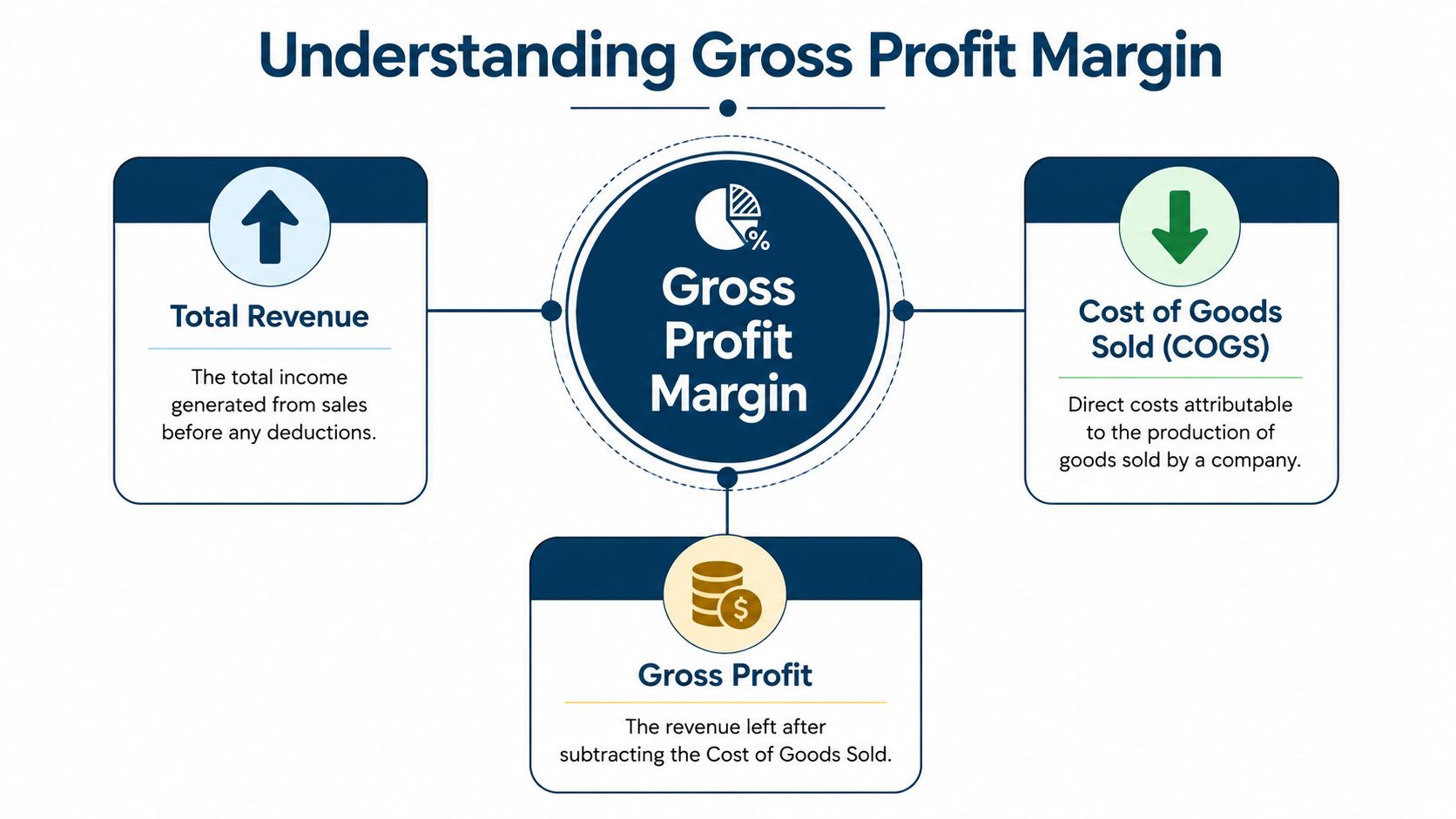
Gross profit margin is the first number I want a business owner to understand. Not revenue. Not net income. Not some fancy dashboard. Gross profit margin tells you how much of each sales dollar is left after paying the direct cost to deliver what you sold.
That means the materials, supplies, and direct labor tied to the work. It does not mean rent, office software, admin payroll, or marketing.
Here's the simplest way to think about it. A cake shop sells a cake for $50. The ingredients and the baker's wage cost $30. The gross profit margin is ($50 – $30) / $50 × 100 = 40%. That means 40 cents of every dollar stays in the business after direct production costs are paid, based on Klipfolio's gross margin example.
What this number is really telling you
If you only track sales, you can fool yourself. A lot of owners do.
A big top line can hide thin margins. You can be winning work, staying busy, and still leaving yourself very little room to cover payroll, rent, insurance, software, taxes, and owner pay. Gross profit margin is your first reality check.
Practical rule: If you don't know your gross profit margin, you don't really know whether your pricing works.
This number also helps you compare different parts of your business. Maybe one service line looks busy but barely leaves any money behind. Maybe another sells less often but is much healthier. Gross profit margin helps you see that difference clearly.
What belongs in direct costs
Direct costs are the costs that exist because you sold the job, product, or service.
A few easy examples:
- Product businesses: raw materials, packaging, freight tied to inventory, wages for workers making the product
- Construction and trades: lumber, drywall, fasteners, job-site labor, equipment tied directly to the project
- Service businesses: billable labor and supplies used to deliver the service
If you sell online, you may already track metrics for DTC brands like return rate, average order value, and fulfillment efficiency. Those metrics matter because they shape your direct costs and, in turn, your gross profit margin.
The point is simple. Gross profit margin shows what's left from sales before overhead shows up. If that number is weak, the rest of the income statement usually gets ugly fast.
How to Calculate Your Gross Profit Margin
You don't need a finance degree for this. You need clean numbers and the discipline to sort direct costs from everything else.
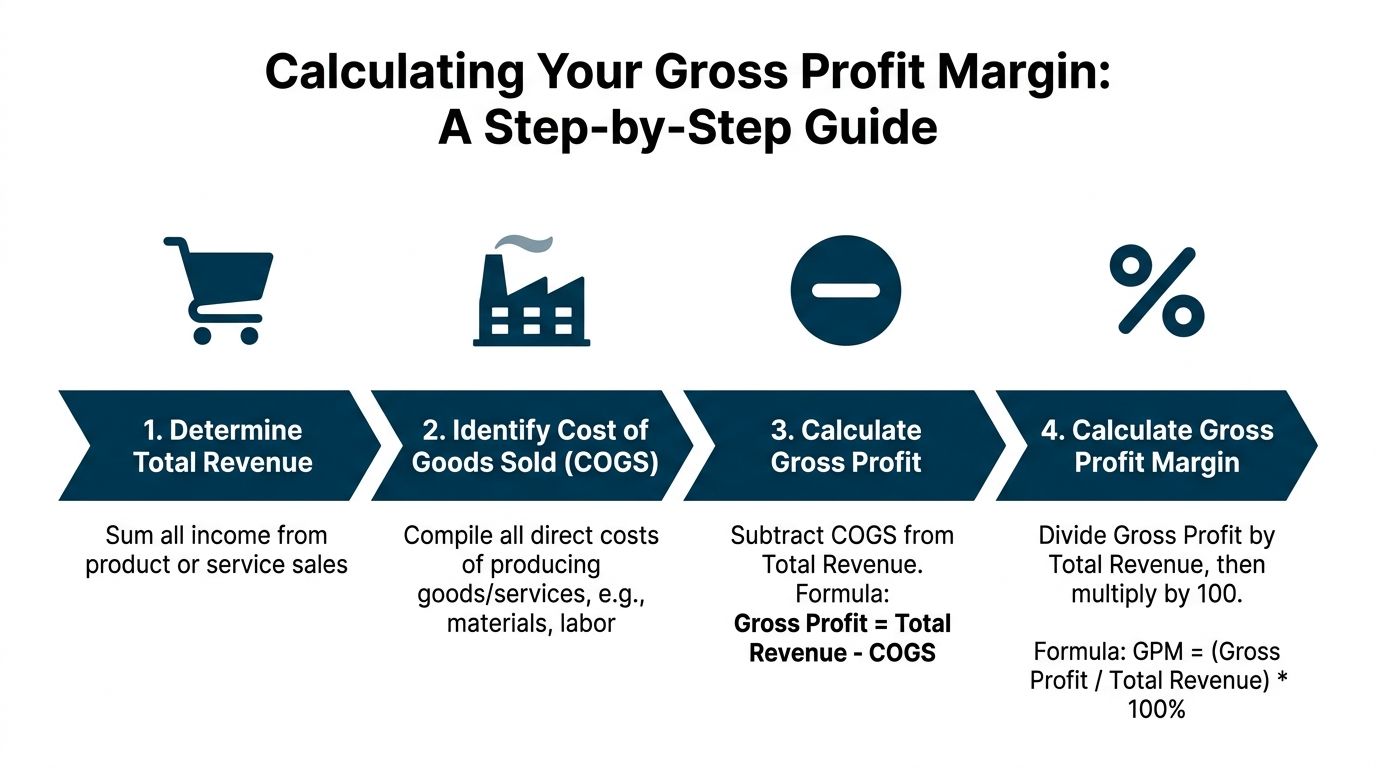
The formula is standard: (Revenue – COGS) / Revenue × 100.
The four steps
Pull your revenue
Use sales for the period you want to review. Monthly is usually best for small business owners because it's frequent enough to catch problems early.Pull your direct costs
COGS includes only the direct costs to make or buy what you sell, like raw materials and worker wages, but not indirect costs like office rent or marketing. For a service business, “cost of services sold” takes the place of COGS, and it usually includes labor and supplies for the job, as explained in Paychex's guide to calculating gross profit.Find gross profit
Subtract direct costs from revenue.Convert to a percentage
Divide gross profit by revenue, then multiply by 100.
Two examples owners often mix up
A contractor and a consultant both need gross profit margin. They just fill the formula with different direct costs.
| Business type | Revenue | Direct costs included | Gross profit margin use |
|---|---|---|---|
| Construction contractor | Job billings | Lumber, concrete, fixtures, job-site labor | Shows whether estimating and job pricing are working |
| Service firm | Client fees | Billable staff time, service supplies | Shows whether delivery labor is priced correctly |
A contractor should count materials and on-site labor tied to the work. Office rent stays out. The estimator's salary usually stays out if it isn't direct production labor.
A service firm should think in terms of cost of services sold. If an IT company bills a fixed-fee support package, the direct labor of the technicians doing the work belongs in the calculation. The owner's general admin time does not.
If you want a cleaner breakdown of what belongs in direct costs, use this plain-English guide on what cost of goods sold means.
One mistake to stop making
Don't throw every expense into COGS just because it feels related to the business. That ruins the number.
Gross profit margin only works when the inputs are clean. If you bury rent, software subscriptions, admin wages, and ad spend in direct costs, you'll make your jobs look worse than they are and your pricing decisions will be off.
Is Your Gross Profit Margin Healthy
It is common for owners to want a quick answer. “My margin is 35%. Is that good?”
Maybe. Maybe not.
A healthy gross profit margin depends on your industry. Comparing your construction firm to a software company is useless. The cost structure is different, the labor model is different, and the pricing power is different.
Start with the right frame
Most businesses target a gross profit margin between 20% and 60%, but that range varies a lot by industry. Some sectors run much lower. The Uranium industry averages around 8.9% and Oil & Gas Refining averages around 11.3%, according to Salesforce's gross profit margin guide. So don't compare yourself to a business with a totally different model.
What matters is this: compare your margin to businesses that sell work the way you do.
Average gross profit margin by industry 2026 estimates
| Industry | Average Gross Profit Margin Range |
|---|---|
| Retailers and many manufacturing businesses | 50% to 70% |
| Software companies | 37.6% |
| Digital retail businesses | 41.9% |
| Restaurant food | 65% to 70% |
| Restaurant drinks like soda | 80% to 90% |
| Uranium | 8.9% |
| Oil & Gas Refining | 11.3% |
The retailer, manufacturing, software, and digital retail figures above come from Salesforce's overview of gross profit margin benchmarks. The restaurant figures are covered elsewhere in this article.
How to judge your own number
Use these questions:
- Are you improving over time even if your margin isn't perfect yet?
- Are your direct costs classified correctly so the percentage means something?
- Does your margin leave enough room to cover overhead and still produce real profit?
- Are you comparing against the right peers instead of random companies online?
A gross profit margin trend is often more useful than a single month's number. A stable method matters more than a pretty result.
If you want to go one step deeper, look at what contribution margin means in accounting. That helps you separate direct profitability from the other variable costs that show up as you grow.
For service firms, healthcare practices, and contractors, I'd be blunt here. If your gross profit margin is weak and you can't explain why, you probably have a pricing problem, a labor efficiency problem, a cost control problem, or all three.
Four Practical Ways to Improve Your Margin
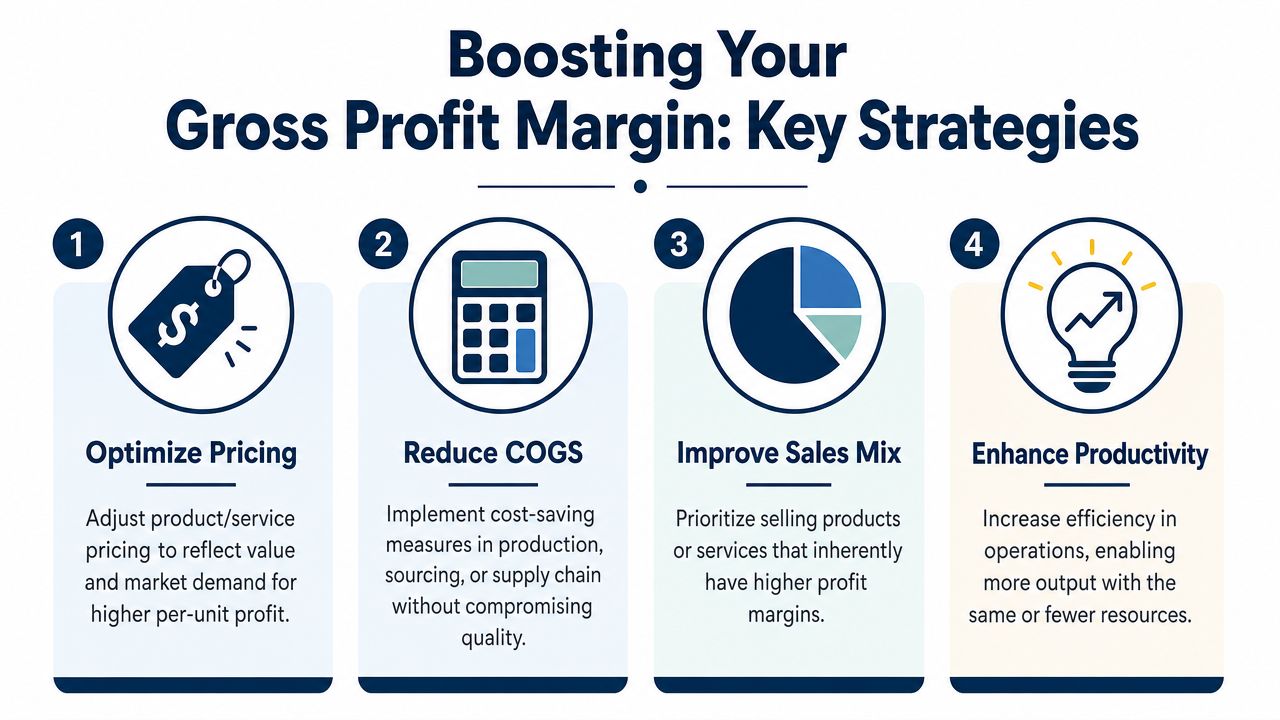
If your gross profit margin is soft, don't start with wishful thinking. Start with the two levers you control: price and direct cost.
Most owners wait too long to act because they think fixing margin means a huge overhaul. It usually doesn't. It means making a few smarter decisions, consistently.
Raise prices with a reason
A lot of owners underprice because they're afraid of losing work. That fear is expensive.
You don't need random price increases. You need pricing tied to scope, speed, complexity, and value. If clients want faster delivery, extra revisions, emergency response, or custom reporting, charge for it. Don't absorb it.
Cut direct costs without cutting quality
Supplier quotes should not stay untouched for years. Labor processes shouldn't stay bloated because “that's how we do it.”
Review purchasing, waste, rework, and scheduling. In a service business, this often means tightening handoffs and reducing non-billable delivery time. In construction, it often means better estimating, tighter material controls, and fewer labor overruns.
If you're in the trades, this roundup of strategies for improving trade profit margins is a useful companion read because it stays focused on real field decisions.
Sell more of what pays you better
Your sales mix matters more than most owners realize.
In restaurants, food often runs around 65% to 70% gross profit margin, while drinks like soda can run 80% to 90%, based on Xero's restaurant margin examples. That's why smart operators push drinks, desserts, and add-ons. The mix changes the outcome.
The same logic applies outside restaurants:
- A clinic: one service line may be smooth, well-staffed, and consistently profitable, while another creates scheduling chaos and weak margins
- A contractor: small repeat jobs may produce better margins than large custom jobs with messy change orders
- A consulting firm: fixed-scope packages often hold margin better than open-ended custom work
Track the drivers, not just the result
A margin percentage by itself won't fix anything. You need to know what changed.
Workday's guidance on margin analysis recommends breaking the movement into price, volume, mix, and cost, then reviewing it in a margin bridge or waterfall format in its margin analysis article. That's smart advice because it forces you to stop guessing.
Watch realized price, discounting, and unit cost. Those numbers usually tell you the story before the monthly close does.
Look Deeper Than Your Overall Margin
A company-wide gross profit margin can look fine while part of your business loses money.
That's not a theory. It's a common problem in firms that run multiple jobs, clients, or service lines at the same time. If one strong project covers the damage from three weak ones, the blended company number can fool you for months.

Why blended numbers hide bad work
If you run construction projects, healthcare programs, or client service engagements, every job has its own labor pattern, material use, timeline, and pricing pressure.
One client pays quickly, approves scope changes, and stays inside the plan. Another burns hours, asks for extras, and fights every invoice. If you only watch the total company margin, those two realities get blended together.
That's why job-level profitability matters. You need to know gross profit margin by project, by client, by service line, or by location.
The case for job-level gross margin
Analysis shows SMBs in construction and healthcare often have a healthy 40% company gross margin while 30% of their individual jobs are loss-making. The same analysis says SMBs that tracked job-level gross margin reduced unprofitable projects by 35% and increased overall net margins by 12% in one year, according to GrowthForce's discussion of gross profits and profitability.
That's the part many business owners miss. A decent blended margin doesn't prove your work is healthy. It may just prove your best jobs are carrying your worst ones.
If you don't know which jobs lose money, you'll keep selling them.
What to track at the job level
You don't need a massive finance team to do this. You need discipline.
Track direct revenue and direct cost by:
- Project or engagement
- Client or patient program
- Service line
- Location or crew
Then ask simple questions. Which jobs finish with strong margins? Which ones always run over labor? Which clients force too many small changes? Which pricing model gives you the least trouble?
A clean profit and loss statement example helps, but project-based businesses usually need more detail than a standard monthly P&L alone can provide.
For many owners, this is the turning point. They stop managing the business as one blurry bucket and start managing it job by job.
Turn Your Numbers into a Growth Strategy
Here's the hard truth. Knowing your gross profit margin is useful. Acting on it is what changes the business.
The owners who get the most value from this number do three things well. They review it regularly, they break it down by job or service line, and they use it to make decisions about pricing, staffing, and which work to pursue.
Build a simple operating habit
Keep the process boring and repeatable.
Review gross profit margin every month. Then review job-level profitability if your business runs multiple projects, clients, or service lines. If margins moved, identify whether the cause was price, cost, or sales mix. Then decide what changes this month, not someday.
For tax planning, forecasting, and scenario work, it also helps to understand how CPAs handle tax advisory, especially if profitability changes are going to affect owner pay, estimated taxes, or cash planning.
Don't do all of this in your head
Most owners wait too long to get help because they think outside support only matters when the books are a mess. That's backwards. Good support matters when you want to turn clean numbers into better decisions.
One option is MyOfficeOps, which provides bookkeeping, financial analytics, and CFO-level advisory for small and midsize businesses. For project-based firms, that kind of support can help set up cleaner tracking, clearer reports, and a better process for reviewing profitability without turning the owner into a full-time analyst.
Your gross profit margin is not just an accounting number. It's a decision tool. Used well, it tells you what to charge, what to fix, what to stop selling, and where your best profit really comes from.
If you want help turning your financials into something you can use, talk to MyOfficeOps. They help small and midsize businesses clean up the numbers, track profitability more clearly, and make better decisions on pricing, cash flow, hiring, and growth.