

You're staring at a bank feed that doesn't match, a payroll email that landed too late, and three invoices sitting in someone else's inbox. The books aren't “almost done.” They're waiting on people, systems, and approvals that don't all live inside accounting. That's why month-end close feels hard, even when you know the steps.
The fastest teams don't treat close like a last-minute rescue mission. They treat it like a repeatable workflow that starts before month-end, runs through the month, and ends with a clean sign-off. When you do how to do month end close the right way, the job stops being a scramble for missing pieces and becomes a controlled process with clear owners, cutoff rules, and evidence for every adjustment.
What Month-End Close Feels Like in Practice
It's Tuesday night, and you're still in the books. The bank statement shows one balance, Stripe shows another, and the sales platform has not paid out what you expected. Then HR sends a note about a final paycheck, leaving you to decide whether the accrual belongs in this month or the next.
That pressure is what many owners remember. The checklist matters, but the waiting matters more.
The bottleneck is coordination
Month-end close feels messy because its inputs sit across departments and systems. The bookkeeper has the ledger open, AR is waiting on customer payments, payroll is finalizing wages, and the owner is answering questions about the number everyone needs to trust. A late input shifts every dependent task, even when the accounting work itself is straightforward.
Owners often cannot control payroll timing, bank access, ecommerce payouts, or approval queues. They can still set the handoffs: who supplies each file, which cutoff applies, who approves an adjustment, and what happens when a deadline is missed.
A good close finishes a workflow that has been progressing throughout the month. Bank feeds, payroll, ecommerce payouts, vendor bills, and approval chains must line up before anyone marks the books complete. That requires coordination rules, not just accounting skill.
Practical rule: if a number can change because someone outside accounting has not sent an input, assign an owner and deadline outside the ledger. The accounting team can record the result, but another person may control the evidence.
This perspective changes the questions you ask. Instead of waiting for a final cleanup, identify upstream owners, cutoff dates, review points, and backup evidence. Those decisions reduce chasing and make the close easier to verify.
The Pre-Close Work That Makes the Close Easier
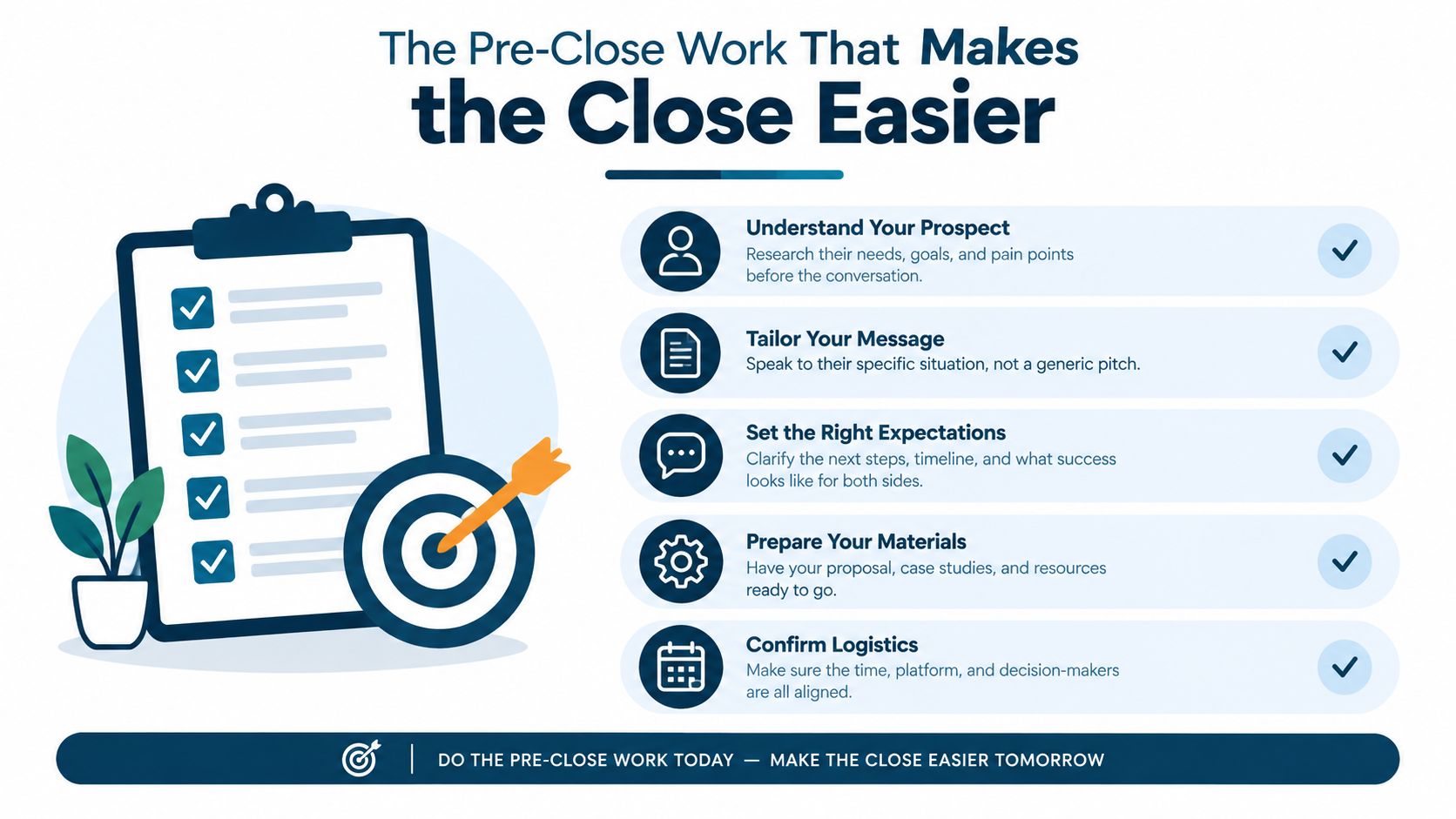
The cleanest closes start long before the month ends. If you wait until day one to find missing receipts, uncategorized charges, and payout mismatches, you're doing detective work under a deadline. If you handle that work as it comes in, close turns into validation instead of discovery.
Keep transaction coding current
When a bank feed transaction lands, code it the same day if you can. That keeps merchant names, expense categories, and tax tags from drifting month to month. It also makes the trial balance easier to scan later, because you're not sorting through a pile of old mystery items.
Weekly payout checks matter too. Stripe, PayPal, and Amazon payouts should be tied back to settlement reports before the month gets away from you. If you wait too long, you lose the trail between gross sales, fees, and the cash that hit the bank.
Build one place for support
Store contracts, payroll reports, loan statements, and recurring reconciliation files in the same folder structure every month. The controller, or whoever reviews the close, should not have to hunt through email threads for backup. When support lives in one place, journal entries become easier to approve and easier to defend later.
Assign the boring jobs to named people
Someone should own the billing reminder. Someone should own the bank rec. Someone should own the payroll journal entry. If those tasks float around, they'll get handled late, or twice, or not at all.
A simple way to think about it is this, every hour spent on clean-up during the month saves three hours of digging during close. That is where the time goes, not into the final report, but into finding what the report needs.
For a practical cleanup sequence, a bookkeeping clean-up checklist can help a team spot what still needs attention before the month shuts.
Running the Close Step by Step
The close itself should feel methodical, not improvised. Each step exists to stop a specific mistake from slipping into the financials, and each step should tie back to source documents in the close folder.
Start with the cash accounts and subledgers
Lock the bank feeds, then confirm every bank and credit card account has been reconciled to the period-end balance. Do the same for accounts receivable and accounts payable against the general ledger. If those balances are off, nothing downstream is worth trusting yet.
After that, tie in loans, payroll liabilities, taxes payable, and other balance sheet items. A missing merchant fee reversal or a Shopify payout timing gap can distort the cash side fast. The point isn't to make the numbers look neat, it's to prove they agree with outside records.
Post entries only when you can support them
Recurring and adjusting entries should follow the same pattern every month. That includes prepaid insurance amortization, depreciation, accrued expenses, payroll liabilities, and owner draws. If an entry can't be traced to a bill, a schedule, a payroll report, or another document in the close folder, it's not ready.
Accruals matter because they keep expenses in the right period. If a bill belongs to this month but arrives next month, the month-end entry captures the cost now and reverses it later so it doesn't get counted twice. Payroll accruals work the same way when payday lands after month-end.
Review cutoffs and the trial balance
Look at anything dated after period-end and ask whether it belongs in the next month. That catches late deposits, vendor bills, final-paycheck timing issues, and other items that often get recorded in the wrong period. Then run the trial balance and scan for balances that don't make sense, because odd numbers usually point to a missed tie-out or a duplicated entry.
The general ledger reconciliation guide is useful here if you need a clean way to check whether each account really matches what the books say.
Finish with the reporting and sign-off
Once the balances are stable, produce the income statement, balance sheet, and cash flow statement. Then get review and sign-off from the owner or controller before the period is locked.
| Month-End Close Tasks by Day | Task | Mistake It Prevents |
|---|---|---|
| Day 1 | Reconcile cash, cards, A/R, and A/P | Starting with unstable balances |
| Day 2 | Post recurring and adjusting journal entries | Missing accruals and depreciation |
| Day 3 | Review cutoffs and unusual balances | Recording next month's items too early |
| Day 4 | Prepare core statements | Drafting reports from incomplete data |
| Day 5 | Review and sign off | Shipping numbers without approval |
A Realistic Timeline for Small and Midsize Businesses
The benchmark range matters because it keeps expectations honest. APQC's study of more than 2,300 organizations found a median monthly close time of 6.4 calendar days, while the top quartile finished in 4.8 days or less and the bottom quartile needed 10 or more days in a widely used benchmark summary of month-end close performance. That spread is why one team can finish cleanly in a workweek while another is still dragging into double digits. APQC benchmark summary
Small teams can usually move faster, if the data is clean
A team of one to three people with under 500 transactions can often target a five-business-day close. That only works when bank feeds are current, payroll is predictable, and the chart of accounts isn't changing every month.
In that setup, Day 1 is reconciliation, Day 2 is journal entries, Day 3 is review, and Days 4 to 5 are reporting and sign-off. The work can run in parallel only if the inputs are already landing on time.
Mid-size teams need more coordination, not just more hands
A four to ten person finance team with multiple entities or revenue streams usually needs a seven-to-ten-day window. The extra time goes to cross-checking, not because people are slow, but because more accounts and more approvals create more handoffs.
| Business Profile | Team Size | Target Close Window | Day 1-2 Focus | Day 3-5 Focus | Day 6-10 Focus |
|---|---|---|---|---|---|
| Small service business | 1 to 3 people | 5 business days | Cash, cards, A/R, A/P | Entries and cutoff review | Statements and sign-off |
| Mid-size multi-entity company | 4 to 10 people | 7 to 10 business days | Recs across entities | Adjustments and variance review | Consolidation and approval |
| Early-stage company | Lean team | Longer until process is stable | Clean up chart of accounts | Standardize entries | Build a repeatable close |
Three variables stretch the timeline
More bank and credit card accounts mean more reconciliation work. Payroll frequency adds timing noise, especially when final payroll, benefits, and taxes land near month-end. Inventory or project costing adds another layer because you're not just checking cash and liabilities, you're checking whether costs hit the right job or product.
Parallel work speeds things up when reconciliations start while data is still flowing. Sequential work still matters at the end, because final review has to wait for everything else to be complete.
Why the Close Always Takes Longer Than You Think
The owner expects a short final push, but the bookkeeper is still waiting for payroll files, vendor invoices, customer payment details, or approval on an unusual transaction. The close cannot move until those inputs arrive. Extra effort during the last few days only concentrates the waiting and review work into a tighter window.
Handoffs create the delay
Work changes hands repeatedly. The owner waits on the controller, the controller waits on payroll, and the bookkeeper waits on the CPA. Each handoff adds a small pause. Across ten tasks, those pauses become the schedule.
For owners who do not control payroll, banking, or approvals, this is a coordination problem before it becomes an accounting problem. Set an owner, deadline, and required format for every outside input. A cutoff rule also needs a consequence, such as booking an estimate and revising it when the final support arrives.
One missing accrual can reopen the review. If the supporting detail never arrives, the statements may need revision and final sign-off moves later. Unreconciled intercompany balances create the same risk. One unresolved item can keep the team from locking numbers that may still change.
Checklist pressure can make numbers worse
A two-day close encourages skipped tie-outs and guessed entries when upstream work is incomplete. Faster delivery without upstream control sends questionable numbers forward, then creates rework during review.
Ownership clarity shortens the process. Payroll, banking, sales operations, and approvers need visible deadlines, cutoff rules, and a named person responsible for each input. Accounting can chase exceptions instead of repeatedly asking who is supposed to send the file.
Many teams discover that their close issue is a dependency issue. Map each input, its owner, its due date, and its reviewer. Once those relationships are visible, delays stop looking random, and managers can fix the handoff causing the longest wait.
Where Automation Helps and Where It Is Overkill
Automation is useful when it removes repetitive work that is already stable. It is not useful when the underlying data is still messy. That's why the first question should always be, what part of the close is repeatable, and what part still needs human judgment?
Start with the low-friction wins
Bank and credit card feeds are high value and low cost because they remove manual entry. Rules-based transaction categorization helps too, as long as the chart of accounts is stable enough for the rules to work. Recurring journal entries are another easy win, since the same accruals and depreciation entries happen every month.
Three-way matching for accounts payable can also help, but it makes more sense when volume is high enough to justify the setup. If the team is small and the invoice load is light, the tool can cost more time than it saves.
Skip the expensive stuff until the process is ready
AI-driven anomaly detection sounds smart, but it's overkill if the underlying data is still fragmented. Complex workflow approvals are also too much for a team of four that already knows who has to sign what. Full ERP projects can be a waste if basic cloud bookkeeping would solve the bottleneck faster.
If you want a deeper look at AI in finance ops, the finance AI agents guide is a useful read because it frames where automation helps and where it still needs human control.
Decision rule: automate the tasks that repeat, then automate the review path only after the data is clean enough to trust.
For a practical starting point on payables, the accounts payable automation guide is worth a look because AP is often where close cleanup begins.
Use the current cost to decide
If manual cleanup is eating hours every month, the process is probably big enough for automation. If the team keeps fixing the same feed, the same coding issue, or the same recurring entry, that's the signal to automate that exact step first. Only revisit advanced tools when the volume justifies the spend.
The clean sequence is simple. Fix data capture first, then categorization, then recurring entries, then any bigger automation layer after the workflow is stable.
Making Month-End Close Boring on Purpose
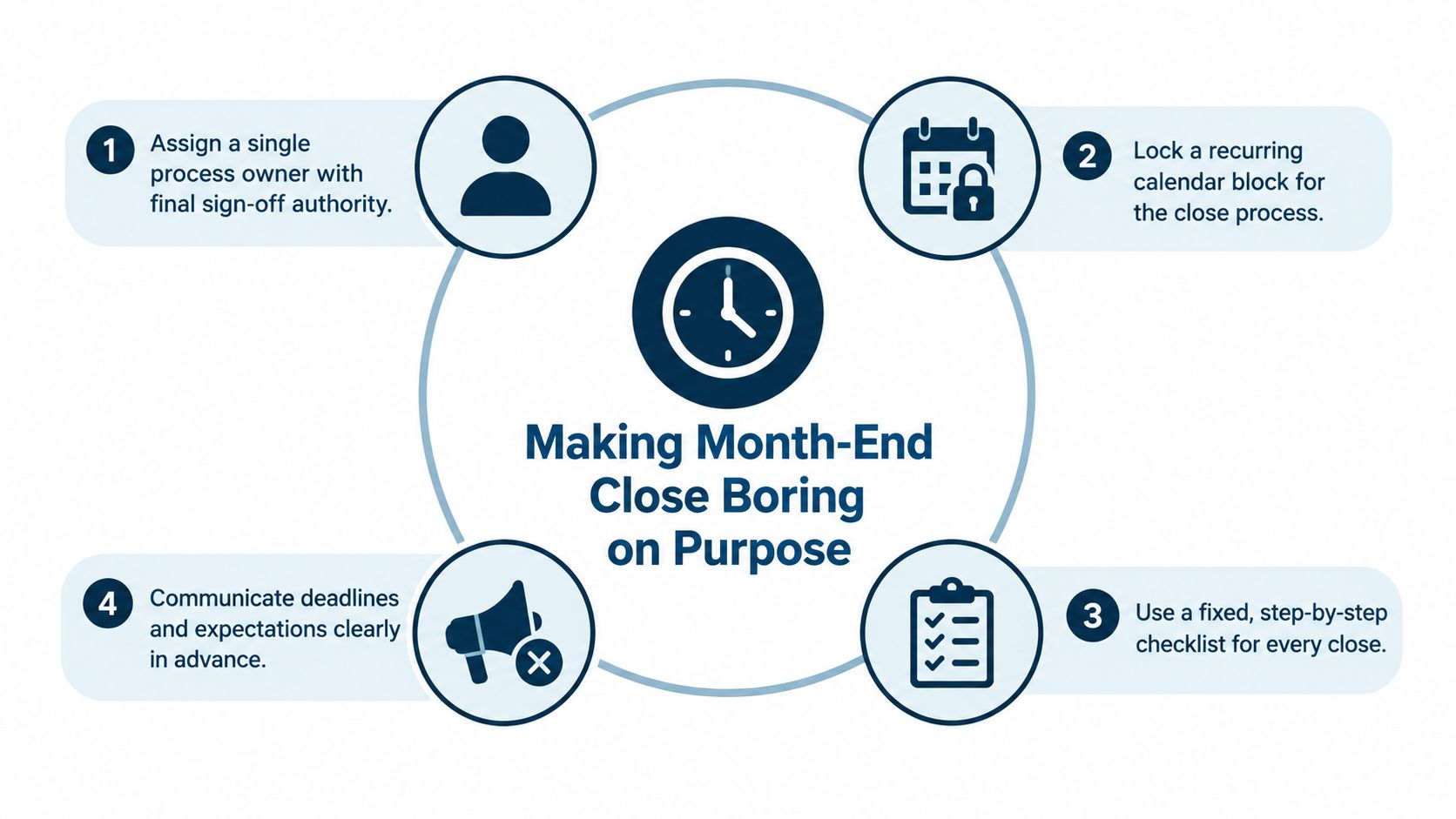
A boring close is a good close. Nobody should be inventing new rules every month, and nobody should be guessing who owns what on the last day. The whole point is to make the process predictable enough that it stops eating the first week of every month.
Put one person in charge
Assign a single process owner with final sign-off authority. That person doesn't do every task, but they do own the calendar, the deadline reminders, and the final call on whether the books are ready. Without that, every issue becomes a group decision, and group decisions are slow.
Lock a recurring calendar block for close work. Enforce handoff deadlines with payroll and AR/AP so the work arrives before the close window is half gone. Store recurring journal entries and reconciliation templates in a shared drive so the team isn't rebuilding the same files every month.
Keep the review loop short
A 15-minute retrospective after each close is enough to capture one fix. Not ten fixes, one fix. If the team found a recurring fee issue, a late payroll report, or a bad cutoff habit, write it down and change the process before the next month starts.
Simple rule: whoever enters the journal entry should not be the only person who knows why it exists.
That means you need clear ownership rules. One person enters, another reviews, and anything above your material threshold gets approved by the controller or owner. Exceptions should be documented in the close folder so the next cycle starts with better context instead of old confusion.
Keep the process map short enough to use
A one-page process map works better than a giant manual nobody reads. It should show who sends inputs, who posts entries, who reviews balances, who approves exceptions, and where the close ends. If a step can't fit on one page, it probably needs simplification before it needs more detail.
Sample month-end process map
- Gather bank, payroll, AP, AR, and payout data.
- Reconcile cash and subledgers.
- Post recurring and adjusting entries.
- Review unusual balances and cutoffs.
- Prepare statements and management reports.
- Obtain final sign-off and lock the period.
If you want a partner that already works inside this kind of monthly rhythm, MyOfficeOps provides bookkeeping, payroll integration, financial reporting, and CFO-level support for small and midsize businesses. That kind of support can help clean up the inputs, tighten the review process, and make month-end close less reactive for owners who don't control every upstream team.