
Pricing a construction job comes down to this: figure out your real costs, add some to cover your business expenses (overhead), and then add a little more for your profit. It sounds simple, but getting each part right is what makes a contractor successful. You want to be fair to your client, but you also need to make money to stay in business.
The Three Core Pricing Methods for Any Construction Job
Figuring out how to price construction jobs starts with picking the right tool. You wouldn't use a sledgehammer to hang a picture, and you shouldn't use the same pricing method for every project. The three main ways are Lump Sum, Time and Materials (T&M), and Unit Pricing.
Choosing the right one is the first step to a good bid and a smooth project. Let's break down when to use each one.
Lump Sum (Fixed Price)
This is the simplest method. You give the client one single price for the whole project. It's clean and easy for everyone.
A Lump Sum price is perfect for jobs where you know exactly what needs to be done and nothing is likely to change. Think of a standard bathroom remodel where the tiles, toilet, and sink are already picked out. Clients love it because they know the final cost from day one. You can make more profit if you work faster than you planned.
The risk? If you mess up your math or run into unexpected problems, that extra cost comes straight out of your pocket.
Time and Materials (T&M)
With a T&M price, you bill the client for the actual hours your crew works and the real cost of the materials you use, plus a markup on both. This way is very open and honest, and it’s great for projects where you don't know what you'll find.
Imagine you're fixing a leak and you're not sure what's behind the wall. A T&M price protects you from losing money on surprises. The client pays for the actual work done, which is fair for everyone when you can't see the whole picture at the start.
Unit Pricing
This method is often used on bigger jobs or projects where you do the same thing over and over. You break the project down into chunks—like square feet or linear feet—and set a price for each chunk.
For example, a paving contractor might charge a set price per square foot of asphalt. If the job is paving 5,000 square feet, the total price is just the unit price multiplied by 5,000. This is really helpful when you don't know the exact final amount at the start, but you know the type of work you'll be doing.
To see how various services and tools in the construction industry structure their offerings, you might explore different service pricing models and tiers.
Deciding which model to use is all about balancing risk with how clear the project is. Here’s a quick cheat sheet to help you decide.
Which Pricing Method Is Right for Your Job?
A quick comparison of the three main construction pricing models to help you choose the best fit.
| Pricing Method | Best For | Risk for Contractor | Example |
|---|---|---|---|
| Lump Sum | Projects with a very clear, well-defined scope. | High. If you bid too low or have problems, it hurts your profit. | A standard deck build with all materials and design decided upfront. |
| Time & Materials | Projects with a lot of unknowns or a changing scope. | Low. You get paid for all your time and the materials you use. | A historic home renovation where you will probably find hidden issues. |
| Unit Pricing | Large-scale projects with repetitive, easily measured tasks. | Medium. Your risk is in getting your per-unit cost right. | Installing 2,000 feet of fencing or paving a large parking lot. |
In the end, the best method protects both you and your client by matching the price structure to what the job is actually like.
Key Takeaway: The pricing method you choose changes your risk and the client's budget. Match the method to the project's clarity—use Lump Sum for clear jobs and T&M for unclear ones.
Calculating Your Direct Job Costs: Materials and Labor
Once you've picked your pricing method, it's time to get into the real numbers. This is where a guess turns into a solid plan. Your bid is only as good as your cost calculations—and that starts with two things: materials and labor.
Getting these two right is the foundation of a profitable job. Get them wrong, and you could end up working for free.
Nailing Down Your Material Costs
This sounds easy, but it’s a place where even experienced contractors mess up. You can't rely on old prices. The cost of lumber, steel, or even drywall can change a lot from one week to the next.
I once saw a contractor lose thousands on a project. He based his bid on a steel quote from a job he did just three months earlier. In that short time, the price had shot up. He had to eat the difference, which wiped out his entire profit. Don't let that be you.
For every single job, you need fresh quotes from your suppliers. It’s an extra step, but you can't skip it.
- Make a detailed list: Go through the plans and list every single thing you need, from big boards and concrete down to the last box of screws.
- Get multiple prices: Send your list to at least two different suppliers, if you can. This helps you get a fair price.
- Don't forget delivery: Always add the cost of getting materials to the job site. Those fees add up.
Pro Tip: Keep your material lists organized. When you’re busy, it’s easy to mix things up. A simple spreadsheet can save you from a major headache later on.
The True Cost of Labor: The Burdened Rate
Now for the big one: labor. Knowing how to price construction jobs almost always comes down to understanding your true labor cost. It's not just what you pay your crew per hour. That’s just the start.
You have to figure out your burdened labor rate. This is the real, all-in cost for every hour an employee works for you. It includes their wage plus all the extra costs of having them on your team. For a lot of new contractors, seeing this number for the first time is a real shock.
This is a super important number that you'll use no matter which pricing method you choose.
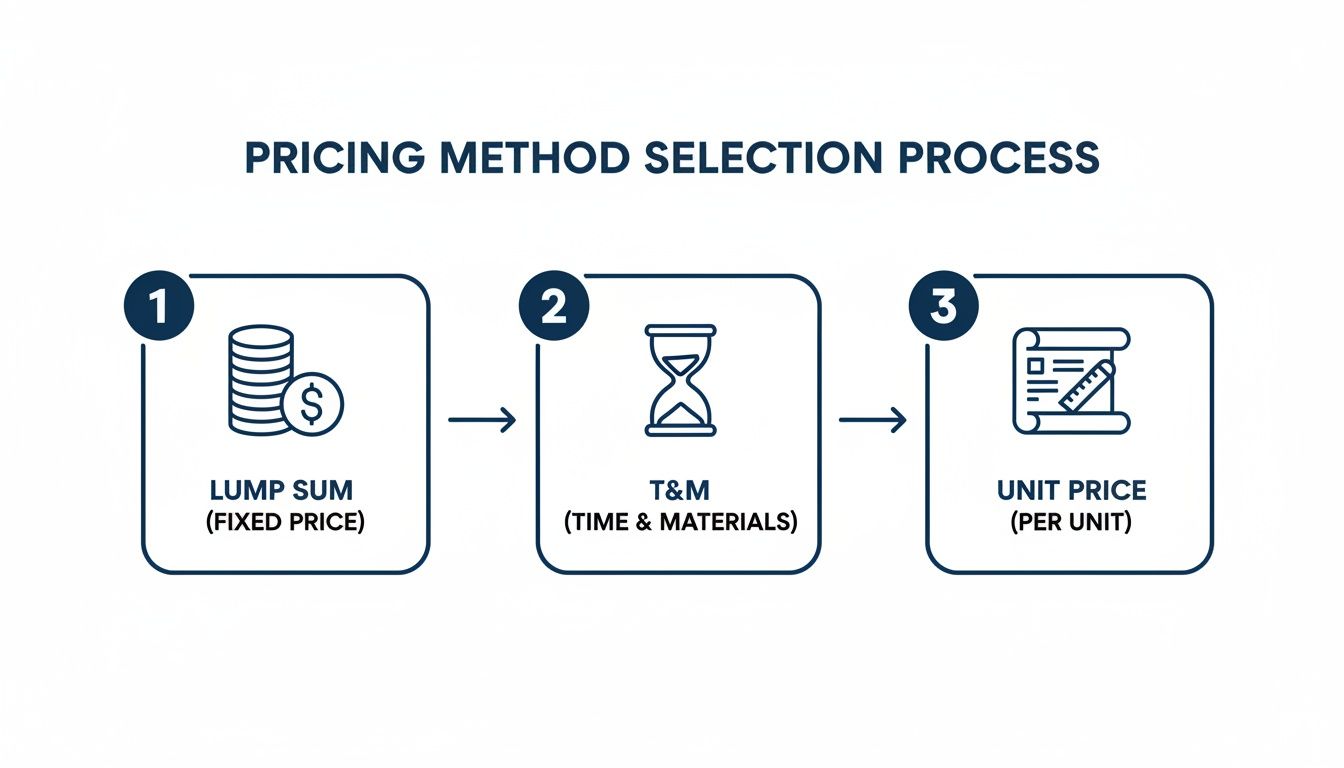
Whether you use Lump Sum, T&M, or Unit Price, your direct costs for materials and that fully-burdened labor rate are the base of your bid.
So, what actually goes into this "burdened" rate?
- Base Hourly Wage: This is the easy one—what you pay them per hour.
- Payroll Taxes: This includes things like Social Security, Medicare, and unemployment taxes.
- Workers' Compensation Insurance: This can be very different depending on the job. A roofer's rate is much higher than a painter's.
- Benefits: This covers things like health insurance, retirement plans (like a 401k), and paid time off (vacation and sick days).
A Real-World Example: Calculating a Burdened Rate
Let’s run the numbers for a carpenter named Alex, who you pay $30 per hour.
- Annual Base Pay: $30/hour x 2,080 hours/year = $62,400
- Payroll Taxes (around 10%): $62,400 x 0.10 = $6,240
- Workers' Comp (let's say 8% for a carpenter): $62,400 x 0.08 = $4,992
- Health Insurance ($500/month): $500 x 12 = $6,000
- Paid Time Off (2 weeks): 80 hours x $30/hour = $2,400
Now, let's add it all up to find the total annual cost to have Alex on the team:
$62,400 + $6,240 + $4,992 + $6,000 + $2,400 = $82,032
To get the burdened hourly rate, we divide that total cost by the number of work hours in a year (2,080):
$82,032 / 2,080 hours = $39.44 per hour
Think about that. You're paying Alex $30 per hour on his paycheck, but he actually costs your business $39.44 for every single hour. If you use the lower number in your bid, you're underpricing your labor by almost 25%. Keeping good track of these numbers is key, which is why a solid system for bookkeeping for construction companies isn't just nice to have—it's necessary.
Mastering your labor costs is more important than ever. The number of available construction workers is tight, which means wages are going up. In some places, skilled trade wages are climbing 5-7% every year. Since labor often makes up 30-40% of a job's total cost, you have to get this number right.
Adding Overhead and Profit to Your Bid
You’ve done the hard part—you’ve figured out your direct costs for materials and labor. That’s a huge step. But if you stop there, you're making the biggest and most common pricing mistake in construction. You're forgetting to pay for the business itself, and you're forgetting to pay yourself.
Too many contractors get their job costs right but forget they have to keep the lights on. That's your overhead. It’s the rent for your shop, the gas in your truck, your insurance, and your cell phone bill. If you don't add these costs into every single bid, you're basically working for free.

Figuring Out Your Overhead Costs
Overhead is every dollar you spend that isn't for a specific job but is needed to run your company. Think of it as the cost of being in business every day, whether your crew is working or not.
First, you need to know what your total overhead costs are for a whole year. Grab a spreadsheet and start listing them. It’s a bit of work, but it’s super important.
These usually include:
- Office or Shop Rent: The cost of your main location.
- Utilities: Power, water, and internet.
- Truck Payments & Insurance: All the costs for your work vehicles.
- General Liability & Workers' Comp: You must have these.
- Salaries: This is for your office staff—like a manager or a bookkeeper, or even yourself if you're not swinging a hammer.
- Marketing & Advertising: Your website, business cards, and any ads.
- Software & Phone Bills: Any software you use for jobs, accounting, and your phone plans.
Once you’ve added all that up, you’ll have your total annual overhead. Let's say it's $100,000 for the year. This is the minimum amount of money you need to get back from your jobs just to break even.
Applying Overhead to Your Jobs
Okay, so how do you spread that $100,000 across all your projects? You turn it into a percentage that you can add to every bid. To do that, you need to know your total direct job costs for the year (your total material and labor costs from all projects).
Let's imagine last year your total direct job costs were $500,000. The math is pretty simple:
(Total Annual Overhead / Total Annual Job Costs) x 100 = Overhead Percentage
($100,000 / $500,000) x 100 = 20%
This 20% is your magic number. It means for every dollar you spend on labor and materials for a job, you need to add another 20 cents just to cover your business expenses. So, if a job has direct costs of $10,000, you must add $2,000 for overhead.
Key Takeaway: Forgetting to add overhead is like agreeing to pay for your own truck insurance out of your own wallet. Your business needs to cover its own costs. Figure out your overhead percentage and add it to every single bid. No exceptions.
Don't Forget Your Profit
After you've covered your job costs and your overhead, you're at your breakeven point. Now, finally, it’s time to actually make some money. That’s where profit comes in.
Profit isn't a bad word. It’s what lets you grow your company, buy new tools, survive the slow months, and build a business that has real value. A good profit margin for most construction jobs is somewhere between 10% and 20%, depending on the project's risk, how hard it is, and your local market.
You add your profit margin after you’ve added your overhead. The final calculation looks like this:
Direct Costs + Overhead + Profit = Total Price to Client
The Critical Difference Between Markup and Margin
This is a spot where even experienced contractors get tripped up and leave a lot of money on the table. Markup and margin sound similar, but they are not the same thing. Mixing them up will shrink your profit without you even knowing it.
Let's break it down with a simple example. Say your total job cost (direct costs + overhead) is $10,000 and you want to make a 20% profit margin.
- The common mistake is to add a 20% markup. You'd calculate: $10,000 x 0.20 = $2,000 profit. Your final price to the client would be $12,000.
- But what's your real profit margin? Margin is based on the final price. So, your $2,000 profit / $12,000 final price = a 16.7% profit margin. You wanted 20%, but you shorted yourself.
To get a true 20% profit margin, you have to use this formula:
Price = Total Costs / (1 – Desired Profit Margin)
Price = $10,000 / (1 – 0.20) = $10,000 / 0.80 = $12,500
In this case, your profit is $2,500. Let’s check the margin: $2,500 / $12,500 = 20%. Boom. By understanding this simple math, you just made an extra $500. On every single job, that's the difference between just getting by and building a strong business.
Planning for Surprises with Contingency and Change Orders
In construction, the one thing you can always expect is the unexpected.
You might open a wall and find a hidden pipe, lose three days of work to a big storm, or have a client suddenly decide they want different cabinets. If you don't plan for these surprises, your profit can disappear in a flash.
Smart contractors build a safety net right into their bids. It’s called a contingency fund. This isn't a secret stash of cash; it's a part of the budget set aside just for problems you can't see coming.
I remember a job where we started digging for a foundation and found out the soil was much worse than the report said. It could have destroyed our budget. But because we had included a contingency, we covered the extra groundwork without a single panicked phone call to the client. It saved the project and our relationship with the homeowner.

Building Your Contingency Buffer
So, how much should you set aside? A good starting point for contingency is usually 5% to 10% of the total direct job costs. You add this on after calculating your materials, labor, and overhead, but before adding your final profit.
- For simple, predictable jobs: A lower contingency of around 5% might be enough.
- For complex or risky projects: Renovating an old building or working on a site with known problems might need a bigger buffer, maybe even 15%.
The key is to be open about it. You should explain to your client what the contingency is for. It’s not for your mistakes; it’s for the unknown issues that can pop up on any construction project.
This buffer is especially important when material prices are bouncing around. According to one recent report, the price of structural steel has been climbing, with some costs jumping over 10% from what was first estimated. For small and midsize companies, this means adding a contingency of 5-10% for metals alone is a smart move to avoid losing money. You can learn more by reviewing the Fall 2025 Construction Market Trends report.
Managing Change Orders Effectively
Contingency covers the unexpected, but what about when the client changes their mind? That's where a change order comes in. A change order is the official way to document a change to the original plan.
Without a clear process, you can fall victim to "scope creep"—when small changes pile up until you're doing way more work than you bid for, often without getting paid for it.
Pro Tip: Never agree to a change, no matter how small, on a handshake. A simple "yes" to adding an outlet can turn into an argument later. Always, always get it in writing.
A proper change order process protects both you and your client. It makes sure everyone agrees on what the change is, how much it will cost, and if it will affect the project timeline. A strong change order process also helps keep your numbers clean, which is a big part of smart construction cash flow management.
Here’s what every change order should include:
- Clear Description: Write out exactly what new work is being added or changed.
- Cost Breakdown: List the costs for the extra materials and labor for the change.
- Schedule Impact: Note if the change will add any time to the project.
- Signatures: Have both you and the client sign it before any new work starts.
This process turns a possible fight into a simple business deal. For a deeper dive into managing project changes, you can check out a comprehensive guide to change orders for more tips and examples. By planning for both surprises and client changes, you take control of your projects and protect your profit.
Using Past Jobs to Create Smarter Future Bids
The best contractors I know have a secret weapon for pricing jobs. It’s not some fancy software or a complicated formula. It’s the information from the job they just finished.
They don’t just guess on the next bid; they use what they learned from the last one.
This is where good bookkeeping stops being a chore and becomes your best bidding tool. By using a process called job costing, you track the real costs of every single project and compare them to what you originally estimated. It's like looking at a project's report card.
Did you make money? How much, exactly? Where did you spend too much? It’s not about blaming anyone. It’s about learning.
From Bookkeeping to Business Intelligence
Job costing means you stop thinking "how did the business do last month?" and start asking, "how did the Smith kitchen remodel do?" You link every dollar you spend—from lumber to labor hours—to a specific project. When the job is done, you compare your estimated costs to your actual costs.
This simple comparison is a goldmine. It shows you exactly where your estimates are good and where they’re weak.
Maybe you are always right about your material costs but always seem to guess too low on labor hours for framing. That’s not a failure; that’s important information. On your next bid, you’ll know to add a few more hours to that part of the job.
This process turns your financial records from just a history of what happened into a tool that helps you predict what will happen. It’s the single best way to make your pricing better and protect your profits.
Finding Your Most Profitable Work
Over time, this information shows you powerful trends. It shows you which types of projects are your real money-makers and which ones are secretly costing you money.
You might feel like you’re great at building decks, but after tracking three deck projects in a row, the numbers show you barely make any money on them. On the other hand, you might find that your kitchen remodels consistently bring in a 25% profit margin, even though they feel more complicated.
This kind of knowledge is priceless. It helps you decide which jobs to go after and which ones to politely say "no" to. You start building your business around the work you’re not just good at, but also most profitable at. A solid system for accounting for construction companies is what powers this whole process, giving you the clear data you need to make these smart decisions.
Pricing for Today's Financial Realities
Looking at past jobs also gets you ready for new challenges, like a changing economy. In today's world with high interest rates, the cost of borrowing money is a huge factor that can make or break a job's profit.
A recent 2025 Outlook from Buildern warns that with U.S. interest rates sitting above 5%, the interest on a big, long-term project can be millions more than it was a few years ago. This affects everyone. Smart contractors are now adding 2-3% to bids just to cover the interest costs on parts of their jobs they have to finance. You can find more details on this in the full construction industry outlook.
Without accurate job costing, you're just guessing. You have no idea if you have enough wiggle room in your prices to handle these kinds of modern money pressures. By reviewing your past work, you can see how things like higher material financing costs hit your bottom line, letting you adjust your overhead and profit numbers for future bids. It’s about using your own history to make your business stronger for whatever comes next.
Common Questions About Pricing Construction Jobs
Even the most experienced contractors have questions when it comes to pricing. You're always trying to balance being competitive, being fair to the client, and—most importantly—actually making a profit. Let's tackle a few of the most common questions we hear.
How Do I Price a Job I Have Never Done Before?
Taking on a new type of project is how you grow, but it can be scary when you have to put a price on it. The key is to avoid guessing. Instead, break the project down into the smallest possible pieces.
First, make a super detailed task list. I'm talking every single step, no matter how small. For materials, don't use old prices or what you think something costs. Call your suppliers and get current, real quotes for everything.
When you estimate your labor, be honest with yourself. Since it’s your first time doing this kind of work, it will take longer. Add extra hours to your estimate for each task. It's also a good idea to show your plan to a contractor friend you trust—someone who isn’t bidding against you—to get their opinion.
Finally, you need a bigger safety net.
For any new type of project, your contingency needs to be bigger to cover the unknowns. If you normally use a 5-10% contingency, bump it up to 15-20% for this job. That extra cushion is what protects your profit from the learning curve.
What Is the Biggest Pricing Mistake Contractors Make?
Hands down, the single biggest mistake is forgetting to include overhead and profit in the bid. It happens all the time.
Contractors get so focused on the direct costs—the wood, the concrete, their crew’s paychecks—that they completely forget about the cost of running the business itself. They forget about the truck payment, the insurance, the rent for their yard, and their own salary.
When you don't add overhead, you can work 60-hour weeks all year and have almost nothing to show for it. You’re basically running a non-profit business where you pay for everything out of your own pocket.
Remember this formula: Direct Costs + Overhead + Profit = Final Price. Your overhead and profit aren't optional extras; they are a necessary part of every single bid you submit.
Should I Show My Client a Detailed Cost Breakdown?
This is a great question, and there’s no single right answer—it depends on the type of contract you’re using. The amount of detail you share should always match the pricing agreement you have.
Here’s how to handle it:
For Time & Materials (T&M) Jobs: Yes, absolutely. Honesty is key with T&M contracts. The client is paying for your actual costs plus a markup, so you need to be an open book. Be ready to share material receipts and detailed timesheets. It's just good business and how you build trust.
For Lump Sum (Fixed Price) Jobs: Generally, no. With a fixed-price contract, the client is buying a finished project for one price. They aren’t buying the individual pieces of wood and hours of labor.
Showing a detailed cost breakdown on a lump sum bid, especially your overhead and profit, is just asking them to start negotiating. Suddenly, they're questioning your profit or wanting to shop around for cheaper materials.
Instead of a list of costs, give them a professional, detailed scope of work that clearly explains everything you will deliver for the total fixed price. This keeps the conversation focused on the final product, not the numbers you need to run a healthy business.
Getting your pricing right is the foundation of a strong construction business. It ensures you can deliver high-quality work, pay your team well, and grow for the future. But accurate pricing relies on clean, up-to-date financial data. At MyOfficeOps, we provide the bookkeeping and CFO-level insights that turn your financial history into a powerful tool for creating smarter, more profitable bids. Stop guessing and start pricing with confidence. Learn more at https://myofficeops.com.